
G|A|M|E – The Italian Journal of Game Studies
Open-access peer-reviewed game studies journal published by the Italian cultural association Ludica since 2012, mostly in English.
Documents
WaTa Fight! How Situated Multiplayer Competitive Gaming Can Facilitate the Inclusion of Low Vision and Blind Players
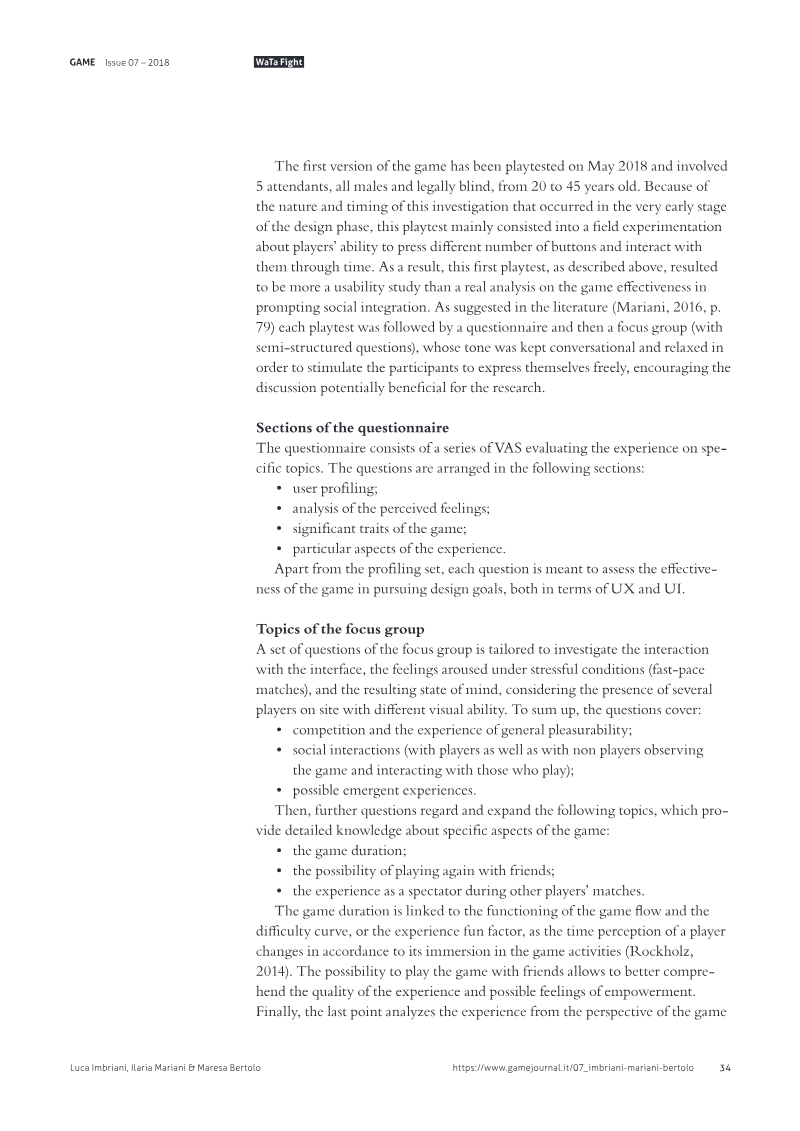
"WaTa Fight!" presents the design and early evaluation of a competitive, audio-based mobile party game intended for mixed groups of sighted and blind or low-vision players.
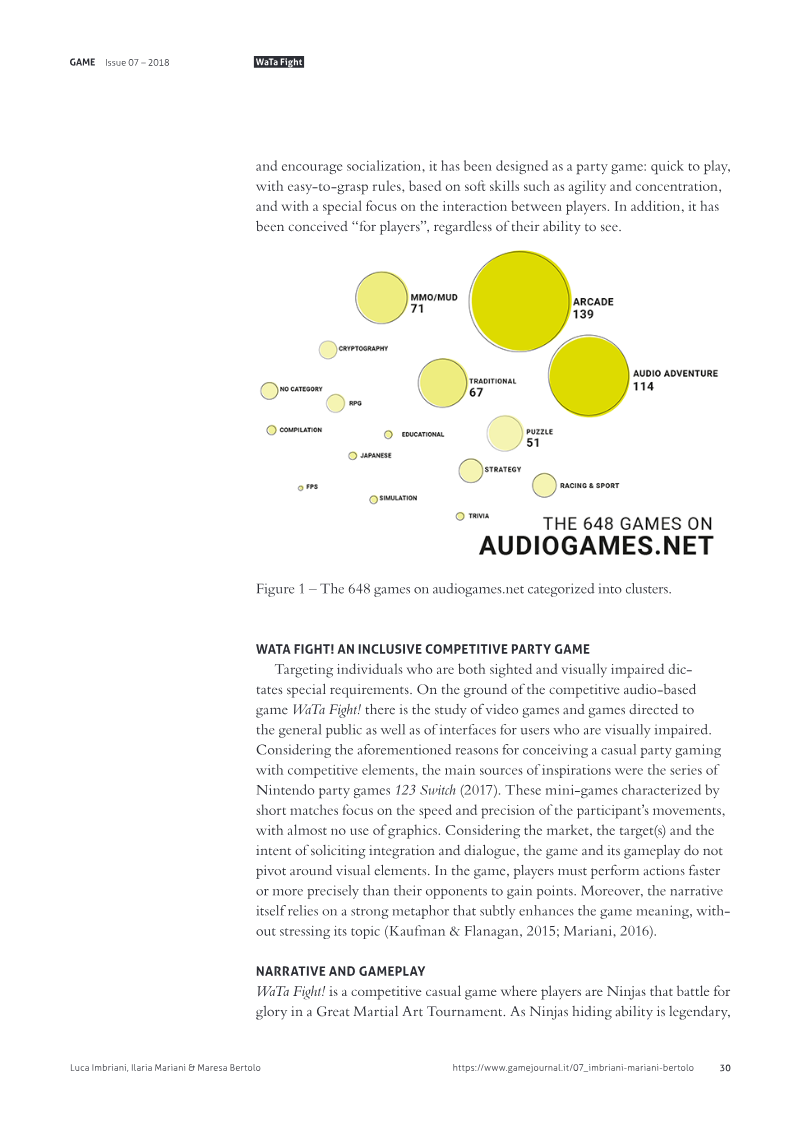
- WaTa Fight! is a competitive, audio-based mobile party game designed for mixed groups of sighted and blind or low-vision players, addressing the scarcity of fast-paced competitive multiplayer audio games.
- In three playtests conducted in 2018 with the Italian Blind and Low Vision Association in Novara, 16 of 18 playtesters reported greater openness toward integration afterward.
- The game shifts the challenge from visual perception to reflexes, memory, and coordination, letting players of differing sight levels compete on comparable terms.
The Whose View of Hue?: Disability Adaptability for Color Blindness in the Digital Game Hue
Theo Plothe's 2018 analysis examines how Hue, an indie color-theory puzzle game, initially excluded colorblind players because its core mechanics depended on color perception.
- Hue, an indie color-theory puzzle game released in 2016, initially excluded colorblind players because its core mechanics depended on color perception, a barrier creator Henry Hoffman discovered during convention testing.
- The fix came from working with the colorblind community to add symbol- and pattern-based alternatives, which made the game more flexible and intuitive for all players, not just colorblind ones.
- The author's central thesis is that accessibility should be designed in from the outset, guided by Universal Design principles such as multiple means of representation, expression, and engagement, rather than retrofitted after release.
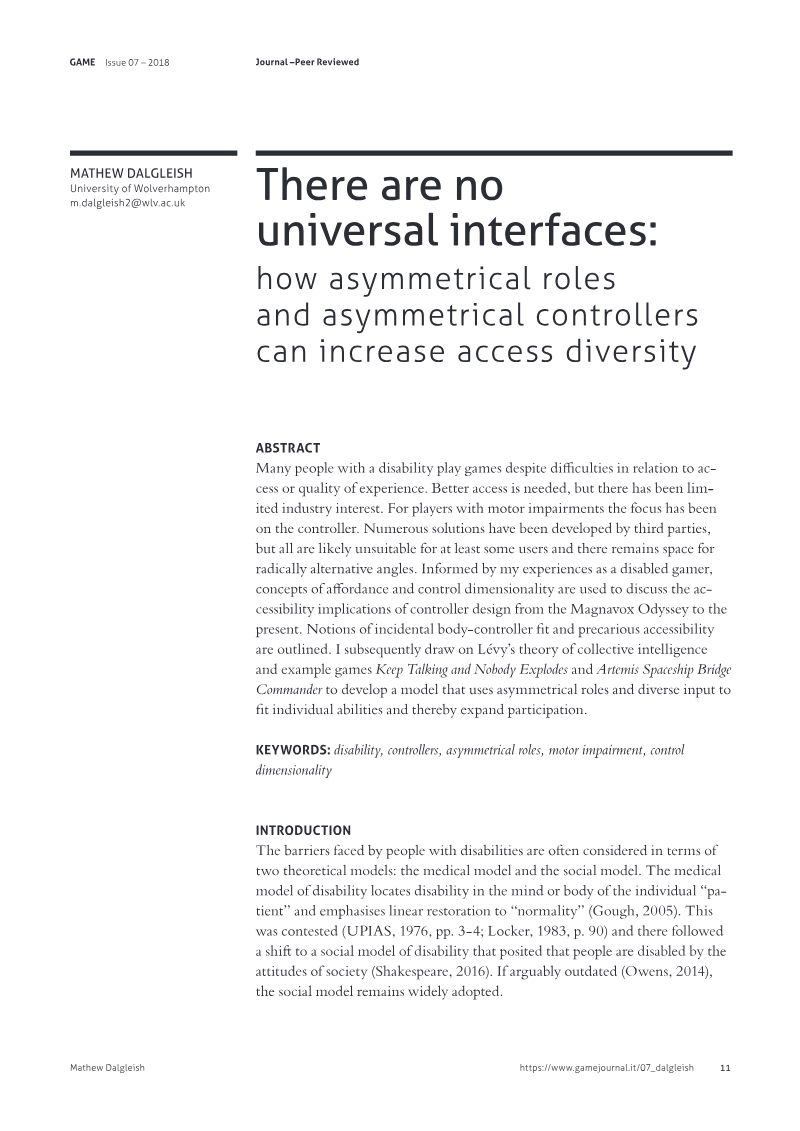
There Are No Universal Interfaces: How Asymmetrical Roles and Asymmetrical Controllers Can Increase Access Diversity
Dalgleish's 2018 paper contends that game controllers have grown steadily more complex, and that this complexity can abruptly exclude players with motor impairments.
- Control dimensionality of game controllers grew from 2 in the Magnavox Odyssey (1972) to 17 in the Nintendo Switch Joy-Con (2017), steadily raising the risk of excluding players with motor impairments.
- Accessibility for disabled players in mainstream games is often accidental, arising only when a standard controller happens to suit a particular body rather than being designed in deliberately.
- The paper proposes the 'asymmetrical roles and asymmetrical controllers' (ARAC) model, which builds diverse roles and input devices into multiplayer game design instead of creating segregated or simplified versions for disabled players.
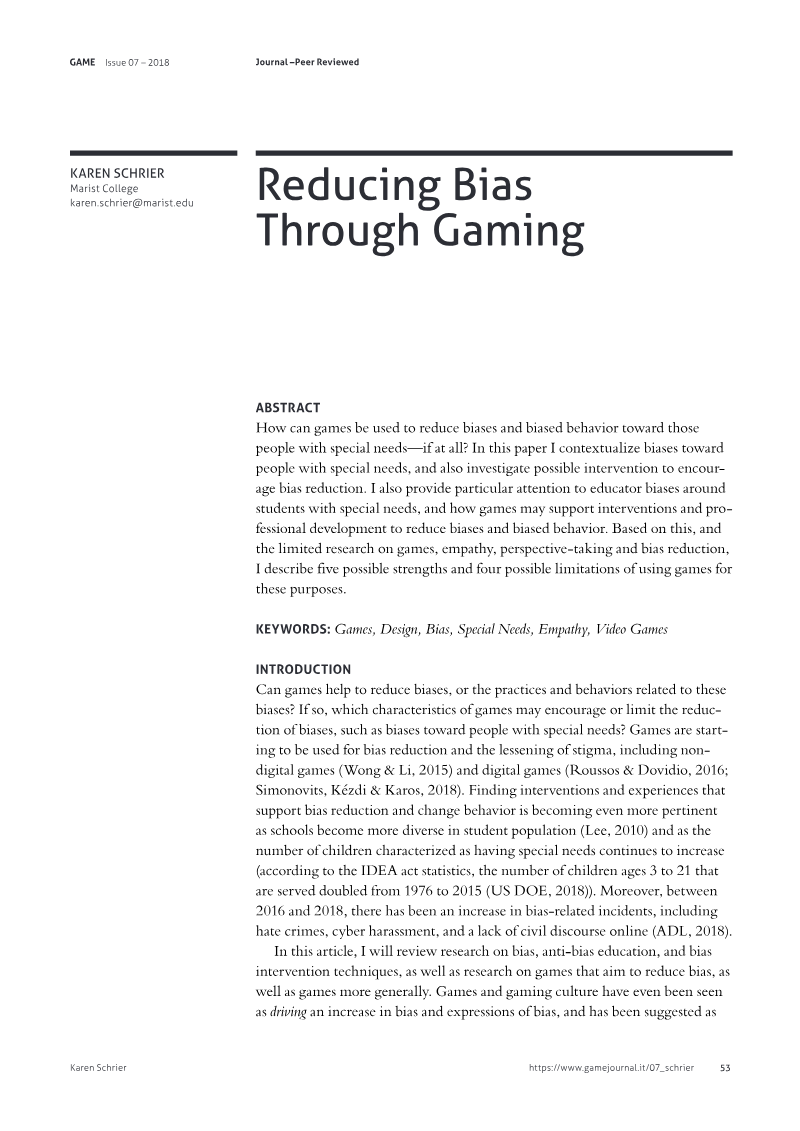
Reducing Bias Through Gaming
Karen Schrier's 2018 paper, "Reducing Bias Through Gaming," examines whether games can reduce biases, particularly the biases educators hold toward people with special needs, and concludes that games can support bias reduction when embedded in well-designed interventions such as professional development.
- Games can reduce bias only when embedded in well-designed interventions such as professional development; outcomes depend on design, context, and player characteristics rather than on the mere presence of a game.
- A perspective-taking game reduced prejudice toward Roma and refugees in Hungary for at least a month, showing that empathy-focused design can produce measurable intergroup effects.
- Cooperative play tends to improve attitudes toward out-groups more than competitive or solo play, while violent or competitive games can reinforce intergroup bias.
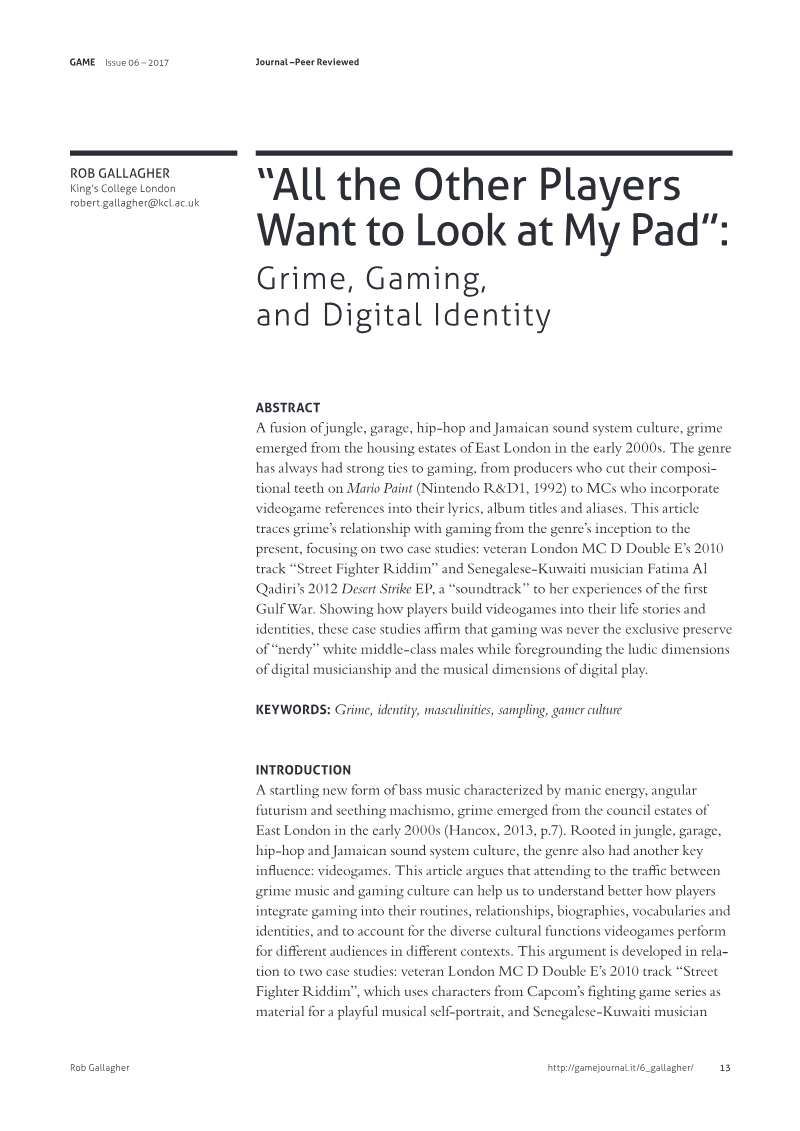
All the Other Players Want to Look at My Pad: Grime, Gaming, and Digital Identity
Rob Gallagher's 2017 peer-reviewed article examines the long-standing relationship between grime music, which emerged from East London in the early 2000s, and videogame culture.
- Gallagher's 2017 peer-reviewed article argues that UK grime artists, emerging from East London in the early 2000s, treat videogames as a musical and cultural resource for constructing identities and life narratives, challenging the stereotype of gamers as exclusively white, middle-class males.
- The article's analysis rests on shared structural logics between grime and games: rule-bound play, sampling as recombination, and live performance generating emergent outcomes, with fighting-game special moves and speedrun-style constraints paralleled in MCs' sonic gestures and constrained lyrical forms.
- Two case studies anchor the argument: D Double E's "Street Fighter Riddim" (2010), which uses in-game characters as lyrical avatars but relies on stereotyped masculinities that limit its progressive potential, and Fatima Al Qadiri's Desert Strike EP (2012), which appropriates a Gulf War game as a non-binary dynamic of power and cultural exchange.
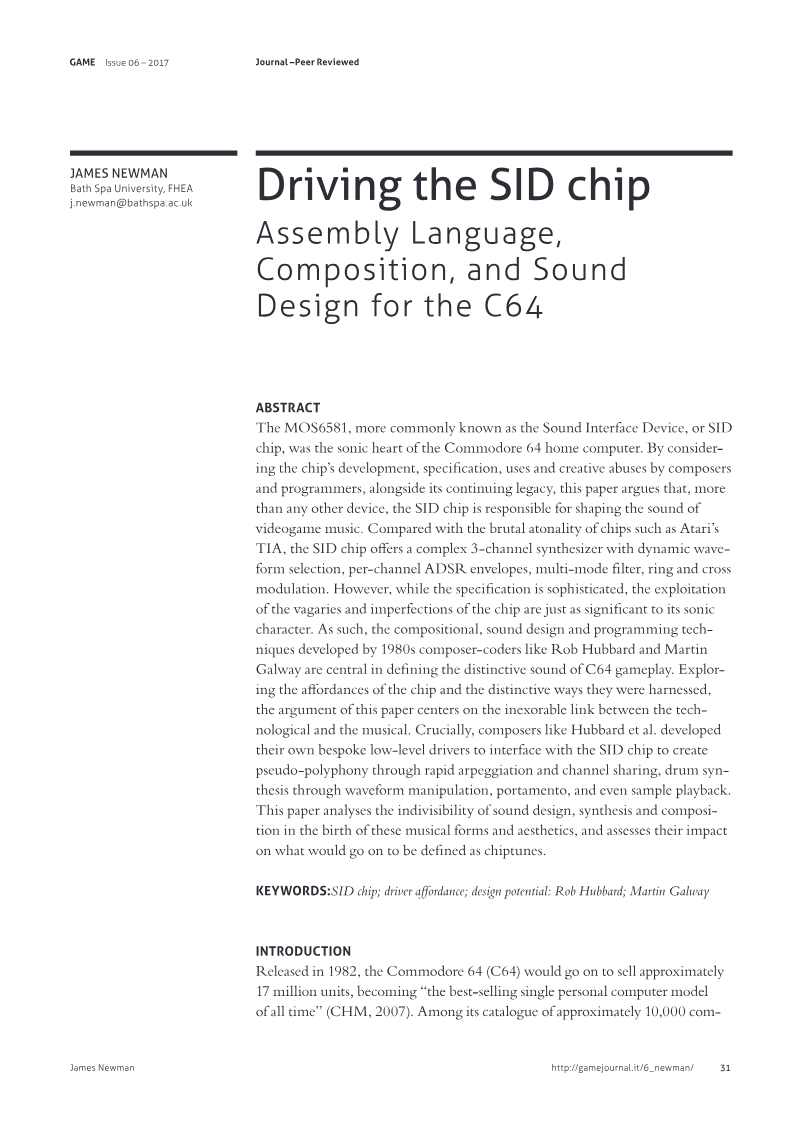
Driving the SID Chip: Assembly Language, Composition, and Sound Design for the C64
James Newman's paper "Driving the SID Chip" argues that the MOS6581 Sound Interface Device shaped videogame music more than any other sound hardware of its era, and that its distinctive Commodore 64 sound cannot be understood through the chip's hardware specification alone.
- The MOS6581 SID chip shaped videogame music more than any other sound hardware of its era, and its distinctive C64 sound cannot be understood from the hardware specification alone, since its most notable techniques emerged through composer-programmers' bespoke music drivers.
- The SID's three-voice synthesizer design, with per-channel ADSR envelopes, a multimode filter, ring and sync modulation, and pulse-width modulation, far exceeded the capabilities of the Atari TIA and NES sound chips.
- The register-level interface, limited polyphony, and frame-locked timing (50Hz on PAL, 60Hz on NTSC) forced techniques such as multiplexing parts across channels, rapid arpeggiation, and frame-accurate waveform manipulation to simulate drums and chords.
The Sound of 1-Bit: Technical Constraint and Musical Creativity on the 48k Sinclair ZX Spectrum
McAlpine's study examines how the hardware limitations of the 48k ZX Spectrum, a British home computer that lacked a dedicated sound chip and relied on a single-channel, 1-bit "beeper" driven directly by the CPU, shaped a distinctive body of game music.
- The 48k ZX Spectrum had no dedicated sound chip; its audio came from a single-channel, 1-bit 'beeper' driven directly by the CPU, and this severe constraint shaped the platform's distinctive game music.
- McAlpine argues that hardware limits were generative rather than merely obstructive, framing creativity under constraint as the force that defined the aesthetic of 8-bit and chiptune music.
- Composers such as Ben Daglish and Matthew Smith adapted works by Bach, Beethoven, and Strauss using implied polyphony, broken-octave bass patterns, and rapid arpeggios to suggest multiple voices on one channel.
Heute Gehört Uns die Galaxie: Music and Historical Credibility in Wolfenstein: The New Order's Nazi Dystopia
The article examines how the soundtrack of Wolfenstein: The New Order (2014) constructs an alternate-history setting in which the Nazis won the Second World War.
- The soundtrack of Wolfenstein: The New Order (2014) builds an alternate-history Nazi-victory setting through 'Nazi rock 'n' roll': German-language parodies of 1950s–60s American hits released under the fictional label Neumond Records.
- The author argues that the music's departure from historical fact paradoxically strengthens the game's verisimilitude, using Planells' semantic-pragmatic model and concepts of authenticity and historical resonance/dissonance.
- The game leans on cultural shorthand, especially the association of German language with the Third Reich, while keeping lyrics ideologically 'aseptic' and largely avoiding explicit Aryan supremacist content, as in the lunar song 'Mond, Mond, Ja, Ja.'
Killing-Off the Crossfade: Achieving Seamless Transitions With Imbricate Audio
This paper, written by Zander Hulme of Queensland University of Technology and published in the 2017 issue of Critical Notes, argues that the crossfade, the dominant technique for transitioning between pre-rendered musical states in video games, creates audible artifacts that break player immersion.
- The crossfade, the dominant method for switching between pre-rendered musical states in games, creates audible artifacts that break player immersion by disrupting the natural decay of acoustic instruments' reverb tails.
- Imbricate audio records scores in short bar-length chunks at multiple dynamic levels, with each chunk's reverb tail overlapping the next so transitions occur without cuts or fades.
- Existing approaches have notable limits: the iMUSE system used in Monkey Island 2 could take up to seven seconds to transition, and virtual instruments approximating live recordings carry high processing costs.
Ludomusicology: Approaches to Video Game Music
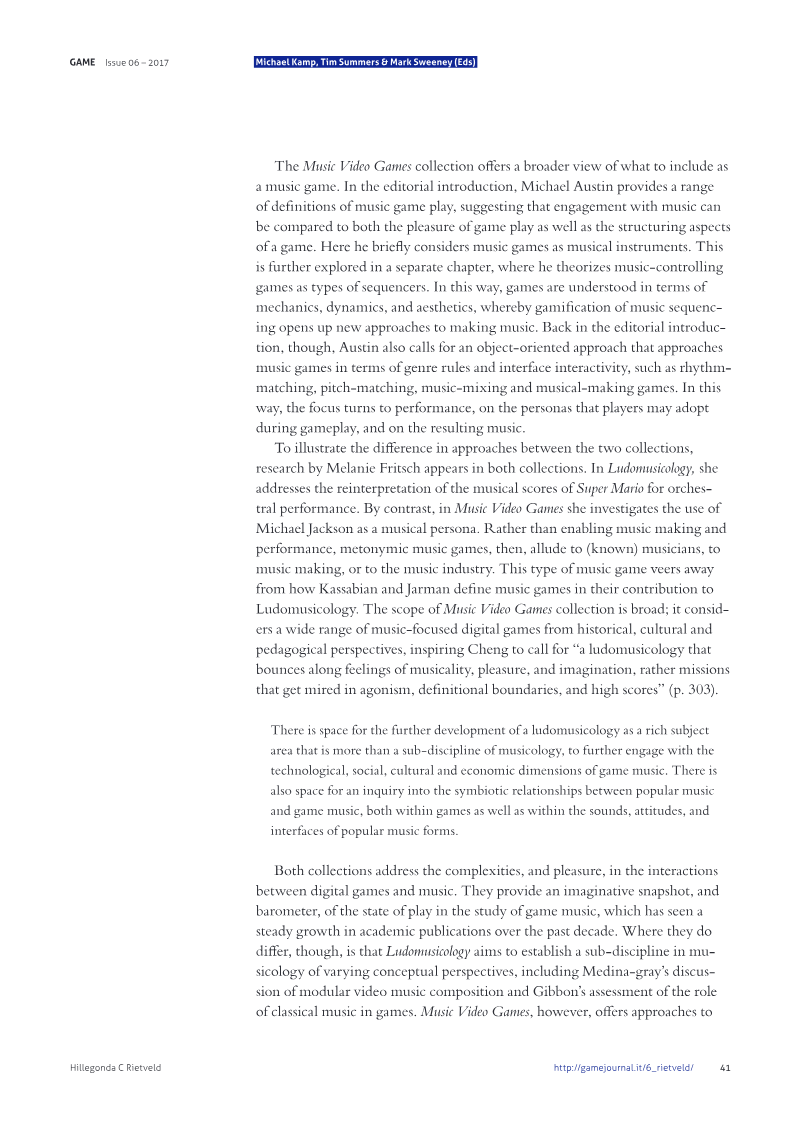
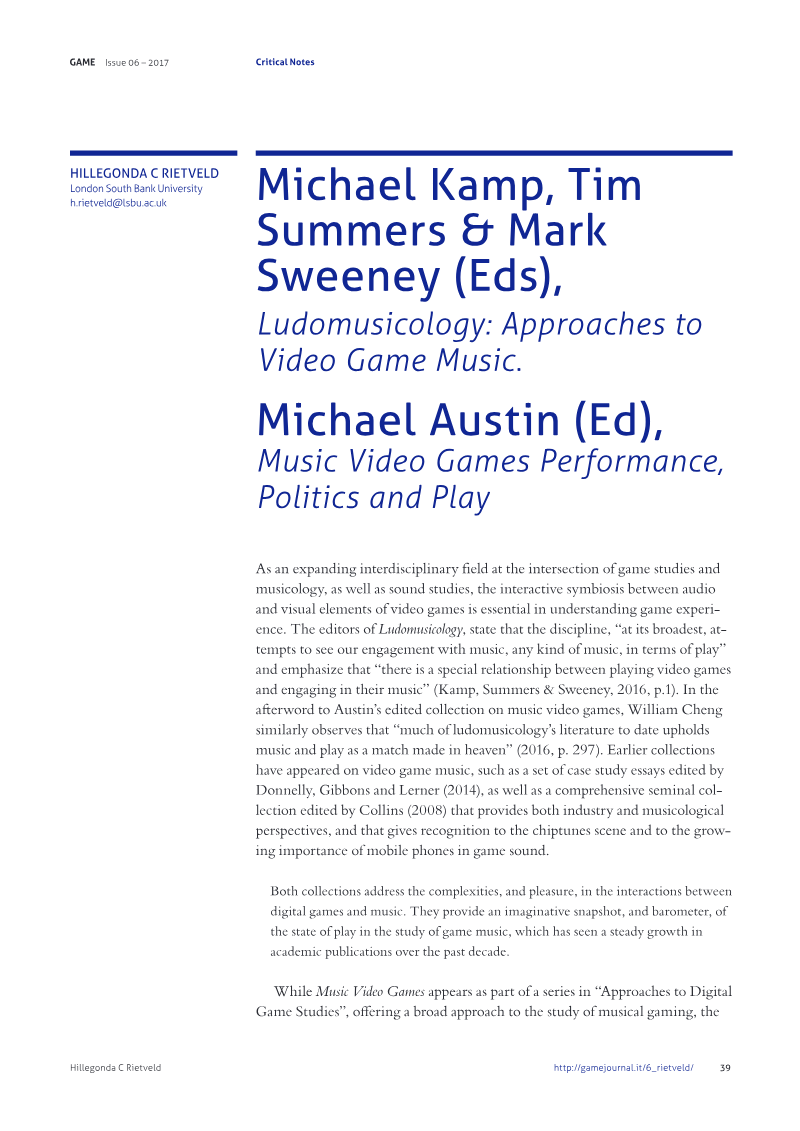
This review by Hillegonda Rietveld assesses two edited collections that mark the growing academic study of video game music: Ludomusicology: Approaches to Video Game Music, edited by Michael Kamp, Tim Summers, and Mark Sweeney, and Music Video Games: Performance, Politics and Play, edited by Michael Austin.
- The review assesses two edited collections marking the growing academic study of video game music: Ludomusicology: Approaches to Video Game Music (eds. Kamp, Summers, and Sweeney) and Music Video Games: Performance, Politics and Play (ed. Michael Austin).
- The author argues that the interactive relationship between audio and visual elements is central to understanding the game experience, situating ludomusicology at the intersection of game studies, musicology, and sound studies.
- Ludomusicology applies musicological methods to games, examining immersion, non-linearity, intertextuality, paratexts, and the classification of music games, including the use of classical and modernist music in Dead Space and menus and start screens as peritexts.
Zones of Control: Perspectives on Wargaming
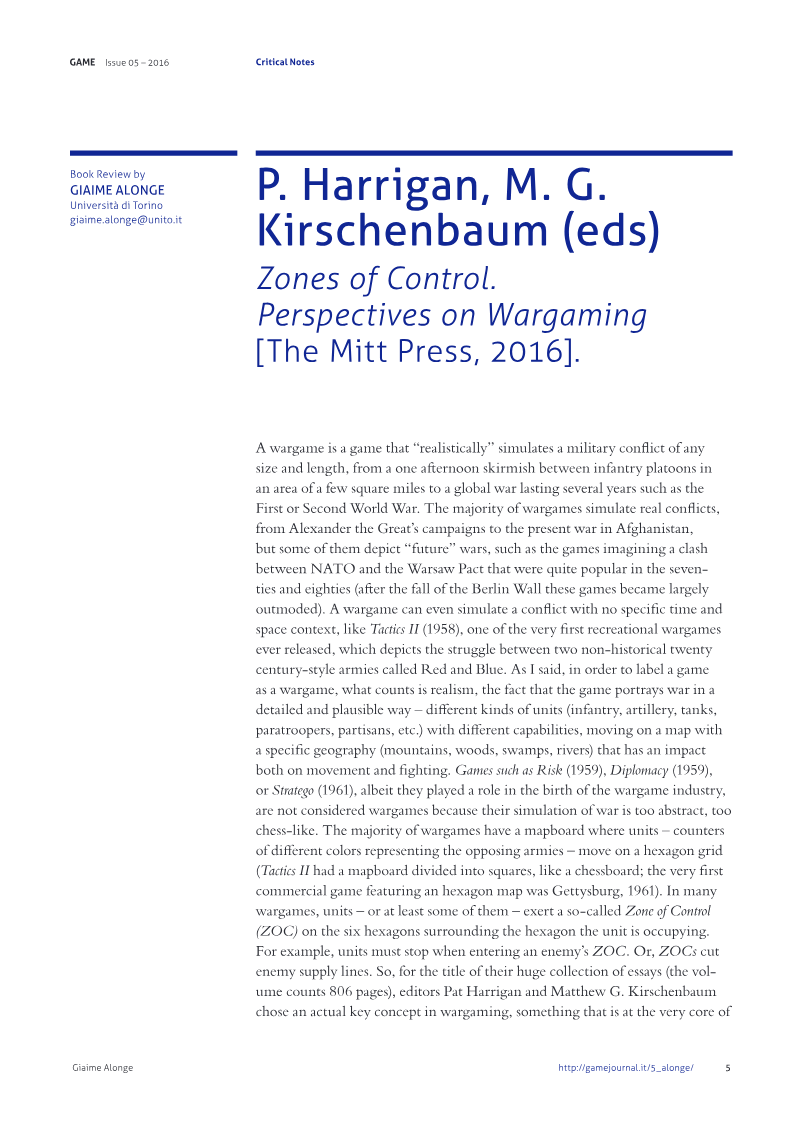
This document is a 2016 book review by Giaime Alonge of "Zones of Control: Perspectives on Wargaming," an 806-page collection of essays edited by Pat Harrigan and Matthew G. Kirschenbaum.
- The review covers an 806-page essay collection on wargaming edited by Pat Harrigan and Matthew G. Kirschenbaum, organized into nine thematic sections spanning history, design, academic applications, and literature.
- Wargaming's lineage runs from 19th-century Prussian Kriegsspiel through the commercial industry launched by Avalon Hill in the late 1950s and 1960s, and wargames are distinguished from abstract games like Risk and Stratego by their realistic simulation of units, terrain, and movement.
- Traditional wargames have declined amid competition from role-playing and video games, while card-driven wargames such as We the People and Twilight Struggle have revived the genre since the mid-1990s.
Bust A Cup: Reclaiming Risk in Play
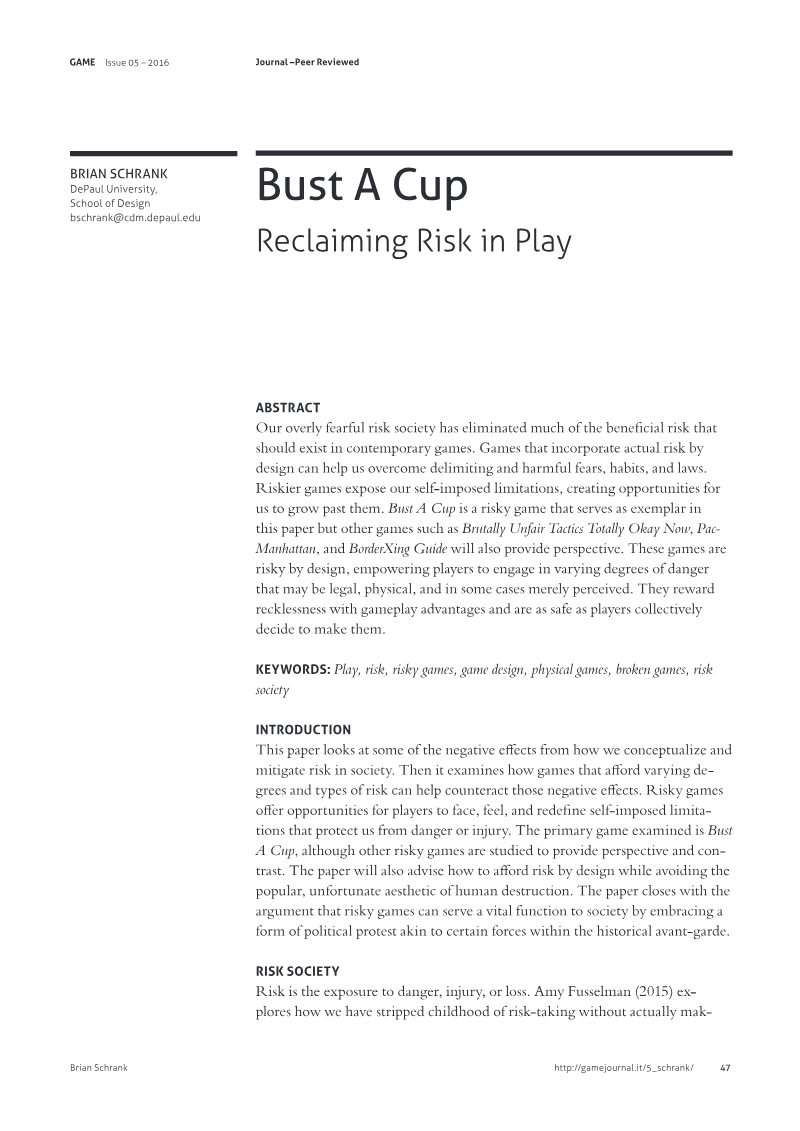
Brian Schrank's "Bust A Cup: Reclaiming Risk in Play" argues that contemporary risk society has drained games and everyday life of meaningful danger, leaving players in a cycle of safe, low-stakes interaction while the perceived world grows more threatening.
- Schrank argues that contemporary risk society has drained games and everyday life of meaningful danger, leaving players in cycles of safe, low-stakes interaction while the perceived world grows more threatening.
- He contends that games with real, designed risk can help players confront self-imposed limits, reconfigure physical, spatial, legal, and personal boundaries, and build resilience against fear-based manipulation.
- The central example, Bust A Cup, is a two-player puppet brawl using coffee cups that softens the reality of street combat while preserving its capacity to unsettle and provoke.