
European Conference on Games Based Learning (ECGBL)
Annual European conference on game-based learning and serious games; its proceedings are published open access (CC BY) by Academic Conferences International.
Documents
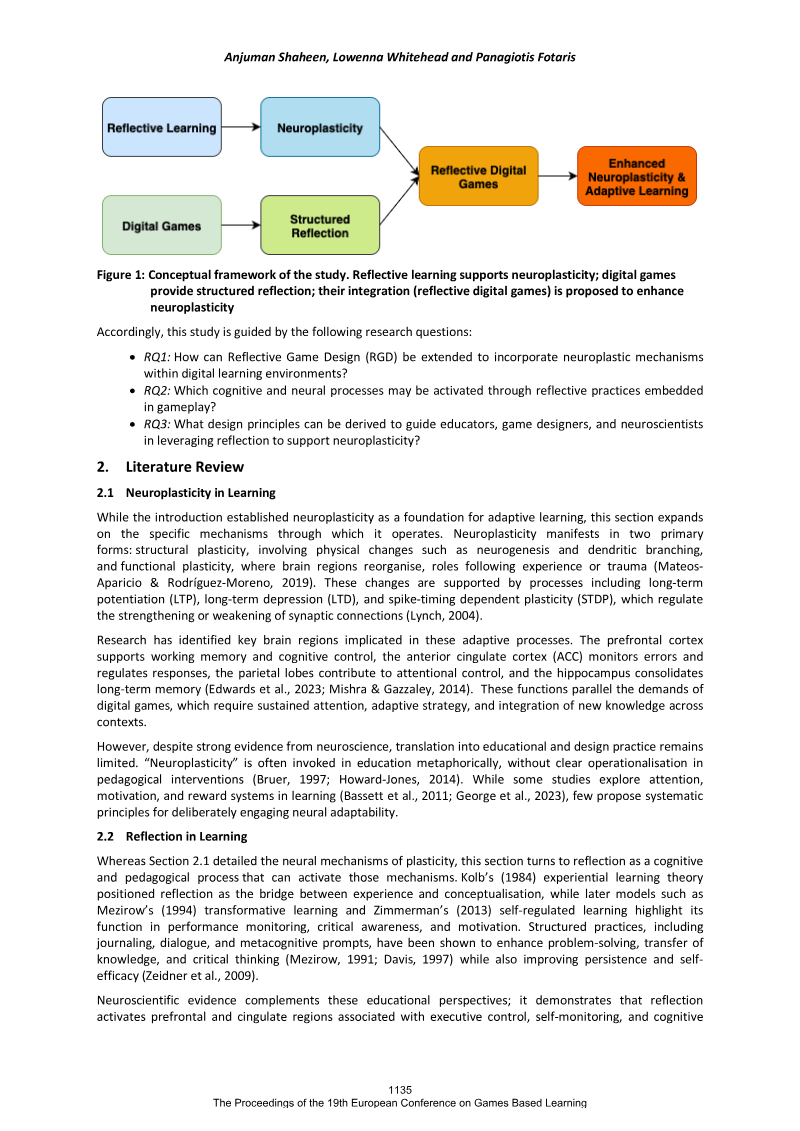
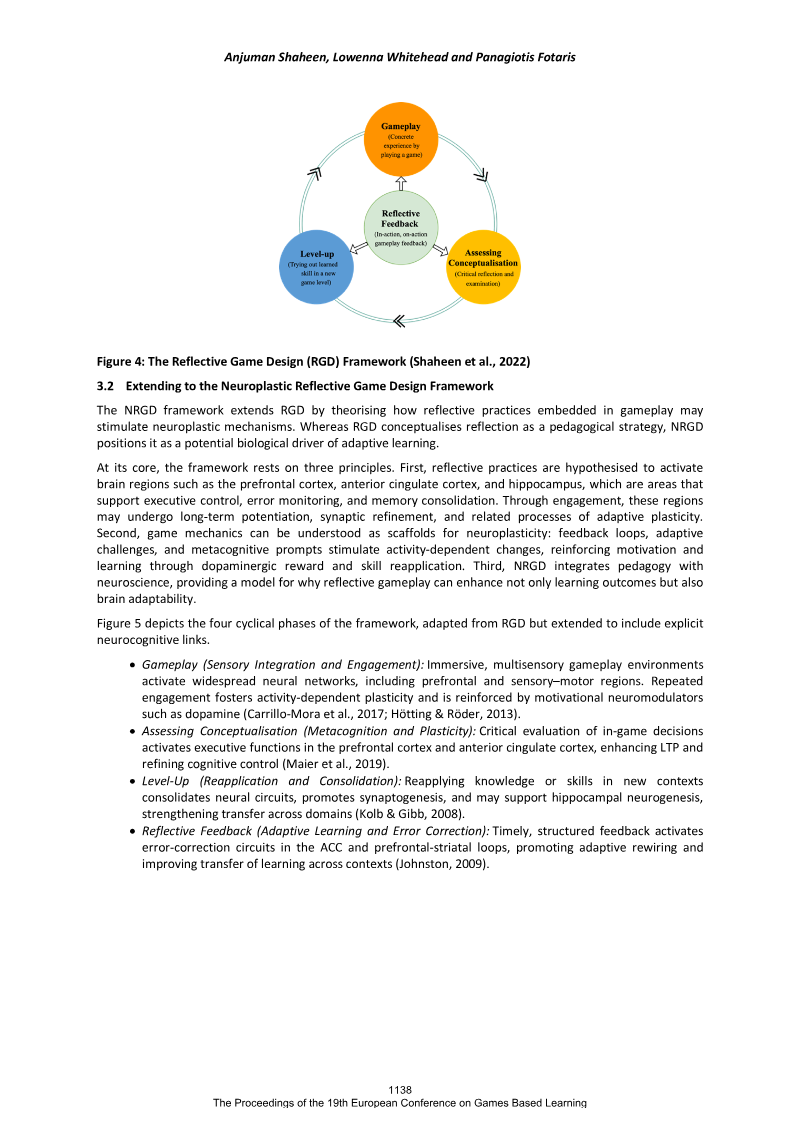
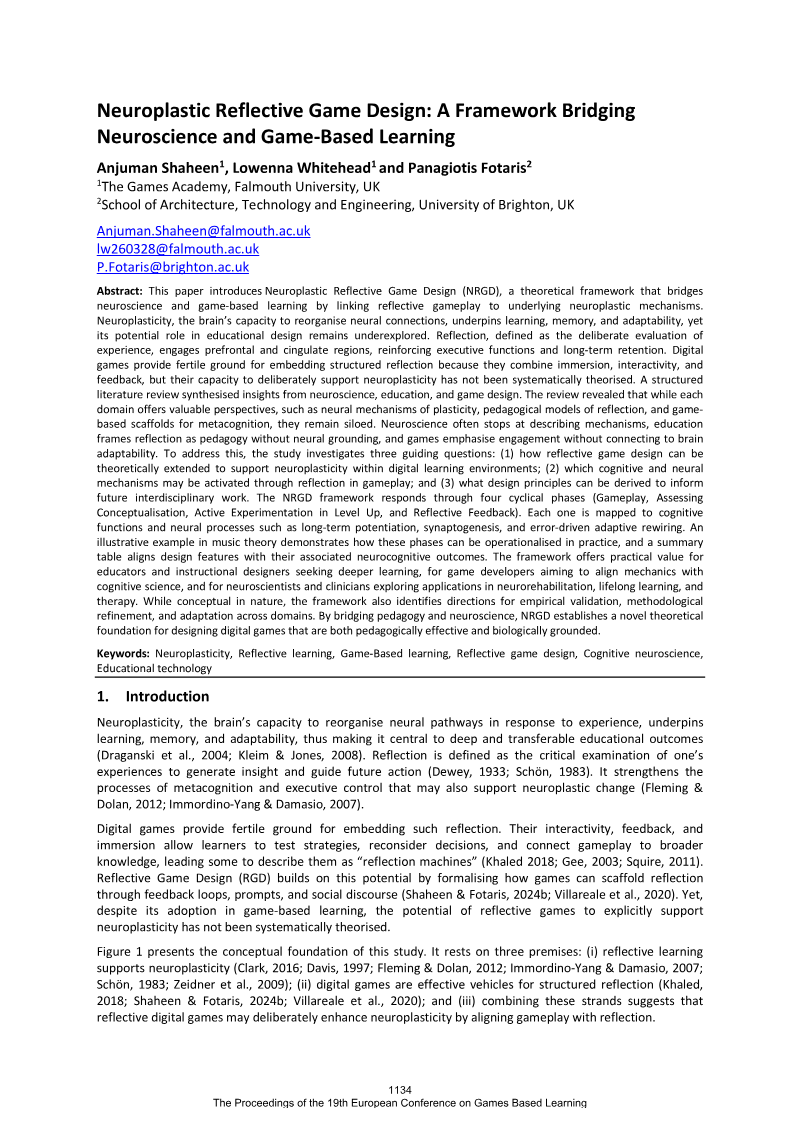
Neuroplastic Reflective Game Design: A Framework Bridging Neuroscience and Game-Based Learning
The paper proposes Neuroplastic Reflective Game Design (NRGD), a conceptual framework that extends Reflective Game Design by connecting reflective gameplay to neuroplastic mechanisms such as long-term potentiation, synaptogenesis, synaptic pruning, and error-driven rewiring.
- The paper proposes Neuroplastic Reflective Game Design (NRGD), a conceptual framework extending Reflective Game Design by linking reflective gameplay to neuroplastic mechanisms such as long-term potentiation, synaptogenesis, synaptic pruning, and error-driven rewiring.
- The central argument is that neuroscience, education, and game design research have developed largely in isolation, and bridging them could explain how well-designed games produce lasting cognitive change.
- NRGD is organised as a cyclical four-phase model (Gameplay, Assessing Conceptualisation, Level-Up, and Reflective Feedback), with each phase mapped to specific cognitive functions and neural processes.
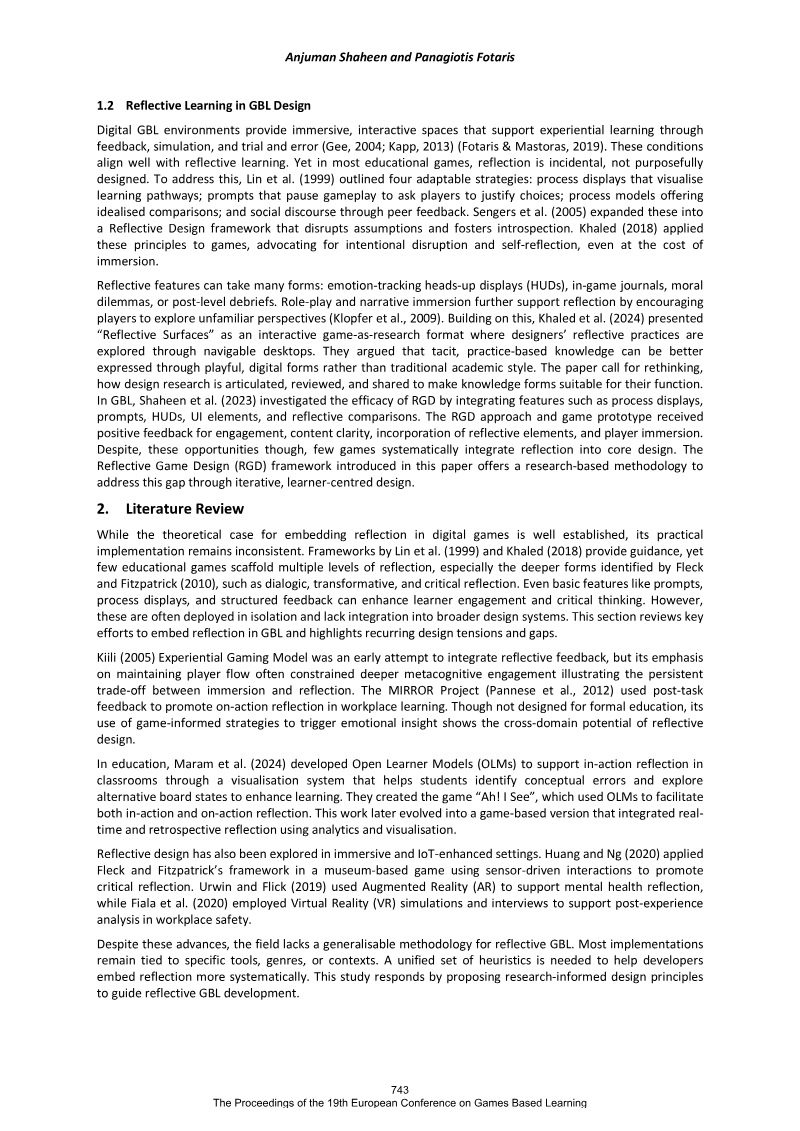
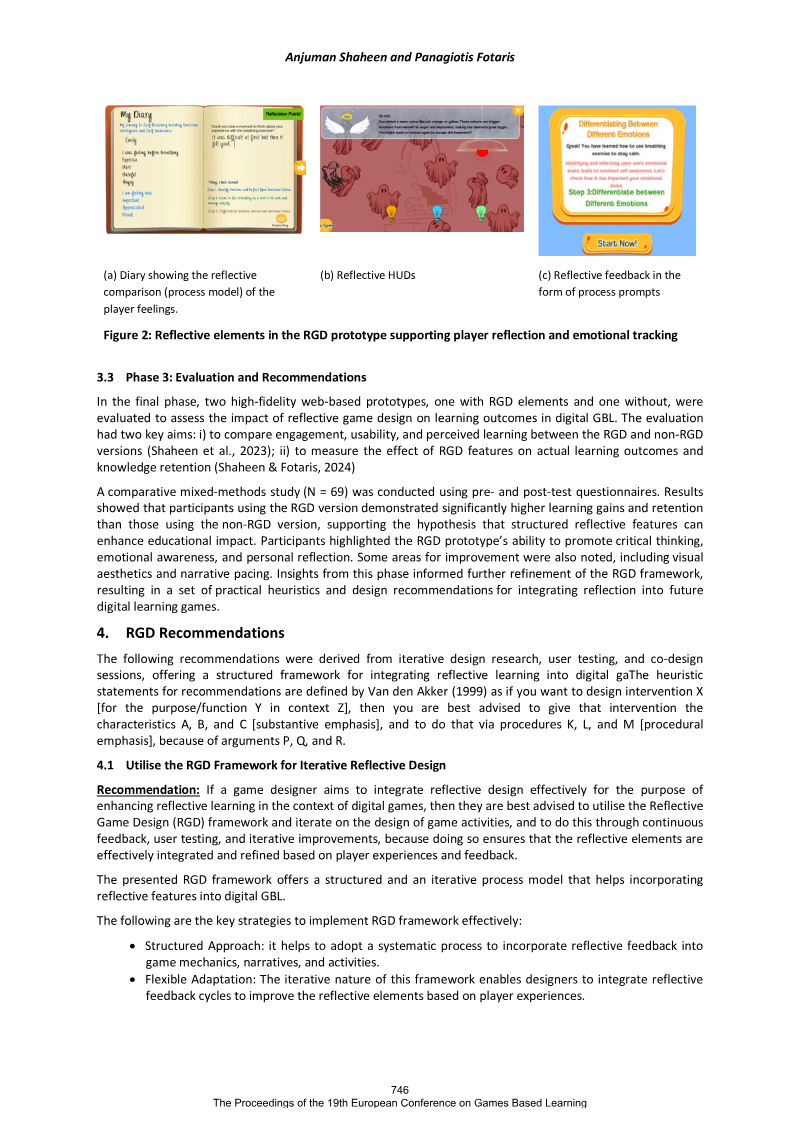
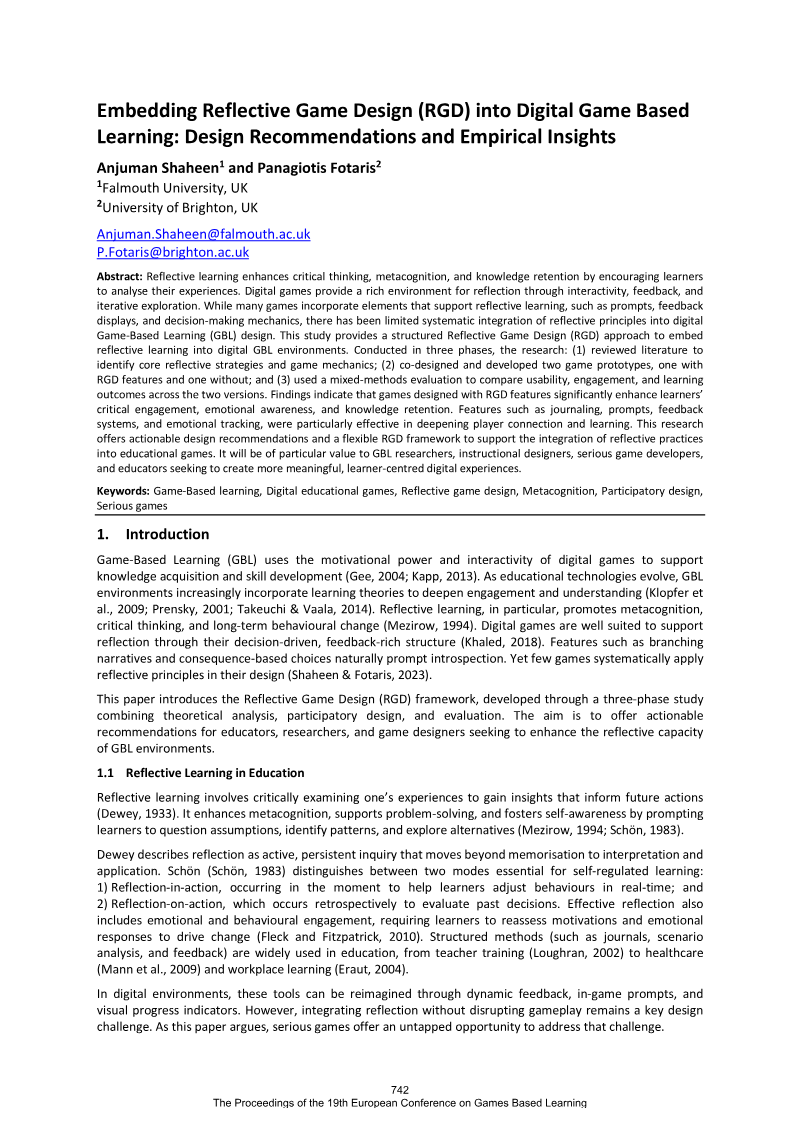
Embedding Reflective Game Design (RGD) into Digital Game Based Learning: Design Recommendations and Empirical Insights
This study introduces the Reflective Game Design (RGD) framework, an approach for embedding reflective learning into digital game-based learning (GBL) environments.
- The Reflective Game Design (RGD) framework embeds reflective learning into core gameplay of digital game-based learning, rather than leaving reflection as an incidental feature, and was developed via literature review, participatory co-design, and mixed-methods evaluation.
- In a comparative evaluation of two prototypes of the narrative game The Mend (one with RGD features, one without) involving 69 participants aged 18 to 24, the RGD version produced significantly higher learning gains and knowledge retention.
- The RGD version also showed improvements in critical engagement and emotional awareness, with journaling, process prompts, emotion-tracking heads-up displays, and feedback systems identified as the most effective features.
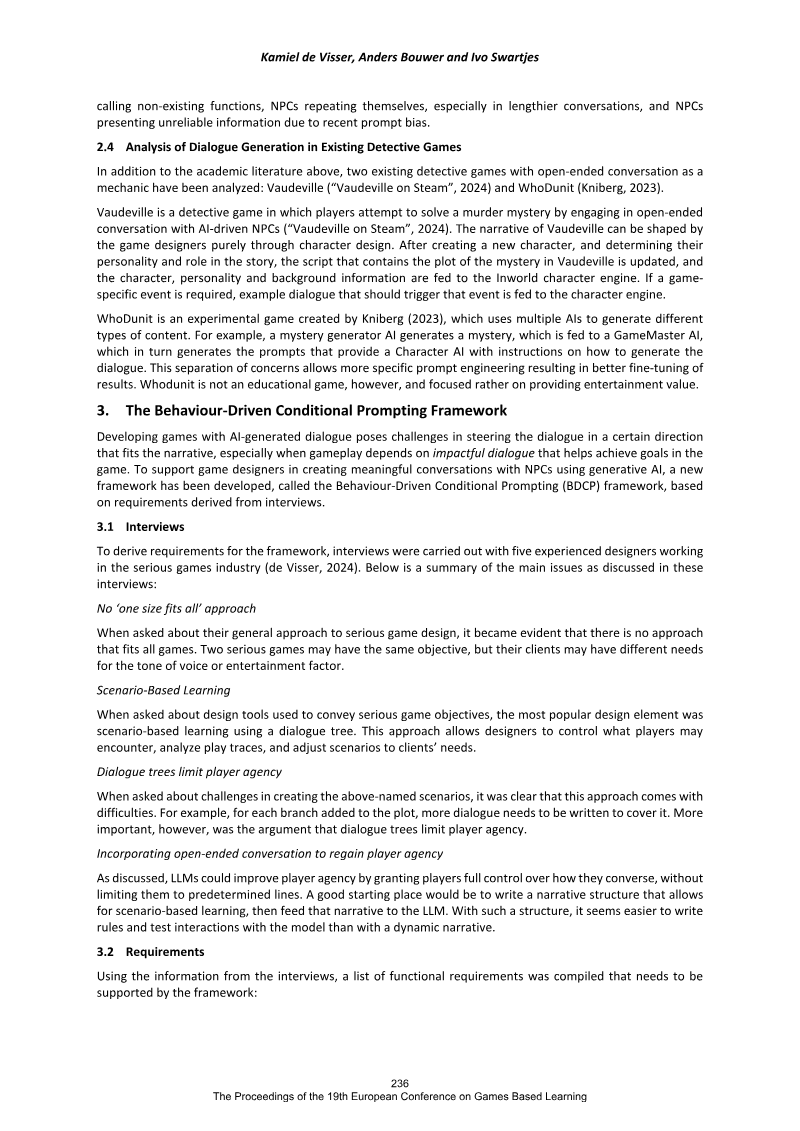
Designing Meaningful AI-Generated Dialogue: The Behaviour-Driven Conditional Prompting Framework for Serious Games
The paper presents the Behaviour-Driven Conditional Prompting (BDCP) framework, a design approach for integrating open-ended, LLM-driven dialogue into serious games.
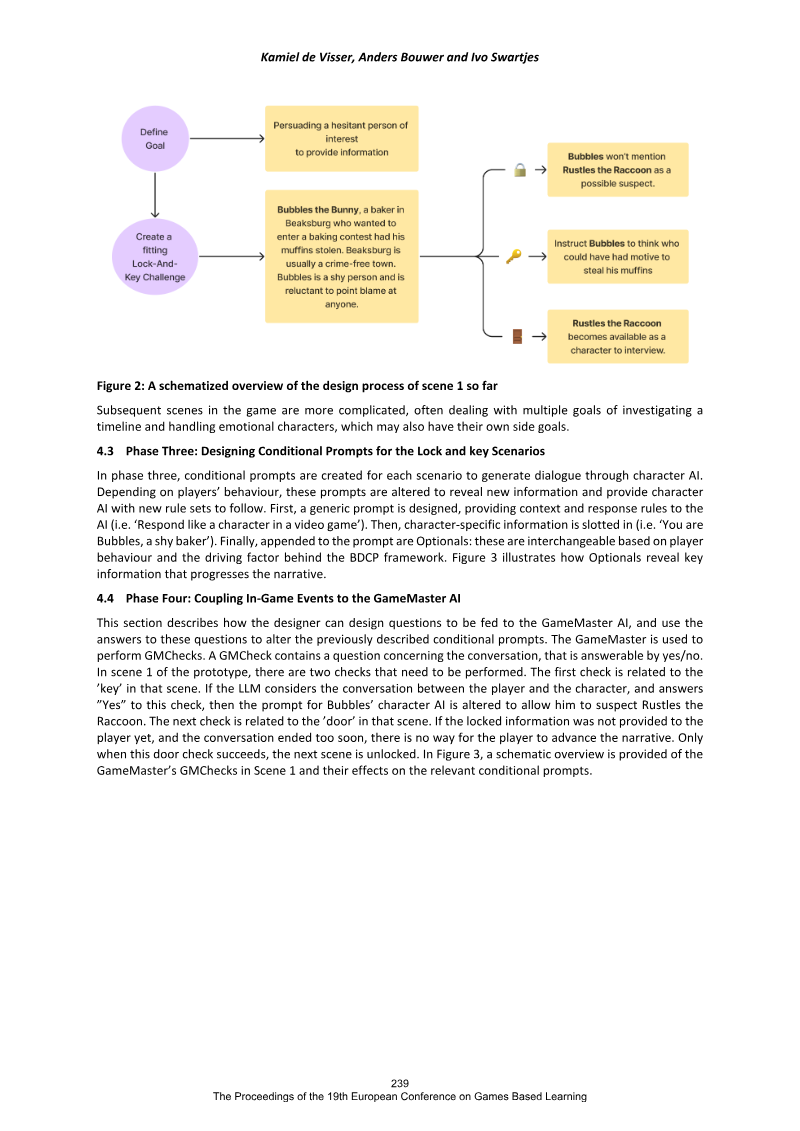
- The Behaviour-Driven Conditional Prompting (BDCP) framework integrates open-ended LLM dialogue into serious games through a four-phase process (Goal, Lock and Key Scenario, Conditional Prompts, Events), in which a Character AI generates dialogue while a GameMaster AI evaluates player behaviour and triggers in-game events.
- The framework was built from interviews with five serious games designers and organised around six functional requirements (such as open conversation, responsive dialogue, and high-level LLM control) plus three qualitative goals: ease of use, adaptability, and player feedback.
- It was demonstrated in 'Detective Duck,' a detective-style serious game whose non-player characters run on GPT-3.5-turbo, using lock-and-key scenarios in which the GameMaster AI answers yes/no checks on player dialogue to modify character prompts and unlock narrative progress.
Gamification for Enhanced Recycling Engagement in Circular Economies
This paper presents the Transformers project, a gamified, web-based application designed to counter declining public engagement with Germany's complex recycling system.
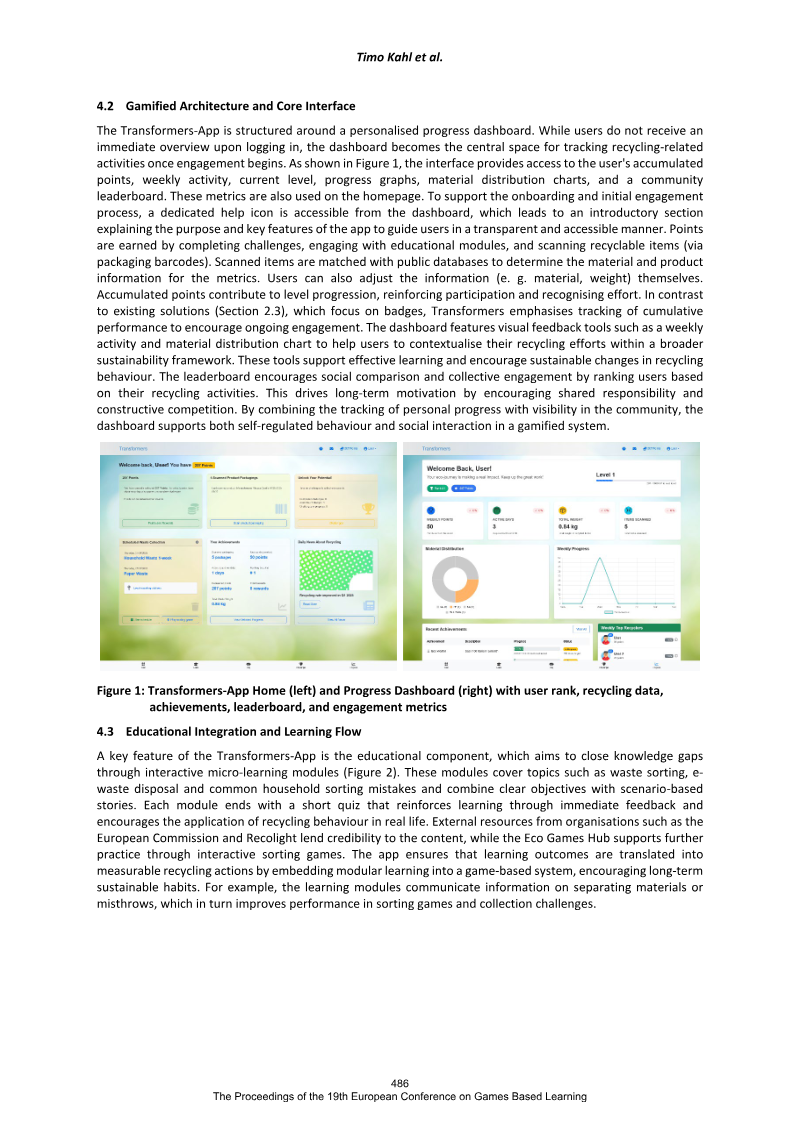
- The Transformers project is a gamified web application (progress dashboard, time-bound challenges, micro-learning quizzes, sorting simulations, leaderboards, rewards) aimed at countering declining public engagement with Germany's complex recycling system, grounded in Self-Determination Theory.
- The authors identify knowledge gaps, invisible environmental impact, and lack of feedback as the principal barriers to recycling participation.
- Existing tools GoBeEco, RecycleMich, JouleBug, and Sensoneo are judged to lack an integrated combination of modular learning, real-time tracking, and personalised feedback, which Transformers seeks to provide.

Using VR as a New Pedagogical Approach for Food Science and Technology Education in Hong Kong
This study proposes "Food Science Academy VR," a virtual reality cooking game designed to teach food science and cookery to junior secondary students in Hong Kong.
- The study proposes 'Food Science Academy VR', a virtual reality cooking game to teach food science and cookery to junior secondary students in Hong Kong, motivated by a shortage of staff: only 430 teachers serve 440 schools, and 195 schools lack teachers with relevant training.
- The core investigation is a small, quasi-experimental comparison between VR gameplay and video recordings of the same egg-based recipes, with scaffolded difficulty, so the evidence is qualitative and underpowered.
- In a pilot with four Grade 7 students, the two VR learners scored 18.5 and 19 out of 24 overall versus 10 and 11 for the two video-condition learners, with the widest gap on the written test (6.5–7 of 10 for VR versus 1 for video).
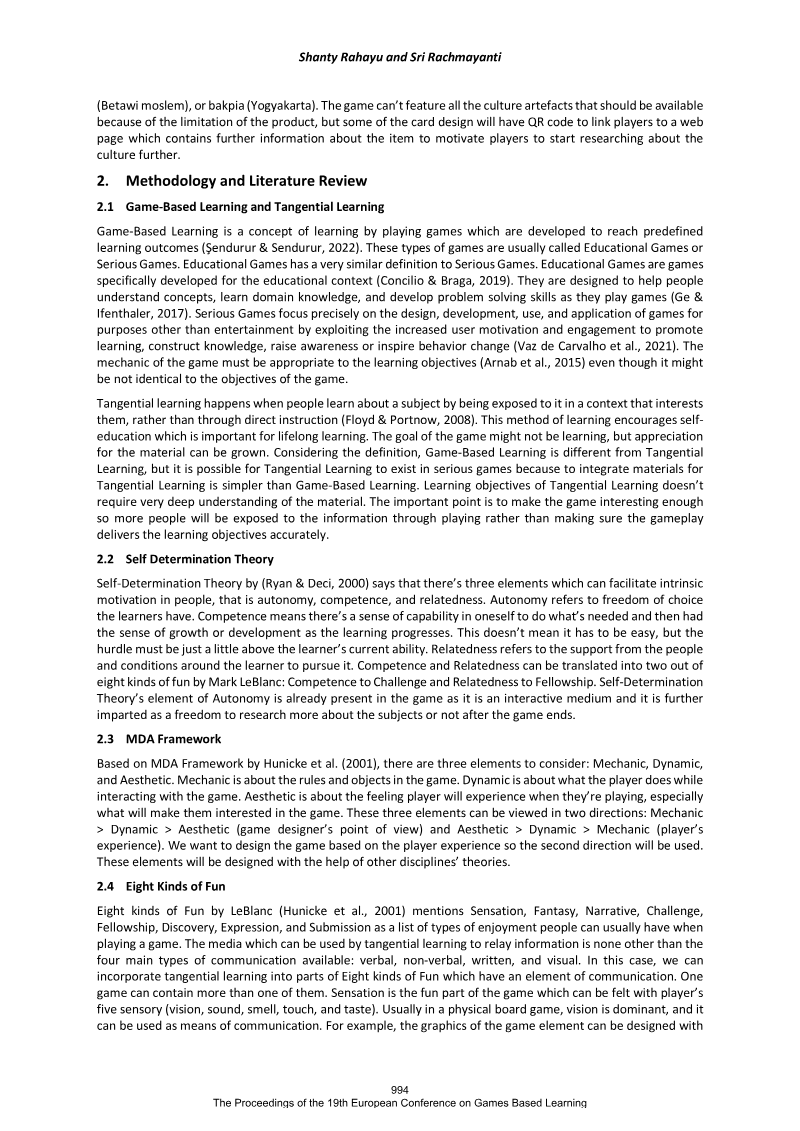
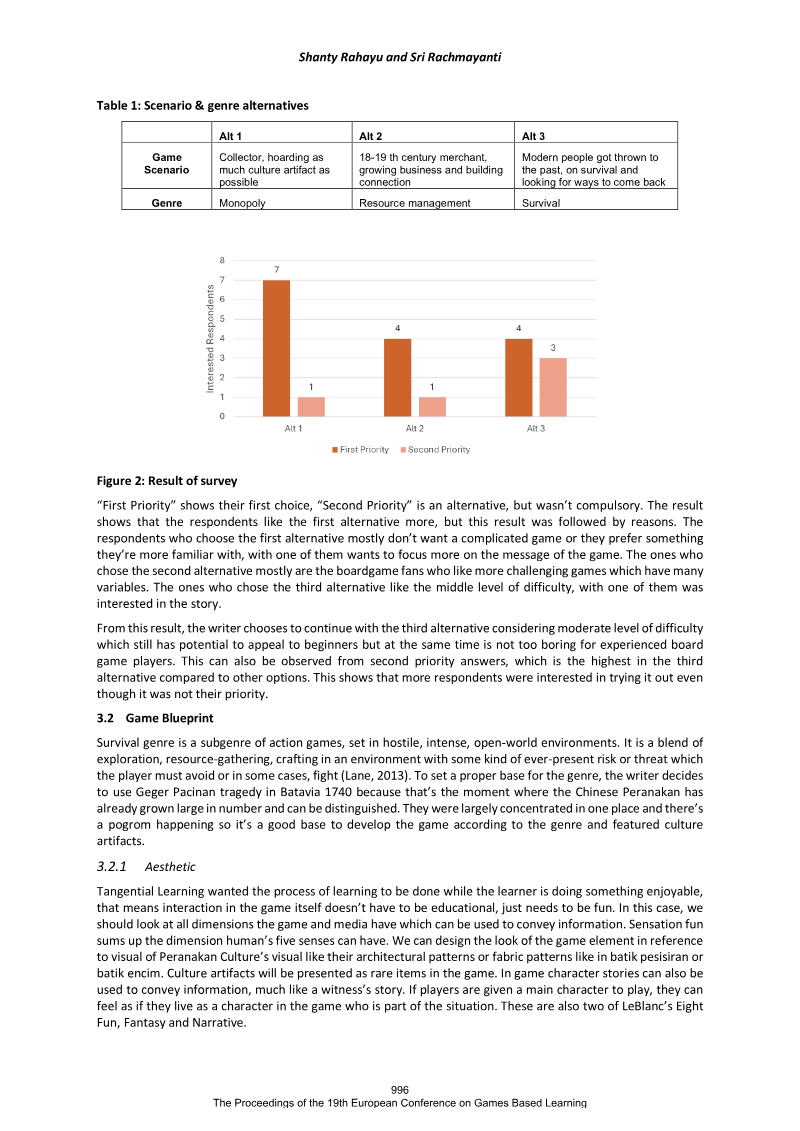
Tangential Learning in Board Game Design to Introduce Peranakan Culture
This paper proposes applying the concept of tangential learning, in which people absorb information through engaging activities rather than direct instruction, to board game design as a way to introduce Peranakan Chinese culture in Indonesia.
- The paper proposes using tangential learning, where people absorb information through engaging activities rather than direct instruction, to introduce Peranakan Chinese culture in Indonesia through board game design.
- The authors argue that educational games often fail to attract general audiences, while games that embed cultural references in aesthetics, narrative, and mechanics can spark curiosity and self-directed learning.
- The framework combines Eight Kinds of Fun, Self-Determination Theory, and the MDA framework, applied to a prototype survival board game set during the 1740 Geger Pacinan tragedy in Batavia.
Trust, Pedagogy and Play
A 9-week study of two Grade 7 classrooms in British Columbia, in which students played Nintendo Switch games (WarioWare: Get it Together and Super Mario Maker 2) for 15 minutes a day, forms the empirical basis for an argument that trust is an overlooked precondition for both play and learning.
- The authors argue trust is an overlooked precondition for learning: learning involves risk and destabilization of existing understanding, so students must trust teachers (epistemic trust) and the game itself (ludic trust) to engage with it.
- Students enjoyed the games and trusted their technical reliability, yet classroom power structures, teacher uncertainty about videogames, limited time, reduced task demands, and teachers not playing alongside students all constrained educational value.
- Converting game experiences into conventional written tasks effectively 'cancels out' what games uniquely offer, so game-based pedagogy requires media-appropriate design and substantial teacher investment rather than simply inserting games into existing routines.
A Theoretical Model for Game Mechanics: Bridging Design Practice and Education
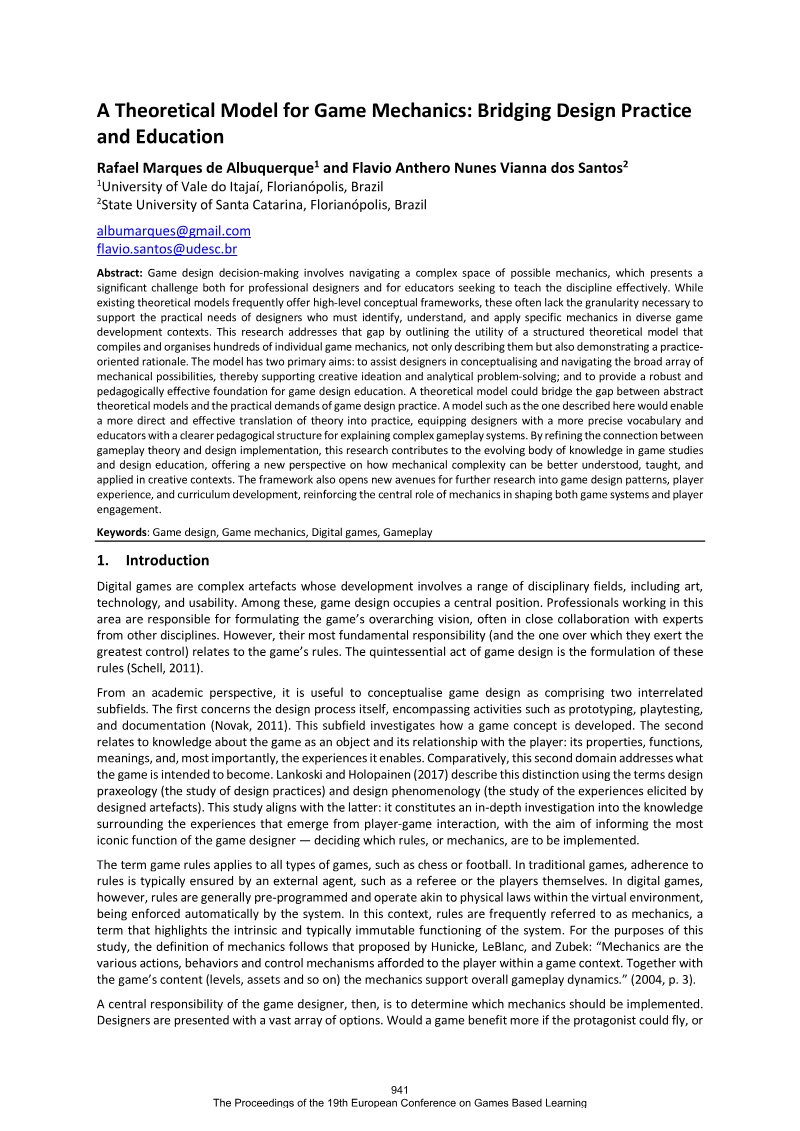
This paper proposes a theoretical model for organising digital game mechanics so that they can serve both professional game designers and educators.
- The paper proposes a theoretical model that organises digital game mechanics and links each mechanic to the player experiences it is likely to elicit, aiming to serve both professional designers and educators.
- The authors argue that existing game studies frameworks operate at a high conceptual level (e.g., competition, chance, motivation) without specifying the concrete mechanics that produce those experiences.
- The review surveys prior taxonomies, including Björk and Holopainen's collection of over 160 design patterns, Schell/Fullerton/Crawford formal element frameworks, Bartle, BrainHex and Quantic Foundry player typologies, and self-determination theory motivational models.
Designing a User-Centred Adaptive Gamified Learning System: A Multidisciplinary Approach from Pedagogy to Artificial Intelligence
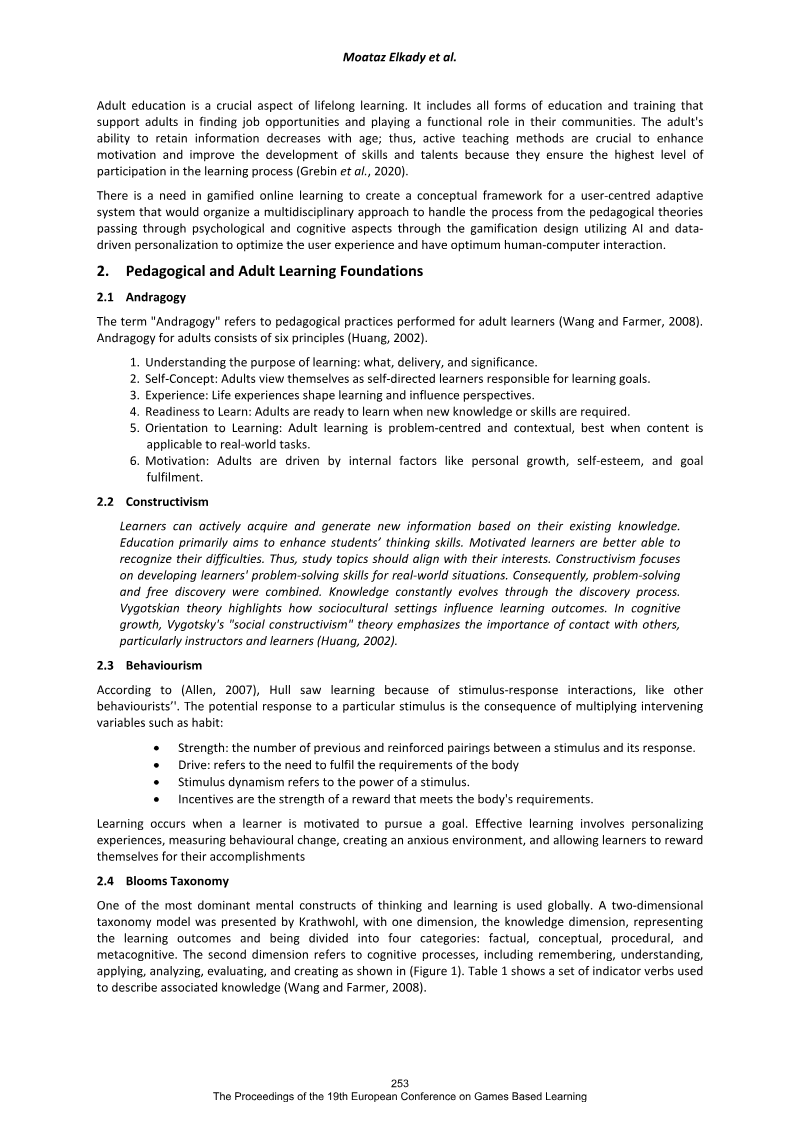
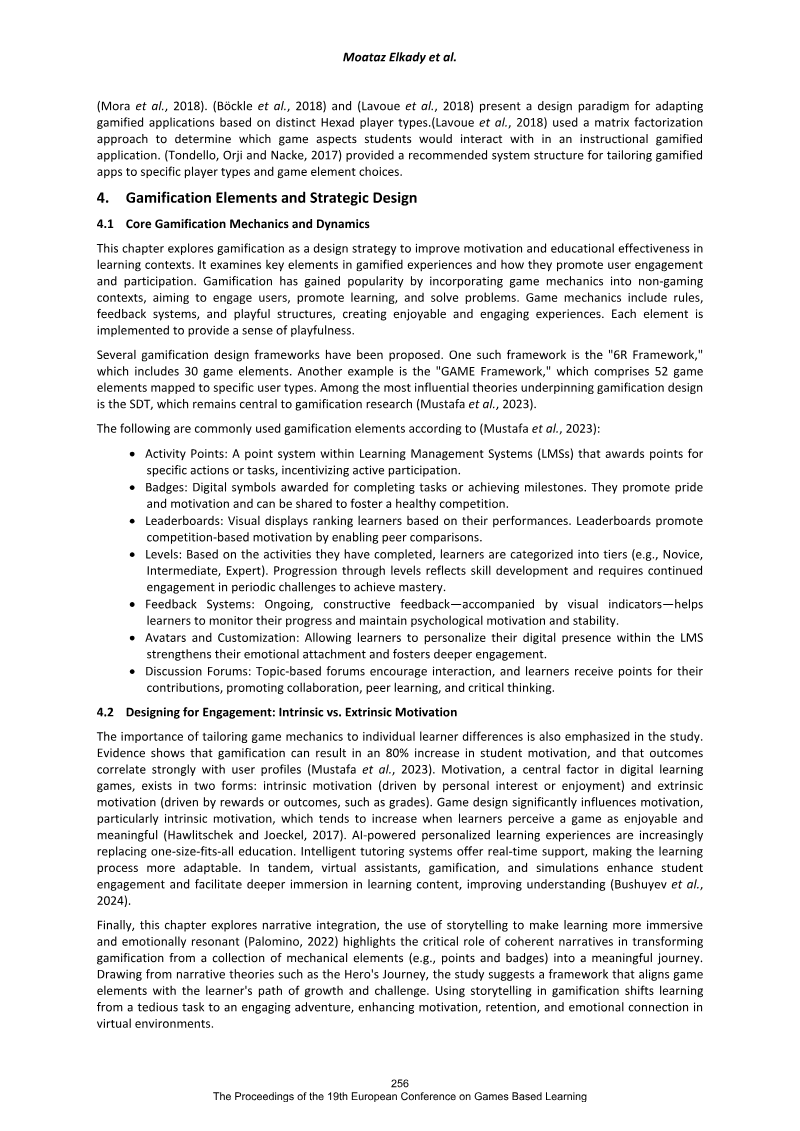
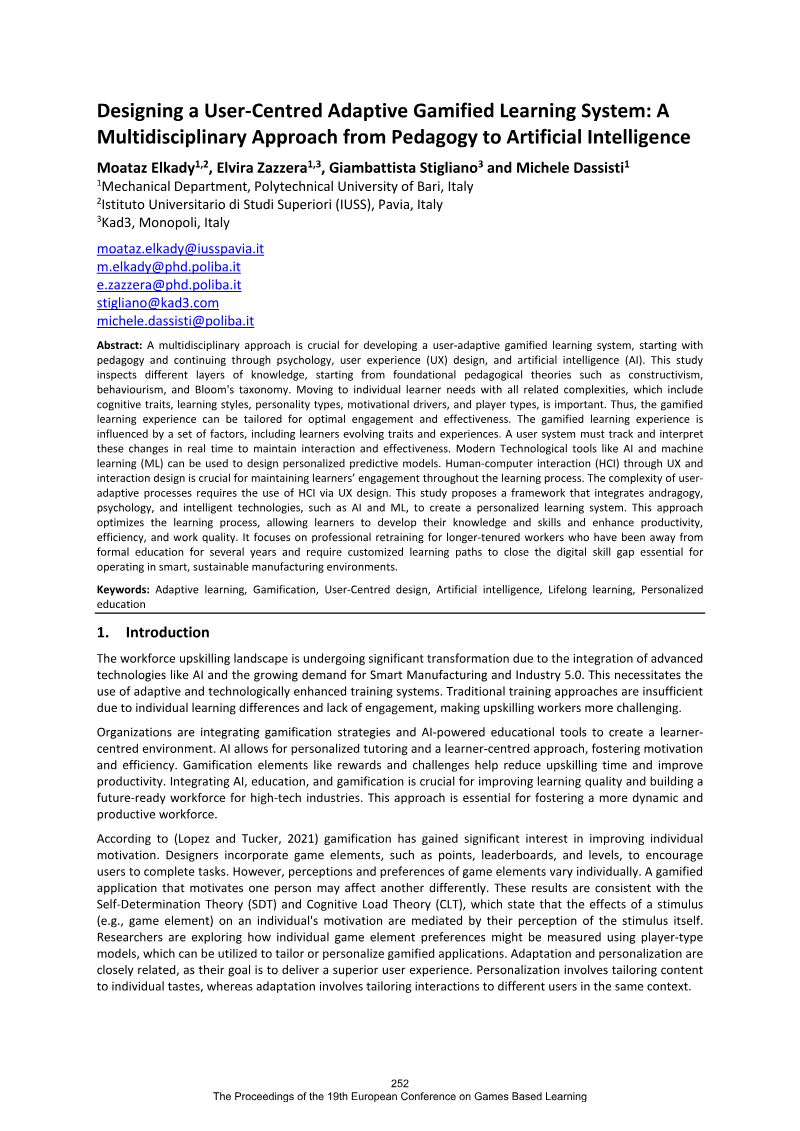
This paper proposes a multidisciplinary framework for designing user-adaptive gamified learning systems that draw together adult learning theory, motivational psychology, and artificial intelligence.
- Adaptive gamification tailored to player types was reported to significantly improve user performance compared with non-adapted systems, supporting the paper's central argument that individual tailoring drives effectiveness.
- Learning styles showed no significant correlation with test results, although kinaesthetic learning was the most preferred style in online classes.
- Gamification is associated with substantial motivation gains, with one cited figure indicating an 80% increase in student motivation.


Bridging Virtual and Real: Gamification in Teaching Architectural Features with Assassin's Creed Odyssey
This study examines whether exploration of Assassin's Creed Odyssey's Discovery Mode can teach Ancient Greek architecture more effectively than text-based instruction.
- Twenty participants without design training were split into two groups of ten: one explored three Ancient Greek architectural features within Assassin's Creed Odyssey's Discovery Mode, while the control group read a transcript of the same in-game narration.
- The game-exploration group scored 80–100% on spatial comprehension questions and 60–90% on theory questions, whereas the text group scored 40–100% on spatial questions and 70–90% on theory questions.
- The authors conclude that immersive, interactive exploration offers a clear advantage for spatial understanding and produces more consistent learning outcomes across learners than text-based instruction.
Designing AI-Enhanced Educational Digital Escape Room Games (EDERGs): A Framework for Teacher Implementation
This paper presents a design and development research study aimed at helping teachers integrate artificial intelligence into the creation of educational digital escape room games (EDERGs).
- Teachers building educational digital escape room games (EDERGs) struggled most with linking storylines to puzzles and often could not finish their games in a reasonable time, which the authors identify as the two main early obstacles.
- Introducing AI-supported content generation together with templates, sample prompts, and model games was reported to speed up design, let teachers playtest within the same session, and raise their confidence and engagement.
- Teachers became noticeably more skilled at prompting AI tools over the course of the training, according to the study's observation notes and interviews.

Using AI and Cognitive Taxonomies to Map Learning Processes in Board Games
This study investigates how generative AI and cognitive taxonomies can be combined to support the design of board game-based learning (bGBL), a method that remains underused in formal education largely because of the difficulty of aligning game mechanics with explicit learning goals.
- Board game-based learning remains underused in formal education mainly because aligning game mechanics with explicit learning goals is difficult.
- The authors propose a three-axis framework integrating Anderson and Krathwohl's revised taxonomy, Trinchero's R-I-Z-A model, and Le Boterf's situated competence concept, operationalized in GADBot, a prototype Custom GPT.
- GADBot is trained on a curated BoardGameGeek dataset annotated with Engelstein and Shalev's classification of board game mechanics, and is designed to recommend games and generate phased learning activities with inclusive adaptations.