1 free read left. Create a free account for unlimited reading + AI research.
Create free accountWhitepaper European Conference on Games Based Learning (ECGBL)
1 free read left. Create a free account for unlimited reading + AI research.
Create free accountWhitepaperEuropean Conference on Games Based Learning (ECGBL)
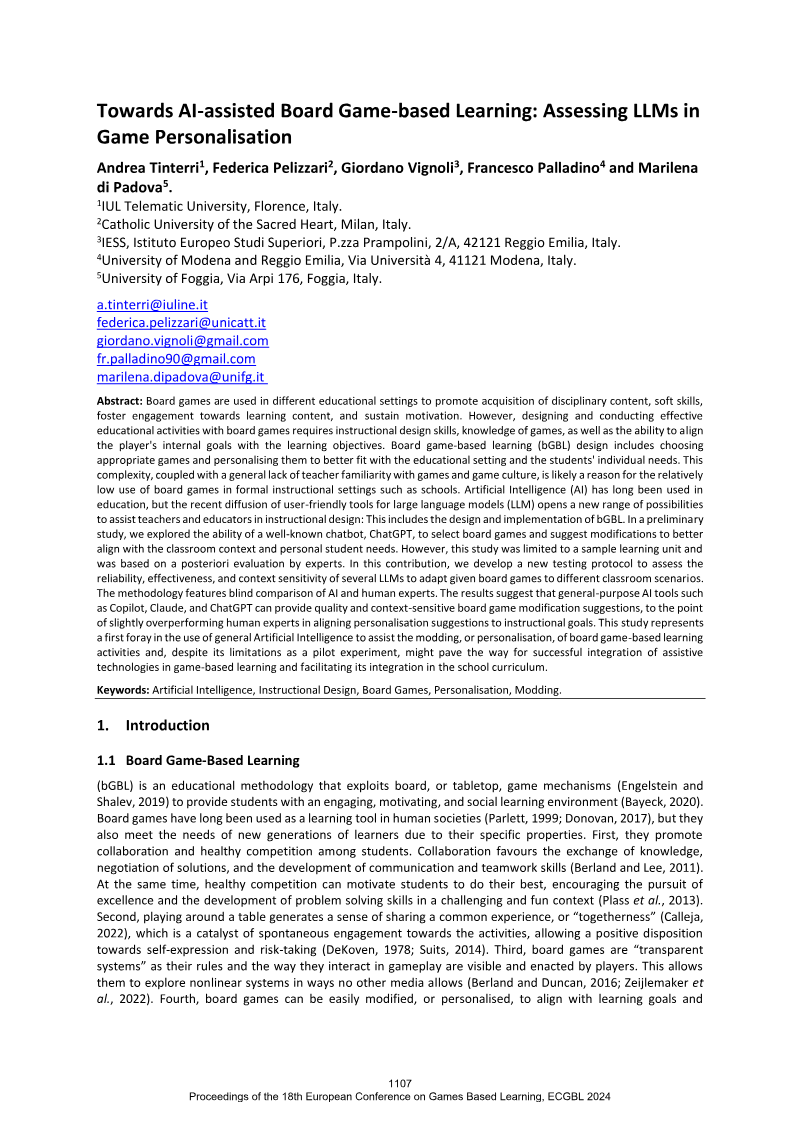
The study describes board game-based learning as a method that remains underused in formal education. It attributes this mainly to the difficulty of aligning game mechanics with explicit learning goals.
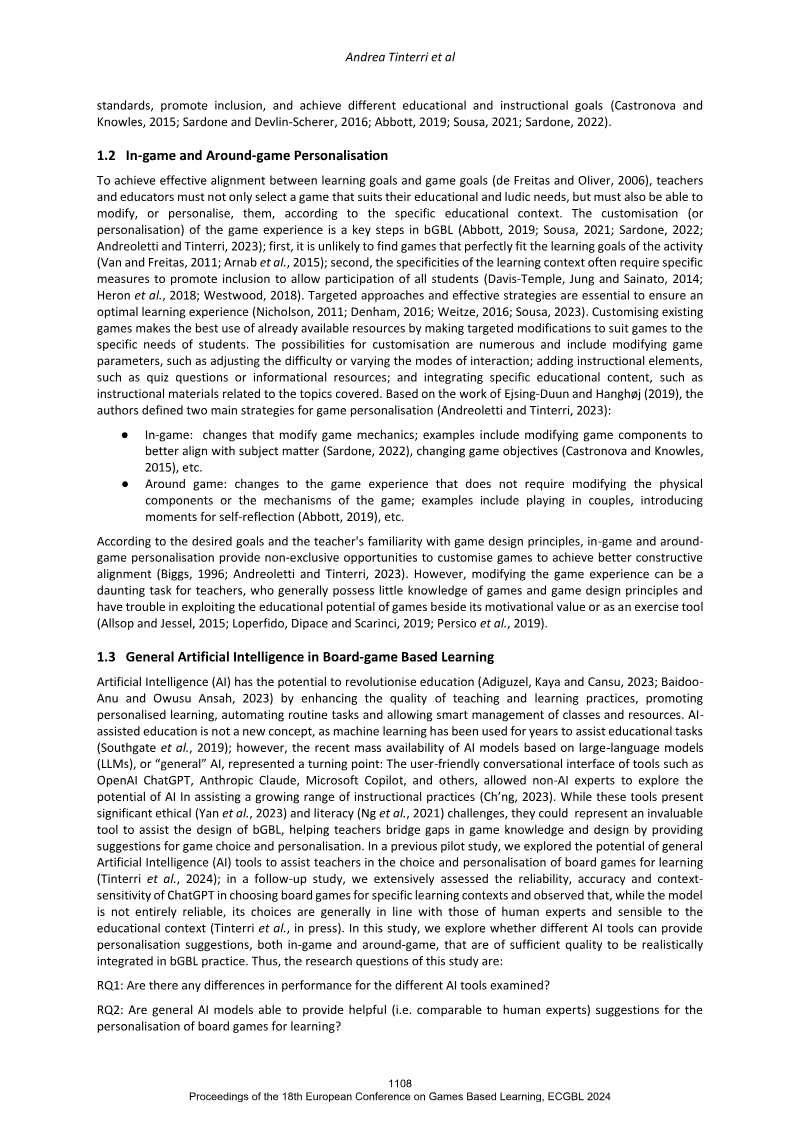
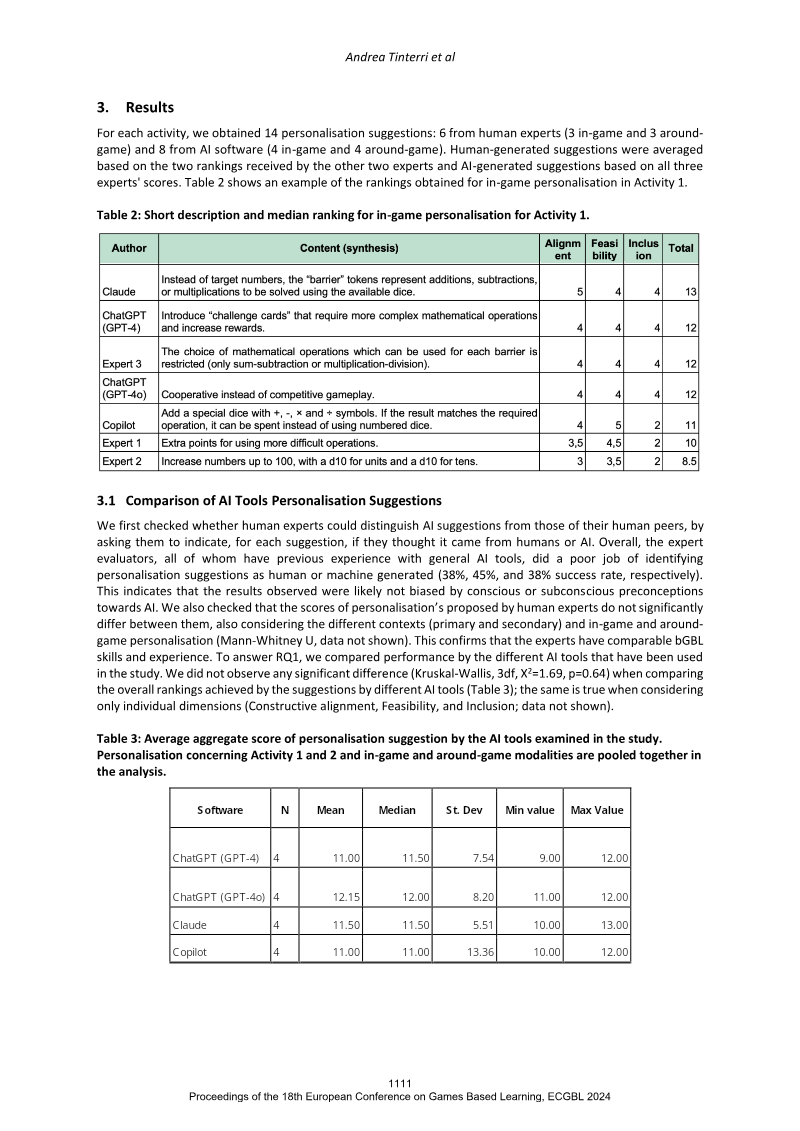
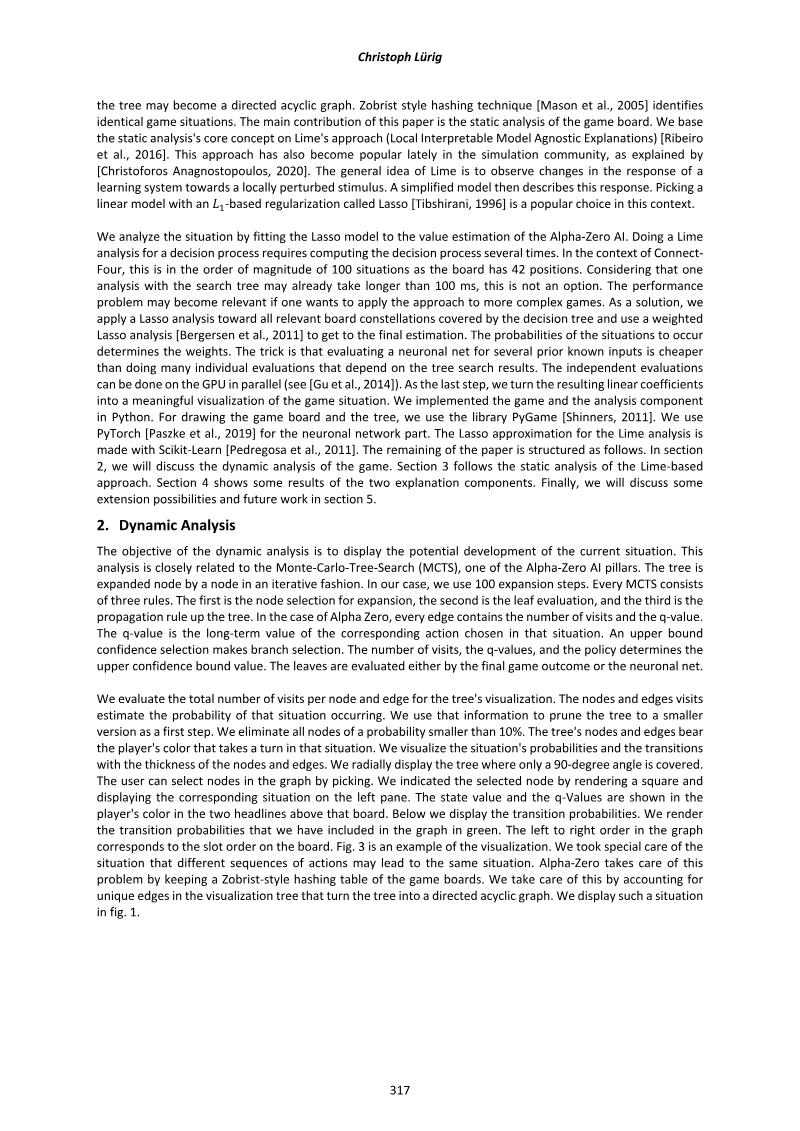
This study investigates how generative AI and cognitive taxonomies can be combined to support the design of board game-based learning (bGBL), a method that remains underused in formal education largely because of the difficulty of aligning game mechanics with explicit learning goals. The authors propose a three-axis theoretical framework that integrates Anderson and Krathwohl's revised taxonomy, Trinchero's R-I-Z-A model, and Le Boterf's concept of situated competence, and they operationalize it in GADBot, a prototype Custom GPT trained on a curated BoardGameGeek dataset annotated with Engelstein and Shalev's classification of board game mechanics. The tool is designed to recommend games and generate phased learning activities with inclusive adaptations.
In a sample evaluation using a four-criterion rubric covering activity structure, game selection, learning objectives, and personalization, three expert raters were generally satisfied with GADBot's outputs for a 5th-grade lesson on the fall of the Western Roman Empire. However, the evaluators observed recurring weaknesses, including outputs misaligned with stated learning objectives, the recommendation of games only tangentially related to the activity, and the omission of required information. The authors characterize the tool as a work in progress and identify its principal limitations as the narrow scope of assessment, the absence of validation by classroom teachers, and the lack of evidence regarding student learning outcomes.
The work is situated within research on game-based learning, experiential and situated learning theory, competence-based education, and generative AI in education, and it builds on the authors' earlier work on automating board game evaluation with AI. The paper's contribution is primarily conceptual and prototypical: it offers a framework and an early-stage tool rather than empirical findings on classroom effectiveness, which the authors plan to pursue through further expert and classroom-based evaluation.



European Conference on Games Based Learning (ECGBL) · 2026



European Conference on Games Based Learning (ECGBL) · 2026



European Conference on Games Based Learning (ECGBL) · 2026



European Conference on Games Based Learning (ECGBL) · 2026



European Conference on Games Based Learning (ECGBL) · 2026



European Conference on Games Based Learning (ECGBL) · 2026



European Conference on Games Based Learning (ECGBL) · 2026



European Conference on Games Based Learning (ECGBL) · 2026



European Conference on Games Based Learning (ECGBL) · 2026



European Conference on Games Based Learning (ECGBL) · 2026



European Conference on Games Based Learning (ECGBL) · 2026



European Conference on Games Based Learning (ECGBL) · 2026
European Conference on Games Based Learning (ECGBL) · 2026