1 free read left. Create a free account for unlimited reading + AI research.
Create free accountWhitepaper European Conference on Games Based Learning (ECGBL)
1 free read left. Create a free account for unlimited reading + AI research.
Create free accountWhitepaperEuropean Conference on Games Based Learning (ECGBL)
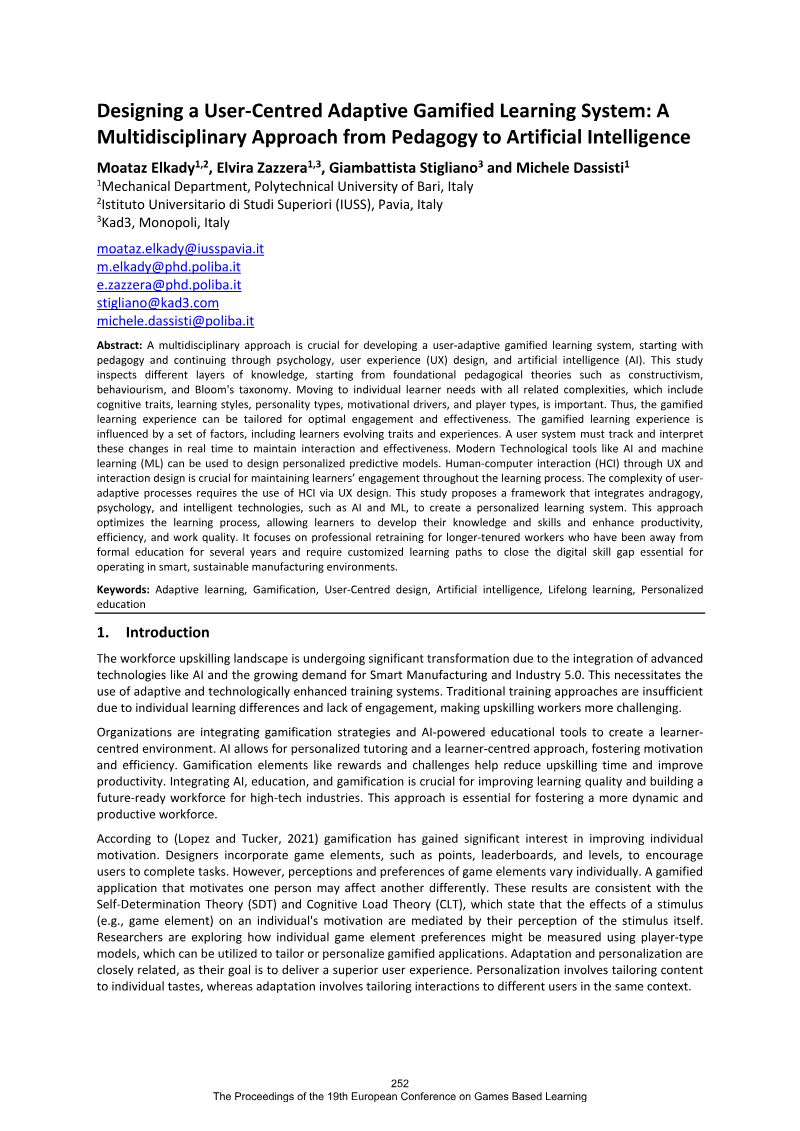
The framework is motivated by closing digital skill gaps among older workers in smart manufacturing. It draws on adult learning theory, motivational psychology and artificial intelligence.
This paper proposes a multidisciplinary framework for designing user-adaptive gamified learning systems that draw together adult learning theory, motivational psychology, and artificial intelligence. Its foundation rests on andragogy, constructivism, behaviourism, and Bloom's taxonomy, combined with models such as Self-Determination Theory, Cognitive Load Theory, VARK learning styles, and the Hexad player-type model. The central argument is that gamified learning environments are most effective when tailored to the individual, since motivation and learning outcomes depend on how each user perceives and responds to game elements. The authors position this approach as particularly relevant for retraining older workers to close digital skill gaps in smart manufacturing.
The evidence cited supports the value of adaptation. Adaptive gamification aligned with player types was reported to significantly improve user performance compared with non-adapted systems. Conversely, learning styles showed no significant correlation with test results, although kinaesthetic learning emerged as the most preferred style in online classes. Gamification more broadly is associated with substantial gains in motivation, with one cited figure indicating an 80% increase in student motivation. A gamified learning management system was also linked to markedly higher login frequency (7,200 versus 3,151) and stronger academic performance than traditional platforms.
On the technical side, the paper reviews learning analytics and machine learning applications, including a model that predicted student performance from facial expression key points and an adaptation engine combining static and dynamic personalization. Elements such as points, badges, leaderboards, and levels are examined as the mechanical building blocks of gamified design.
The paper concludes with a proposed conceptual framework for adaptive gamified learning. Its validation through a Delphi study and pilot testing is identified as planned future work, so the framework remains theoretical at this stage.



European Conference on Games Based Learning (ECGBL) · 2026



European Conference on Games Based Learning (ECGBL) · 2026



European Conference on Games Based Learning (ECGBL) · 2026



European Conference on Games Based Learning (ECGBL) · 2026



European Conference on Games Based Learning (ECGBL) · 2026



European Conference on Games Based Learning (ECGBL) · 2026



European Conference on Games Based Learning (ECGBL) · 2026



European Conference on Games Based Learning (ECGBL) · 2026



European Conference on Games Based Learning (ECGBL) · 2026



European Conference on Games Based Learning (ECGBL) · 2026



European Conference on Games Based Learning (ECGBL) · 2026



European Conference on Games Based Learning (ECGBL) · 2026
European Conference on Games Based Learning (ECGBL) · 2026