1 free read left. Create a free account for unlimited reading + AI research.
Create free accountWhitepaper European Conference on Games Based Learning (ECGBL)
1 free read left. Create a free account for unlimited reading + AI research.
Create free accountWhitepaperEuropean Conference on Games Based Learning (ECGBL)
The authors argue that game studies frameworks work at a high conceptual level, offering dimensions such as competition, chance, or motivation. They do not specify the concrete mechanics that produce those experiences.
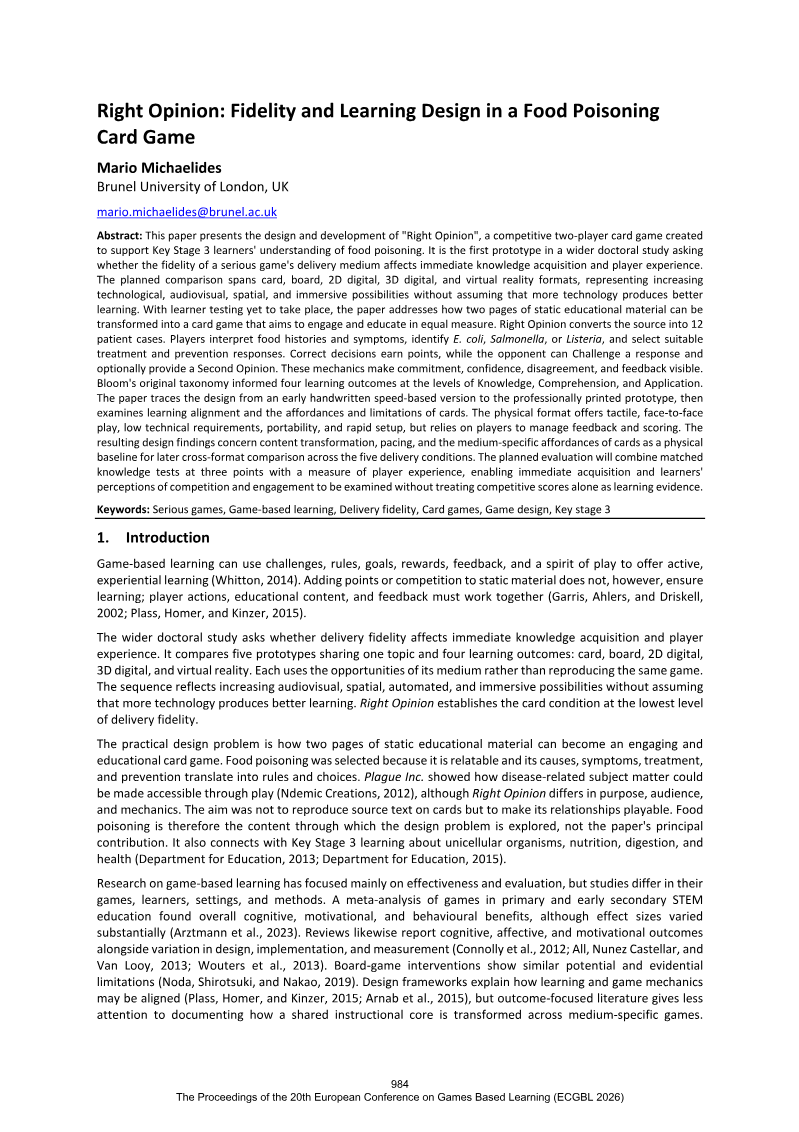
This paper proposes a theoretical model for organising digital game mechanics so that they can serve both professional game designers and educators. The authors argue that existing frameworks in game studies tend to operate at a high conceptual level, offering dimensions of player experience such as competition, chance, or motivation without specifying the concrete mechanics that produce them. Their model aims to compile and structure a broad range of mechanics, linking each to the player experiences it is likely to elicit, and to provide a vocabulary and pedagogical structure for teaching gameplay design. The paper is framed as a doctoral research colloquium contribution, situating the work within the authors' broader thesis rather than reporting completed empirical results.
The argument rests on a review of prior taxonomies and typologies. The authors survey design pattern compendiums such as Björk and Holopainen's collection of over 160 patterns, formal element frameworks by Schell, Fullerton, and Crawford, player typologies such as Bartle's, BrainHex, and Quantic Foundry's model, and motivational models drawn from self-determination theory. They note that many practitioner texts offer fragmented or non-systematic classifications, and that few works connect player experience directly to specific mechanics. The paper is largely conceptual, and the model's methodology is described as still in progress, so no statistical findings or survey data are presented.
The pedagogical motivation is grounded in the authors' teaching experience and in a cited count of 4,116 undergraduate digital games and game design courses in Brazil, mostly distance-learning programmes that have grown steadily since around 2010. The authors suggest that gameplay education remains underdeveloped in this young field. To demonstrate the model's utility, the authors report that an educational card game is under development. The geographic focus is Brazilian higher education, though the theoretical scope is international game studies.



European Conference on Games Based Learning (ECGBL) · 2026



European Conference on Games Based Learning (ECGBL) · 2026



European Conference on Games Based Learning (ECGBL) · 2026



European Conference on Games Based Learning (ECGBL) · 2026



European Conference on Games Based Learning (ECGBL) · 2026



European Conference on Games Based Learning (ECGBL) · 2026



European Conference on Games Based Learning (ECGBL) · 2026



European Conference on Games Based Learning (ECGBL) · 2026



European Conference on Games Based Learning (ECGBL) · 2026



European Conference on Games Based Learning (ECGBL) · 2026



European Conference on Games Based Learning (ECGBL) · 2026



European Conference on Games Based Learning (ECGBL) · 2026



European Conference on Games Based Learning (ECGBL) · 2026
European Conference on Games Based Learning (ECGBL) · 2026



European Conference on Games Based Learning (ECGBL) · 2026