1 free read left. Create a free account for unlimited reading + AI research.
Create free accountWhitepaper European Conference on Games Based Learning (ECGBL)
1 free read left. Create a free account for unlimited reading + AI research.
Create free accountWhitepaperEuropean Conference on Games Based Learning (ECGBL)
The Behaviour-Driven Conditional Prompting framework integrates open-ended LLM dialogue into serious games. A Character AI generates dialogue while a GameMaster AI evaluates player behaviour and triggers in-game events.
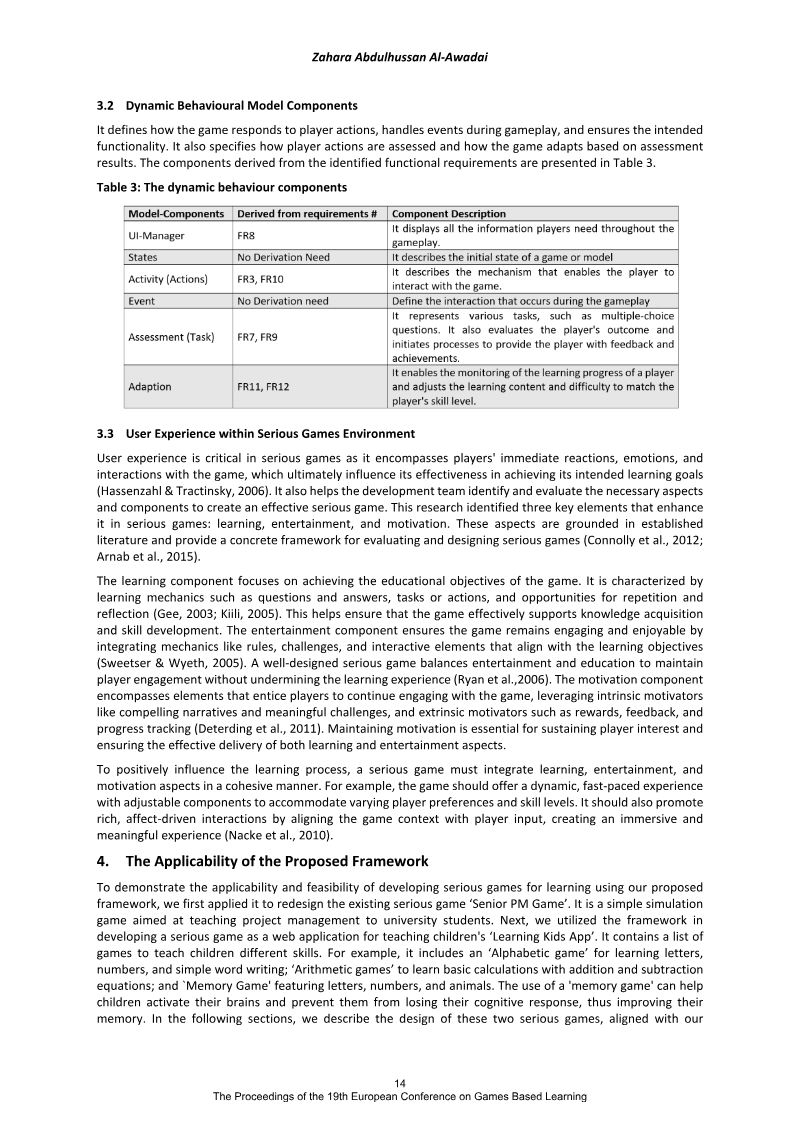
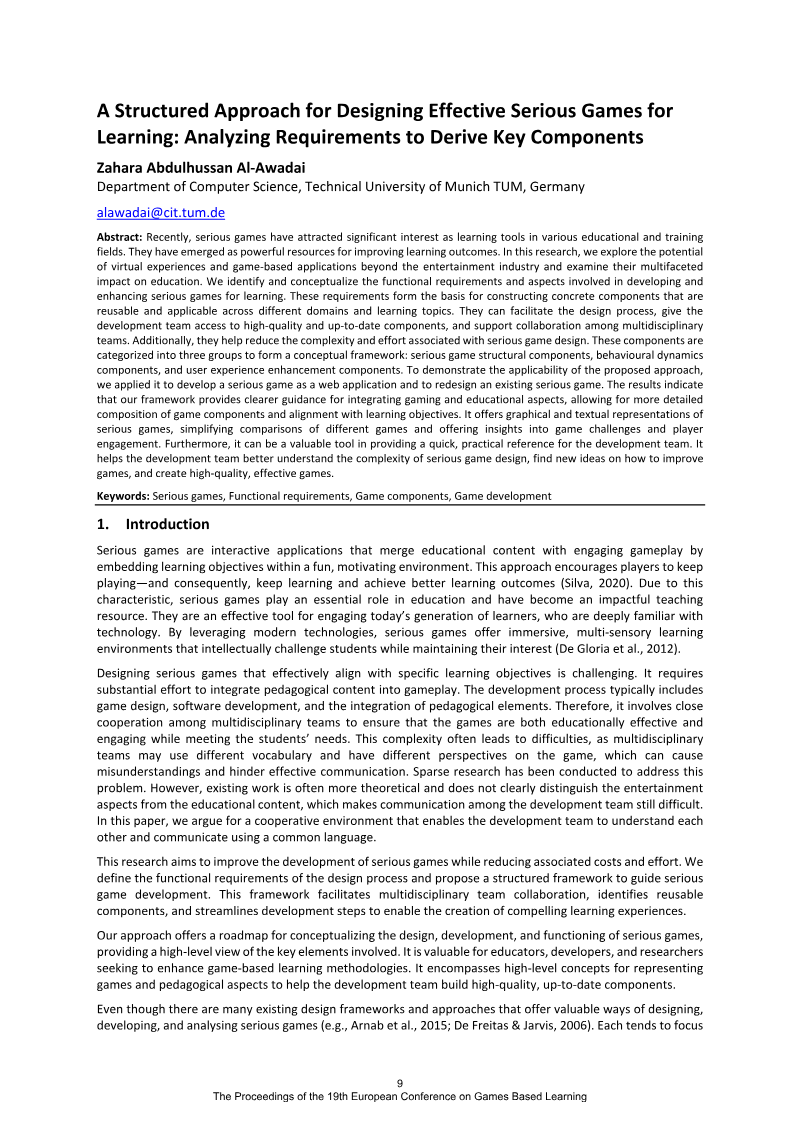
The paper presents the Behaviour-Driven Conditional Prompting (BDCP) framework, a design approach for integrating open-ended, LLM-driven dialogue into serious games. Grounded in interviews with five serious games designers, the framework is built around six functional requirements, such as open conversation, responsive dialogue, and high-level LLM control, along with three qualitative goals: ease of use, adaptability, and player feedback. Its core is a four-phase design process (Goal, Lock and Key Scenario, Conditional Prompts, and Events) in which a Character AI generates dialogue while a GameMaster AI evaluates player behaviour and triggers in-game events.
The framework is demonstrated through "Detective Duck," a detective-style serious game whose non-player characters are powered by GPT-3.5-turbo. Its mechanics rely on lock-and-key scenarios, in which the GameMaster AI answers yes/no checks on player dialogue to dynamically modify character prompts and unlock narrative progression. Evaluation by five professional game designers found the framework intuitive and transferable to other soft-skill training contexts. However, participants reported conversation derailment, where dialogue strayed from intended paths, and the authors acknowledge that further refinement is needed before real-world deployment.
The work's scope is focused on the design of serious games with conversational NPCs, with a prototype built on a single commercial LLM and evaluated by a small expert sample. The paper does not offer large-scale quantitative findings; its contributions are primarily conceptual and qualitative. The reference list situates the framework within research on procedural and AI-driven dialogue, including systems such as Façade and retrieval-augmented generation, as well as broader work on serious games and dialogue design.

European Conference on Games Based Learning (ECGBL) · 2026



European Conference on Games Based Learning (ECGBL) · 2026

European Conference on Games Based Learning (ECGBL) · 2026



European Conference on Games Based Learning (ECGBL) · 2026



European Conference on Games Based Learning (ECGBL) · 2026



European Conference on Games Based Learning (ECGBL) · 2026



European Conference on Games Based Learning (ECGBL) · 2026



European Conference on Games Based Learning (ECGBL) · 2026



European Conference on Games Based Learning (ECGBL) · 2026



European Conference on Games Based Learning (ECGBL) · 2026



European Conference on Games Based Learning (ECGBL) · 2026



European Conference on Games Based Learning (ECGBL) · 2026



European Conference on Games Based Learning (ECGBL) · 2026
European Conference on Games Based Learning (ECGBL) · 2026
European Conference on Games Based Learning (ECGBL) · 2026