
DiGRA
The Digital Games Research Association: the international association of academics and professionals who study digital games. Its Digital Library holds the proceedings of the DiGRA conferences since 2002.
Documents
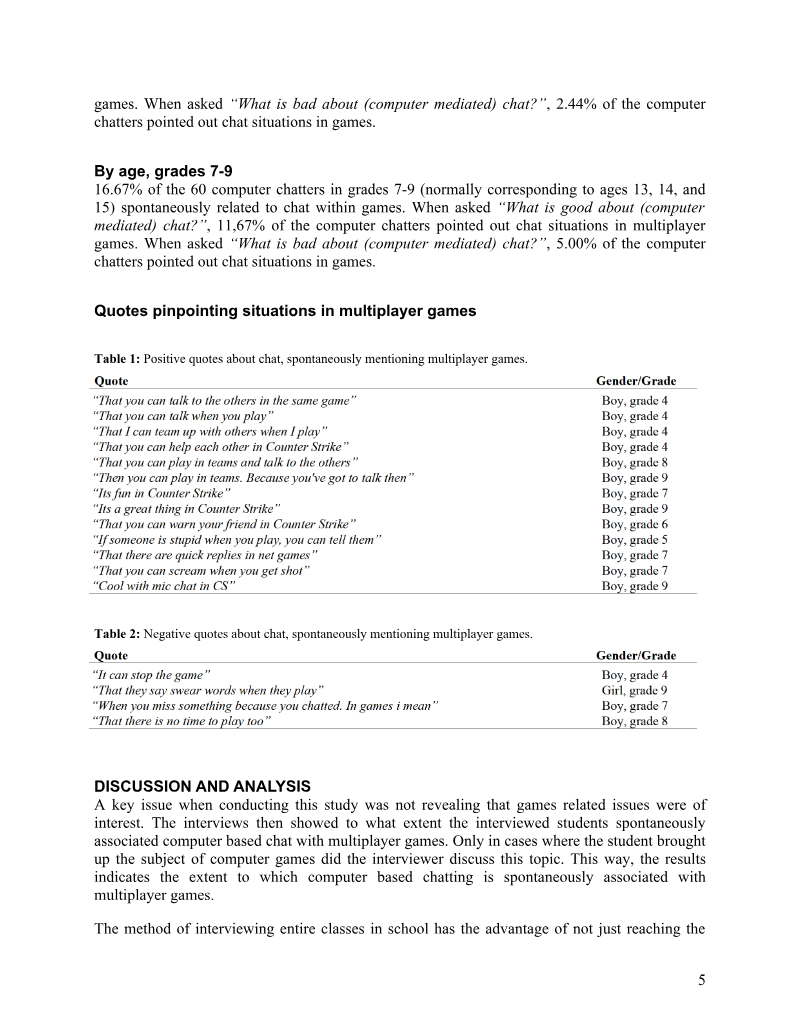
Game Mediated Communication: Multiplayer Games as the Medium for Computer Based Communication
This study by Mats Wiklund at Stockholm University investigates whether multiplayer games are becoming the natural medium for computer-based communication, a question motivated by the growing prominence of in-game chat and voice interaction.
- Roughly 16.83% of computer chatters spontaneously linked chat with multiplayer games even though the interviewer never raised games, suggesting games are already a natural association for computer-mediated conversation.
- Among students aged roughly 10 to 15 at two Swedish schools, 101 of 131 interviewed reported chat use, and spontaneous game association was nearly identical for younger and older students (17.07% vs. 16.67%).
- Positive associations dominated: 76.47% of game-related answers arose from questions about the benefits of chat.
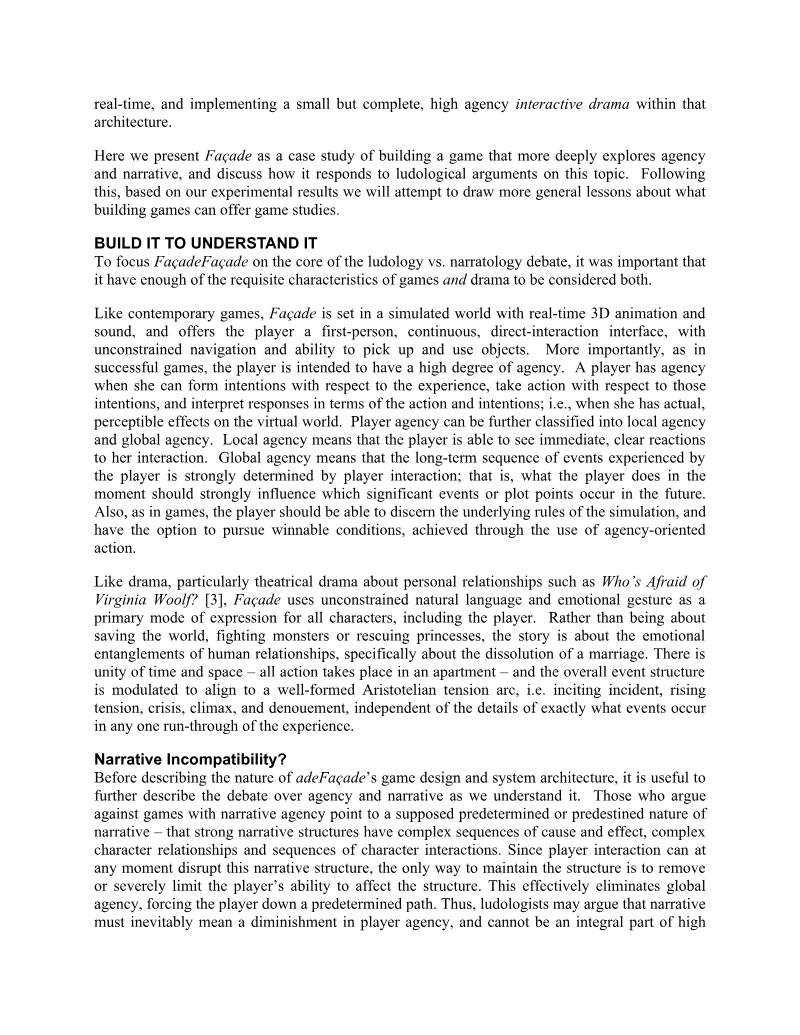
Build It to Understand It: Ludology Meets Narratology in Game Design Space
Mateas and Stern's paper argues that building experimental games can advance game studies beyond the analysis of existing titles.
- Mateas and Stern argue that building experimental games yields theoretical and design insights that purely analytical study of existing titles cannot reach, because analysis cannot anticipate new regions of design possibility.
- The authors contend that ludologist skepticism about combining player agency with strong narrative partly reflects the absence of successful agency-rich narratives, and they test this claim with their interactive drama Façade.
- Façade recasts story interactions as abstract social games (affinity, hot-button, and therapy games) driven by natural-language discourse acts and coordinated by a layered architecture and drama manager managing multiple narrative fronts.
Player as Author: Conjecturing Online Game Creation Modalities and Infrastructure
This paper argues that the videogame industry has entered a period of creative stagnation, characterized by sequels, familiar genre templates, and tight control over production, and that the producer-consumer dichotomy limits innovation.
- The paper argues the videogame industry has entered creative stagnation, marked by sequels, familiar genre templates, and tight production control, and that the producer-consumer dichotomy limits innovation.
- Its central thesis is that players should be recognized and enabled as authors who create game content, scenarios, mods, and entirely new games, framed as an emancipatory movement.
- Cited examples of player authorship include user-generated machinima, photo-novel stories produced from The Sims, object scripting in Second Life, and modding communities supported by Valve and id Software.
Connecting Worlds: Fantasy Role-Playing Games, Ritual Acts and the Magic Circle
Marinka Copier's paper argues that fantasy role-playing games should not be studied as isolated objects but as part of a broader fantasy subculture, and that the prevailing use of Johan Huizinga's "magic circle" concept in game studies misrepresents his original ideas.
- Marinka Copier argues that fantasy role-playing games should be studied as part of a broader fantasy subculture rather than as isolated objects, and that the prevailing use of Johan Huizinga's "magic circle" concept in game studies misrepresents his original ideas.
- The paper contends that the play space is not a fixed chalk-line boundary, as Salen and Zimmerman's visualization suggests, but is actively constructed through negotiation and ritual acts such as bricolage.
- Role-playing is framed through ritual and performance theory (Turner, van Gennep, Schechner), treating RPGs as collections of performances that connect worlds rather than as activities bounded off from everyday life.
The Expressions of Colours
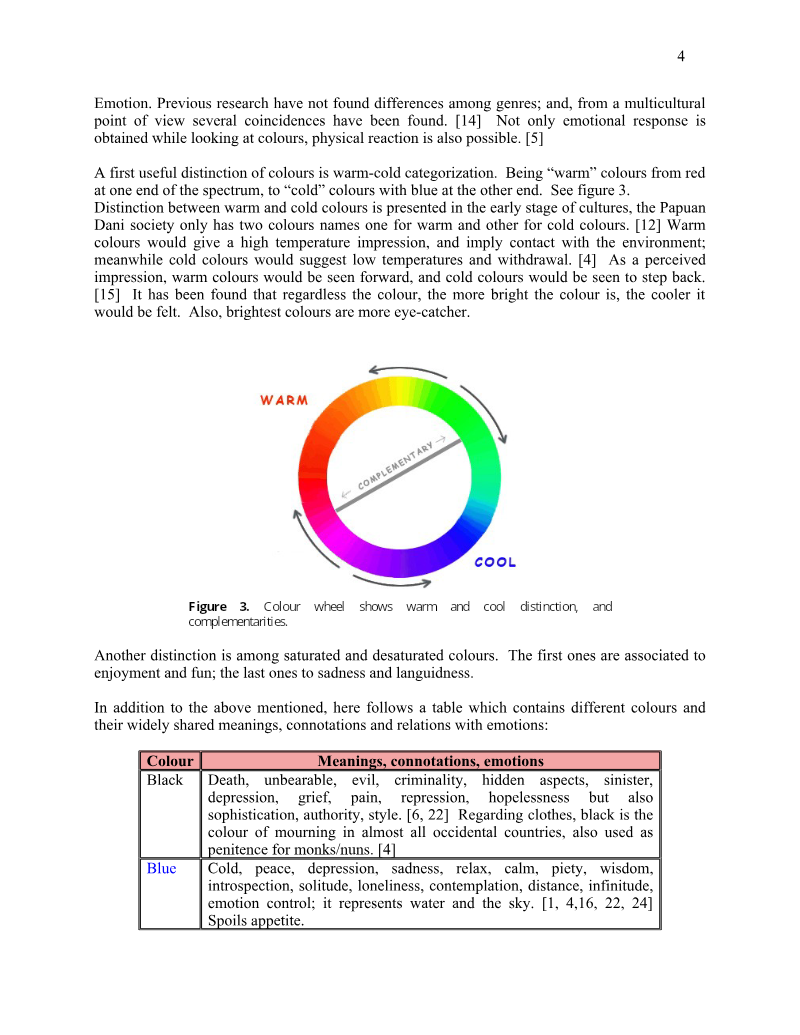
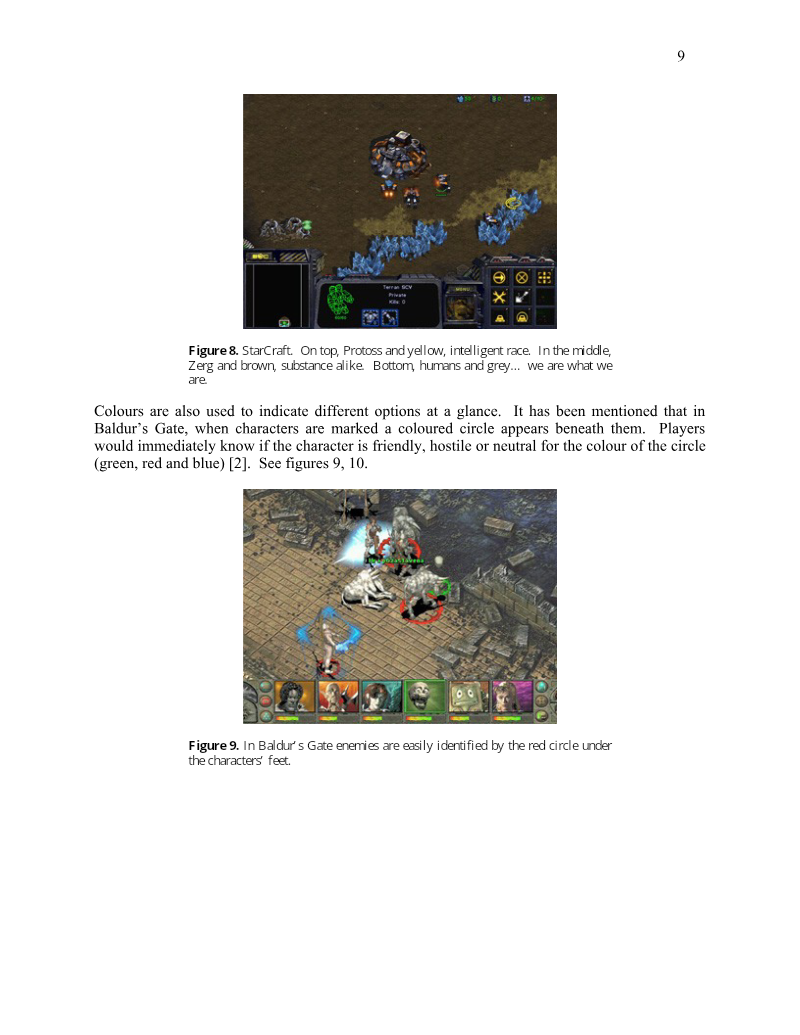
Zammitto's paper, presented at the DiGRA 2005 conference, examines how colour communicates meaning in digital games and argues that game designers should use colour deliberately rather than intuitively.
- Colour meaning in games rests on three overlapping layers, innate, personal, and cultural, so designers must account for both universal associations and regional differences such as red signifying weddings in China versus white in Western weddings.
- Colour-vision deficiency affects roughly one in twelve men, a significant concern because most players are male, making accessible palette choices important for designers.
- The paper argues that game designers should use colour deliberately rather than intuitively, applying its meanings to character costuming, interface elements, and environmental palettes.
Towards Emotionally Adapted Games Based on User Controlled Emotion Knobs
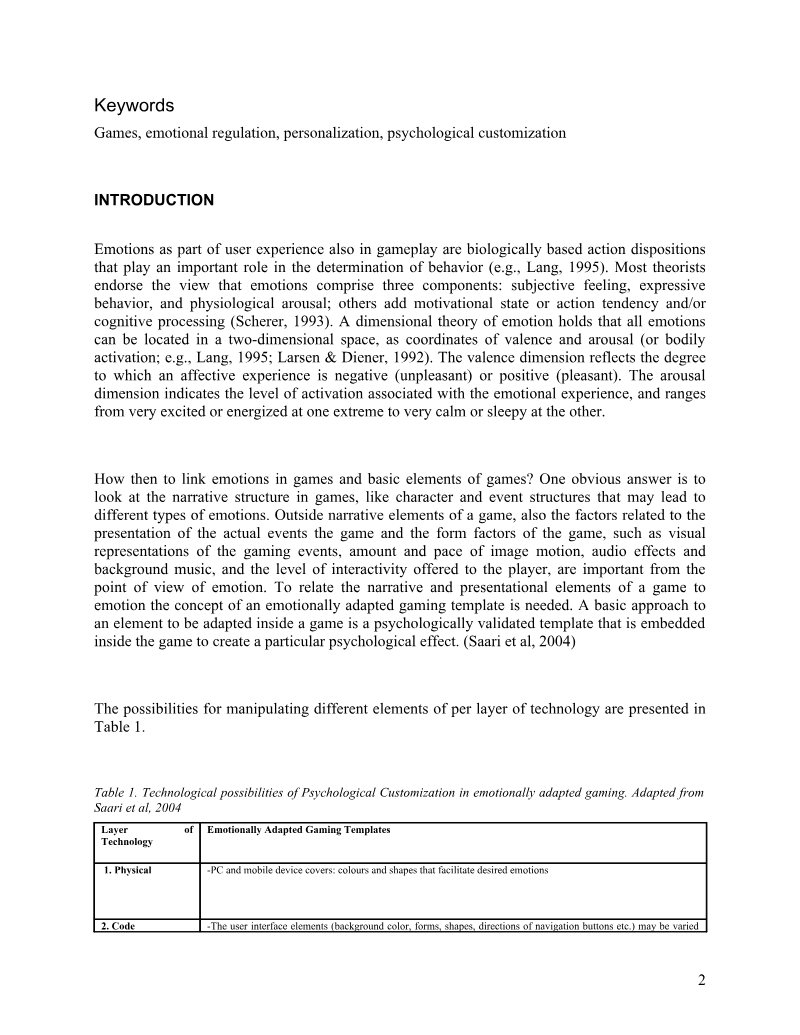
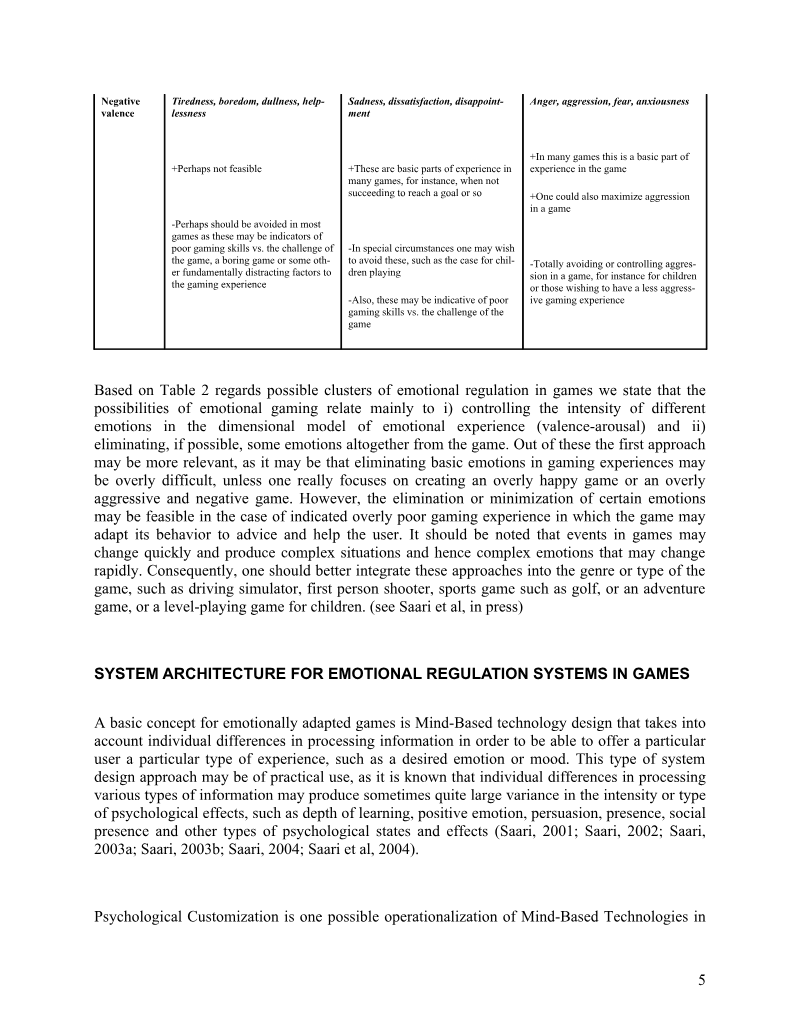
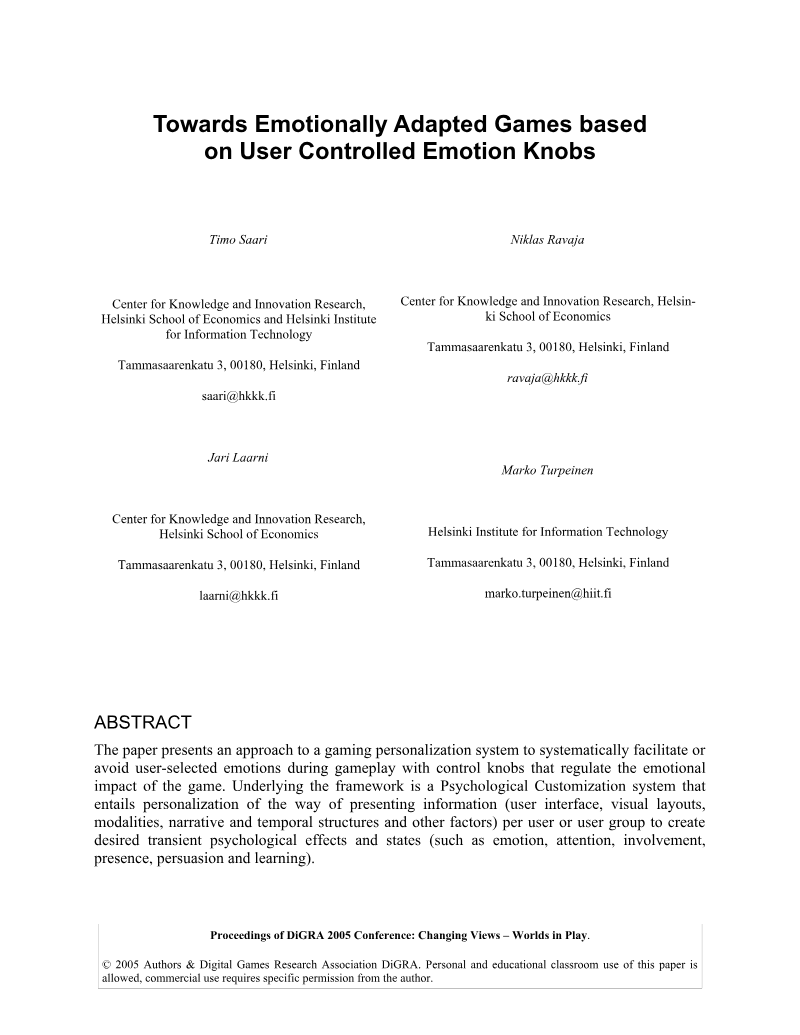
This paper proposes a conceptual framework for personalizing video games so that players can deliberately facilitate or avoid particular emotional states during play.
- The paper proposes an "emotion knob," a user-controlled mechanism that adjusts a game's emotional impact along the valence and arousal dimensions of the circumplex model of emotion, letting players deliberately facilitate or avoid particular emotional states.
- The framework is built on Psychological Customization, which tailors interface layout, modality, narrative structure, and pacing to produce transient effects such as emotion, attention, and presence.
- Transient narrative emotions such as fear, satisfaction, and aggression are seen as the most natural targets for manipulation, while eliminating basic emotions is judged less feasible than controlling their intensity.
Virtually Visual: The Effects of Visual Technologies on Online Identification
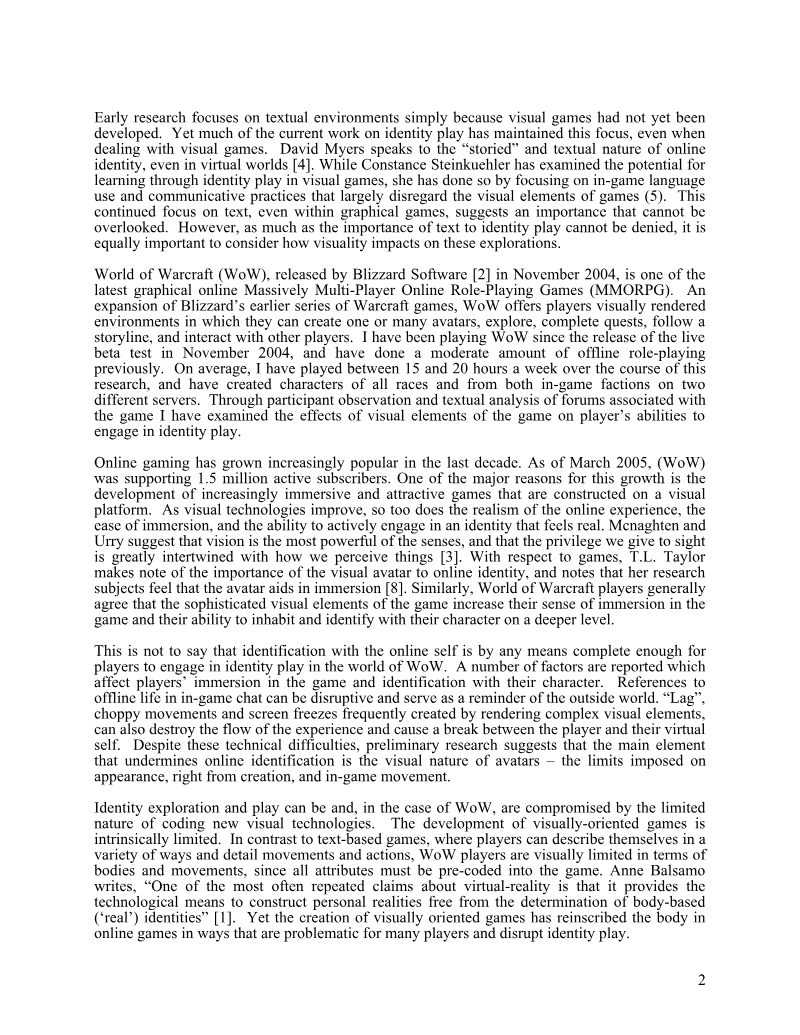
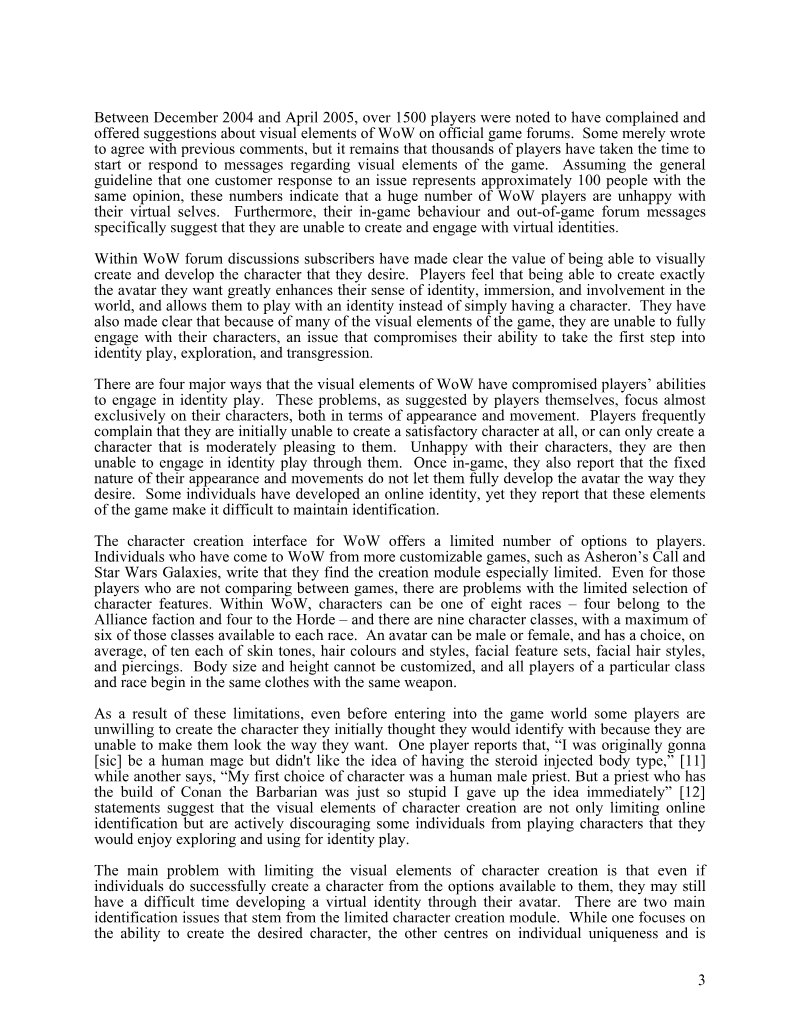
Jennifer Martin's study examines how the visual design of online games shapes players' ability to identify with their avatars, using World of Warcraft as its case.
- The paper argues that visual rendering aids immersion and online selfhood in graphical games, but that pre-coded limits on appearance, movement, and interaction can undermine the identity play that visuality enables.
- Its central claim is that the fluid, boundless identity exploration found in earlier text-based world research does not transfer cleanly to graphical environments, where bodies and actions must be built in advance.
- Using World of Warcraft as its case, the study combines 15 to 20 weekly hours of participant observation across multiple races, factions, and two servers with analysis of over 1,500 player forum complaints and suggestions from December 2004 to April 2005.
Towards the Unification of Intuitive and Formal Game Concepts: Applications to Computer Chess
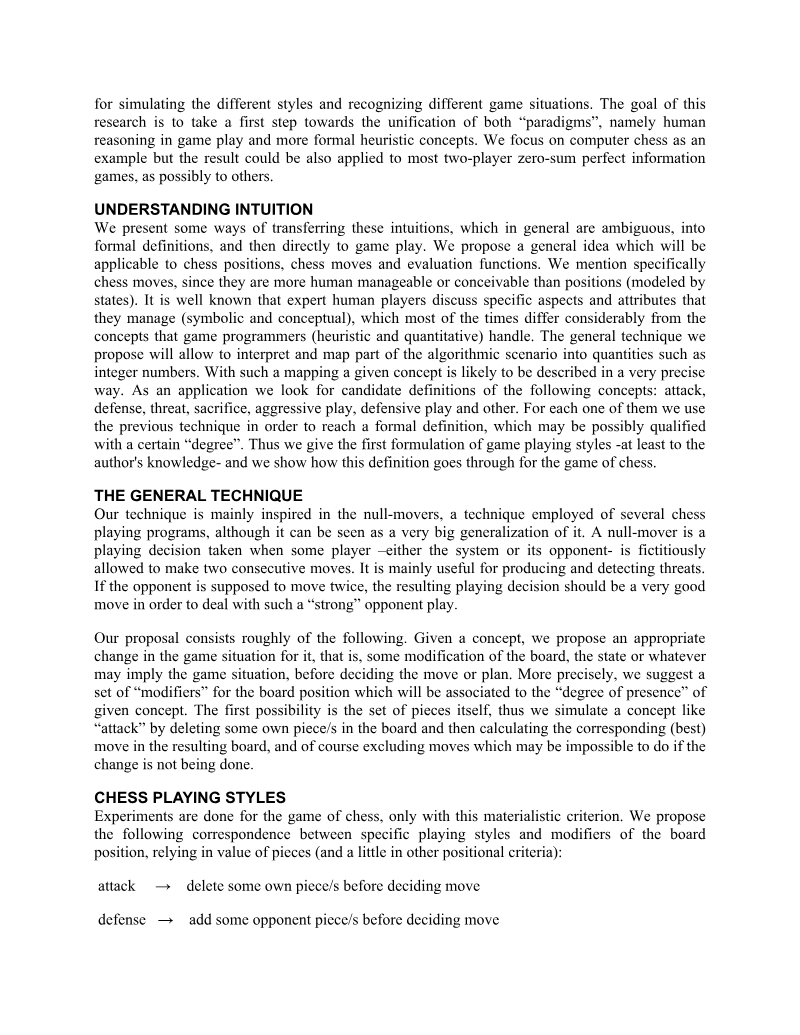
Arbiser's paper proposes a general technique for formalizing intuitive, human-oriented concepts in competitive board games, with computer chess as the primary testbed.
- The paper proposes formalizing intuitive concepts such as attack, defense, threat, sacrifice, and playing styles by modifying the board position before running a conventional move-selection algorithm, rather than relying only on heuristic evaluation.
- The approach generalizes the null-move technique into a family of 'modifiers' that add, delete, relocate, or change pieces, with each modification tied to a specific concept: deleting one's own piece simulates attack, adding an opponent piece simulates defense, and granting an extra move simulates threat.
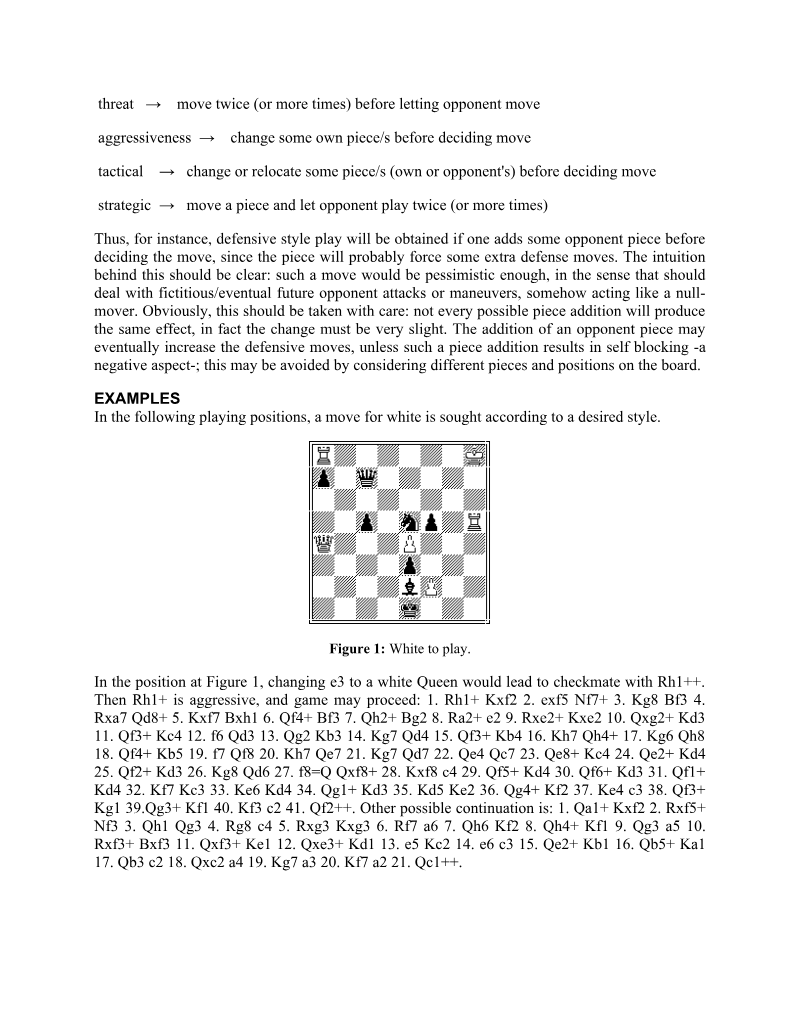
- Illustrative chess positions show a queen substituted for a pawn revealing a forced mating sequence, and a knight substitution guiding multi-move planning, though these are qualitative demonstrations only.
Game Engineering for a Multiprocessor Architecture
This paper argues that future game consoles and personal computers are likely to adopt symmetric multiprocessor architectures, and that the traditional sequential game loop must therefore be replaced with a concurrent design.
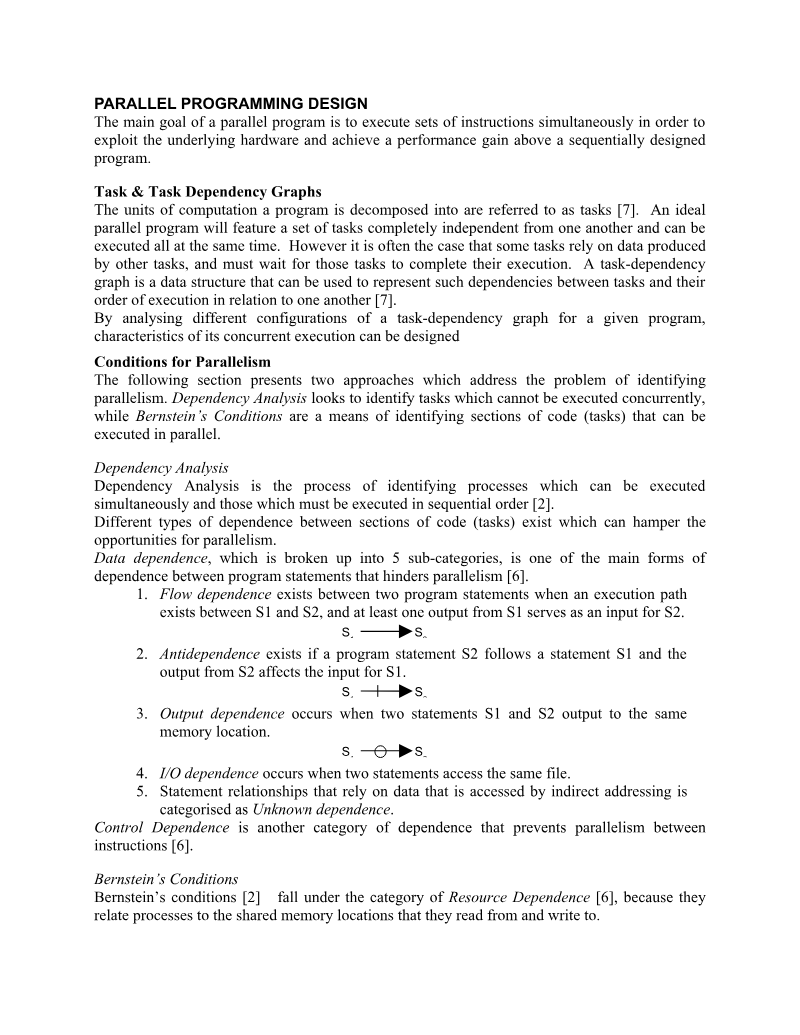
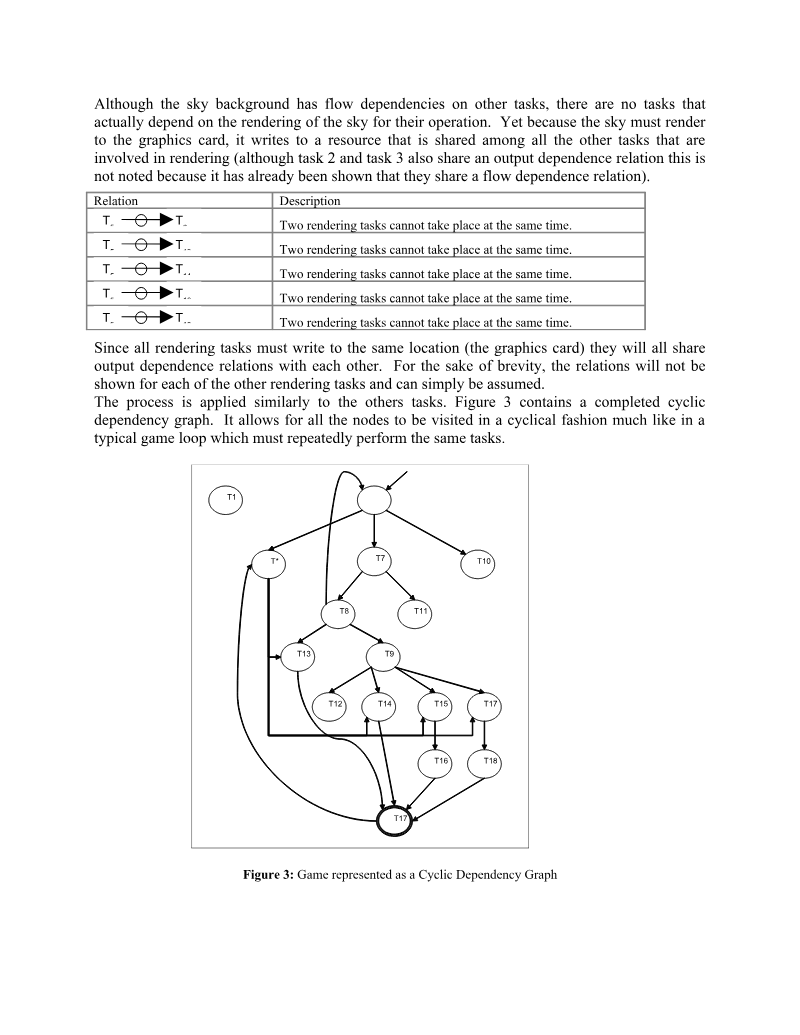
- The authors argue future consoles and PCs will likely adopt symmetric multiprocessor architectures, so the traditional sequential game loop should be replaced with a concurrent design organised as a cyclic task-dependency graph run by a scheduler across worker threads.
- The model was implemented in a Concurrent Game Programming Framework providing synchronisation primitives, thread creation objects, and a task manager, and was tested by decomposing a nineteen-task sequential loop from a 3D capture-the-flag car game.
- On a Hyper-Threaded Intel Pentium 4 at 2.80 GHz (two logical processors), the framework with one, two, or four workers produced no performance gain over the sequential loop, which the authors attribute to the model needing roughly three processors before benefits appear.
Designing Sound for a Pervasive Mobile Game
This paper examines how sound design can serve as a primary information channel in pervasive mobile games, using a working research prototype called The Songs of North as a case study.
- Sound is argued to be a primary information channel for pervasive mobile games, especially where players cannot look at a screen, such as walking through busy streets, and where small mobile displays limit visual feedback.
- The prototype The Songs of North, built for the Nokia N-Gage by the Hypermedia Laboratory at the University of Tampere, uses GSM cell positioning to track players acting as shamans, so that physical movement becomes a core game mechanic.
- Players monitor their spirits and game-world events through audio, with visual information available on demand, allowing gameplay to continue while players walk.
Tangible Interfaces for Pervasive Gaming
This paper, produced by researchers at the ISNM International School of New Media in Lübeck and presented at the DiGRA 2005 conference, proposes a low-cost framework for building tangible and pervasive games.
- The paper proposes a low-cost framework for tangible and pervasive games, arguing that embedding computing in physical environments can free players from screen-bound play, encourage face-to-face social interaction, and let them manipulate real-world objects.
- The technical core is the Phidgets USB sensor/actuator kit (motors, lamps, pressure, motion and RFID components) paired with Macromedia Flash for graphical interfaces.
- The authors built PhidgetLink, middleware that wraps Phidgets hardware in a Windows server and broadcasts sensor and switch events as XML over a local network so Flash ActionScript 2.0 applications can receive hardware input.
Gaming Mind, Gaming Body: The Mind/Body Split for a New Era
This paper, presented at the 2005 DiGRA conference, argues that playing first-person shooters (FPS) produces a double erasure of the body: the player's physical body recedes from awareness, and the virtual avatar also becomes invisible because the first-person perspective and fast pace keep attention fixed on actions rather…
- The paper argues that first-person shooter play produces a double erasure of the body: the player's physical body recedes from awareness, and the avatar also becomes invisible because attention stays fixed on actions rather than on the character performing them.
- Drawing on Drew Leder's phenomenology and Randy Martin's social theory, the author contends FPS play foregrounds only the mind, reinforcing a Cartesian mind/body split and naturalizing the body's disappearance from everyday social life.
- The argument rests on an interpretive, ethnographically informed reading of an 80-plus person overnight LAN gathering at Indiana University in November 2003, where players used Counter-Strike, Desert Combat, and Unreal Tournament, rather than on quantitative data or a survey sample.