1 free read left. Create a free account for unlimited reading + AI research.
Create free accountWhitepaper DiGRA
1 free read left. Create a free account for unlimited reading + AI research.
Create free accountWhitepaperDiGRA
Game programming relies mainly on heuristic and quantitative evaluation, while concepts such as attack, defense, threat, and sacrifice are typically ambiguous.
Arbiser's paper proposes a general technique for formalizing intuitive, human-oriented concepts in competitive board games, with computer chess as the primary testbed. Concepts such as attack, defense, threat, sacrifice, and playing styles (aggressive, defensive, tactical, strategic) are typically ambiguous in game programming, which relies mainly on heuristic and quantitative evaluation. The author's central thesis is that these intuitions can be made precise by modifying the board position before calling a conventional move-selection algorithm. The approach extends the null-move technique, in which a player is fictitiously allowed two consecutive moves, into a broader family of "modifiers" that add, delete, relocate, or change pieces, with each modification associated with a particular concept or style.
The paper maps specific modifications to specific styles: deleting one's own piece simulates attack, adding an opponent piece simulates defense, and granting an extra move simulates threat. Several chess positions are worked through as illustrations, including one where substituting a queen for a pawn reveals a forced mating sequence and another where a knight substitution guides multi-move planning. The author also argues that such evaluation should attach to moves rather than static positions, which better reflects how human players reason. The experiments are presented as qualitative demonstrations; the paper does not report large-scale statistical testing, sample sizes, or comparative performance results.
The proposed applications span machine learning, including combining multiple evaluation functions, education, including training novice players to avoid habits such as indiscriminate captures, and opponent modeling. The author acknowledges significant open problems: the technique may not be accurate or complete, complicated concepts like positional play lack clear modifiers, and the additional computation required for modifier tests must be controlled relative to search depth. The work is framed as an early step toward unifying human and algorithmic game reasoning, with its generality suggested for other perfect-information games such as Checkers, Othello, and Go.
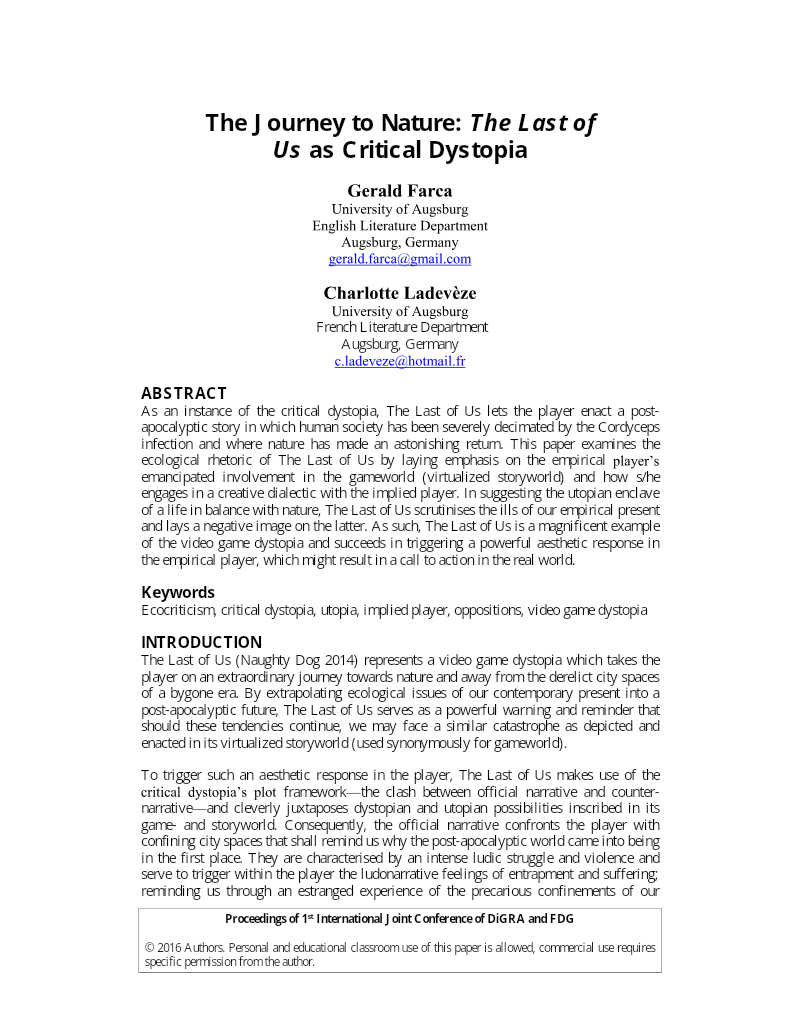
DiGRA · 2016
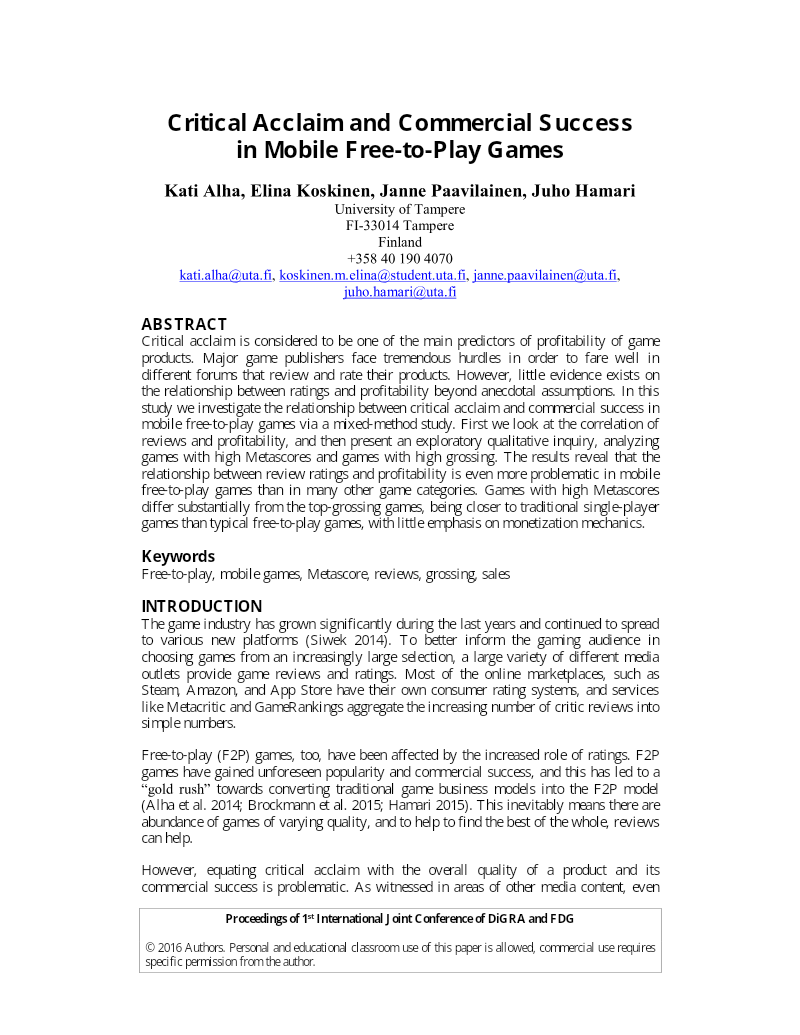
DiGRA · 2016
DiGRA · 2016



DiGRA · 2016



DiGRA · 2016



DiGRA · 2016



DiGRA · 2016



DiGRA · 2016



DiGRA · 2016

DiGRA · 2015



DiGRA · 2015



DiGRA · 2015
The Game Business · 2026