1 free read left. Create a free account for unlimited reading + AI research.
Create free accountWhitepaper DiGRA
1 free read left. Create a free account for unlimited reading + AI research.
Create free accountWhitepaperDiGRA
The paper argues that embedding computing in physical environments can free players from screen-bound play. It also encourages face-to-face interaction and lets players manipulate real-world objects.
This paper, produced by researchers at the ISNM International School of New Media in Lübeck and presented at the DiGRA 2005 conference, proposes a low-cost framework for building tangible and pervasive games. The central argument is that pervasive gaming, which embeds computing into everyday physical environments, can overcome limitations of conventional screen-bound games by freeing players from monitors, encouraging face-to-face social interaction, and letting them manipulate real-world objects through tangible user interfaces. The authors position their work within a 2004 Vienna workshop agenda on tangible interfaces for pervasive games and argue that a comprehensive framework for such games had been lacking.
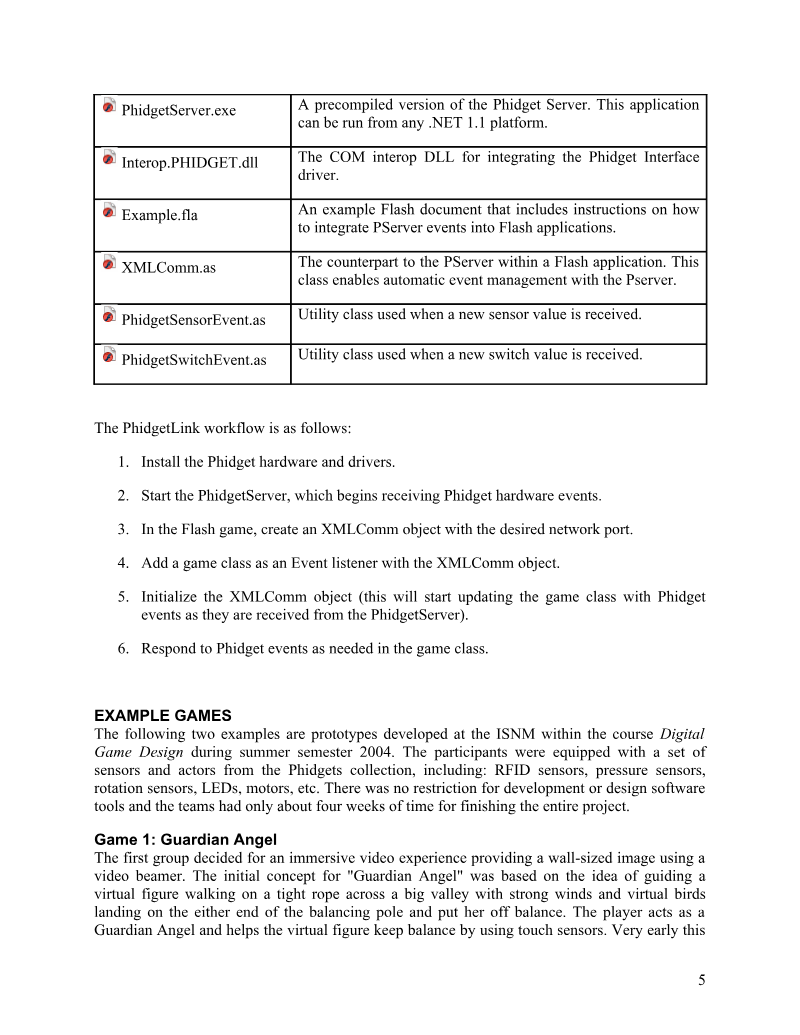
The technical contribution centers on the Phidgets hardware kit, which provides USB-connected sensors and actuators such as motors, lamps, pressure, motion, and RFID components, paired with Macromedia Flash for graphical interfaces. The authors built the PhidgetLink, a middleware package that wraps Phidgets hardware in a Windows server and broadcasts sensor and switch events as XML over a local network, allowing Flash applications to receive hardware input through ActionScript 2.0 event classes. The paper documents the workflow for integrating this system but offers no quantitative performance benchmarks, latency measurements, or formal user study data.
Two prototype games illustrate the approach: Guardian Angel, in which players control a projected tightrope walk with a physical rotation-sensor balancing pole, and Fruit Salad, a two-player board game using RFID tags, motorized rotating discs, and a shaker sensor. Both were developed within a single four-week student project during a summer 2004 Game Design course at the ISNM. Evidence of success is qualitative, drawn from an Open House event where visitors reportedly enjoyed the games and engaged in conversation, which the authors contrast favorably with conventional video games. The paper concludes that classroom development of tangible pervasive games is feasible.

DiGRA · 2016

DiGRA · 2016

DiGRA · 2016



DiGRA · 2016



DiGRA · 2016



DiGRA · 2016



DiGRA · 2016



DiGRA · 2016



DiGRA · 2016

DiGRA · 2015



DiGRA · 2015



DiGRA · 2015
Game Dev Unchained · 2023






Comments