
DiGRA
The Digital Games Research Association: the international association of academics and professionals who study digital games. Its Digital Library holds the proceedings of the DiGRA conferences since 2002.
Documents
"I Like the Idea of Killing But Not the Idea of Cruelty": How New Zealand Youth Negotiate the Pleasures of Simulated Violence
This paper, authored by Gareth Schott of the University of Waikato, examines how adolescent game players in New Zealand understand and articulate their engagement with violent content in interactive digital games.
- The study argues that academic and public language about game violence is too narrow, and that young players are routinely denied a voice in debates about games' effects, a critique aimed directly at experimental psychology's causal and desensitization models.
- Based on a two-year project funded by the Royal Society of New Zealand, the research followed 61 students (53 male, 8 female) in weekly game clubs across five schools in the Waikato and Bay of Plenty regions over a full school year, supplemented by focus groups and interviews.
- Players consistently distinguished between 'violence' and 'cruelty': they endorsed combat and killing in heroic or defensive contexts while rejecting gratuitous or sadistic content.

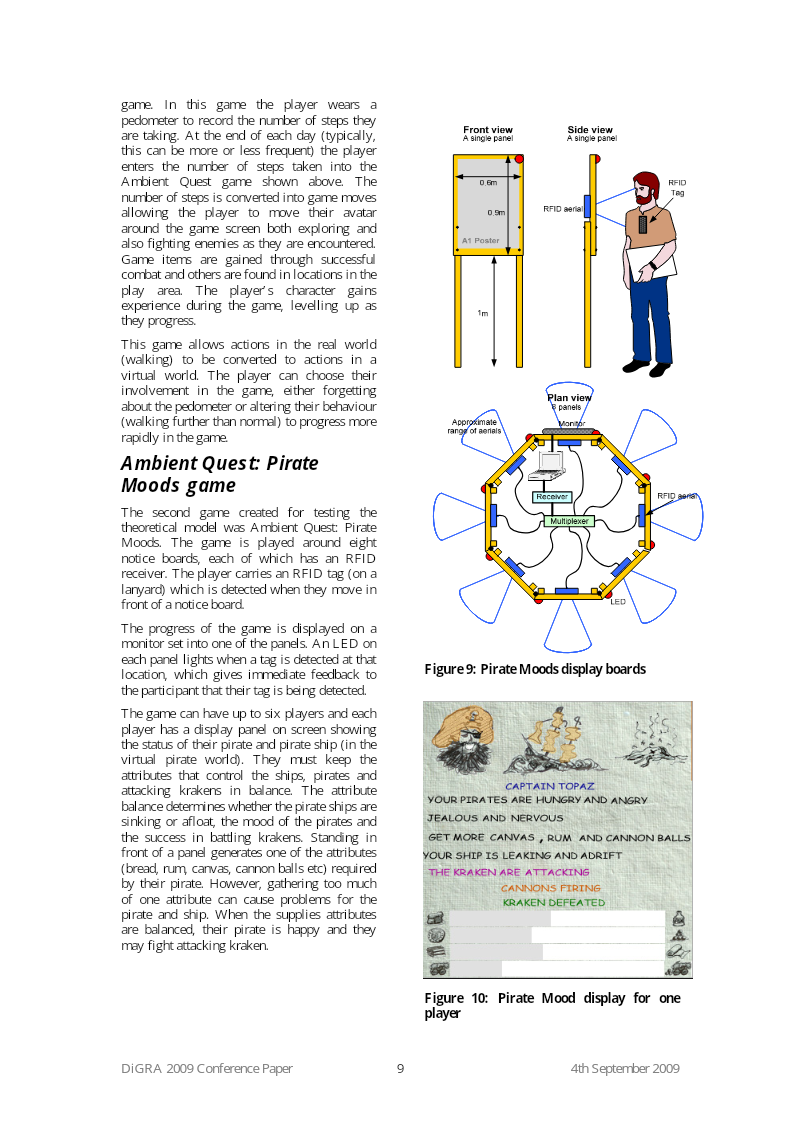
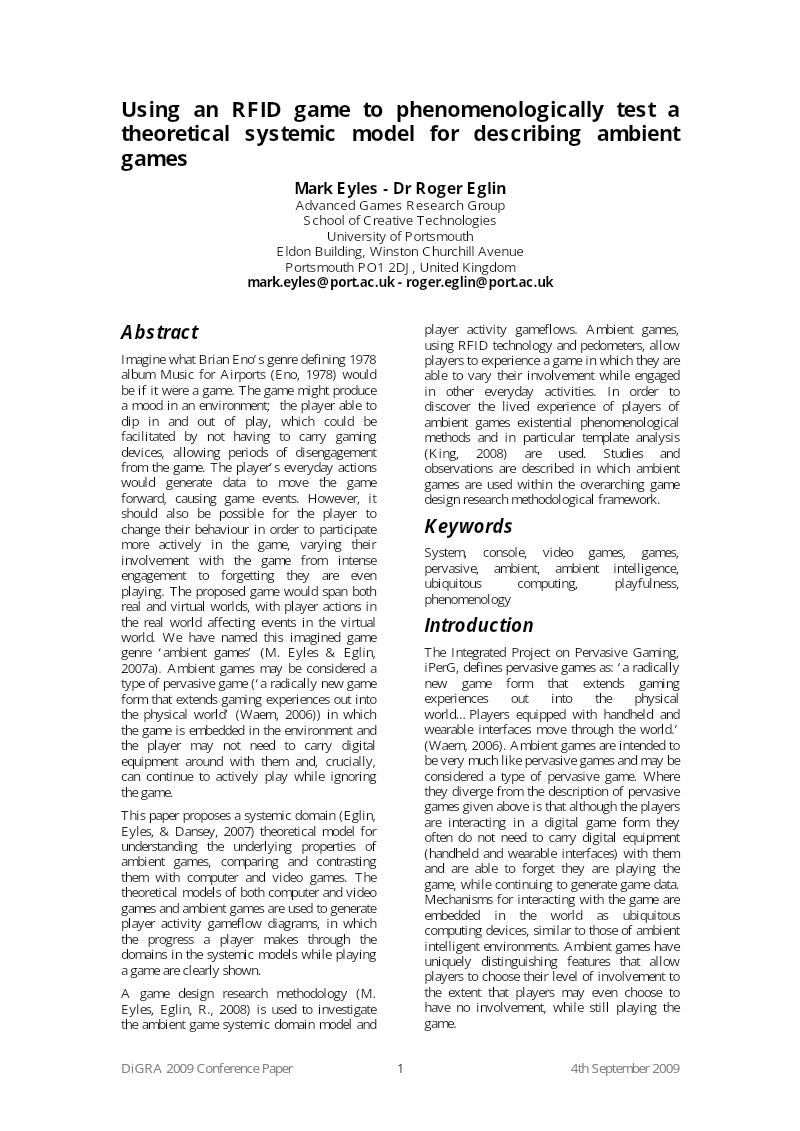
Using an RFID Game to Phenomenologically Test a Theoretical Systemic Model for Describing Ambient Games
This DiGRA 2009 paper proposes a systemic domain model for describing "ambient games," a form of pervasive play in which players can freely vary their level of engagement, ignore the game entirely while still generating data, and control their own pacing rather than responding to game-imposed prompts.
- The paper proposes a systemic domain model for "ambient games" built around three elements: engaging, generating data, and perceiving feedback, contrasted with traditional games that demand sustained attention.
- The central empirical test was a qualitative study of Ambient Quest: Pedometer, an RFID and pedometer-based game, analyzed in NVivo using themes derived from a theoretical gameflow model.
- Findings were drawn mainly from interviews and researcher notes with one intensively studied player over eight weeks, and the authors report the model is broadly supported.
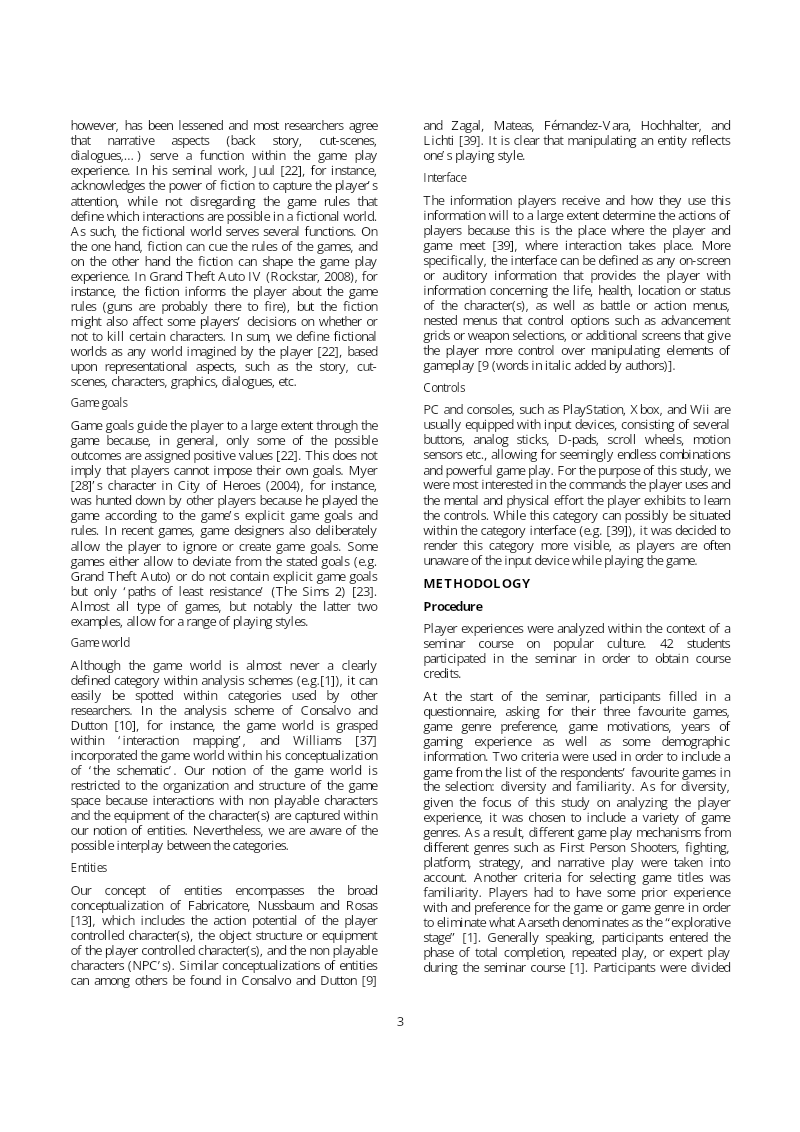
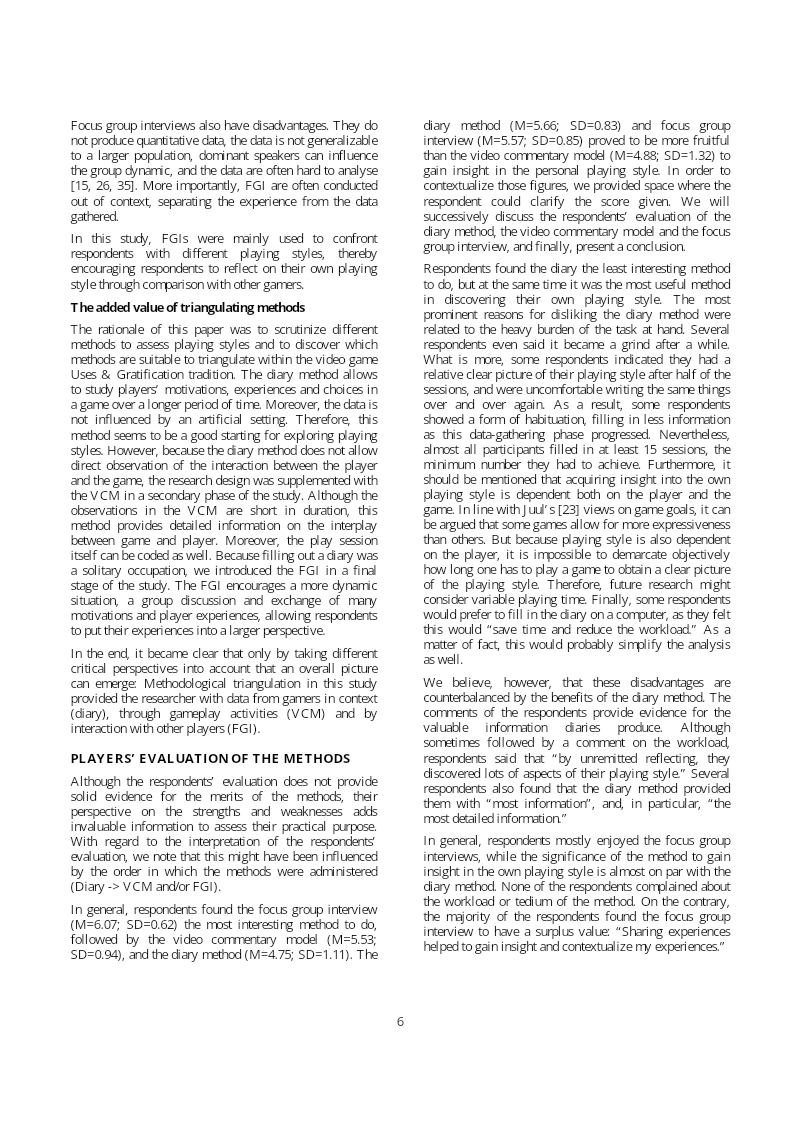
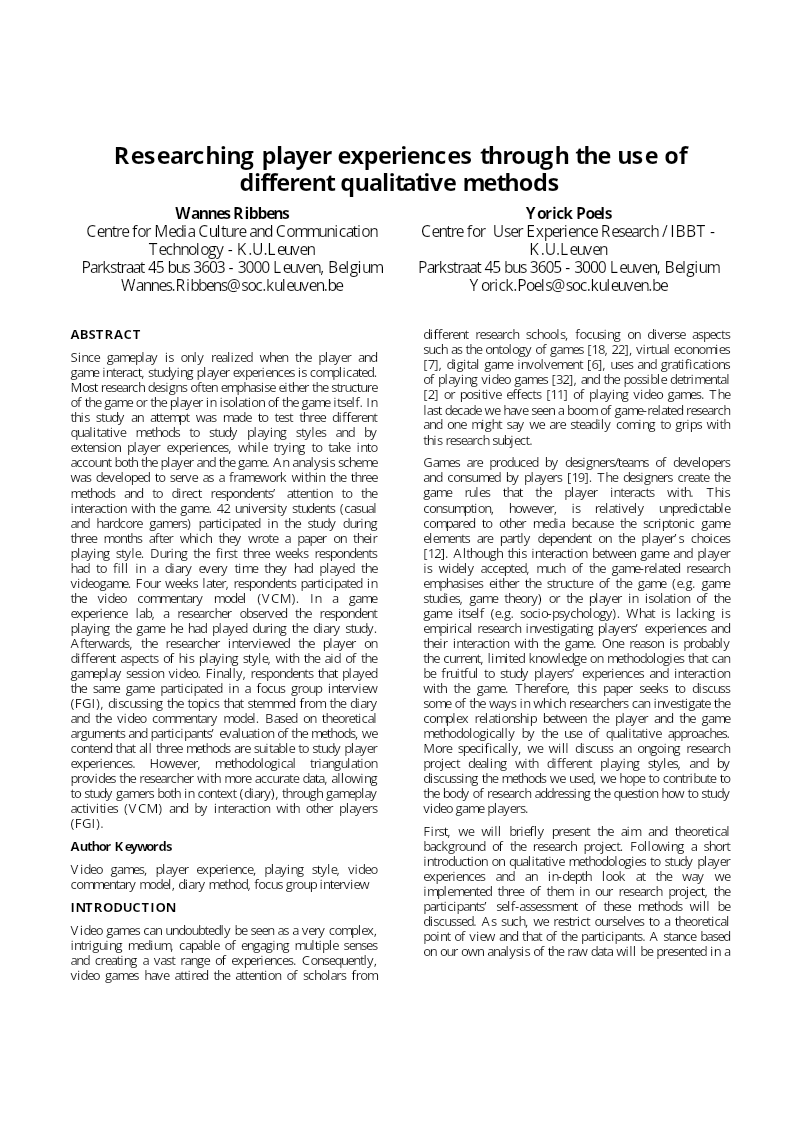
Researching Player Experiences Through the Use of Different Qualitative Methods
This study examines how three qualitative methods, a diary study, a video commentary model (VCM), and focus group interviews (FGIs), can be used to investigate player experiences and playing styles.
- The study argues that no single qualitative method suffices for studying player experience, and that methodological triangulation of diary studies, video commentary models (VCM), and focus group interviews (FGIs) yields a more accurate and complete picture of play than any one approach alone.
- Each method plays a distinct role: diaries capture motivations as they arise in everyday context, VCM reveals moment-to-moment player-game interaction, and focus groups surface the social interpretation of play.
- Participants rated focus group interviews as the most interesting method (M=6.07) and the diary as the most useful for understanding one's own playing style (M=5.66), while the VCM received the lowest and least consistent ratings (M=4.88, SD=1.32).
An Affordance Based Model for Gameplay
This paper presents a formal, affordance-based model for analyzing gameplay, arguing that the interactions players have with game worlds can be understood as a network of affordance relationships among objects.
- The paper proposes a formal, affordance-based model for analyzing gameplay, grounded in an analysis of 35 first-person games released between 1998 and 2008, and it is conceptual and taxonomic rather than empirical, offering no quantitative data.
- A core set of six gameplay affordances and two diegetic affordances is argued to account for all objects, including constraining movement, changing object or avatar parameters, altering the environment set, and supporting diegesis.
- Although first-person shooter worlds appear experientially varied, their underlying functional architecture is considerably simpler than their diegetic surface, with most environmental objects acting as controlled triggers enabling predefined, typically single-use interactions.
The New Gatekeepers: The Occupational Ideology of Game Journalism
Game journalism occupies a precarious position between the industry it covers and the readers it serves, and this study examines the occupational ideology shaping that relationship.
- Game journalism depends on advertising revenue and privileged access to games, creating a constant tension between reader loyalty and publisher influence, which the authors term the "carrot and the stick" dynamic.
- Publishers shape outlets through advertising spending and control over review copies and information, pressuring traditional journalistic independence.
- The games market is concentrated among a small number of publishers, and print outlets have struggled as they migrated online, with historical titles such as Computer & Video Games and Nintendo Power marking the field's roots.
Boys' Play in the Fourth Space: Freedom of Movement in a Tween Virtual World
Searle and Kafai's study examines how preadolescent boys, aged roughly 10 to 12, play in Whyville.net, a virtual world with about 1.5 million registered users.
- Virtual worlds give preadolescent boys a 'freedom of movement' similar to open-ended console play, but with a stronger emphasis on social interaction and avatar design, since players create their own paths rather than following a fixed storyline or end goal.
- The study draws on logfile data from 595 players on Whyville.net, a virtual world with about 1.5 million registered users, plus observations of an after-school gaming club of 21 tweens aged roughly 10 to 12.
- Chat, y-mail, and avatar-related activities were the most frequent boy pursuits, while projectile throwing and scamming were used to test masculine identities and social norms.
Ethically Notable Videogames: Moral Dilemmas and Gameplay
Ethically notable videogames are those that prompt players to reason and reflect on moral questions, typically through dilemmas that engage them both emotionally and intellectually.
- A game earns ethical notability when it makes players, not just their avatars, feel personally responsible for in-game choices and makes its ethical framework explicit enough to examine and challenge.
- Ultima IV's 'children's room' dilemma illustrates how a moral dilemma can provoke strong player investment, but playtester responses largely mirrored the game's built-in virtue-based character assignments rather than independent moral questioning.
- Ethical notability depends on consistent, discernible ethical frameworks and on dilemmas players genuinely experience as moral rather than as ordinary difficult gameplay decisions.
Remembering How You Died: Memory, Death and Temporality in Videogames
This paper examines how death and endings function in videogames, arguing that the repeated dying and resurrection of a player's avatar reflects a distinct and serious conception of mortality rather than a trivialisation of life.
- The paper argues that the repeated dying and resurrection of avatars in videogames reflects a serious conception of mortality rather than a trivialisation of life, challenging criticism from Gonzalo Frasca that reversible death cheapens life's sacred value.
- The author contends that Western narrative theory, shaped by Aristotelian plot structure and linear notions of telos, struggles to account for the 'dying and undying' logic of games.
- Drawing on Deleuze's concepts of immanence and virtuality, the paper proposes that in-game death is both immanent and imminent, with each playthrough actualising possible events rather than severing from a fixed past.
Kingdom Hearts, Territoriality and Flow
The analysis examines the Kingdom Hearts franchise, a collaboration between Square-Enix, which develops the core games and characters, and Disney, which licenses many of the worlds the series draws on.
- The report argues the Kingdom Hearts franchise, a Square-Enix and Disney collaboration, thematizes globalization, transnationalism, and cultural flow through its world-hopping structure and questions of intervention versus non-interference.
- The series uses the Heartless threat, the sealing of worlds, and Disney character interventions to dramatize cultural imperialism and global capitalism, which can be read as critiques of homogenization and forced modernization, though the author cautions such readings are overly simplistic.
- Mobility between worlds via dark corridors, Gummi Ships, and commodity-based trade routes forms the series' cosmological and political system, which the report says closely mirrors capitalist connectivity and Japan's own modernization.
Through the Looking Glass: Weavings between the Magic Circle and Immersive Processes in Video Games
The paper contends that the "magic circle," the widely used concept from Huizinga and Salen and Zimmerman for describing the boundary between play and everyday life, should be understood as a graded cognitive mediation structure rather than a rigid barrier.
- The 'magic circle' boundary between play and everyday life should be understood as a graded cognitive mediation structure rather than a rigid barrier, with the boundary solidifying as immersion deepens.
- The authors use Juul's two axes (rules and fiction versus players' social practices) to argue that rules and fiction compete asymmetrically for player attention during play.
- Immersion is modeled as a staged process tied to Parasuraman's three attentional functions (selection, vigilance, and control), alternating between operational immersion, where rules drive selective attention, and narrative immersion, where fiction sustains it.
Around Sigeru Miyamoto: Enactment of "Creator" on Computer Games
This paper examines the work of Shigeru Miyamoto through the lens of the "duality of creators," the idea that computer games are authored jointly by developers, who build the program and rules, and by players, whose engagement completes the work.
- Miyamoto's design rests on a 'duality of creators': developers build the program and rules, while players complete the work through their engagement, and his designs aimed to make players feel creative while subtly shaping how they play.
- Miyamoto introduced challenges in staged progression (remembering, then practicing, then applying a mechanic) and favored rules players could absorb without conscious effort rather than treating player freedom as unqualified good.
- Miyamoto's stated preference for 'golf-type' games with clear, immediately understood goals over 'baseball-type' games with complex rule sets is presented as a deliberate choice that shapes how play becomes internalized.
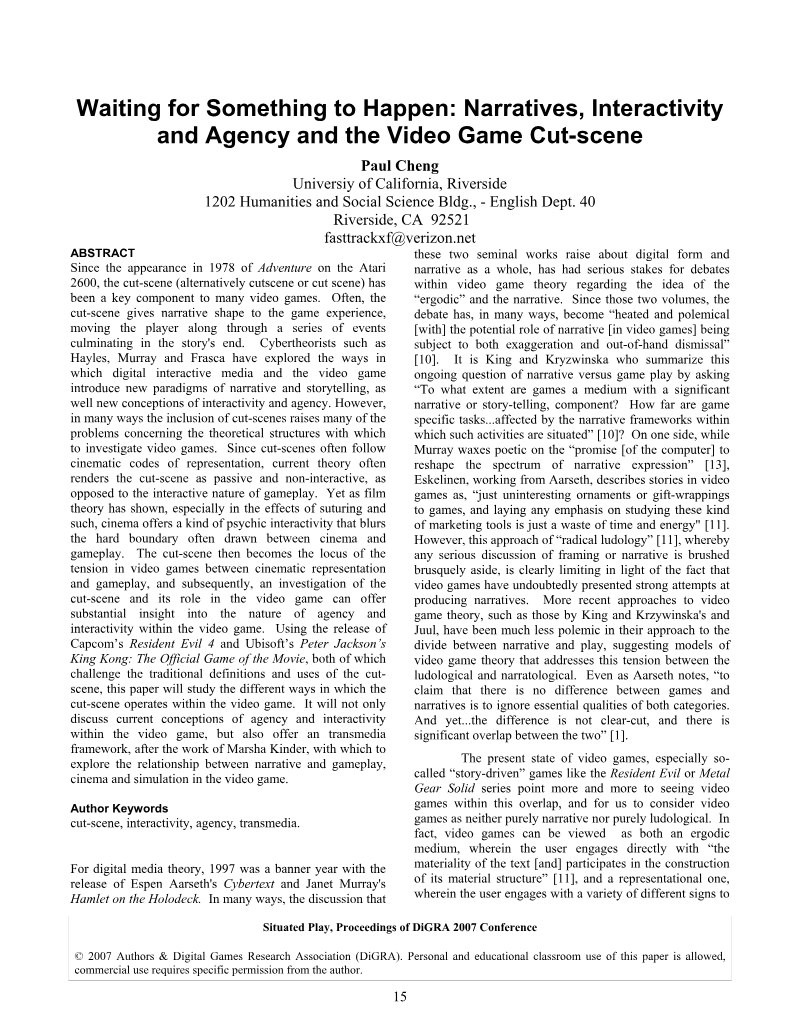
Waiting for Something to Happen: Narratives, Interactivity and Agency and the Video Game Cut-Scene
Cheng's paper treats the video game cut-scene as a contested site where narrative and gameplay converge, challenging the "radical ludology" position that cut-scenes are merely passive interruptions of play.
- The paper argues that interactivity and agency must be distinguished: a cut-scene can involve minimal player input yet still generate a strong sense of agency.
- Using Resident Evil 4, the author shows how quick-time event sequences create "representational agency," the feeling of being the protagonist of an action film, even when the underlying interactivity is tightly constrained.
- The paper challenges the "radical ludology" view that cut-scenes are merely passive interruptions of play, framing them instead as a contested site where narrative and gameplay converge.