1 free read left. Create a free account for unlimited reading + AI research.
Create free accountWhitepaper DiGRA
1 free read left. Create a free account for unlimited reading + AI research.
Create free accountWhitepaperDiGRA
Ambient games are a form of pervasive play in which players can vary how engaged they are, ignore the game, and set their own pacing.
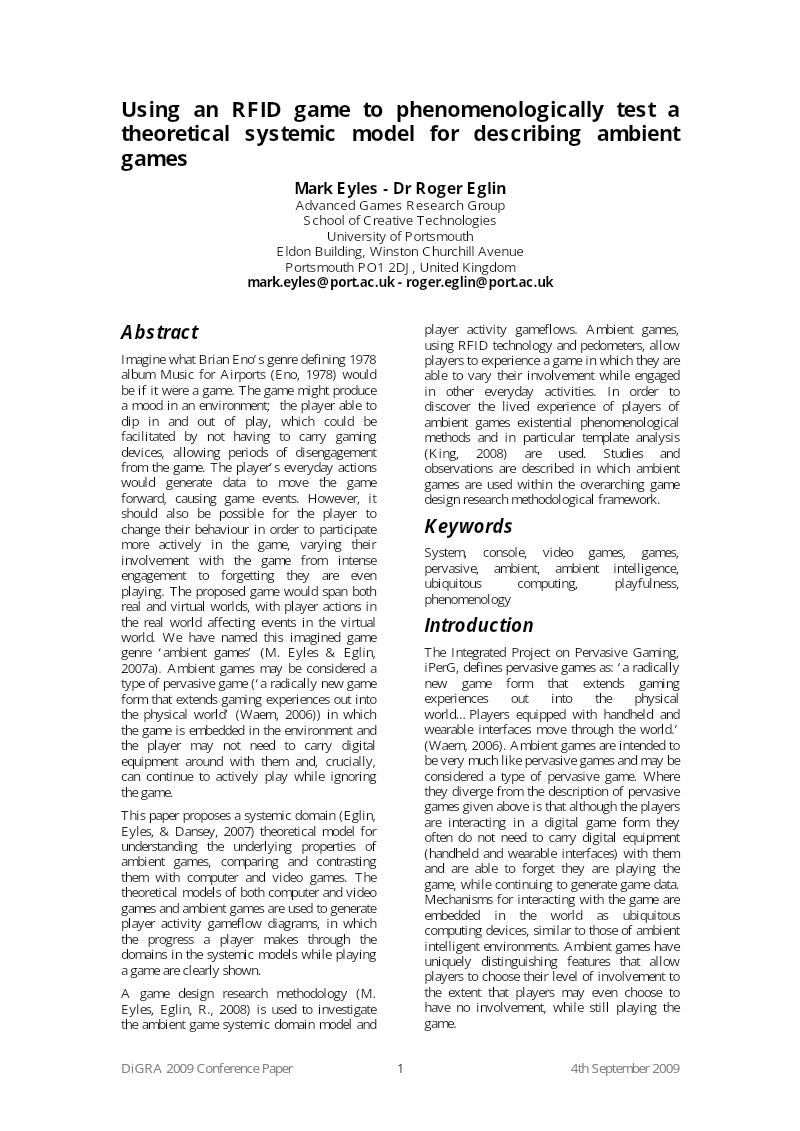
This DiGRA 2009 paper proposes a systemic domain model for describing "ambient games," a form of pervasive play in which players can freely vary their level of engagement, ignore the game entirely while still generating data, and control their own pacing rather than responding to game-imposed prompts. The authors contrast this with traditional console and computer games that demand sustained attention, and they argue that a model built around engaging, generating data, and perceiving feedback better captures how ambient play works. The work is framed as design research, iterating through prototyping and evaluation to test the theory experimentally.
The central empirical contribution is a qualitative study of Ambient Quest: Pedometer, an RFID and pedometer-based game analyzed in NVivo using node themes derived from a theoretical gameflow model. Drawing mainly on interviews and researcher notes from one intensively studied player over eight weeks, the authors report that the model is broadly supported. Emergent themes include the balance of complexity, cheating behaviors such as shaking pedometers or modifying reset buttons, the burden of carrying equipment, and the degree of player control over play. The methodology shifted from quantitative questionnaires, which produced too few responses, to a template-analysis phenomenological approach.
The authors are explicit about the limits of these findings. Results derive from a single researcher-made game and a very small sample, and the study also encountered ethical constraints around covertly observing players in public, which led to testing in a restricted basement area. The conclusion is that the model is useful as a descriptive framework but requires validation across more players and additional ambient games before its claims can be generalized. The paper's scope is therefore best understood as an early, exploratory test of ambient game theory within the RFID and pedometer design space.
DiGRA · 2020
DiGRA · 2020
DiGRA · 2020
DiGRA · 2020
DiGRA · 2020
DiGRA · 2020
DiGRA · 2020
DiGRA · 2020
DiGRA · 2020
DiGRA · 2020
DiGRA · 2020
DiGRA · 2020
Two & a Half Gamers · 2026