
DiGRA
The Digital Games Research Association: the international association of academics and professionals who study digital games. Its Digital Library holds the proceedings of the DiGRA conferences since 2002.
Documents
Fake Rules, Real Fiction: Professional Wrestling and Videogames
"Fake Rules, Real Fiction" argues that professional wrestling, having shifted from a legitimate contest to a scripted form of "sport entertainment," is best understood through a narrative framework that combines Chatman's story and discourse theory with game studies concepts such as scripted narrative and alterbiography.
- The report's central thesis is that wrestlers are active producers of meaning within pre-scripted gimmicks, so match quality depends on their skill in making the scripted narrative intelligible to audiences.
- Professional wrestling shifted from a legitimate contest to scripted 'sport entertainment', with fixing and the kayfabe illusion becoming established during the 1908 to 1911 Hackenschmidt–Gotch matches.
- The authors argue that kayfabe functions as serialized fiction operating at a 1:1 ratio between real and story time, blurring the boundary between performer and character.
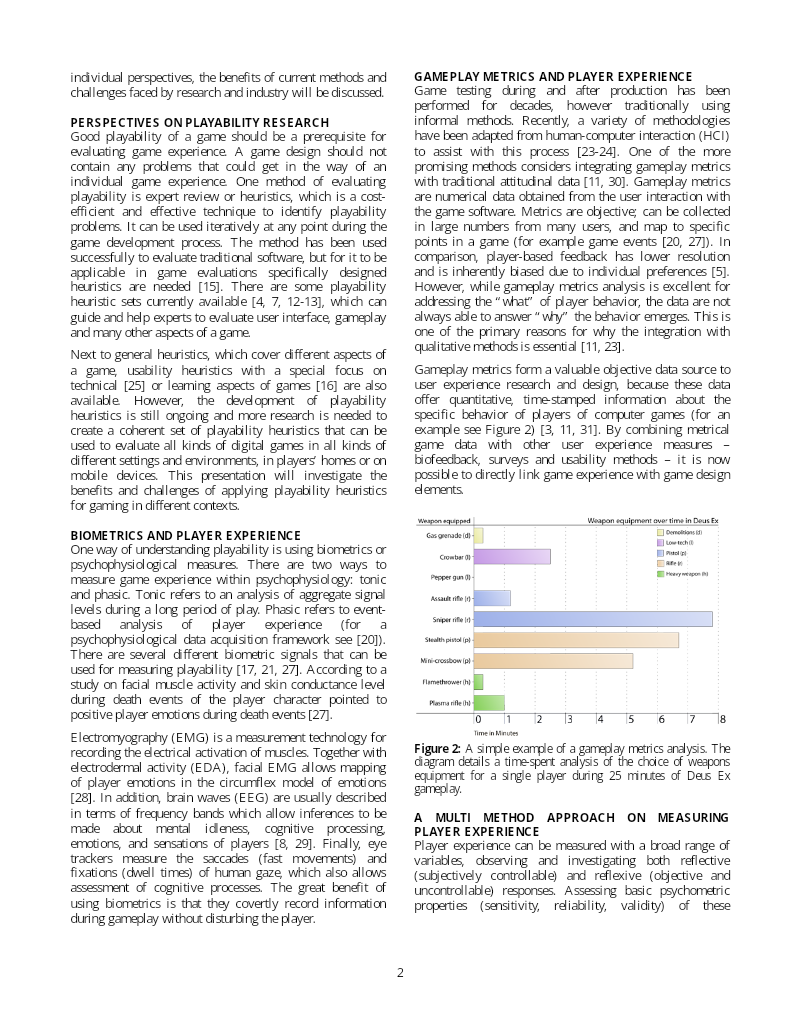
Playability and Player Experience Research
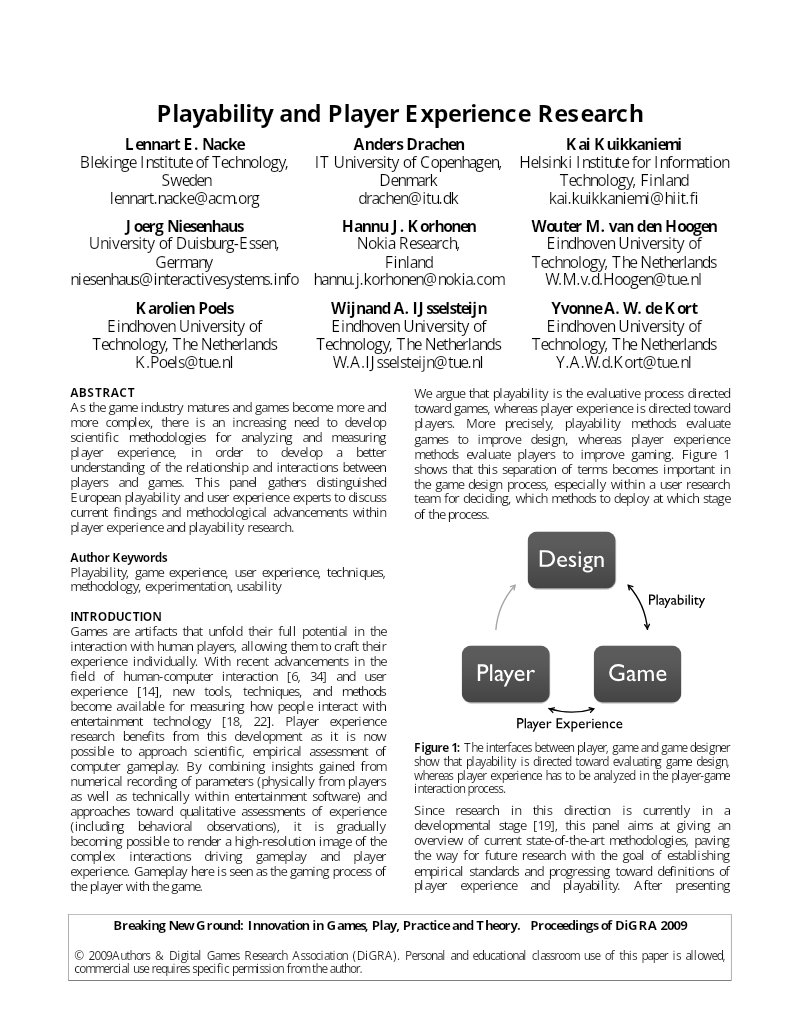
This panel paper, presented at DiGRA 2009, argues that playability and player experience are distinct but complementary research domains: playability evaluates the game itself to improve design, while player experience evaluates players to improve gaming.
- Playability and player experience are presented as distinct but complementary research domains: playability evaluates the game itself to improve design, while player experience evaluates players to improve gaming.
- The paper frames playability and player experience research as a developmental stage rather than a settled discipline, aiming to move the field toward empirical standards and clearer definitions.
- Expert review and heuristic evaluation are cost-effective, iterative methods for finding playability problems, but general usability heuristics must be adapted with game-specific sets.
Understanding 21st Century's Mobile Device-Based Games Within Boundaries
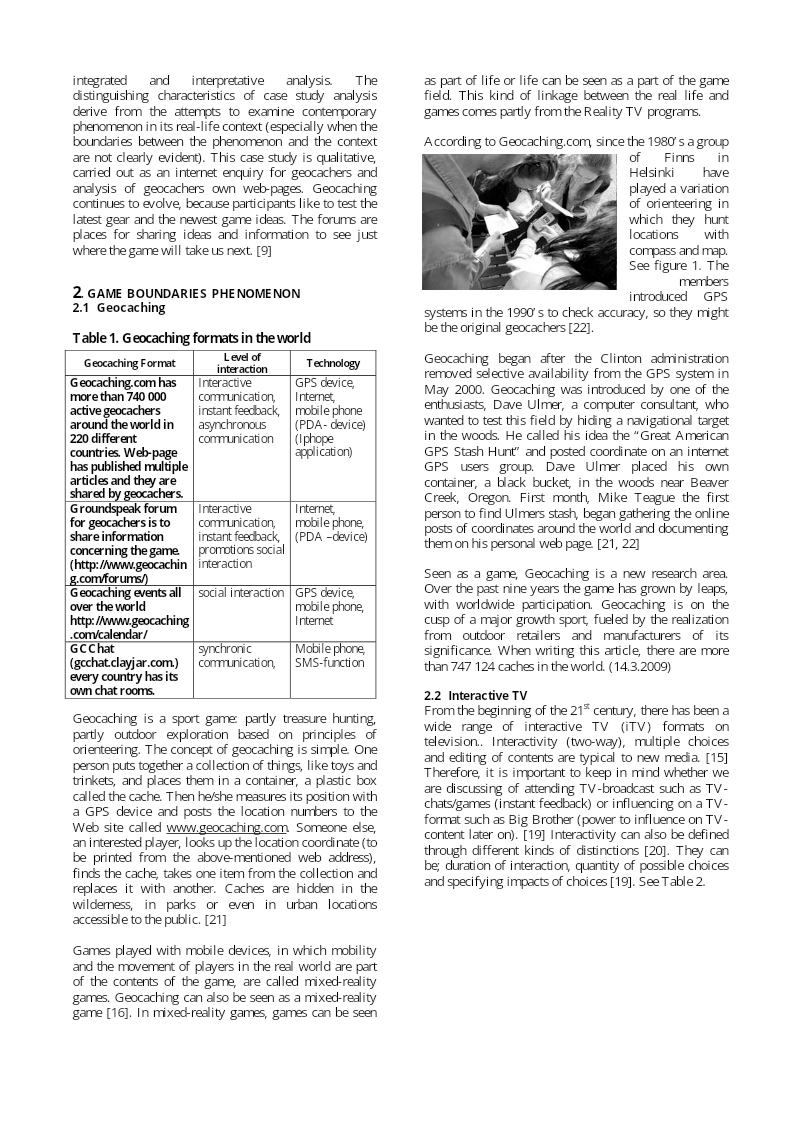
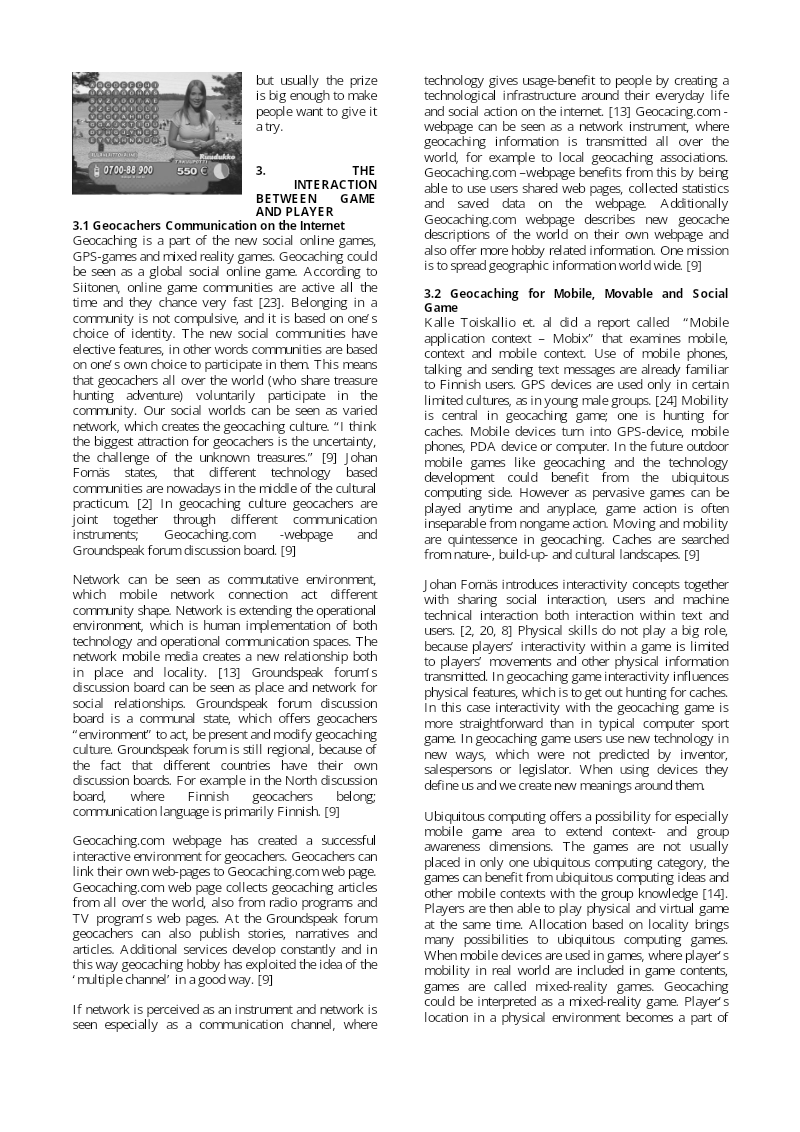
This paper examines two mobile device-based game forms from the 21st century that have achieved strong user popularity yet remain peripheral to mainstream game research: geocaching and SMS-to-TV human-hosted interactive television games.
- Geocaching is treated as a global, socially organized mixed-reality game, with over 740,000 active participants and more than 747,000 caches worldwide by early 2009, supported by a central web platform and regional forums.
- The paper argues that marginal mobile game forms such as geocaching and SMS-to-TV interactive games deserve academic attention because their popularity and boundary-blurring characteristics challenge traditional game studies.
- The study uses a qualitative case-study design combining interviews with geocachers, analysis of geocaching websites and forums, and content analysis of roughly 35 hours of interactive TV broadcasts from 2004 to 2009.
Playing Your Network: Gaming in Social Network Sites
Luca Rossi's paper examines gaming within social network sites, focusing on Facebook as the dominant platform in most Western countries, and uses the UK-based company Playfish as its central case.
- Games on Facebook are built around existing social relationships, shifting gaming from a standalone or shared-passion activity toward one grounded in friendships, a distinct branch of online gaming the paper calls SNS gaming.
- The paper uses UK-based Playfish as its central case, observing a catalogue of about eight titles with over eleven million monthly players, and draws on qualitative, exploratory methods plus preliminary player interviews.
- Skill and knowledge games such as Who Has the Biggest Brain? and Geo Challenge rank players on friend, country, and global ladders, and players use these rankings to assert status within their social circles.
Using Microgenetic Methods to Investigate Problem Solving in Video Games
This paper presents formative research for the Possible Worlds project, a five-year initiative developing middle school life science game modules that use Nintendo DS mini-games and web activities.
- The paper is methodological: it shows how microgenetic methods, which track small-scale, repeated observations of change over time, can be adapted to study how young players solve problems and revise strategies during video game play.
- The study observed 22 students aged 9 to 12 playing commercial puzzle games, primarily World of Goo, with sessions video- and audio-recorded during think-aloud protocols and researcher probing questions about goals, plans, and interpretations of feedback.
- The coding framework works at four levels, from 20-second action clips to one-minute strategy descriptions and whole-level learning summaries, and is designed to map individual learning trajectories against Kuhn and Pease's model of strategic inquiry competence.

Peer Puppeteers: Alternate Reality Gaming in Primary School Settings
Peer Puppeteers examines an alternate reality game (ARG) designed by thirty Year 6 pupils at a South London primary school for thirty Year 5 pupils, using Philip Ridley's novel The Mighty Fizz Chilla as the narrative foundation.
- An alternate reality game (ARG) was designed by thirty Year 6 pupils at a South London primary school for thirty Year 5 pupils, using Philip Ridley's novel The Mighty Fizz Chilla as its narrative foundation.
- The study proposes that children can act as game-makers, storytellers, and covert "puppeteers" who distribute narrative clues through everyday channels such as websites, message boards, films, phone calls, and physical artifacts.
- The authors offer a design framework called the "web of clues" along with a detailed case study of one team's character creation.
Effects of Sensory Immersion on Behavioural Indicators of Player Experience: Movement Synchrony and Controller Pressure
This study examines whether sensory immersion in a racing game shapes behavioural indicators of player experience, specifically controller tilt synchrony with in-game turns and the force applied to gamepad buttons.
- Louder sound (80 dBA versus 60 dBA) produced the strongest effects in the study, significantly increasing self-reported presence, arousal, and dominance as well as the pressure players applied to controller buttons.
- Screen size (20-inch versus 42-inch, corresponding to 14.2° versus 27.5° field of view) affected only self-reported presence, with the larger display producing higher presence ratings.
- Interface pressure on gamepad buttons is proposed as a promising real-time behavioural indicator of player arousal and presence.
"I'm Overburdened!": An Empirical Study of the Player, the Avatar, and the Gameworld
Jørgensen's study investigates how players understand their relationship to controllable figures within video games, challenging the adequacy of existing terminology such as "avatar" and "character" to describe that relationship.
- The study is based on interviews with 22 respondents (17 individual interviews and one five-person group interview) across four games: Crysis, Diablo 2, Command & Conquer 3: Tiberium Wars, and The Sims 2.
- The central distinction it draws is between a direct, one-to-one relationship between player and figure and an indirect, mediated one, which it argues existing terms like 'avatar' and 'character' fail to capture.
- Only Crysis's first-person perspective consistently led players to merge with their figure, experiencing player and character viewpoints as unified and identifying most strongly with the avatar.
A Study on New Gameplay Based on Brain-Computer Interface
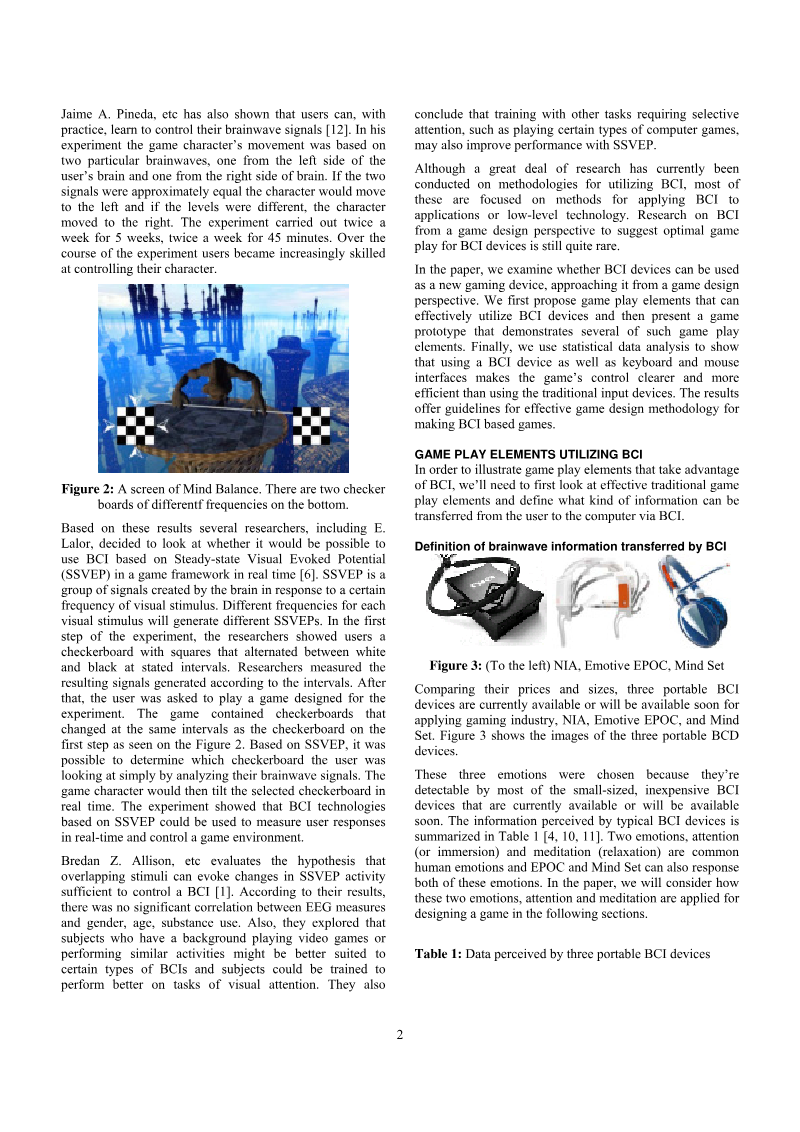
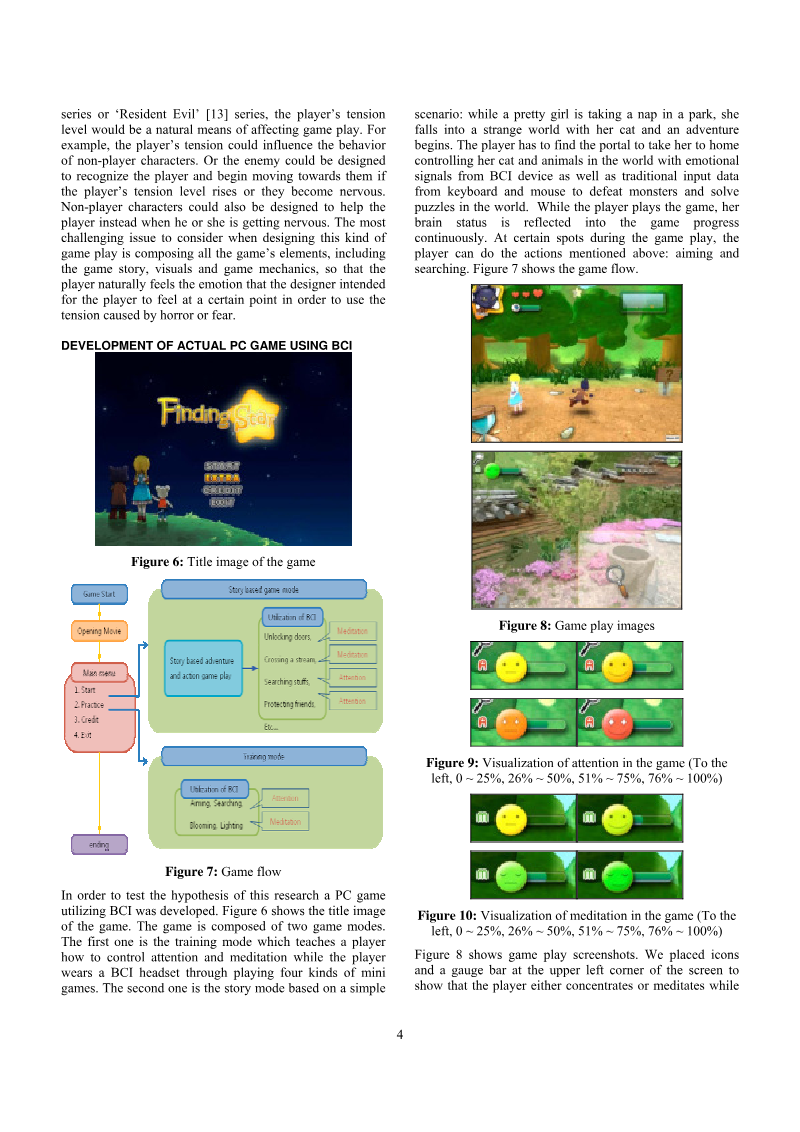
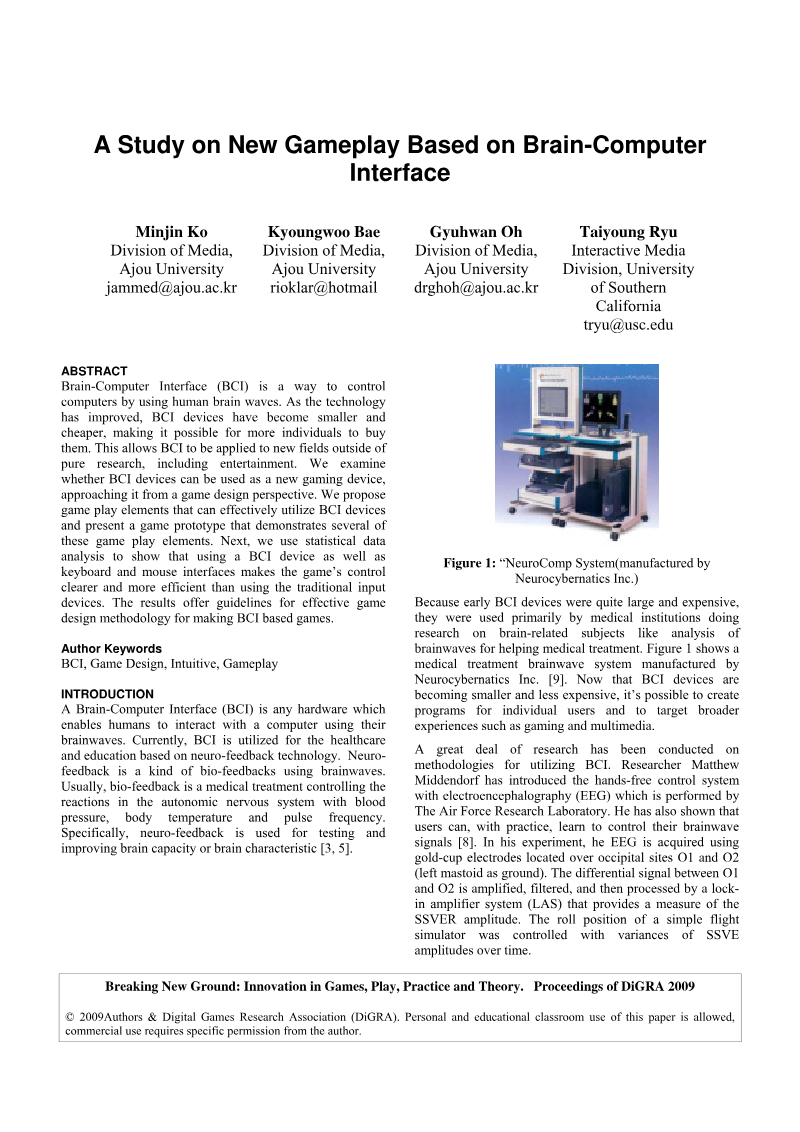
This study examines whether brain-computer interface (BCI) devices can serve as a viable new gaming input, approaching the question from a game design perspective rather than purely technical or medical application.
- The study treats brain-computer interface (BCI) input as a game design question rather than a purely technical or medical one, noting that cheaper, smaller consumer BCI hardware has opened it to entertainment while design-oriented BCI game research remains scarce.
- The prototype maps two brainwave-derived states onto game mechanics: attention reduces crosshair jitter for steadier aiming, while meditation speeds character recovery and aids searching for hidden objects.
- In a comparison of two versions of the same game with 20 participants split evenly, the BCI version scored higher on convenience, fun, and intuitiveness (149 total vs. 102; means 14.9 vs. 10.2), a difference reported as statistically significant (t ≈ 5.605 at the 0.05 level).
Play's the Thing: A Framework to Study Videogames as Performance
"Play's the Thing" argues that videogames should be studied through the lens of performance studies rather than the looser metaphor of "interactive drama."
- The paper argues videogames should be studied through performance studies rather than the looser metaphor of 'interactive drama', drawing on Richard Schechner's definition of performance as 'showing doing'.
- Play, games, sports, theatre, and ritual are said to share four qualities: a special time set apart from everyday life, a non-productive purpose, a bounded performance space, and governing rules, with gambling and MMORPG economies identified as exceptions that complicate the fit.
- The central framework adapts a tri-partite theatrical model (Patrice Pavis's dramatic text, performance, and mise-en-scène, combined with Schechner's approach), aligning code, runtime, and interaction with these elements, supplemented by Hunicke, LeBlanc, and Zubek's MDA framework (mechanics, dynamics, aesthetics).
Meaningful Movement: The Labyrinth and Castlevania: Symphony of the Night
This paper argues that the castle in Castlevania: Symphony of the Night structures the player-character's movement in a manner analogous to the treader of a classical labyrinth, one defined by turning back on oneself.
- The paper argues that the castle in Castlevania: Symphony of the Night functions as a labyrinth not through its visual layout but through a recursive pattern of movement that makes the player repeatedly turn back on themselves, producing a labyrinthine experience.
- The author holds that the meaning of a labyrinthine movement pattern depends on context, citing its different significance in the Theseus myth, the Troia dance in the Aeneid, and medieval English turf mazes before reinterpreting it in the game.
- Within the game, the recursive movement is read as a spatial expression of protagonist Alucard's ambivalence, linked to oedipal themes such as desire, self-control, repression, distorted memory, and the death instinct.
Agency Reconsidered
"Agency Reconsidered" argues that agency in games is not a fixed structural property of a work but an emergent phenomenon arising from the interaction between player and game.
- Agency in games is an emergent property of the interaction between player and game, arising only when the actions a player desires align with what the underlying computational model permits, rather than being a fixed structural feature of the work.
- The apparent intelligence of a system can mislead: the Eliza effect, where players overestimate a system's capabilities, produces only a fleeting illusion of agency, whereas genuine agency requires a playable software model of the fictional domain.
- More realistic, presence-heavy interfaces such as augmented reality can reduce agency by raising player expectations the system cannot meet, according to Steven Dow's research.