
DiGRA
The Digital Games Research Association: the international association of academics and professionals who study digital games. Its Digital Library holds the proceedings of the DiGRA conferences since 2002.
Documents
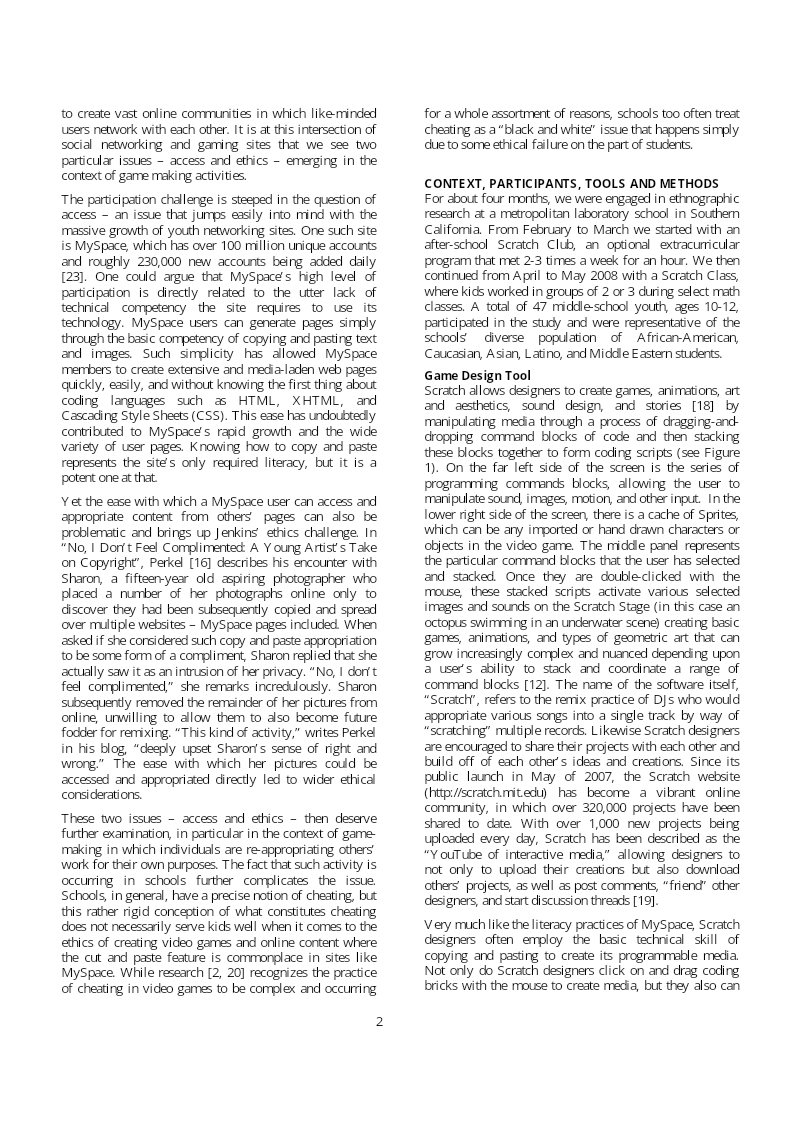
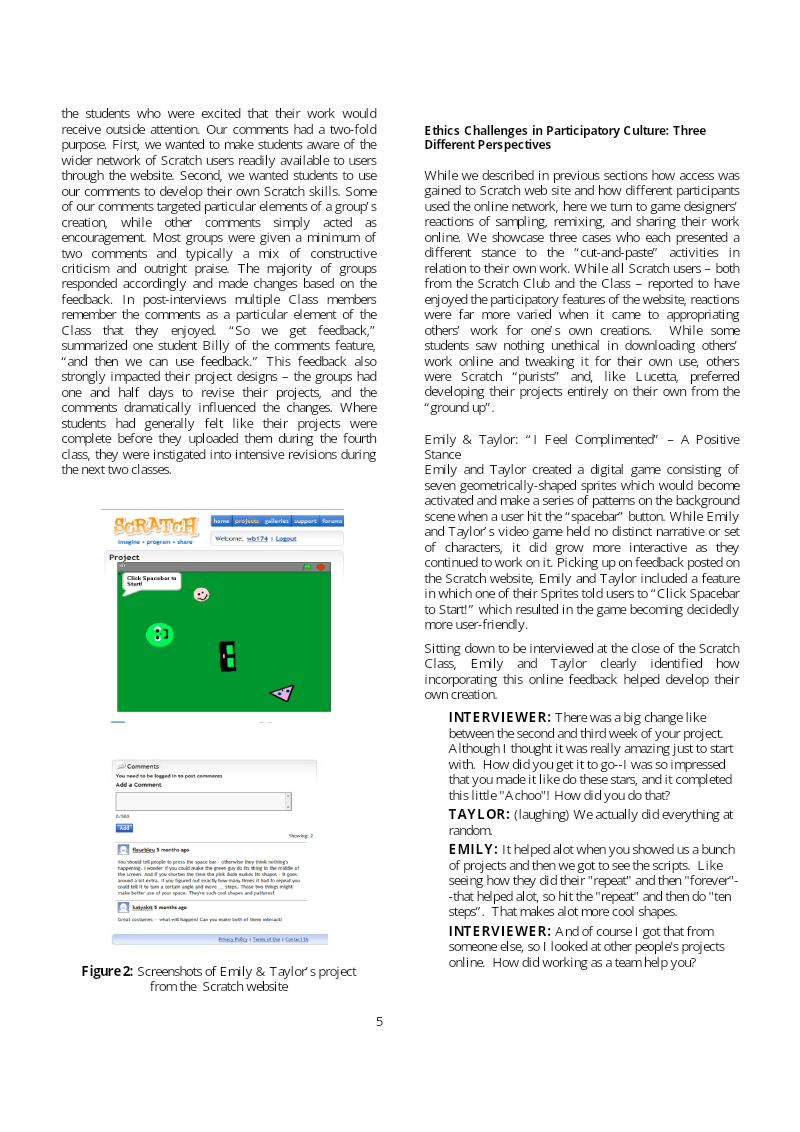
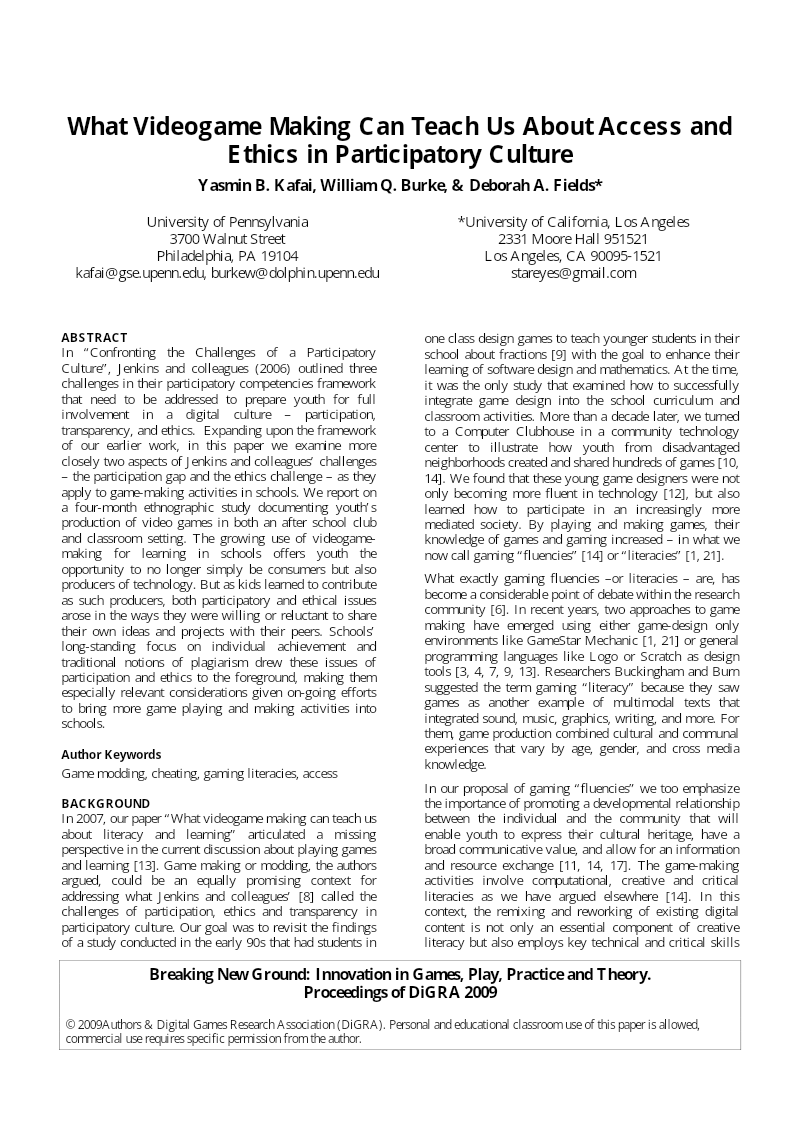
What Videogame Making Can Teach Us About Access and Ethics in Participatory Culture
This study by Kafai, Burke, and Fields examines how access and ethics shape participation in game-making among young people, with particular attention to the tensions between sharing, remixing, and appropriation in digital culture.
- Youth participation in game-making deepened over time: students who initially hesitated to share their work publicly gradually moved from offline tinkering to downloading and remixing others' projects.
- Remix culture raises real ethical tensions around appropriation, since copy-and-paste is easy on platforms like Scratch (which hosted more than 320,000 projects) and MySpace, and students' reactions ranged from valuing shared code for improving their own work to feeling wronged when their creations were reused without credit.
- The study's findings are drawn from a four-month ethnographic investigation of 47 middle-school students aged 10 to 12 in a Scratch after-school club and classroom.
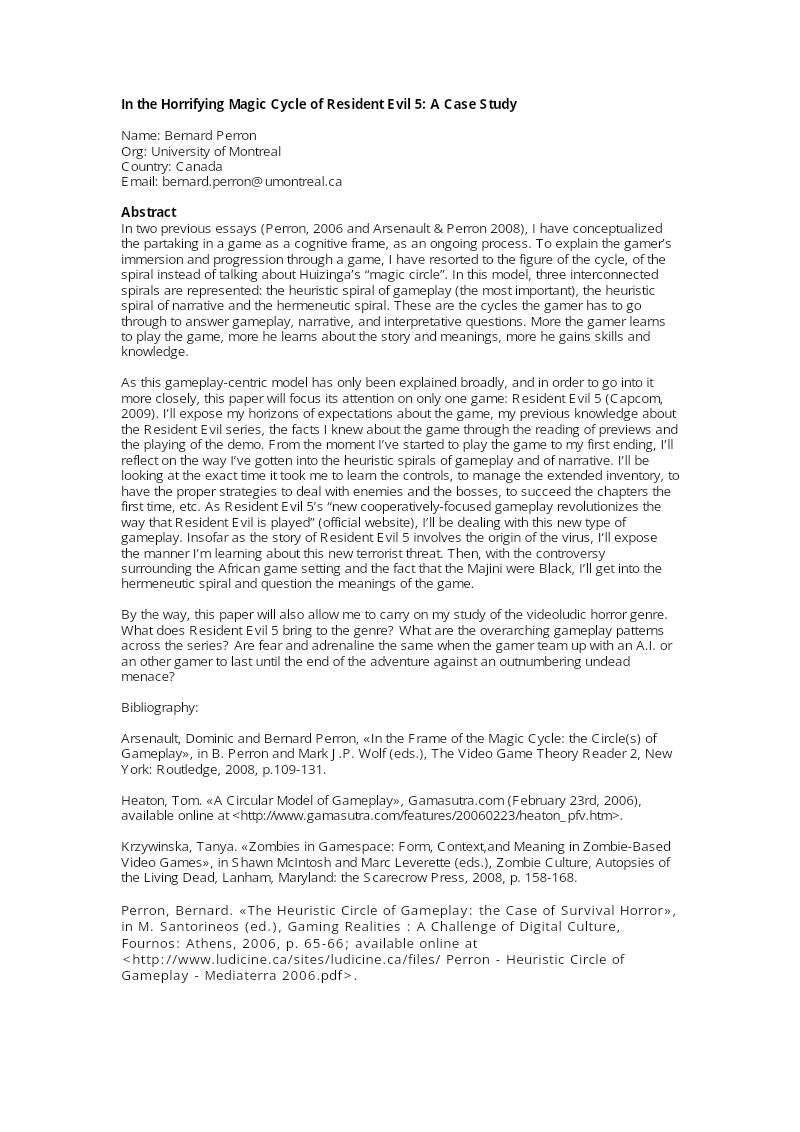
In the Horrifying Magic Cycle of Resident Evil 5: A Case Study
Bernard Perron's paper uses Resident Evil 5 (Capcom, 2009) as a case study to test and refine his gameplay-centric model of play, which he frames as an ongoing cognitive process rather than the static "magic circle" proposed by Huizinga.
- Bernard Perron's paper uses Resident Evil 5 (Capcom, 2009) to test and refine a gameplay-centric model of play, framing it as an ongoing cognitive process rather than Huizinga's static "magic circle."
- The model rests on three interconnected spirals: the heuristic spiral of gameplay (considered the most important), the heuristic spiral of narrative, and the hermeneutic spiral of interpretation, with each pass through the loop building player skill and knowledge.
- The study is a first-person autoethnographic account tracing Perron's progression from first contact to first ending, recording how long it took to master controls, manage inventory, develop strategies against enemies and bosses, and clear chapters on the first attempt.
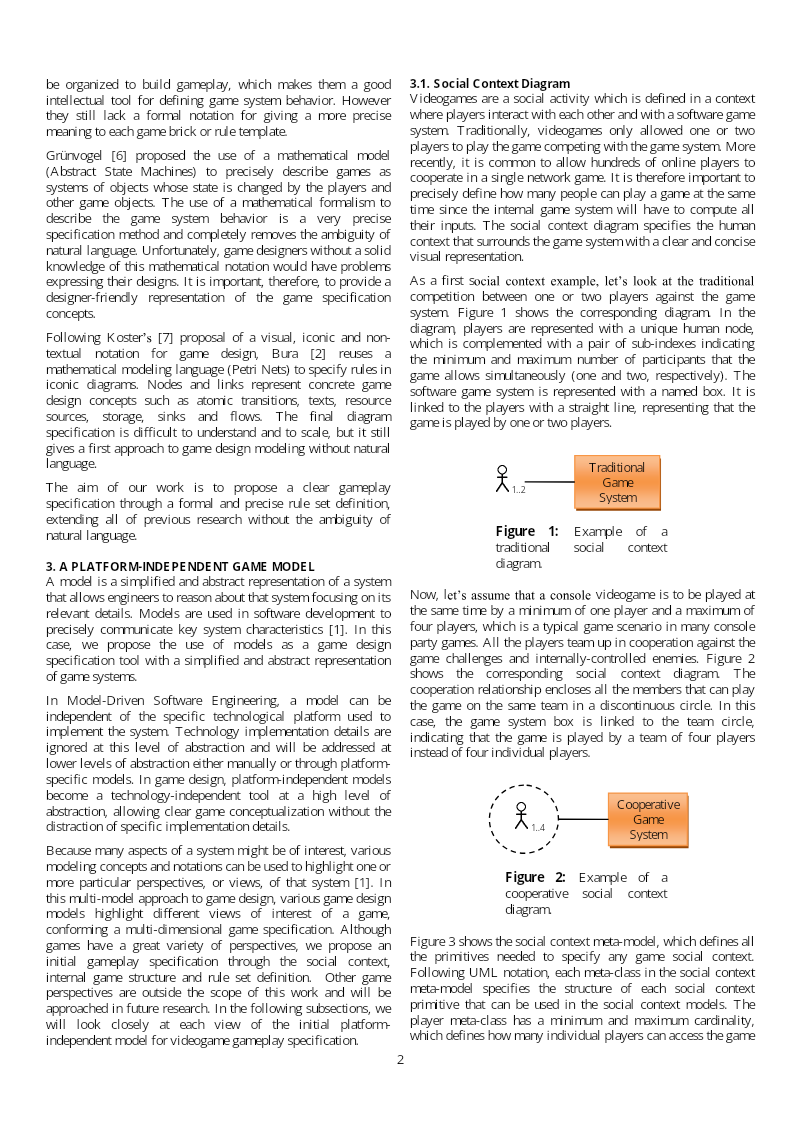
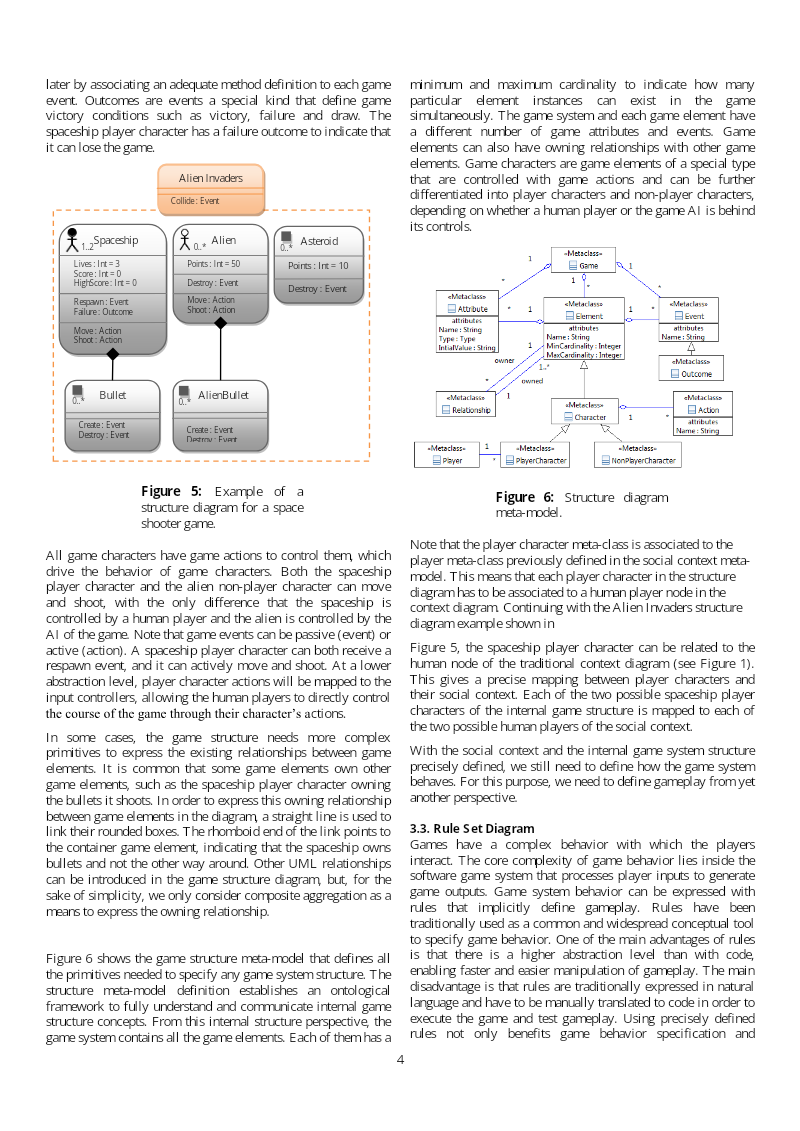
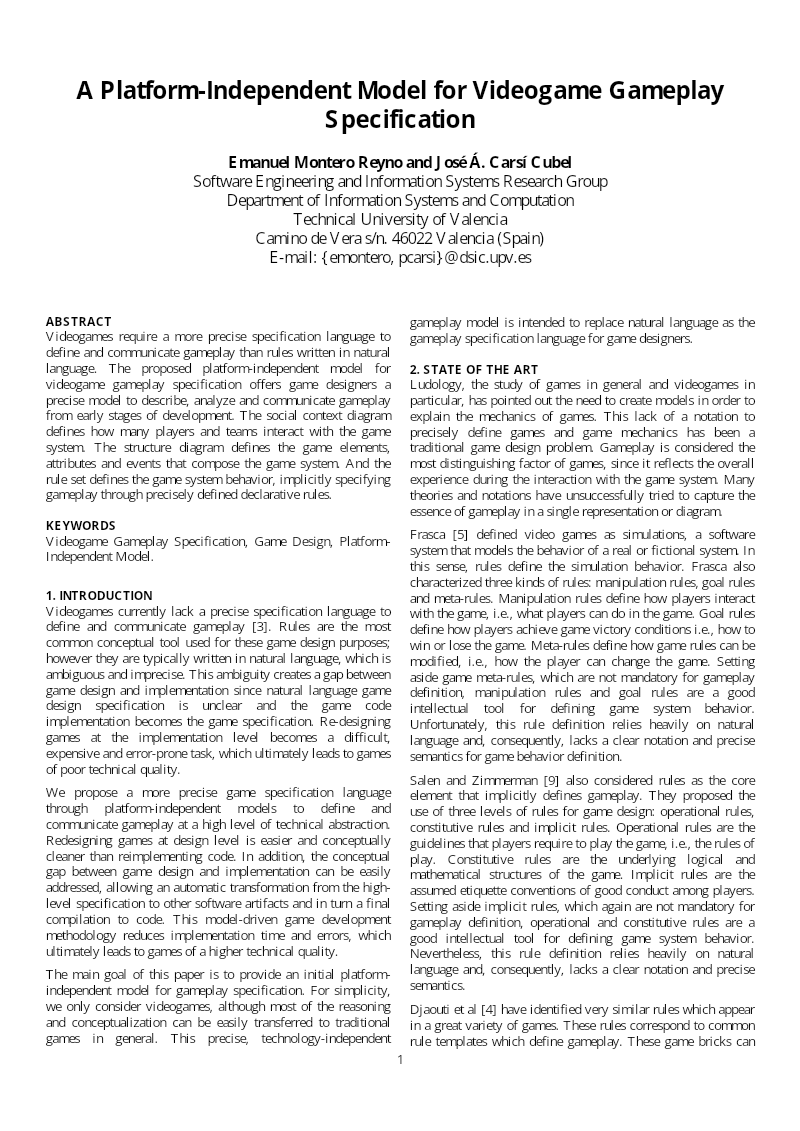
A Platform-Independent Model for Videogame Gameplay Specification
This paper proposes a platform-independent model for specifying videogame gameplay, aimed at giving game designers a precise alternative to natural language rule descriptions, which the authors argue are ambiguous and hinder the transition from design to implementation.
- The paper proposes a platform-independent, model-driven notation for videogame gameplay rules, aiming to replace ambiguous natural-language rule descriptions that hinder the transition from design to implementation.
- The model has three complementary views: a social context diagram (player and team cardinality, cooperative or competitive relationships), a structure diagram (attributes, events, actions, ownership, and player vs. non-player characters), and a rule set diagram (pre- and post-condition rules classified as action, internal, or goal rules).
- The framework builds on established ludology work, including Frasca's manipulation, goal, and meta-rule classification and Salen and Zimmerman's operational, constitutive, and implicit rules.
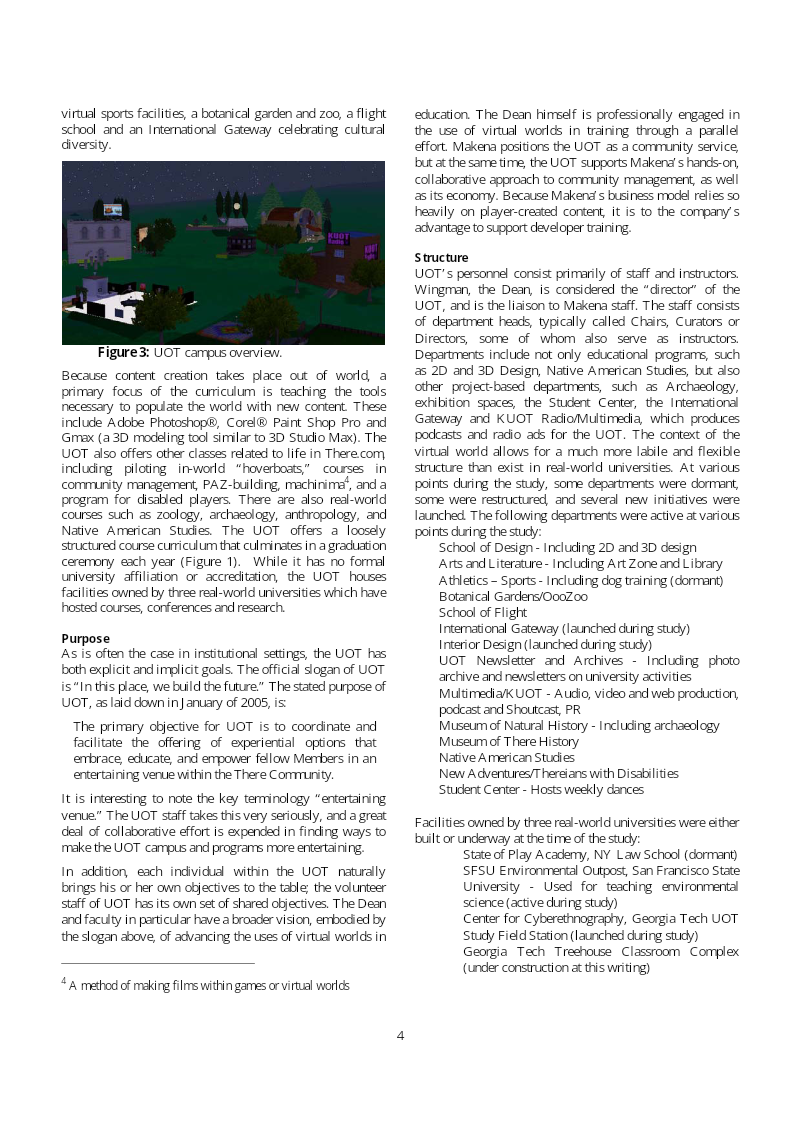
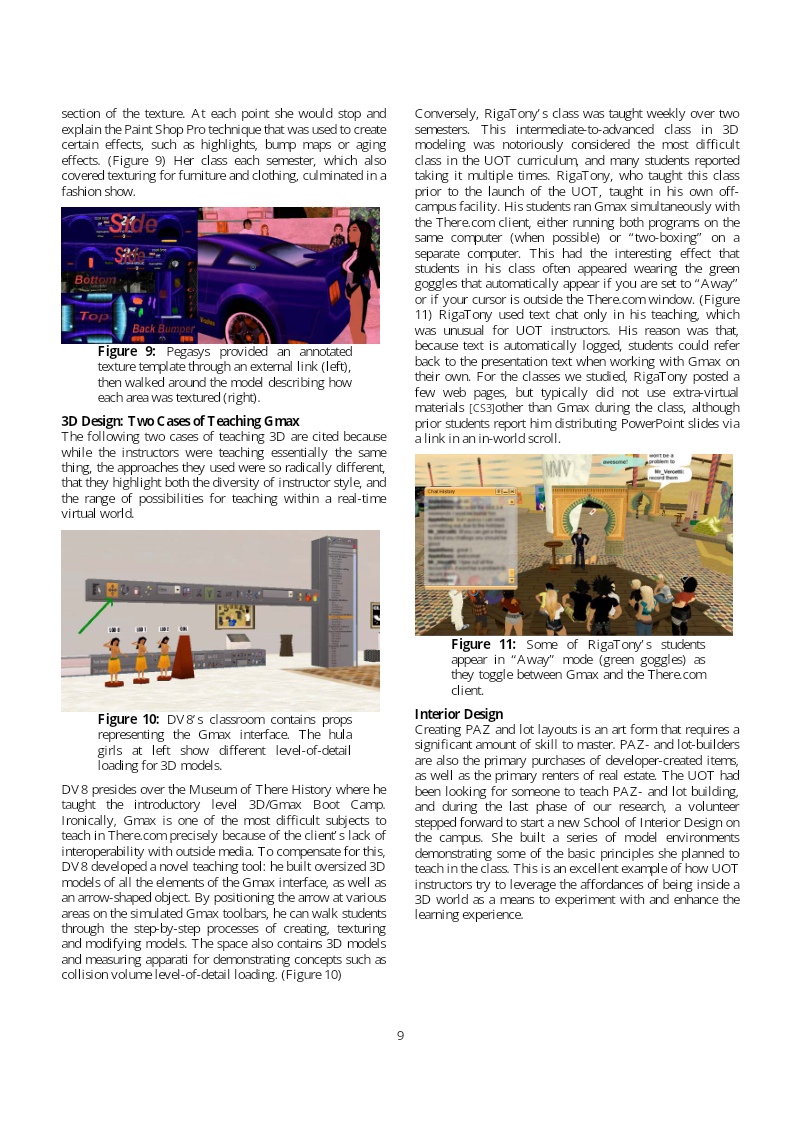
Collaboration, Creativity and Learning in a Play Community: A Study of The University of There
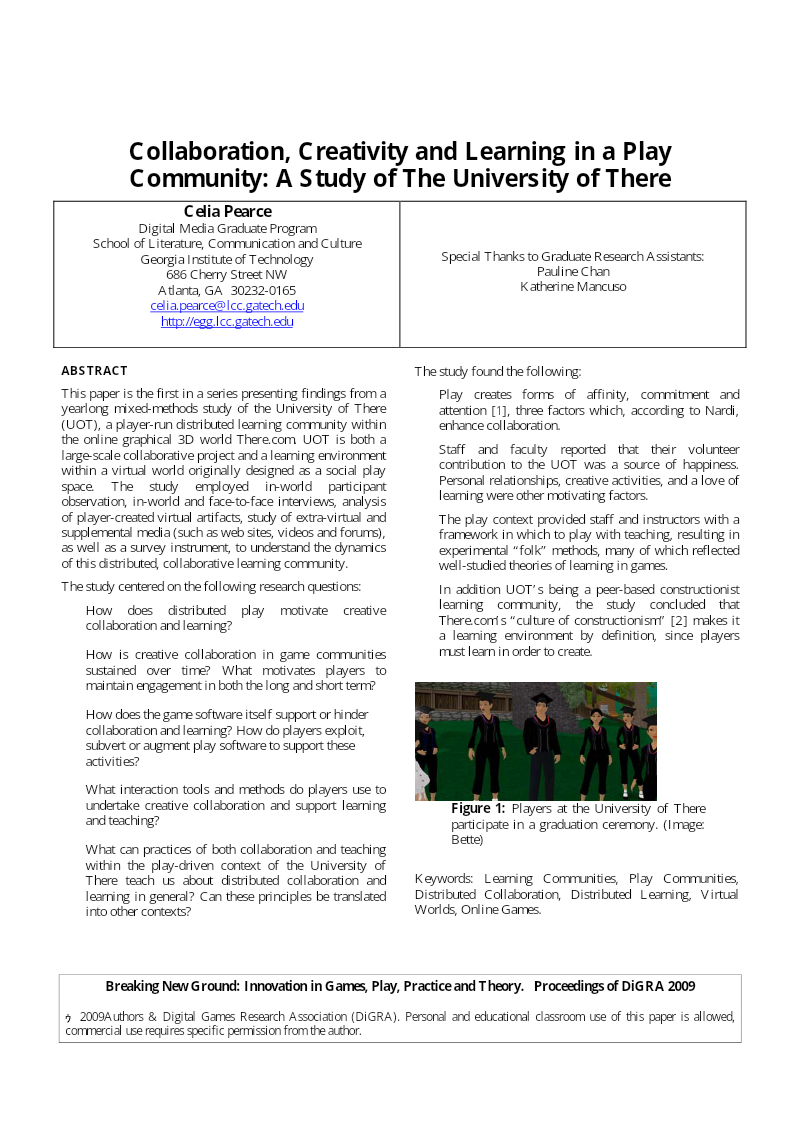
The University of There, a volunteer-run educational community within the 3D virtual world There.com, is examined in this study through a one-year mixed-methods investigation conducted between 2008 and 2009.
- The study identifies play-based affinity, commitment, and attention as the main drivers of collaboration in The University of There, a volunteer-run educational community within the 3D virtual world There.com (estimated 1.8 million players).
- Community approval is the main motivator for user content creation, and learning happens in situ within the three-dimensional world, with participants fluidly switching between teacher and learner roles.
- Staff reported a disability rate of over one-third, far above the national figure of 15 percent, a demographic detail the authors flag as significant to the community's character.
What Makes Online Collectible Card Games Fun to Play?
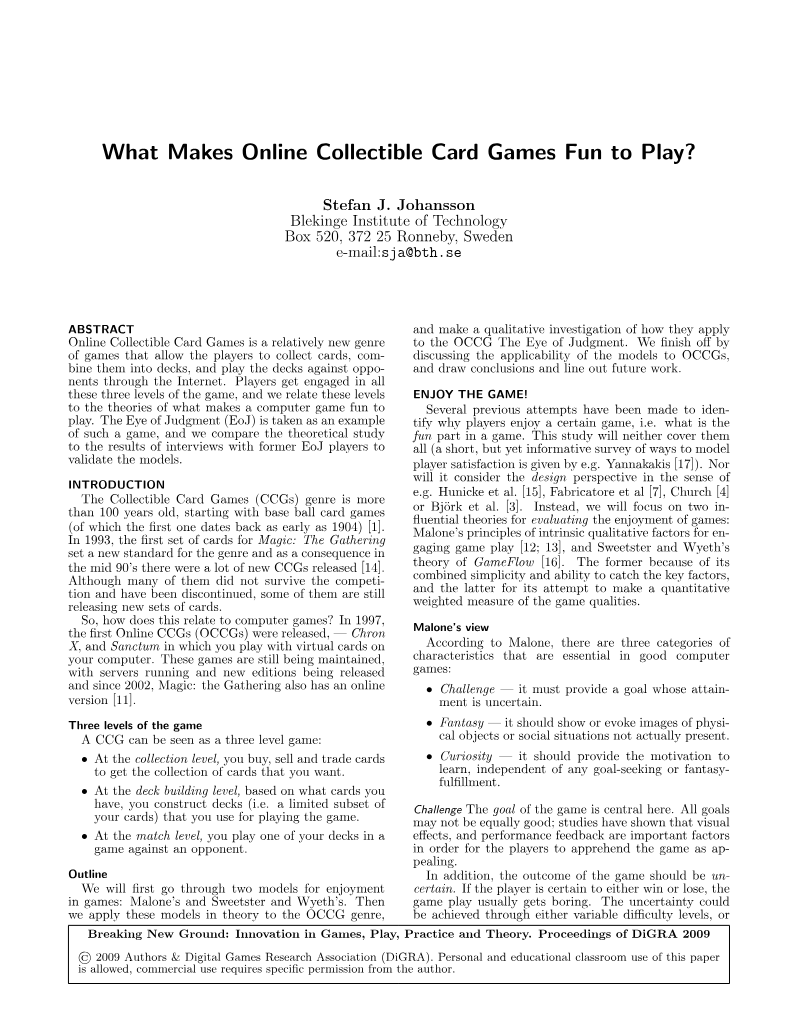
Online collectible card games are fun for different reasons at different levels of play, and a case study of The Eye of Judgment, a PlayStation 3 title, shows that enjoyment is strongest during matches and weakest in the collection and deck-building phases.
- Enjoyment in online collectible card games is strongest during matches and weakest during collecting and deck building, according to a case study of The Eye of Judgment on PlayStation 3 that applied Malone's intrinsic motivation factors and the GameFlow model across three levels of play.
- Match level scored highest on the GameFlow evaluation, followed by deck building and then card collecting, with concentration and skill development less present during collecting and feedback weaker during deck building.
- Players who quit cited cost as the primary barrier, with a full Master set exceeding $1,000, alongside significant time and physical space demands.
Mapping the Game Landscape: Locating Genres Using Functional Classification
This paper examines whether traditional game genres such as action, sports, strategy, and adventure remain useful for describing games, and proposes a more precise alternative based on functional classification.
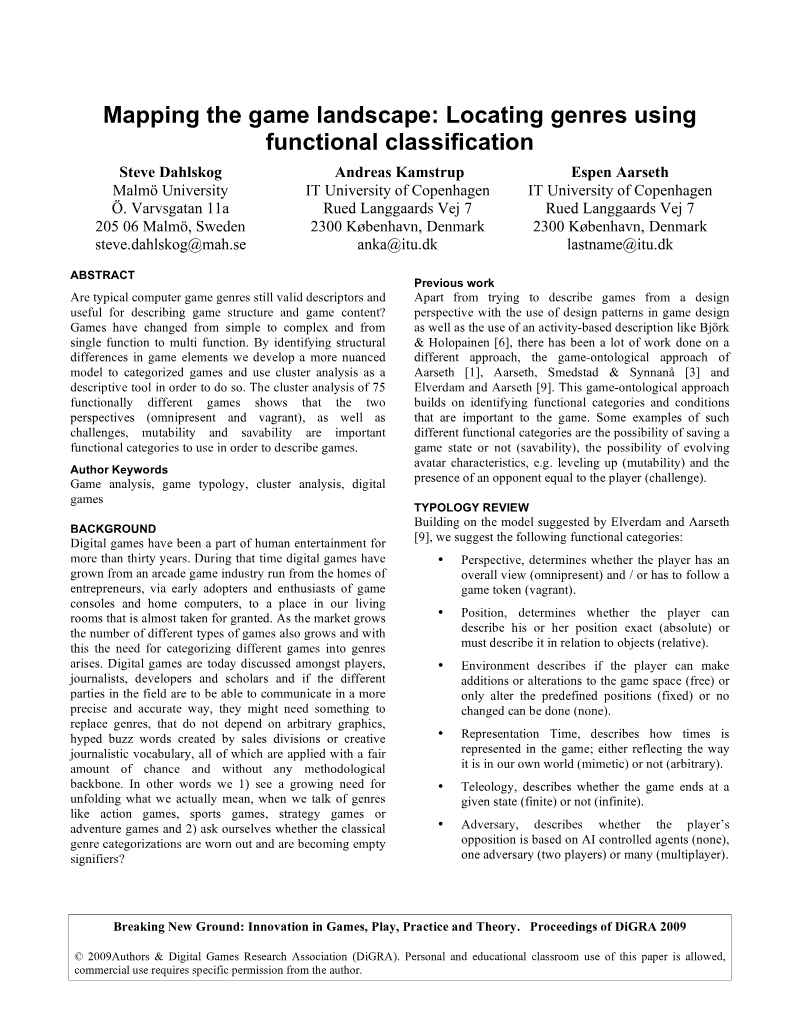
- The authors argue that traditional genre labels such as action, sports, strategy, and adventure have become imprecise because games have evolved from single-function designs into complex, multi-function systems.
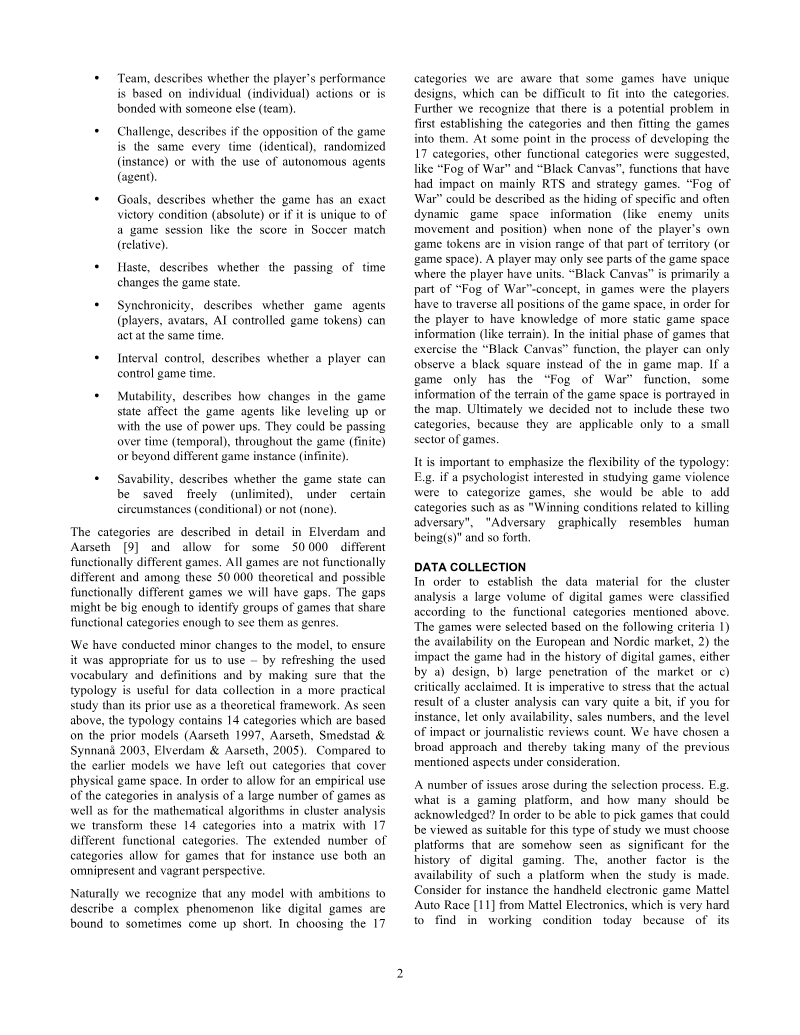
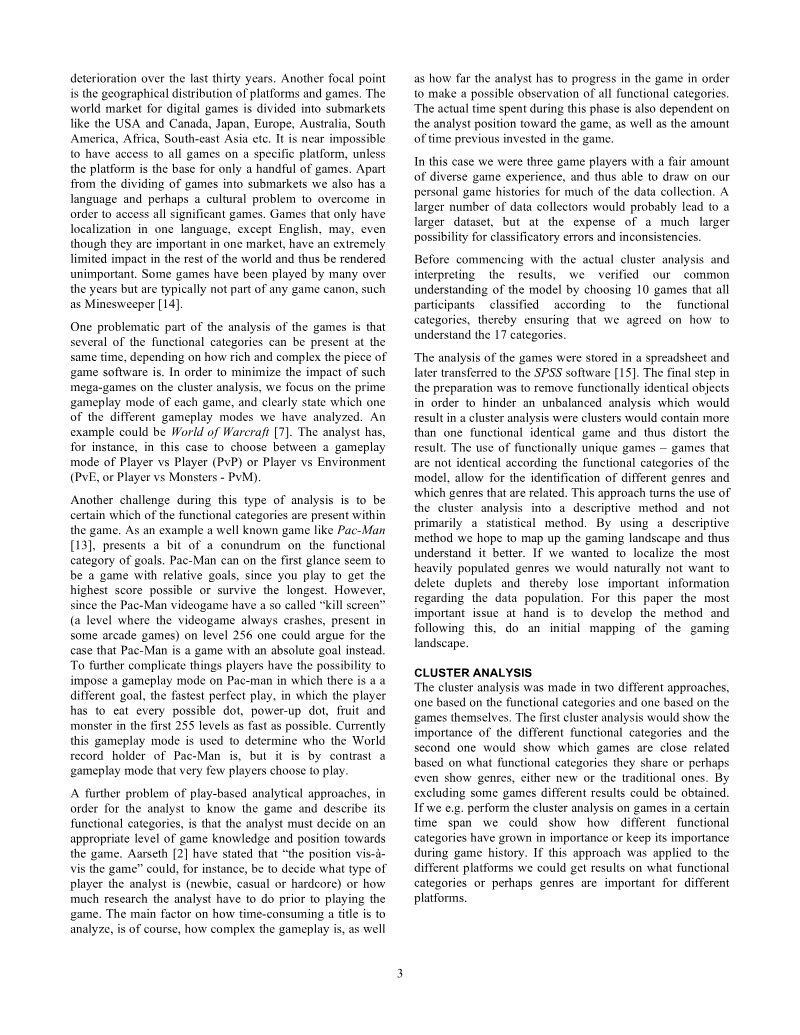
- The proposed alternative is a functional classification matrix of 17 categories, including perspective, position, environment, time representation, teleology, adversary structure, team versus individual play, challenge type, goals, haste, synchronicity, interval control, mutability, and savability.
- A cluster analysis of 75 functionally distinct games, drawn from a pool of around 100 titles selected for European and Nordic market availability and historical impact, was processed in SPSS after three researchers classified the games.
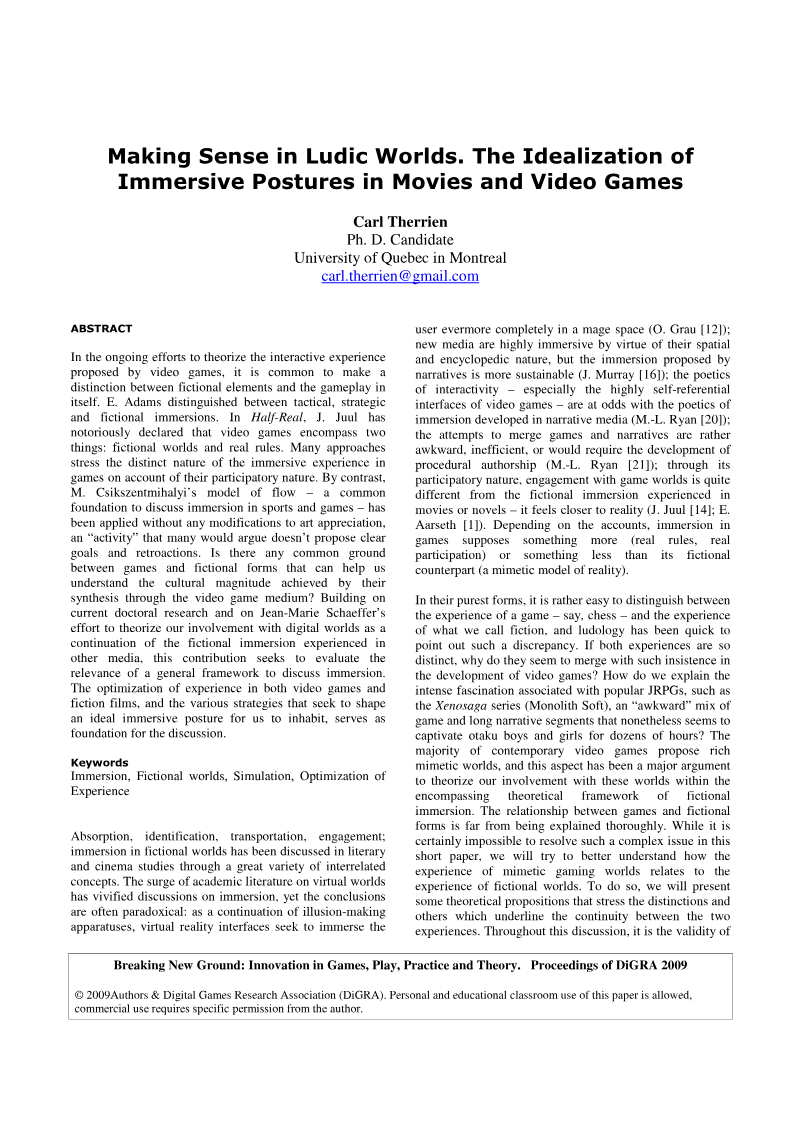
Making Sense in Ludic Worlds: The Idealization of Immersive Postures in Movies and Video Games
Making Sense in Ludic Worlds argues that video games and fiction films should be understood on a common footing rather than as fundamentally different kinds of experience.
- The report argues that video games and fiction films should be understood on a common footing, both unified by an "optimization of experience" in which immersion arises from a balance of skills and challenges within clearly bounded, self-contained worlds, drawing on Csikszentmihalyi's flow model and Schaeffer's theory of mimetic immersion.
- It rejects teleological narratives of game evolution, including those from scholars Aarseth and Juul and Nintendo's marketing, which portray games as steadily converging toward reality, arguing instead that mimetic games depend on selective modeling of reality rather than faithful reproduction.
- Following Schaeffer and Carroll, fiction is treated as a playful, mutually accepted framing of illusion rather than deception, and both film and games rely on hypernormal simplifications, causal clarity, and overt guidance from an editorial intelligence.
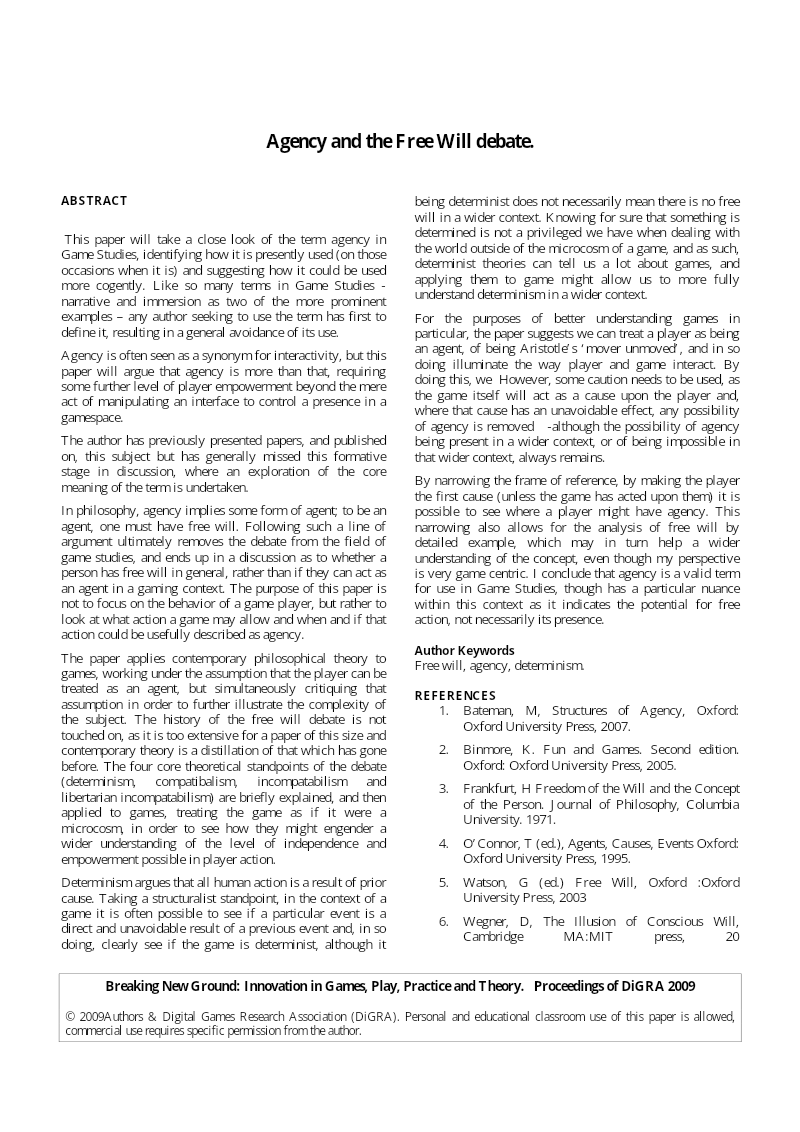
Agency and the Free Will Debate
This paper examines the term "agency" within Game Studies, arguing that it is frequently used as a synonym for interactivity when it deserves a more precise meaning.
- The paper argues that 'agency' in Game Studies is often conflated with interactivity, and that it deserves a more precise meaning requiring a further level of player empowerment beyond manipulating an interface to control a presence in a gamespace.
- The central conclusion is that agency is a valid and useful term for Game Studies, with its value lying less in establishing whether a player acts and more in examining what actions a game permits and whether those actions can usefully be called agency.
- Drawing on the philosophical free will debate, the paper treats the player as an agent, invoking Aristotle's 'mover unmoved', while cautioning that the game itself acts as a cause upon the player, and where that causal influence is unavoidable, the possibility of agency is removed.
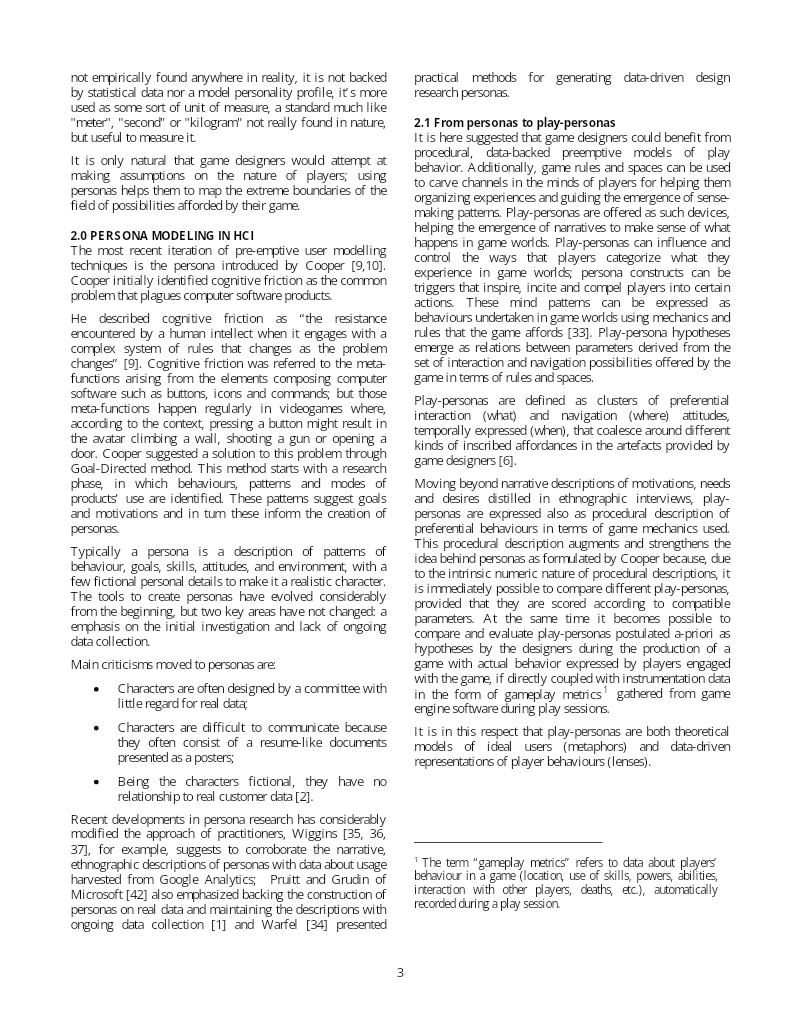
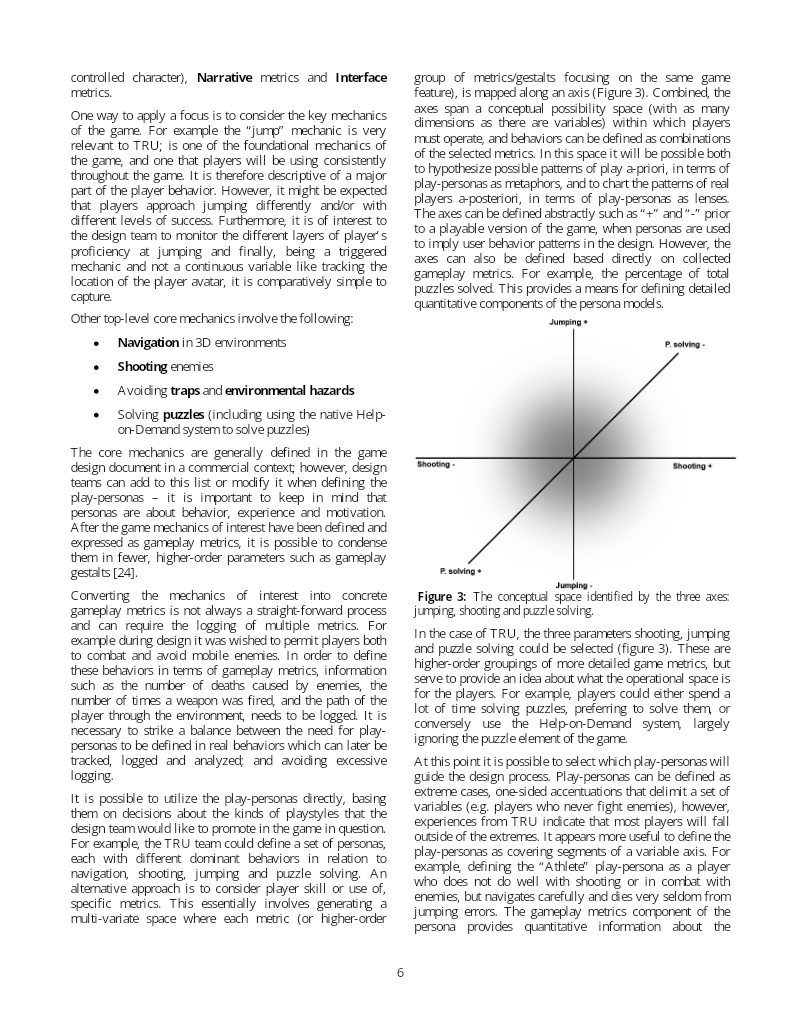
Patterns of Play: Play-Personas in User-Centred Game Development
"Patterns of Play: Play-Personas in User-Centred Game Development" proposes an adaptation of Alan Cooper's human-computer interaction persona framework to game design, introducing "play-personas" as clusters of preferred interaction and navigation behaviors.
- The report adapts Alan Cooper's HCI persona framework to games by introducing "play-personas," which are clusters of preferred interaction and navigation behaviors that let designers keep authorial control while giving players meaningful agency.
- The authors argue personas should shift from narrative-driven, committee-designed archetypes to data-driven models validated against observed play, justified by cognitive and literary theory such as the pattern-seeking drive and Iser's implied reader.
- Play-personas operate both as design metaphors encoding designers' behavioral expectations and as analytical lenses built from high-frequency gameplay metrics.
The Player Character as Performing Object
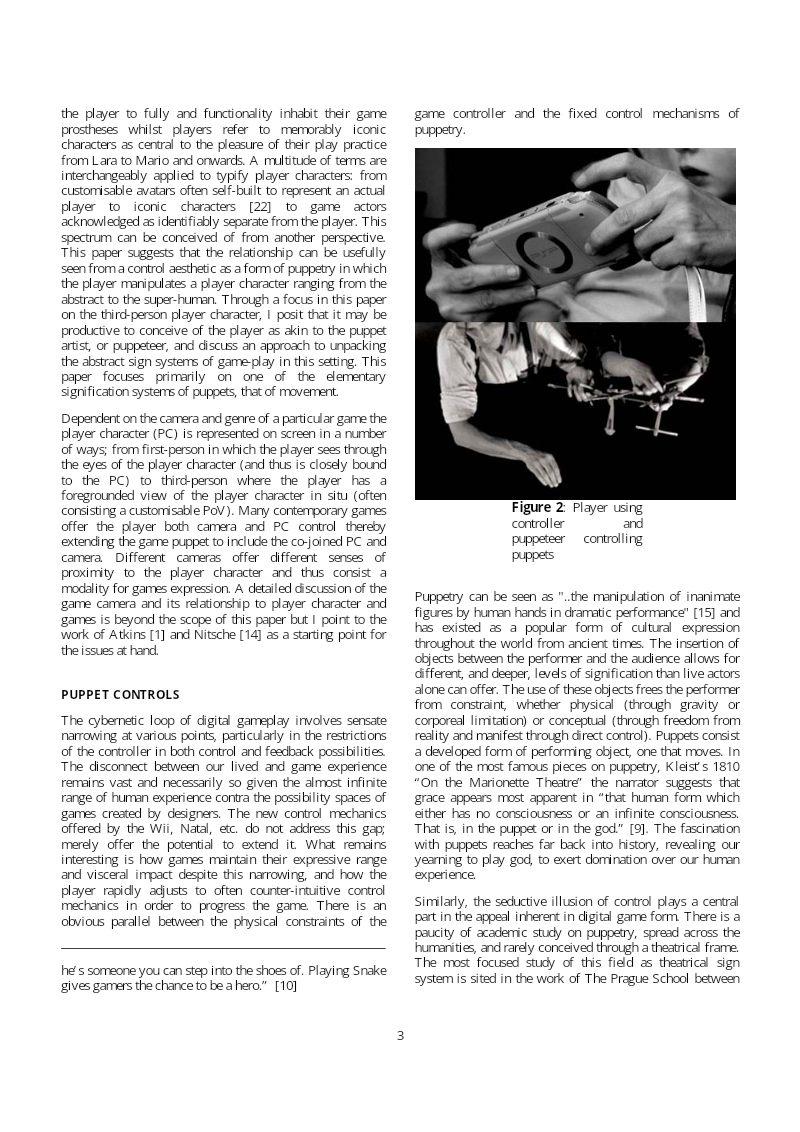
This paper argues that the player's relationship to her player character can be productively understood through the lens of puppetry, with the player cast as a puppeteer manipulating a digital figure that ranges from the abstract to the superhuman.
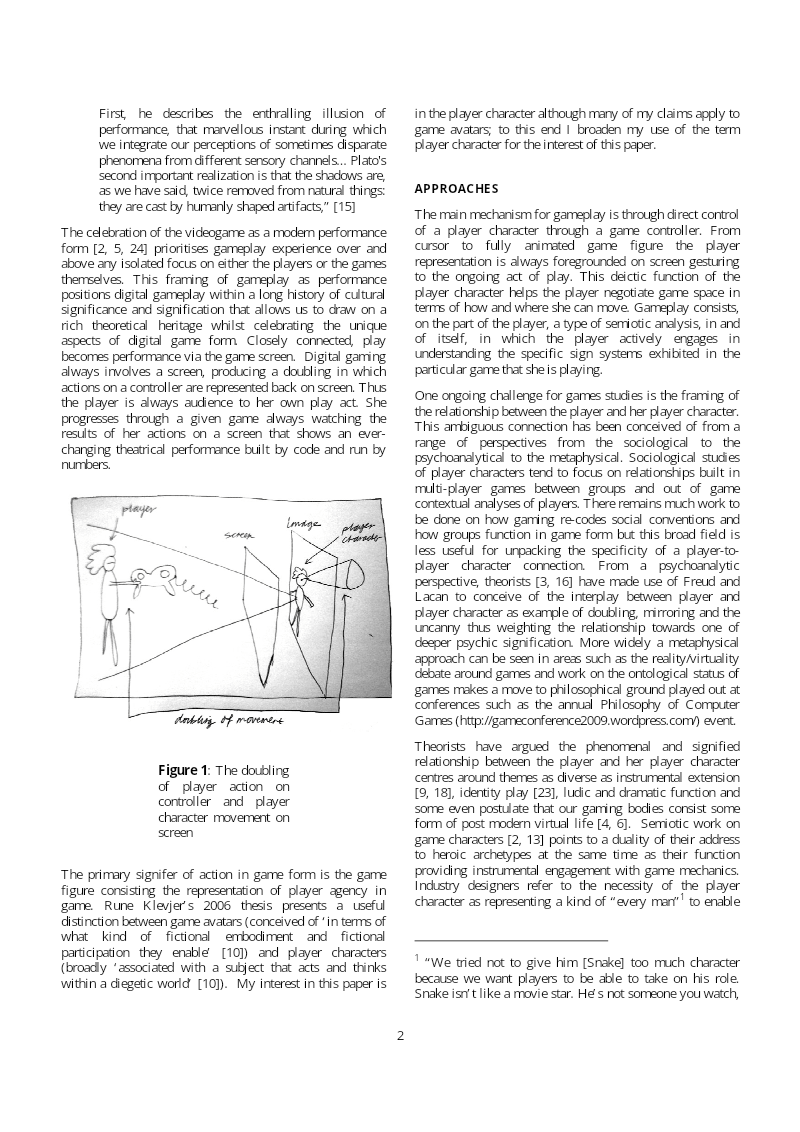
- The paper argues that the player's relationship to a player character is best understood through puppetry, with the player as puppeteer manipulating a digital figure that doubles as a perceived object and an imagined life.
- Movement is treated as the primary signifying system of the player character, with exaggeration techniques such as amplification, interruptible animation loops, and constant responsiveness helping players suspend disbelief and identify with the figure.
- The author contends that the 'figureness' of the player character, rather than realism, is what allows players to bind with the game interface, and that movement design either extends or disrupts play depending on how well it is judged.
In Search of a Minimalist Game
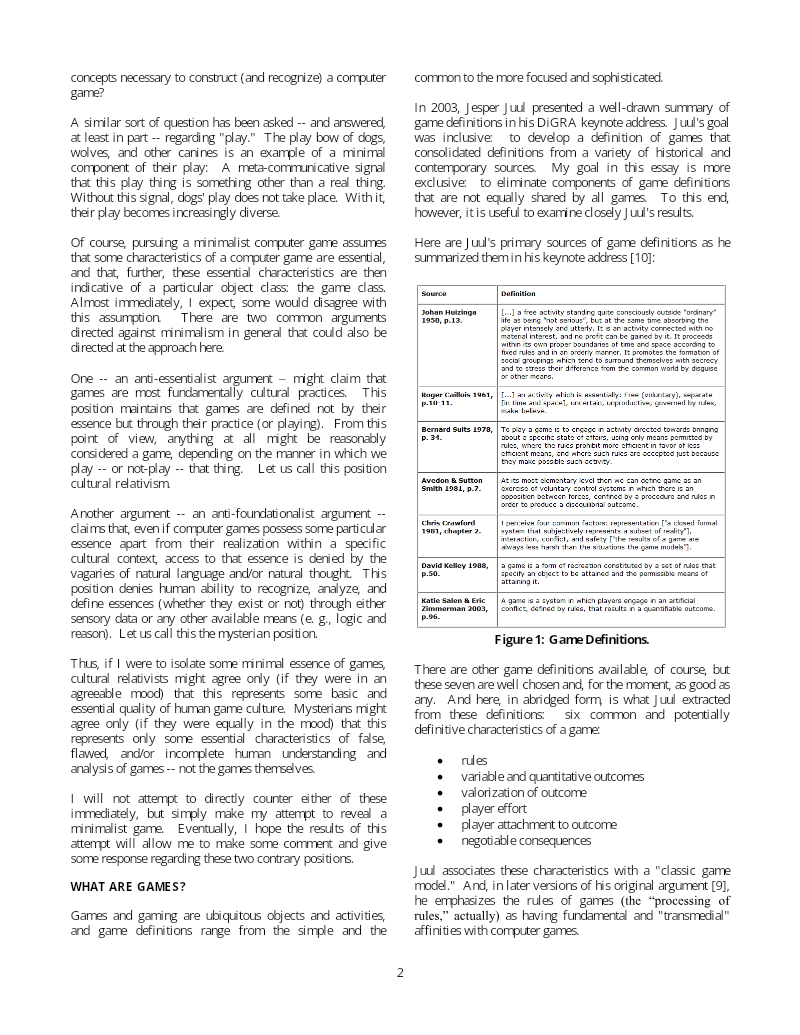
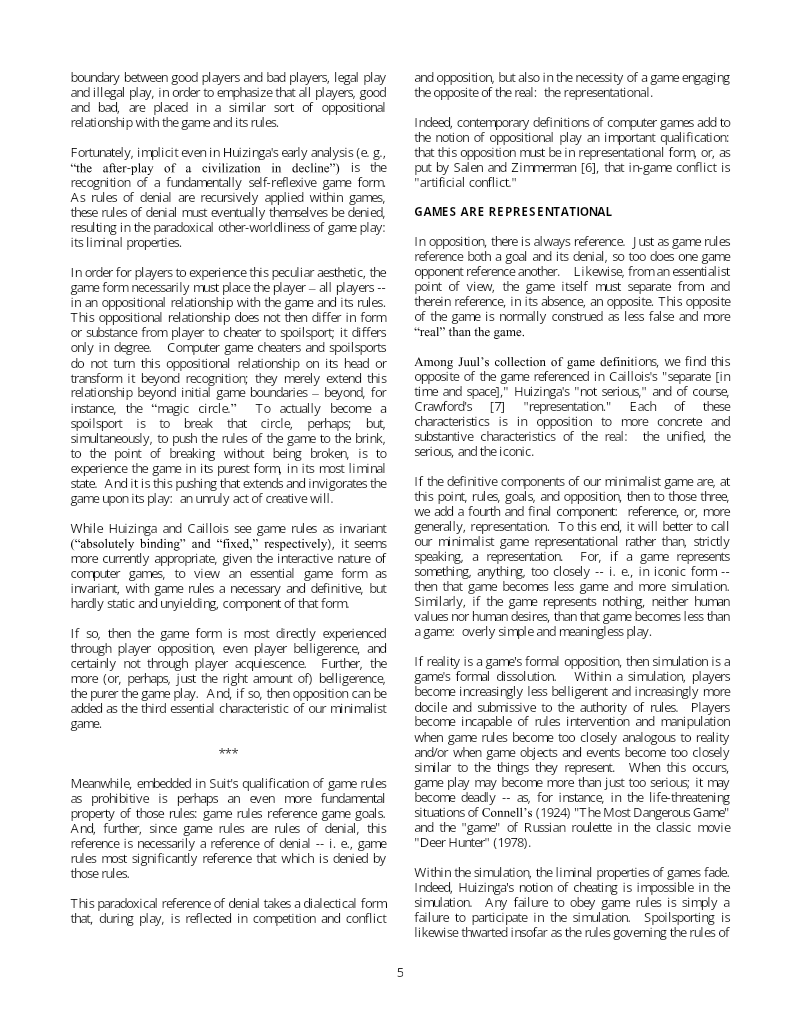
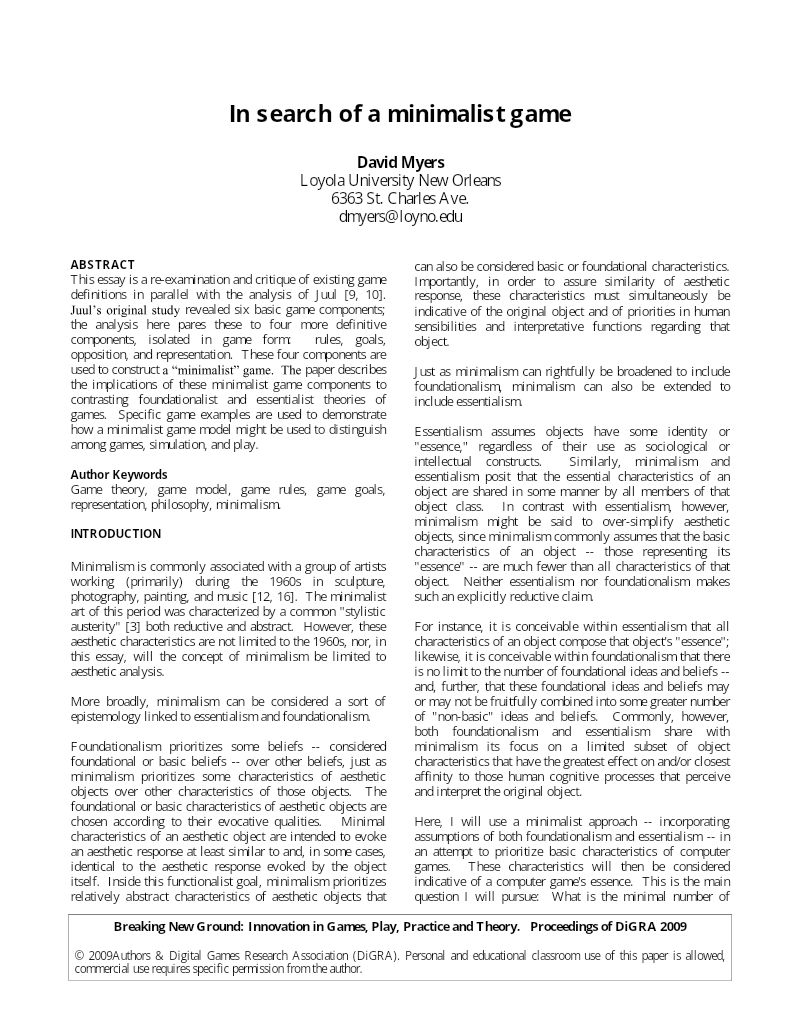
David Myers' essay seeks to isolate a minimalist definition of games by reducing Jesper Juul's six components to four essential elements: prohibitive rules, goals, opposition between player and rules, and representation.
- Myers reduces Jesper Juul's six components of games to four essential elements: prohibitive rules, goals, opposition between player and rules, and representation.
- The model treats rules and goals as the most formally observable core, setting aside player effort, attachment, and cultural context because they are difficult to measure.
- Drawing on Bernard Suits and Wittgenstein, Myers argues that game rules are fundamentally 'rules of denial' that prohibit the most efficient means of reaching a goal, and this self-reflexive prohibition generates the opposition that defines play.
Play as Transgression: An Ethnographic Approach to Queer Game Cultures
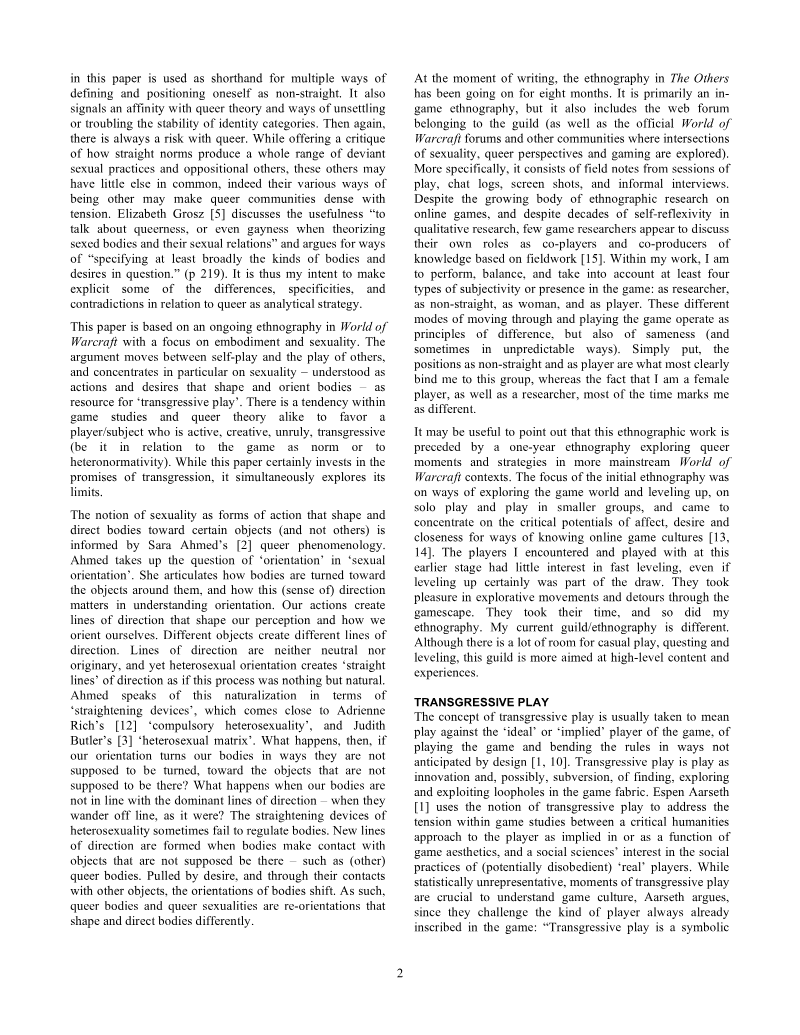
Jenny Sundén's paper offers an ethnographic examination of queer gaming culture, centered on a GLBT guild within World of Warcraft.
- Sundén's participant-observer ethnography of a GLBT guild in World of Warcraft argues that queer players' "transgressive play" exposes the implicit assumption that game design and community norms are built around a straight, male "ideal player."
- The central case, the European guild "The Others", had roughly 200 members, about thirty of whom were active, with sexuality functioning as a bonding point expressed through flirtation, queer banter, and in-game perfume mechanics enabling cross-gender romantic play.
- The 2006 Sara Andrews incident, in which a GLBT-friendly guild announcement drew a warning from Blizzard, illustrates how "straightening devices" regulate queer visibility in online games even as such guilds offer members relief and acceptance.