1 free read left. Create a free account for unlimited reading + AI research.
Create free accountWhitepaper DiGRA
1 free read left. Create a free account for unlimited reading + AI research.
Create free accountWhitepaperDiGRA
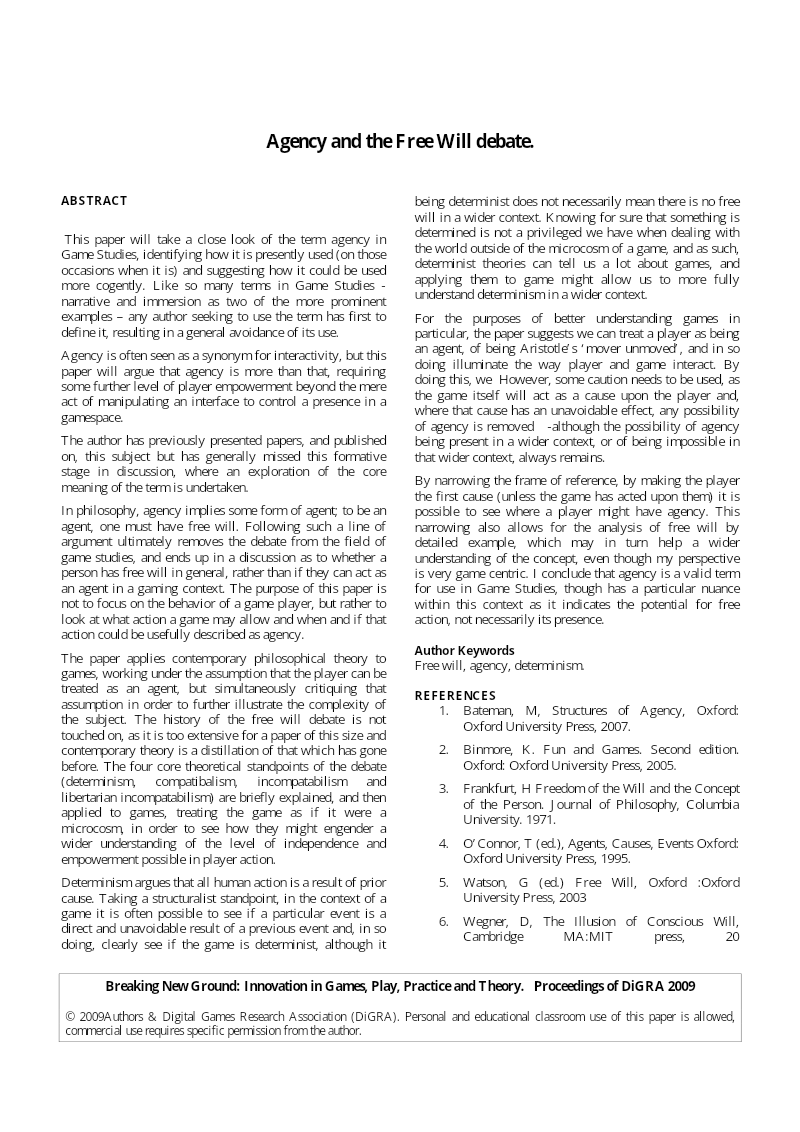
This paper examines the term "agency" within Game Studies, arguing that it is frequently used as a synonym for interactivity when it deserves a more precise meaning. The author contends that agency requires a further level of player empowerment beyond the mere manipulation of an interface to control a presence in a gamespace. Drawing on the philosophical free will debate, the paper treats the player as an agent, invoking Aristotle's notion of the "mover unmoved," while cautioning that the game itself acts as a cause upon the player, and where that causal influence is unavoidable, the possibility of agency is removed. The paper's central conclusion is that agency is a valid and useful term for Game Studies, with its value lying less in establishing whether a player acts and more in examining what actions a game permits and whether those actions can usefully be described as agency.
The methodology is primarily theoretical and conceptual rather than empirical. The paper narrows its frame of reference by isolating the player as a first cause within the microcosm of a game, which allows agency to be analyzed in concrete, detailed examples rather than in the abstract, broader question of whether a person possesses free will in general. It briefly outlines four core positions in the debate, namely determinism, compatibilism, incompatibilism, and libertarian incompatibilism, and applies them to games by treating a game as a self-contained microcosm. The author acknowledges a deliberately game-centric perspective and notes that the history of the free will debate is omitted due to its scope.
The analysis draws on a range of philosophical and game studies literature, including works on structures of agency, the concept of the person, and the psychology of conscious will. The author also observes that determinist theories, though more often applied to the world outside games, can illuminate how games operate and how determinism might be understood in a wider context. The paper is positioned as a foundational exploration of the core meaning of agency, a stage the author believes earlier work had overlooked.

DiGRA · 2019



DiGRA · 2019



DiGRA · 2019

DiGRA · 2019



DiGRA · 2019



DiGRA · 2019



DiGRA · 2019



DiGRA · 2019



DiGRA · 2019



DiGRA · 2019



DiGRA · 2019



DiGRA · 2019












Comments