1 free read left. Create a free account for unlimited reading + AI research.
Create free accountWhitepaper DiGRA
1 free read left. Create a free account for unlimited reading + AI research.
Create free accountWhitepaperDiGRA
The authors argue that games have evolved from single-function designs into complex, multi-function systems. Conventional labels therefore become increasingly imprecise.
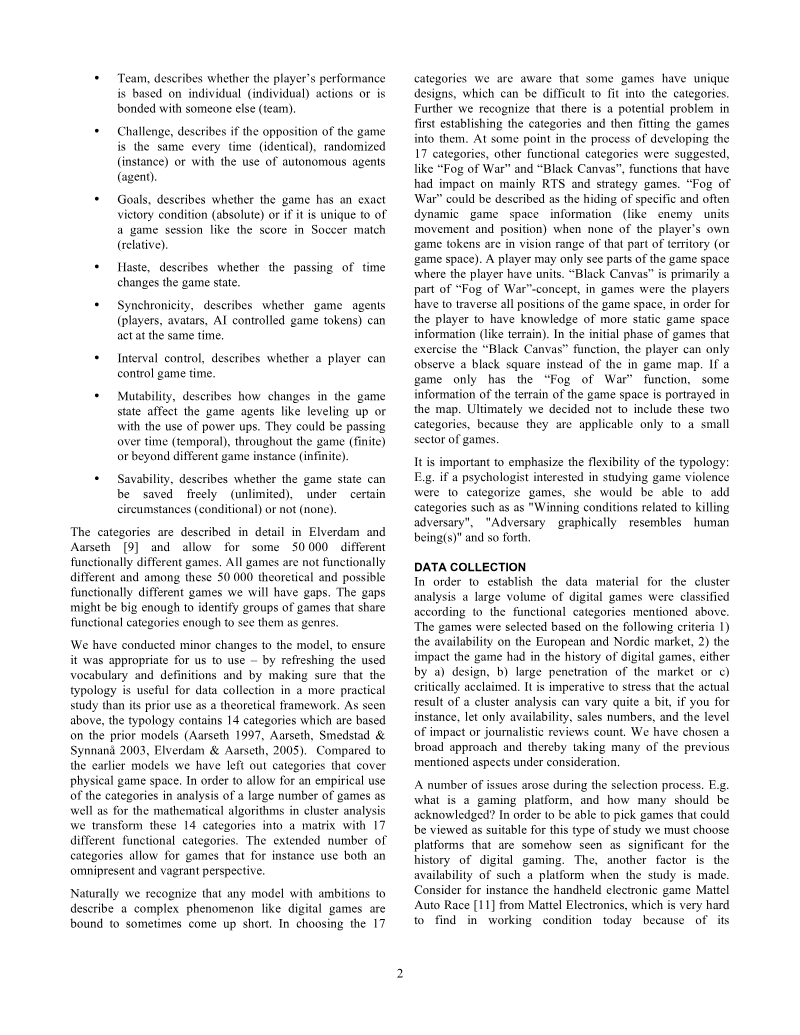
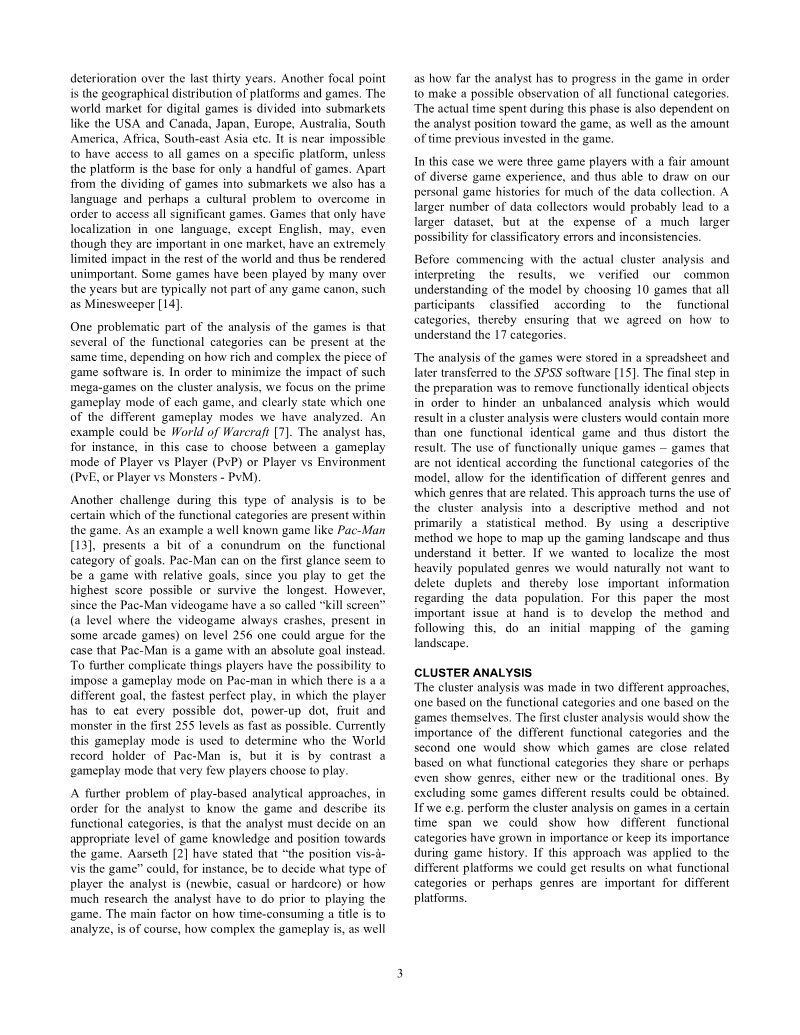
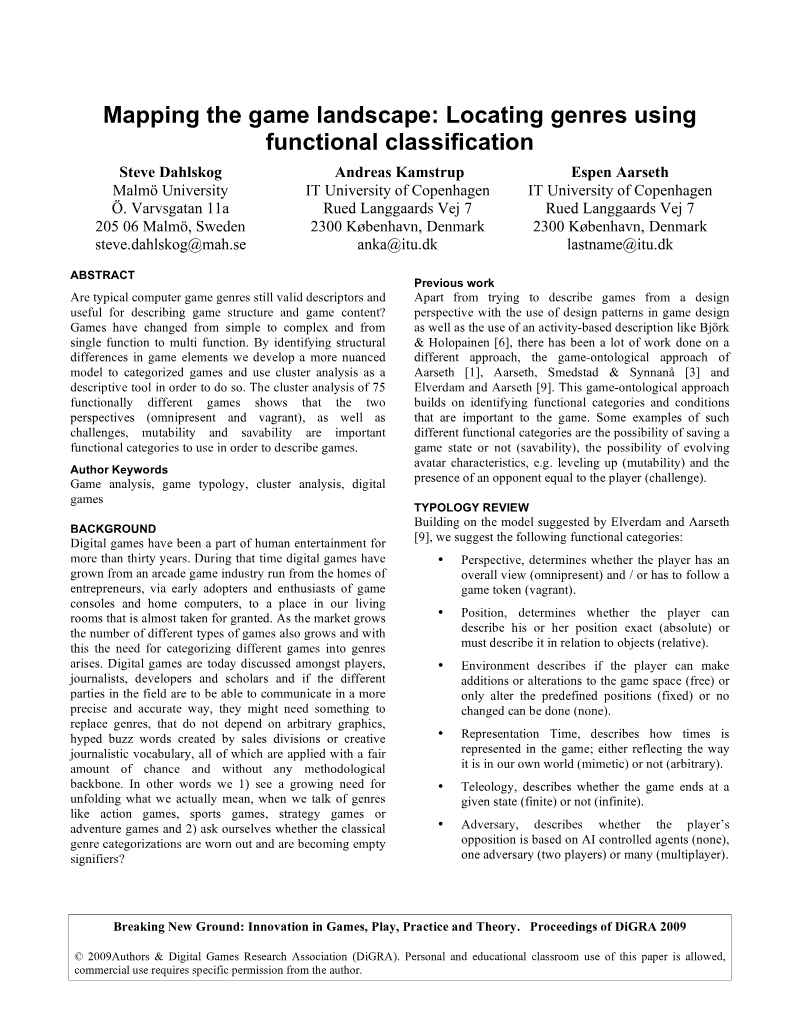
This paper examines whether traditional game genres such as action, sports, strategy, and adventure remain useful for describing games, and proposes a more precise alternative based on functional classification. The authors argue that games have grown from simple, single-function designs into complex, multi-function systems, making conventional genre labels increasingly imprecise. Their approach builds on an existing game-ontological model and expands it into a matrix of 17 functional categories, covering attributes such as perspective, position, environment, time representation, teleology, adversary structure, team versus individual play, challenge type, goals, haste, synchronicity, interval control, mutability, and savability.
The empirical core is a cluster analysis of 75 functionally distinct games, drawn from a larger pool of around 100 titles selected for availability in European and Nordic markets and for their historical impact through design innovation, market penetration, or critical acclaim. Three researchers classified the games, and the classifications were processed in SPSS, with functionally identical titles removed to avoid distorting the results. The analysis produced clusters that the authors interpret as the most meaningful descriptors: savability, mutability, challenge, and perspective were identified as the most influential categories. Four main game clusters emerged, namely strategy games, first person shooters, progression and exploration games, and perfect information games resembling traditional physical games.
The authors acknowledge methodological limitations, including the difficulty of accessing obsolete or regionally restricted platforms, the subjectivity of classifying complex games with multiple gameplay modes, and the reliance on a small team of classifiers, which may introduce inconsistencies. They propose future work using correspondence analysis to map genres in multidimensional space, and they suggest that the typology is flexible enough for researchers to add categories suited to their own inquiries.



DiGRA · 2023

DiGRA · 2023



DiGRA · 2023

DiGRA · 2023



DiGRA · 2023



DiGRA · 2023



DiGRA · 2023



DiGRA · 2023



DiGRA · 2023



DiGRA · 2023



DiGRA · 2023

DiGRA · 2023












Comments