1 free read left. Create a free account for unlimited reading + AI research.
Create free accountWhitepaper DiGRA
1 free read left. Create a free account for unlimited reading + AI research.
Create free accountWhitepaperDiGRA
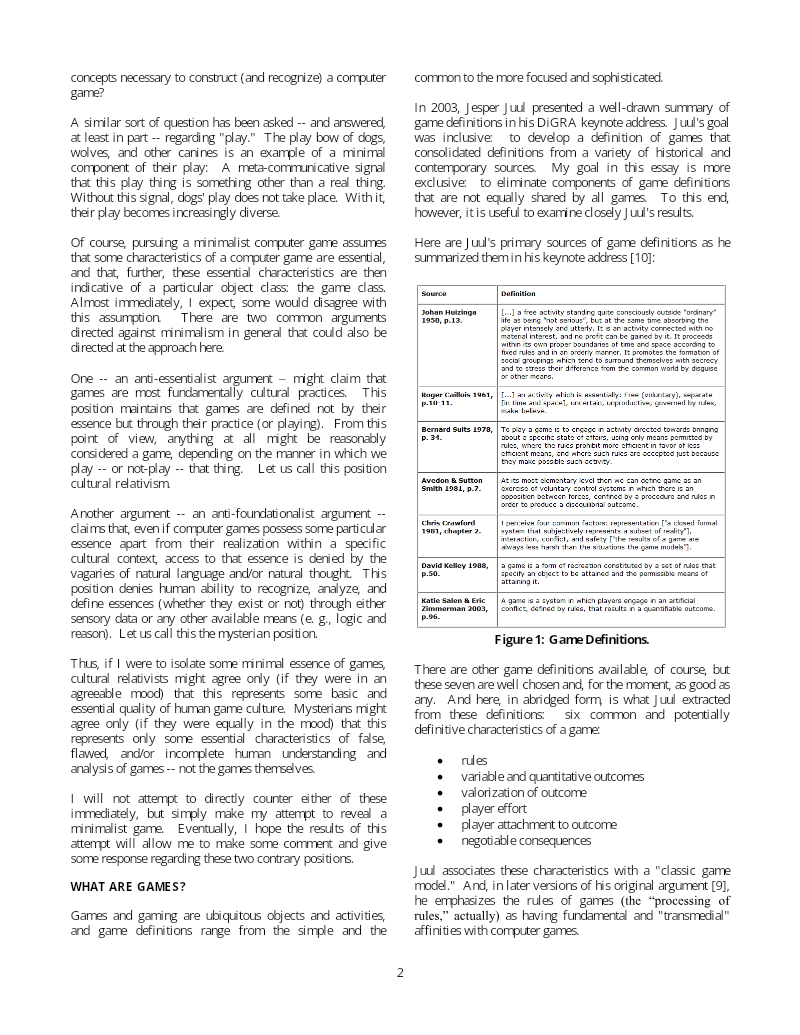
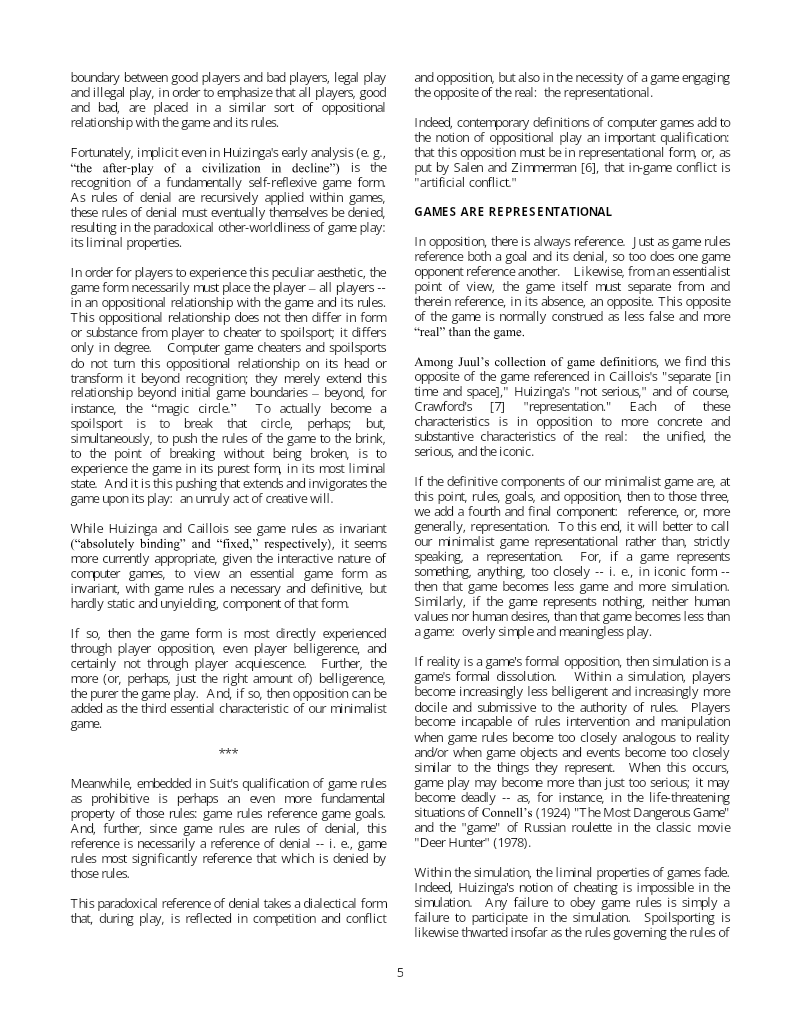
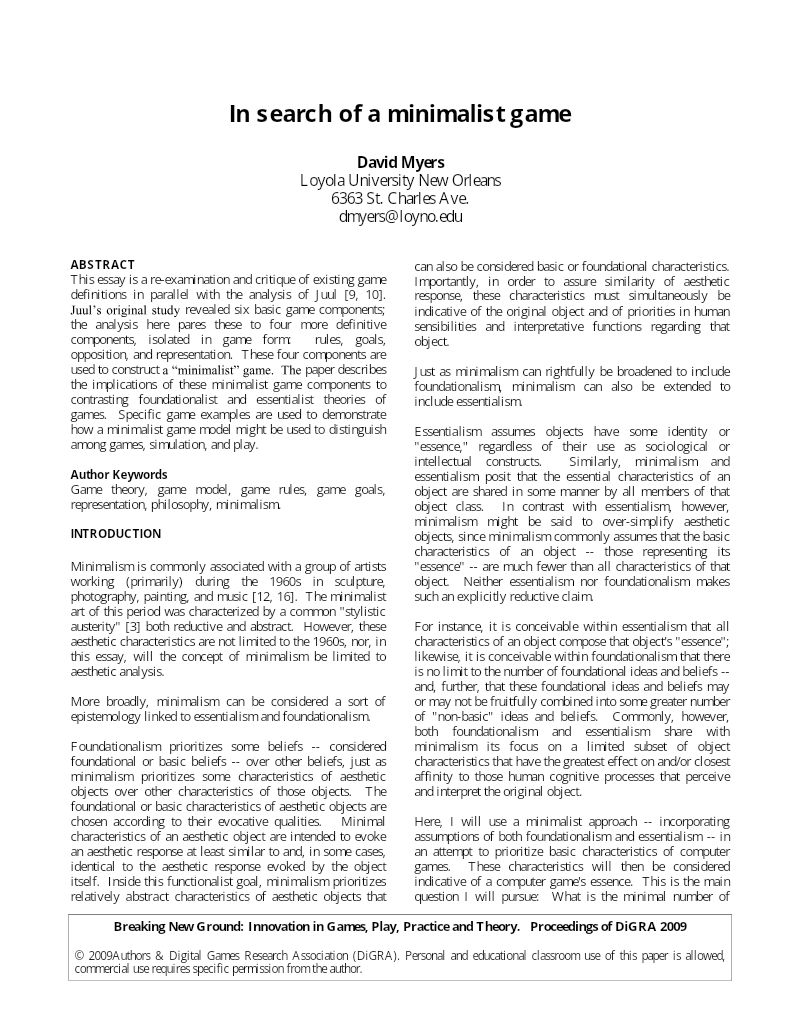
Myers reduces Jesper Juul's six components of games to four essential elements: prohibitive rules, goals, opposition between player and rules, and representation.
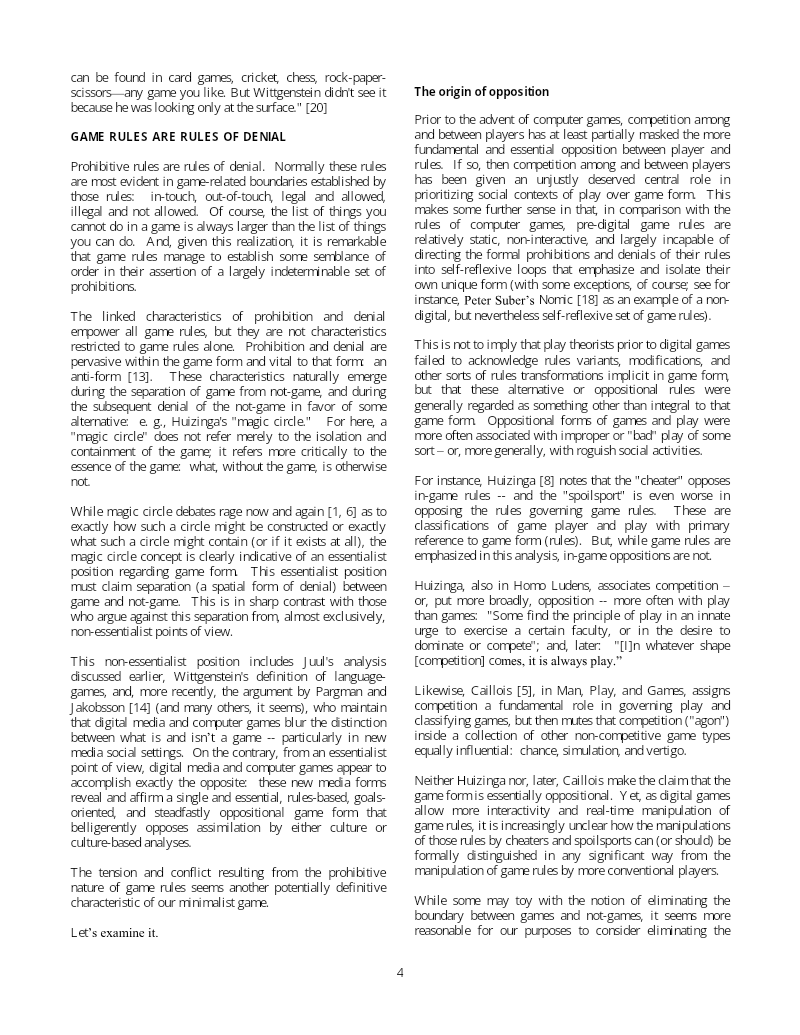
David Myers' essay seeks to isolate a minimalist definition of games by reducing Jesper Juul's six components to four essential elements: prohibitive rules, goals, opposition between player and rules, and representation. Drawing on foundationalist and essentialist philosophy, the argument sets aside player effort, attachment, and cultural context as difficult to measure, and treats rules and goals as the most formally observable core. Central to the thesis is the claim, developed through Bernard Suits and Wittgenstein, that game rules are fundamentally "rules of denial" that prohibit the most efficient means of achieving a goal, and that this self-reflexive prohibition generates the opposition defining the play experience.
The essay builds this model against non-essentialist positions, including those of Juul, Wittgenstein, and Pargman and Jakobsson, who argue that digital games blur the boundary between game and not-game. Myers counters that a liminal space, often described as the "magic circle," must remain distinct for something to qualify as a game. He contends that representation is essential, since games that become either too simulation-like or too arbitrary lose their defining character. The four-part model is offered as a practical tool for classification, with a crossword serving as an example of an activity that falls outside the definition because it lacks opposition.
The analysis then tests the framework against objections, notably the charge that its components are arbitrary artifacts of a particular cultural tradition. The essay concedes that opposition can transform a puzzle into a game and that cultural variation may alter the relative strength of each component, yet it cautions that unbounded relativism would dissolve game studies into social and cultural inquiry. The conclusion holds that an essentialist foundation must be defended against such challenges to preserve the discipline's distinct identity.
DiGRA · 2019
DiGRA · 2019
DiGRA · 2019
DiGRA · 2019



DiGRA · 2019
DiGRA · 2019
DiGRA · 2019
DiGRA · 2019
DiGRA · 2019
DiGRA · 2019
DiGRA · 2019
DiGRA · 2019












Comments