
DiGRA
The Digital Games Research Association: the international association of academics and professionals who study digital games. Its Digital Library holds the proceedings of the DiGRA conferences since 2002.
Documents

"He Could Be a Bunny Rabbit for All I Care": Exploring Identification in Digital Games
Shaw's study examines whether players of digital games identify with on-screen characters, challenging the widely held assumption that identity-matching between player and character drives identification.
- Challenging the common assumption, the study finds that player-character identity-matching does not reliably drive identification: interviews with 27 players from marginalized groups (plus their partners) showed identification was inconsistent and often absent, with interviewees split roughly evenly on whether they connected with their characters.
- Interactivity tends to make players self-reflexive, directing attention toward their own actions, bodies, and social contexts rather than the perspective of the character they control.
- Identification depends on narrative depth, a game's ludic and interactive properties, game type, and the social or physical context of play; abstract avatars and weak narratives limit it, while strong storytelling can draw players into even non-humanoid characters.


Understanding Player Experience Using Sequential Analysis
This paper argues that player experience cannot be fully understood through static measures such as surveys and focus groups, because the order in which players' emotional and behavioural states unfold carries meaningful information beyond their overall totals.
- Static measures like surveys and focus groups miss information carried by the order in which players' emotional and behavioural states unfold; sequential analysis captures that additional signal.
- The authors built a behavioural coding scheme covering frustration, boredom, curiosity, engagement, and engrossment, which showed inter-observer agreement with Cohen's Kappa between .74 and .91, indicating it can be applied reliably by different observers.
- In a repeated-measures study of ten participants playing two early iPhone games, the higher-rated title (6.6) produced significantly more engagement in both frequency and cumulative duration, while the lower-rated title (4.1) elicited more frustration and curiosity and more frustration-to-curiosity transitions.

Do Players Prefer Integrated User Interfaces? A Qualitative Study of Game UI Design Issues
A qualitative study of Assassin's Creed, conducted around 2011, examines whether integrated game interfaces make players more involved than traditional heads-up displays.
- Removing superimposed interface elements does not by itself increase player involvement, since involvement is a multidimensional experience that varies across individuals.
- Players generally accept overlay UI elements when they deliver clear, relevant, gameplay-useful information, though many still find integrated designs more elegant.
- Interface preferences reflect underlying player orientations (imaginative, challenge-based, and sensory immersion players) rather than dictating how people engage with a game.
Casual Mobile Gameplay: On Integrated Practices of Research, Design and Play
The document argues that casual mobile games such as cubodo blur the boundary between play and everyday life, and that studying and designing them therefore requires research, design, and play to be integrated rather than separated.
- The report argues that casual mobile games like cubodo blur the line between play and everyday life, so research, design, and play should be integrated rather than kept separate.
- It proposes a "Living Lab" model, embodied in the Mobile Game Lab within Germany's "Landmarks of Mobile Entertainment" project, in which mobile games are playtested in players' everyday contexts instead of stationary laboratories.
- A December 2010 Bremen study of 12 cubodo players found play was dispersed through daily routines, with 88% of sessions consisting of brief "situation checks."


Game Spaces Speak Volumes: Indexical Storytelling
Clara Fernández-Vara's DiGRA 2011 paper proposes "indexical storytelling" as a refinement of environmental storytelling, drawing on Peirce's semiotics to argue that game spaces can convey narrative through physical traces that players must interpret in order to progress.
- Clara Fernández-Vara's DiGRA 2011 paper proposes "indexical storytelling," a refinement of environmental storytelling grounded in Peirce's semiotics, in which physical traces in game spaces must be interpreted by players to progress.
- Indexical traces differ from mere world-building backdrops because they are directly bound to gameplay and may record either the game world's past or the player's own actions.
- The argument is primarily conceptual, drawing on GDC 2010 industry talks by Richard Rouse and Smith and Worch and supported by illustrative examples rather than quantitative evidence.
Online Video Games in Brazilian Public Health Communication
This paper, drawn from an ongoing doctoral dissertation, examines the potential of online video games, particularly massively multiplayer online role-playing games (MMORPGs), as a channel for public health communication in Brazil.
- Brazil's Unified Health System (SUS) relies heavily on centralized, prescriptive, and unidirectional communication, which tends to ignore local contexts and is less effective with young audiences.
- The authors propose online video games, particularly MMORPGs, as an interactive, dialogic channel that combines entertainment with health education.
- MMORPGs suit health messaging because players progress at their own pace, allowing content to be tailored to individual interests and limitations.
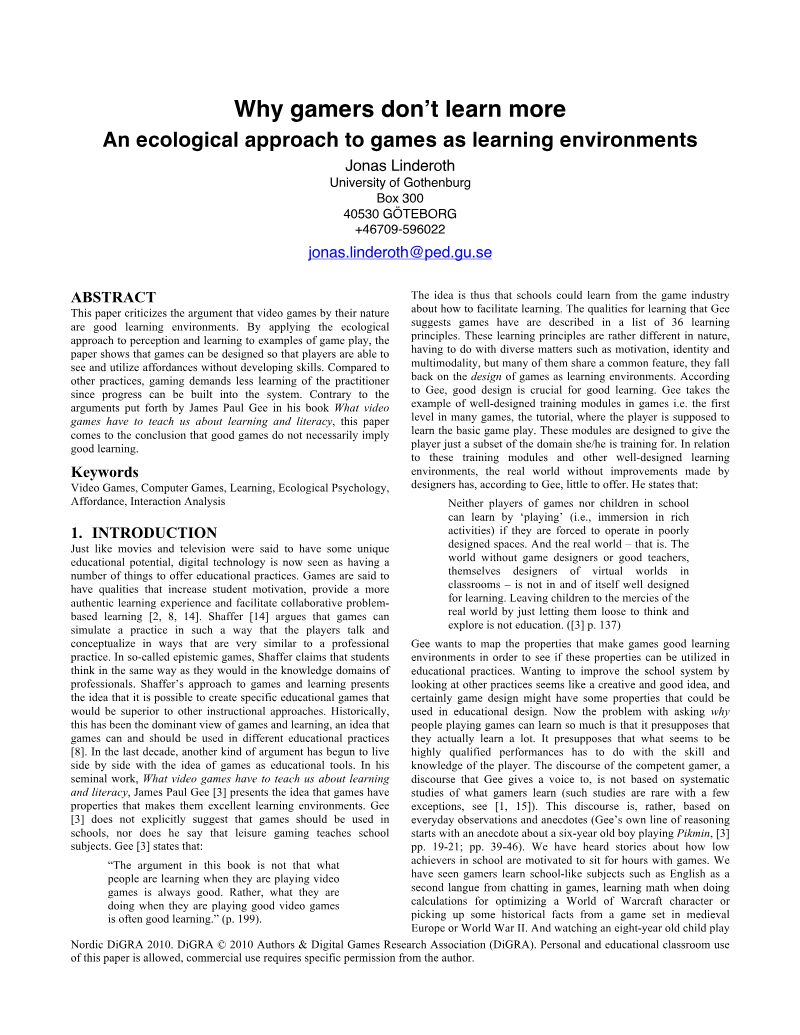
Why Gamers Don't Learn More: An Ecological Approach to Games as Learning Environments
Linderoth's paper challenges the widely held assumption that well-designed games are inherently good learning environments.
- Linderoth argues that well-designed games are not inherently good learning environments: players can perform complex tasks and perceive affordances without developing the corresponding skills, challenging James Paul Gee's claim that good games teach.
- Gee's claim is found by the author to rest mainly on anecdote rather than systematic evidence, so the relationship between game design and learning is treated as an open empirical question.
- The central evidence is an interaction analysis of two players, an eight-year-old and a 36-year-old, playing LEGO Indiana Jones 2, interpreted through the ecological approach to perception and Gibson's concept of tools.


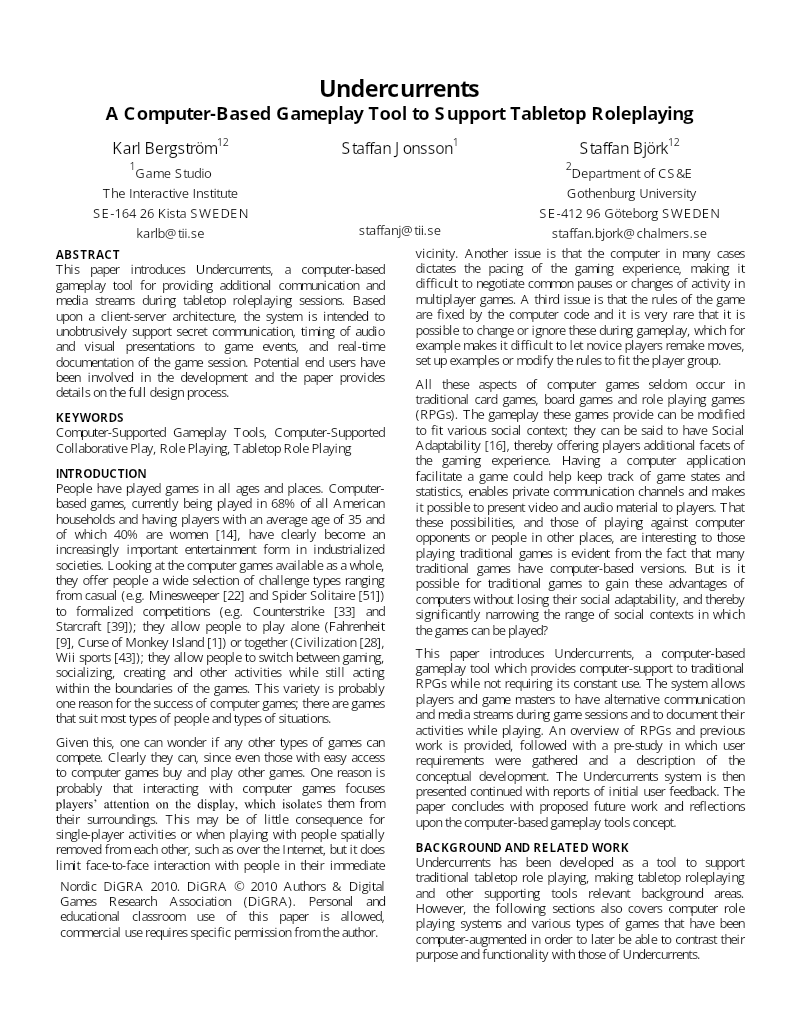
Undercurrents: A Computer-Based Gameplay Tool to Support Tabletop Roleplaying
Undercurrents is a computer-based tool designed to support tabletop roleplaying without dictating its rules, pacing, or social dynamics.
- Undercurrents is a computer-based tool that supports tabletop roleplaying without dictating its rules, pacing, or social dynamics, based on the thesis that computers add most value when they are under player control rather than acting as game authorities.
- The tool was designed to address limitations of traditional computer role-playing games, which impose fixed rules and rhythms, and offers features such as secret player-to-GM messaging, timed audio-visual presentations, and a real-time session wiki.
- Design requirements were gathered from three focus groups of tabletop game masters, all male and aged 16 to 45.
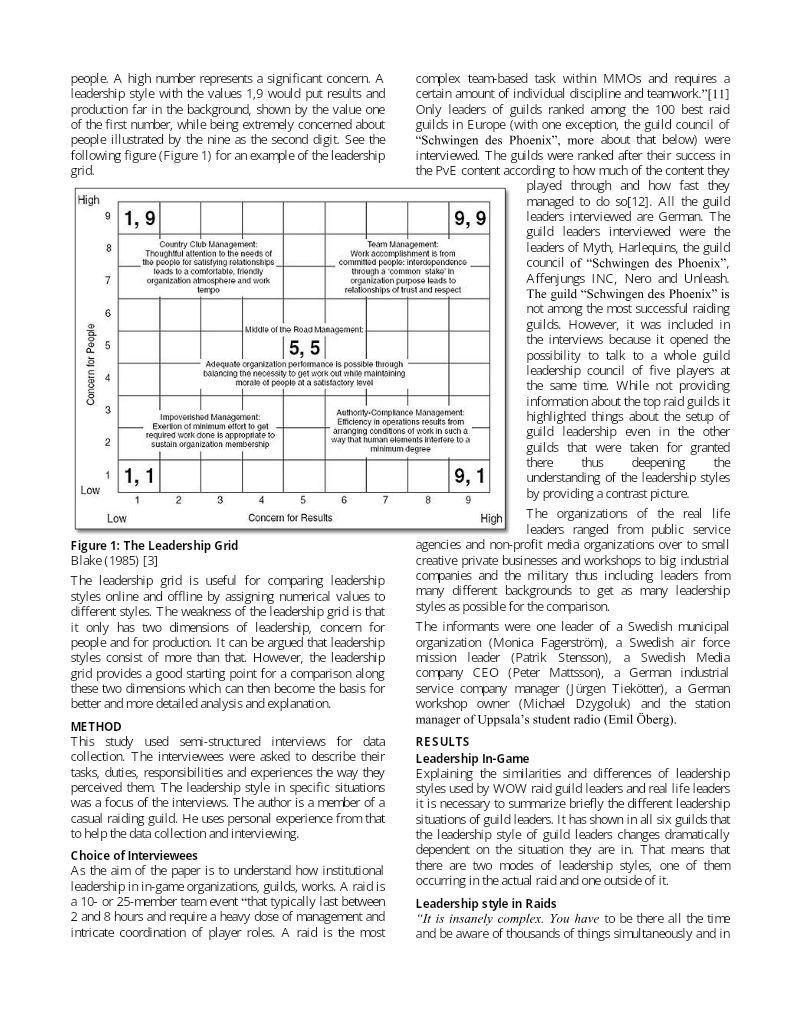

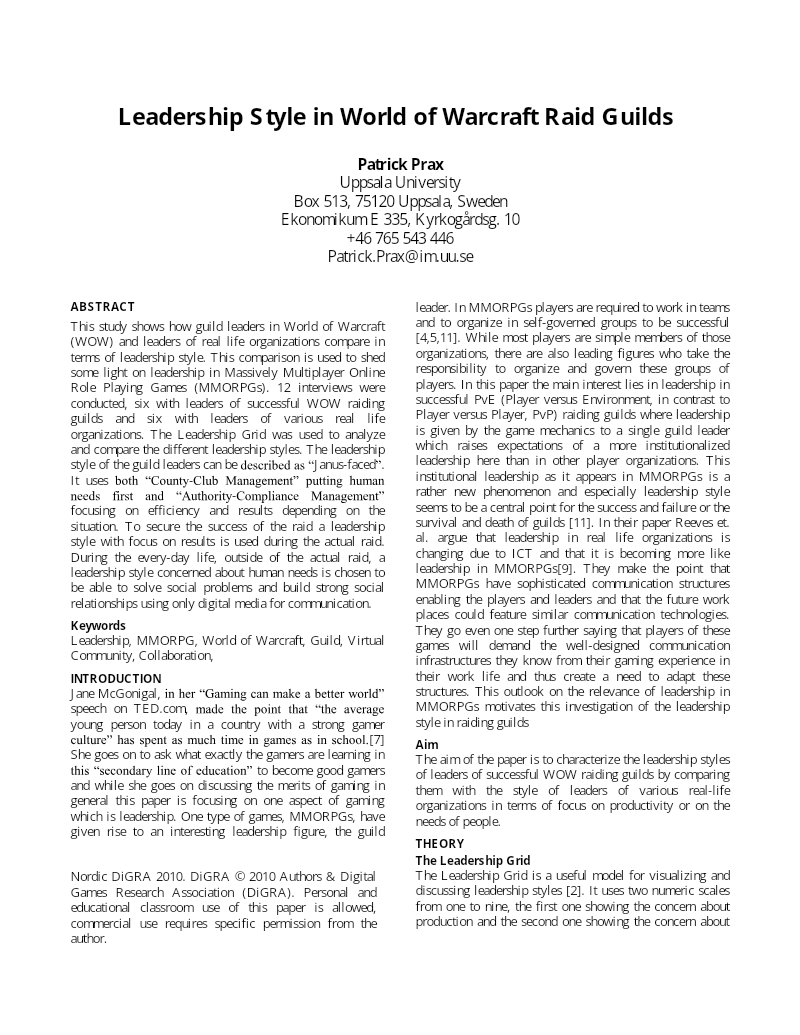
Leadership Style in World of Warcraft Raid Guilds
Patrick Prax's study examines how leaders of World of Warcraft raiding guilds manage their organizations, comparing their approaches with those found in real-life settings.
- Guild leaders behave in a 'Janus-faced' manner, switching between a results-focused, authority-compliance style during raids (scoring 9,1 on the Leadership Grid) and a people-focused, country-club style in everyday guild life that prioritizes members' social satisfaction, enjoyment, and sense of achievement.
- Raid stability is costly: a single absent player can force a raid cancellation, and that failure can cascade into the collapse of the guild, which is why leaders adopt a strict results orientation during raids.
- The study compares two guilds at opposite ends of the spectrum: Harlequins never lost a member to another guild, while Affenjungs INC relied on a small core social circle, treated other members as 'disposable tools,' and suffered high turnover.

And Justice for All: The 10 Commandments of Online Games, and Then Some
This paper examines the rules that players themselves create to govern guilds in massively multiplayer online games (MMOGs) and clans in first-person shooter (FPS) games.
- The study analyzed 30 publicly posted player-authored rule sets (20 MMOG guilds and 10 FPS clans) from a convenience sample, framing them as a form of governance that fills gaps left by formal game rules, which the authors call "implicit rules."
- Both genres share a zero-tolerance stance toward racist and sexist remarks and common definitions of cheating, with variation mainly in how sanctions are applied and how strictly commitment is enforced.
- Raiding guilds and competitive clans use more instrumental, results-oriented structures, while MMOG guilds prioritize social cohesion and rely mainly on warnings as their principal sanction.


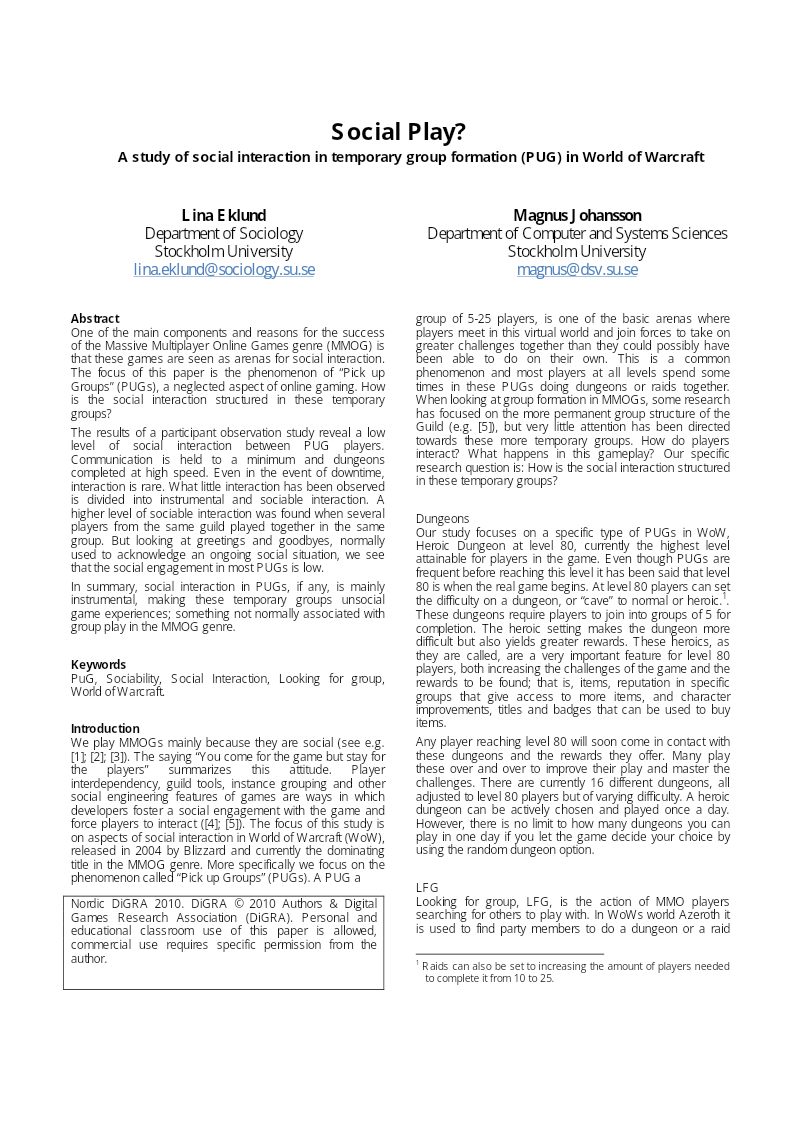
Social Play? A Study of Social Interaction in Temporary Group Formation (PUG) in World of Warcraft
Drawing on 24 recorded random dungeon runs in World of Warcraft, this study examines social interaction in pick-up groups (PUGs), the temporary teams players form to complete dungeons with strangers.
- Pick-up group interaction in World of Warcraft dungeons is predominantly instrumental, focused on tactics, rewards, and task completion, with greetings, farewells, and rapport-building rare.
- The study, based on 24 recorded random dungeon runs, characterizes PUGs as largely "unsocial" when measured against the social expectations commonly associated with massively multiplayer online games.
- Sociable exchanges occur mainly when group members already share a guild or prior acquaintance, indicating that social engagement depends on existing ties rather than arising spontaneously in temporary groups.

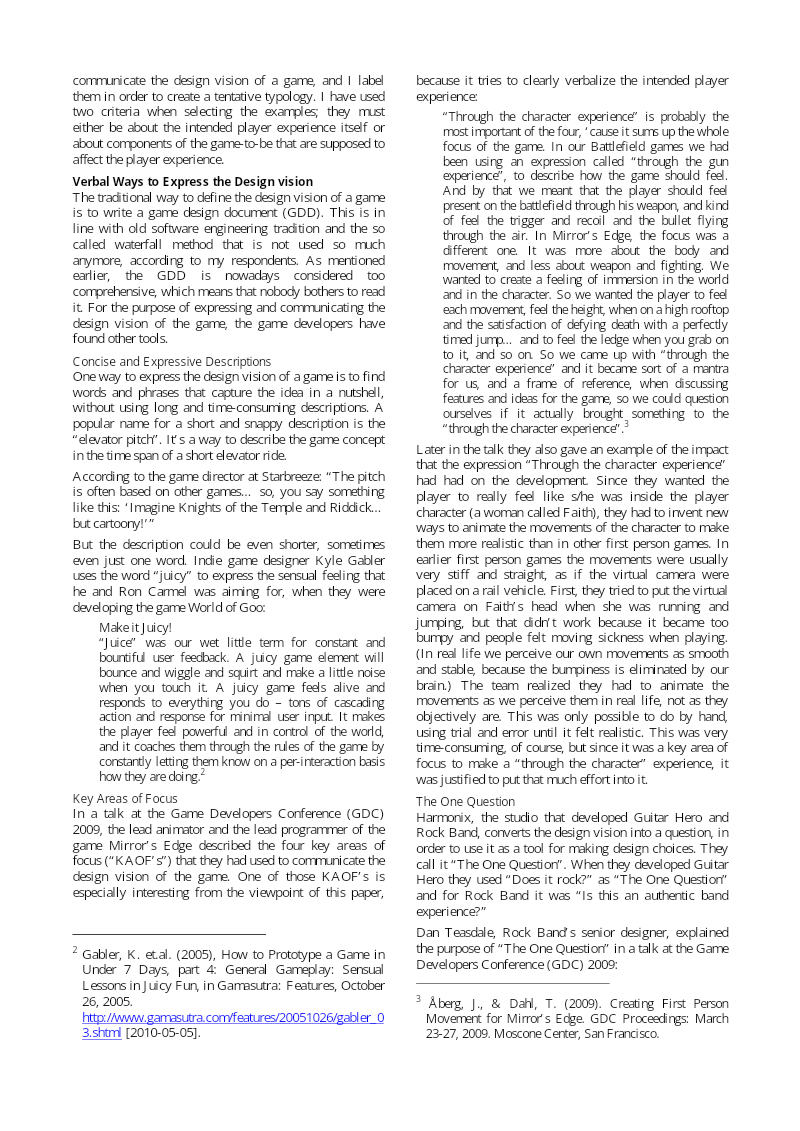
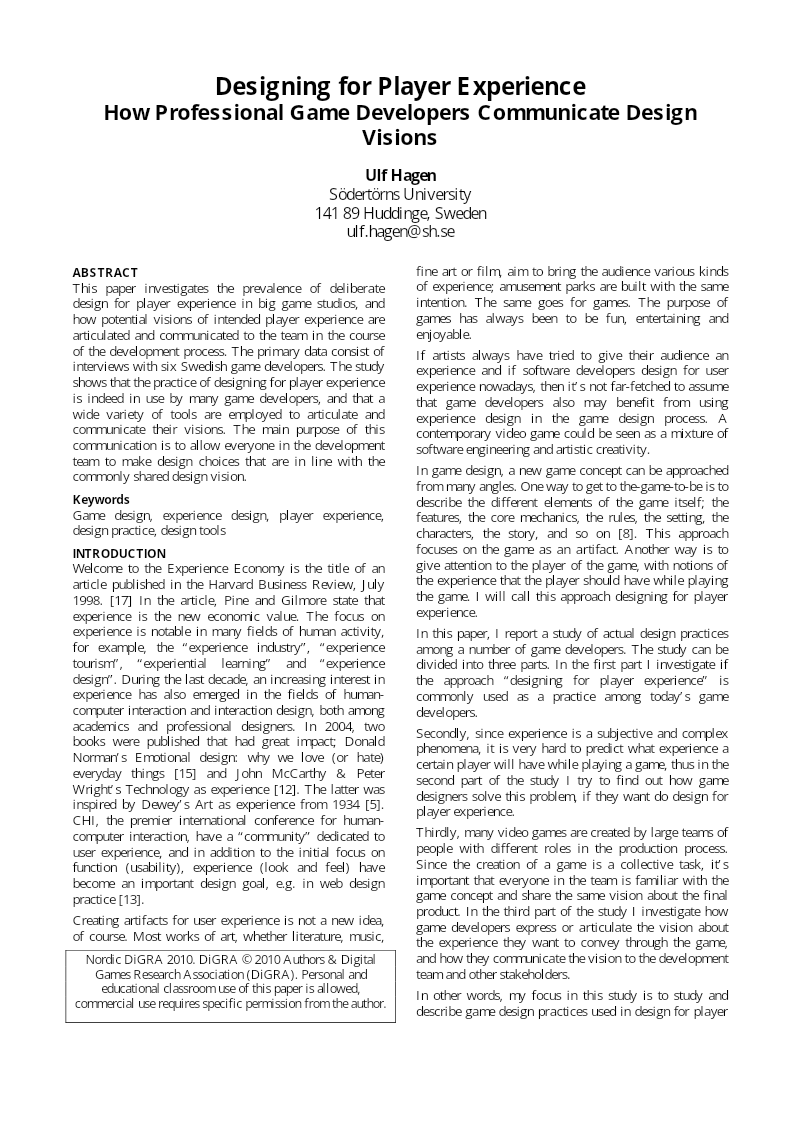
Designing for Player Experience: How Professional Game Developers Communicate Design Visions
Hagen's study examines how professional game developers articulate and communicate the intended player experience of their games, focusing on Swedish studios.
- Designing for player experience, meaning the feelings a player should have rather than mechanics alone, is a widely practiced approach among professional developers, according to Hagen's study of six interviews with developers from five major Swedish studios.
- Strong game development depends on communicating a shared design vision so that team members can be creative within a common framework across large, multidisciplinary groups.
- Studios such as Dice, Harmonix, Avalanche, and Starbreeze communicate their visions through concise descriptors, similes, anti-exemplars, concept art, animation, and music rather than lengthy documents.