
DiGRA
The Digital Games Research Association: the international association of academics and professionals who study digital games. Its Digital Library holds the proceedings of the DiGRA conferences since 2002.
Documents
The Design of Narrative as an Immersive Simulation
This paper argues that narrative in video games is emerging as the design of an immersive simulation, arising from the tension between two game formats: character-oriented games, which build immersion through embodied presence in navigable 3D worlds, and simulation games, which model complex systems and reward the observation…
- Narrative in video games is increasingly framed as the design of an immersive simulation, arising from the tension between character-oriented games (immersion through embodied presence in navigable 3D worlds) and simulation games (modeling complex systems over time).
- The paper treats agency, the satisfying power to take meaningful action and witness its consequences, as the foundational premise for games as a narrative form.
- Drawing on Gibson's affordances and the Umwelt concept of Jakob and Thure von Uexküll, the author argues that presence and agency depend on how well a player's virtual body can perform meaningful tasks, and that embodiment can enable alternative perceptions of reality.

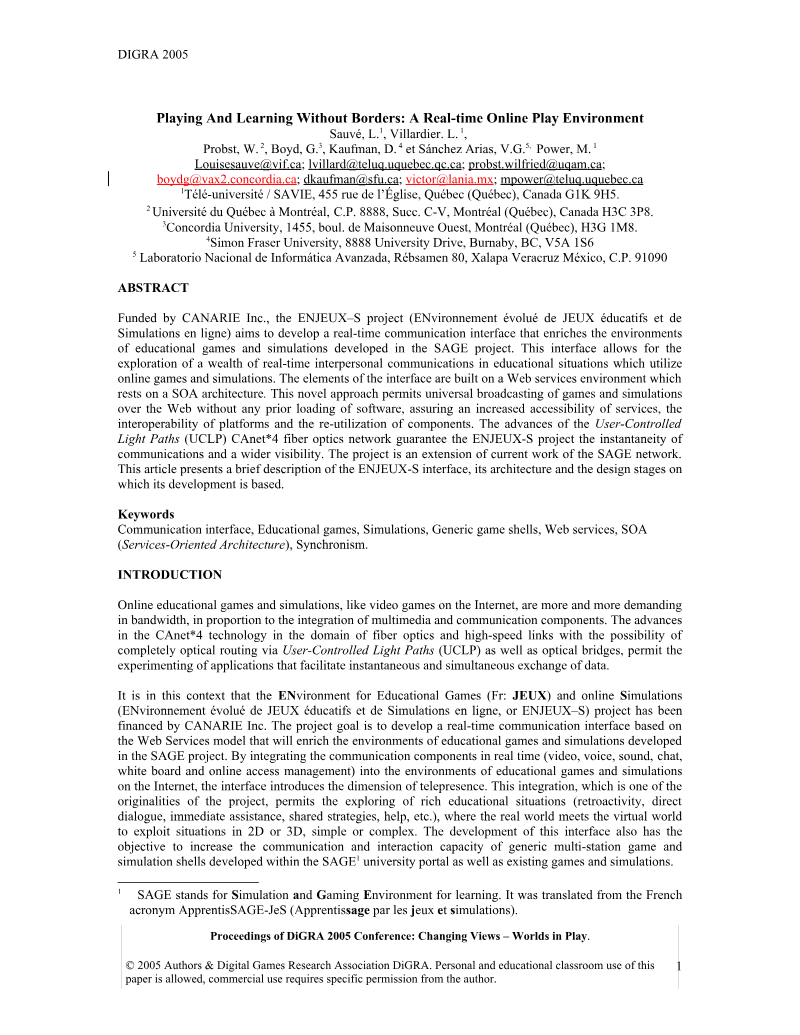
Playing and Learning Without Borders: A Real-Time Online Play Environment
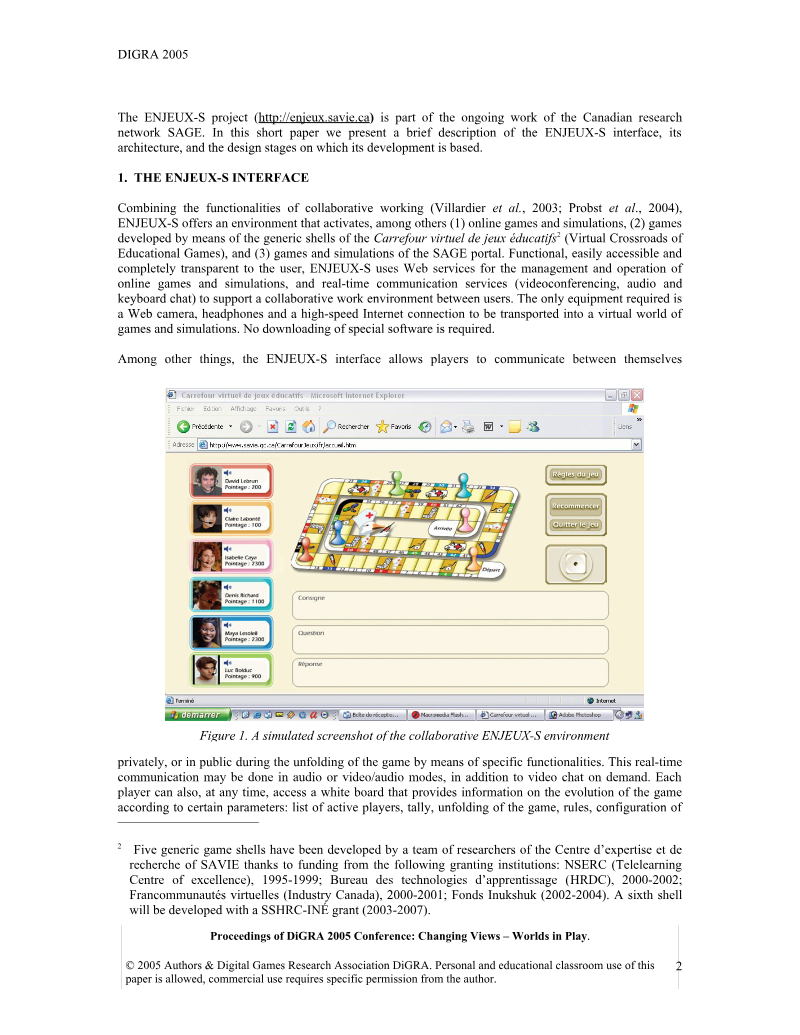
The ENJEUX-S project, funded by CANARIE Inc., presents a real-time online communication interface designed to enrich educational games and simulations developed within the SAGE network.
- The ENJEUX-S project, funded by CANARIE Inc., adds real-time telepresence to browser-based educational games in the SAGE network by integrating video, voice, chat, whiteboard, and access management directly into game environments.
- The system uses a service-oriented architecture built on Web services (XML/SOAP, WSDL, UDDI), a Flash client layer, a network layer over the CAnet4 high-speed fiber backbone with IPv6 support, and a server layer combining a Flash Communication server, data server, and database.
- Users need only a webcam, headphones, and a high-speed connection, with no special software downloads required.
Games, Montage, and the First Person Point of View
Michael Nitsche's paper examines interactive montage in video games, focusing on cuts to and from a first person point of view.
- Montage in video games differs from film because the player initiates each cut, and cuts succeed when they reinforce the player's spatial positioning and control within the virtual environment.
- Player-triggered cuts remain comprehensible when spatial continuity is preserved, even when they break conventions such as the axis of action.
- Siren's 'sight-jacking' feature is presented as a counterexample: complex, changing visualizations weaken player positioning, making the game harder to read and play.

Towards an Ontological Language for Game Analysis
"Towards an Ontological Language for Game Analysis" presents the Game Ontology Project (GOP), a hierarchical framework for describing and analyzing games in terms of their structural elements.
- The Game Ontology Project (GOP) is a hierarchical framework that aims to give game studies and design a shared analytical vocabulary, built inductively from many specific games using prototype theory and grounded theory.
- Rather than classifying games by genre or cataloguing design patterns, the framework takes a black-box, player-perceived perspective that deliberately sets aside representational features such as setting and theme.
- At the top level, games are described through five elements: interface, rules, goals, entities, and entity manipulation, which are then elaborated into finer distinctions such as gameplay, gameworld, and rule-synergy rules.

Place Space & Monkey Brains: Cognitive Mapping in Games & Other Media
Erik Champion's paper examines how architecture and game design relate to the perception and memory of space, and proposes a research program to test whether interactive three-dimensional games engage spatial cognition differently from film and literature.
- Erik Champion's paper is a conceptual, hypothesis-driven proposal rather than a completed empirical study, arguing that interactive 3D games engage spatial cognition differently from film and literature.
- The core hypothesis is that the embodied, ergodic experience of games produces a sequential spatial memory that passive episodic media like film and non-interactive books do not.
- Support for the hypothesis is anecdotal: a virtual heritage project on Mayan sites found task performance depended on which building cluster participants navigated and whether they could gain an overview of the site, and psychology students reported improved spatial memory after playing first-person shooters.
Virtual Worlds in Asia: Business Models and Legal Issues
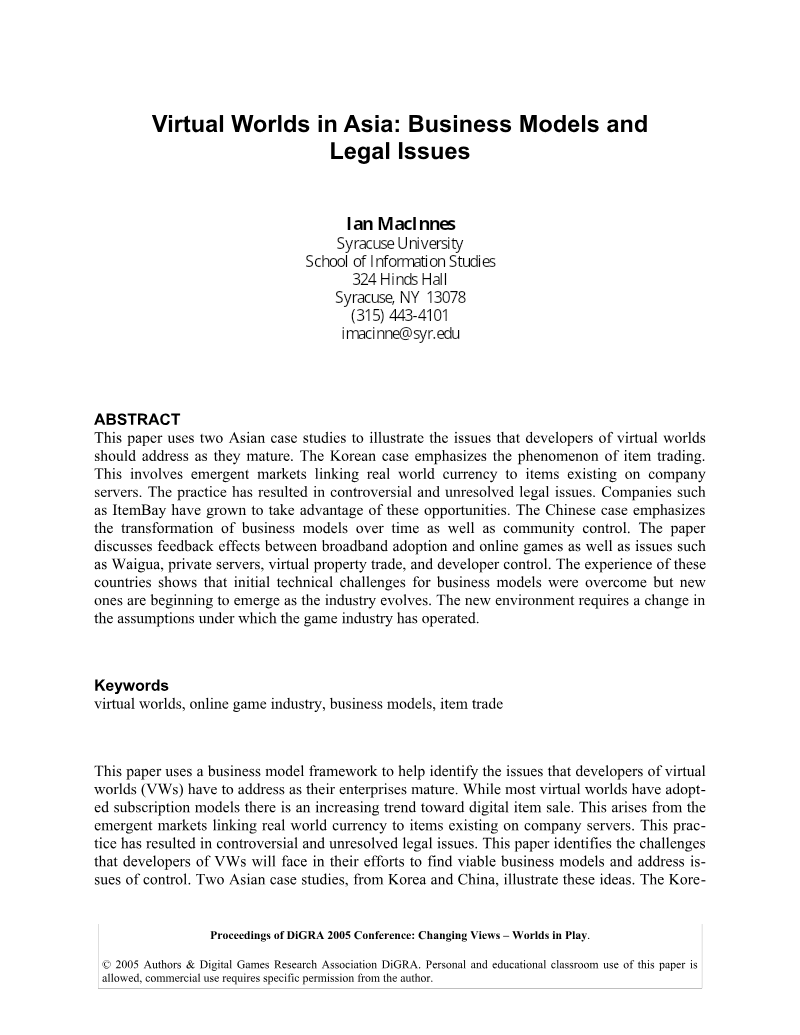
This paper examines the business models and legal challenges facing virtual world developers as their enterprises mature, using Korea and China as case studies.
- The central argument is that early technical obstacles for virtual world businesses have largely been overcome, while new environmental, security, and governance challenges now demand a fundamental rethinking of the game industry's guiding assumptions.
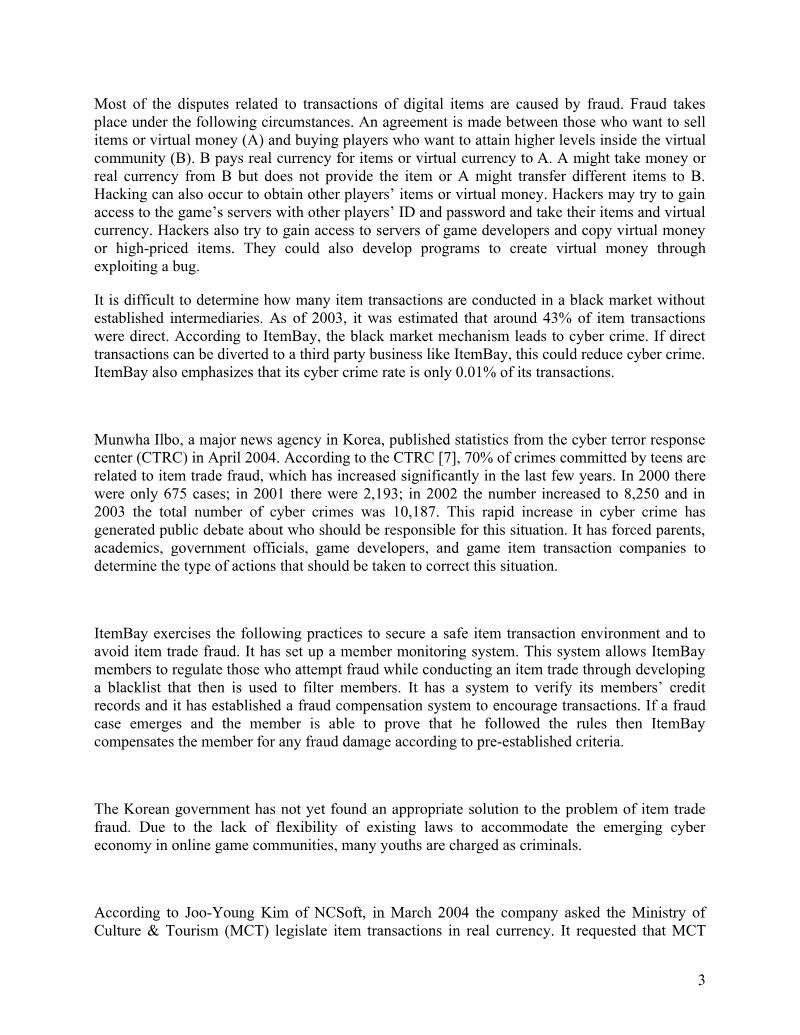
- Korea's item trading market, where real-world currency is exchanged for digital items stored on company servers, exceeded $200 million in transactions in 2004 and supported more than 300 item trade companies.
- Korean developers sharply disagree on item trading: NCSoft opposes it, while smaller developers see it as a way to attract players, and a 2003 industry survey ranged from outright prohibition to unrestricted individual trade.

Machinima: Digital Performance and Emergent Authorship
This workshop paper, authored by John Carroll and David Cameron of Charles Sturt University, examines machinima, the practice of repurposing video game engines and off-the-shelf software such as Halo and The Sims 2 to produce dramatic works.
- Machinima repurposes video game engines and off-the-shelf software such as Halo and The Sims 2 to produce dramatic works, which the authors, John Carroll and David Cameron of Charles Sturt University, argue is an emergent form of digital performance and authorship.
- The authors frame machinima through process drama conventions, particularly role distance and role protection, as a way to understand player agency in game-based performance.
- The history of machinima is traced to recording modes introduced in id Software's DOOM in 1994, which let players capture and share gameplay and later evolved into scripted parodies and episodic productions.

Sex in Games: Representing and Desiring the Virtual
Schott's study of sexual content in games, presented at DiGRA 2005, examines how interactivity and game aesthetics are expanding pornographic territory and reshaping how desire is constituted.
- The paper traces how sexual content in games moved from the margins to mainstream titles, citing early comedic adult games such as Leisure Suit Larry and Golgo 13 and later community-made nude patches for The Sims and celebrity-based adult skins.
- The author argues that virtual characters, celebrity culture, and pornography increasingly blur together, citing the topless Karen Walker cut-scene in Siberia and fan-made nude Lara Croft content as examples.
- Drawing on Baudrillard, Gaines, and Lacan, the paper contends that digital pornographic forms create a 'hyperreal' blend of looking and touching that intensifies voyeuristic desire.
History of Digital Games in Turkey
This paper, a DiGRA 2005 conference study by Erdal Yılmaz and Kürşat Çağıltay of Middle East Technical University, traces the history of digital games in Turkey and assesses the state of its game development industry.
- Turkish players' habits and play durations parallel global averages, but domestic game development has been extremely limited and poorly documented.
- Digital games reached Turkey in the early 1980s via arcade-style "Atari Salonu" halls, which prompted a 1985 regulatory response requiring local permits.
- Turkish home game development passed through three phases: an amateur 1980s period built on the Commodore 64 and magazine-published source code, a semi-professional 1990s period centered on Amiga and PC groups like Siliconworx and Compuphiliacs, and a professional stage from 2000 onward.
A Sociotechnical Conjecture About the Context and Development of Multiplayer Online Game Experiences
This conceptual essay argues that multiplayer online game experiences are sociotechnical constructions whose meaning is continuously co-produced by designers and players, and that development does not end at launch but extends into play itself.
- Multiplayer online game experiences are framed as sociotechnical constructions whose meaning is continuously co-produced by designers and players rather than fixed at launch.
- The central thesis is that 'playing is authoring': designers inscribe rules, roles, and arenas, while players reinterpret and rewrite these conditions through their actions.
- Game design sets up conditions for emergent experience rather than predetermining outcomes, making social interaction the principal driver of what unfolds in a match or community.
Among Pasta-Loving Mafiosos, Drug-Selling Columbians and Noodle-Eating Triads: Race, Humour and Interactive Ethics in Grand Theft Auto III
This paper, a 2005 DiGRA contribution by Dymek and Lennerfors, examines how Grand Theft Auto III handles race, humour, and ethics.
- The paper argues that video games are a meaningful medium through which cultural meanings and social issues such as race circulate and can be critiqued, while noting that games scholarship has paid comparatively little attention to race and humour.
- Using Critical Race Theory, the authors read Grand Theft Auto III's exaggerated gang caricatures (Italian mafiosos, Colombian drug sellers, triad members) as potentially perpetuating white supremacy and racial stereotyping.
- Drawing on Schopenhauer's incongruity theory of humour, the paper proposes that the game's caricatures may clash with players' prior assumptions, prompting reflection on their own racial beliefs rather than merely expressing superiority.
Liberal Sims?: Simulated Difference and the Commodity of Social Diversity
Curlew's paper argues that The Sims, widely praised as socially progressive for its treatment of same-sex relationships, racial equality, and the non-sexualized presentation of women, owes its inclusiveness less to a genuine shift in cultural ideology than to a change in how marginalized consumers are marketed to under late…
- Curlew argues that The Sims' praised inclusiveness stems less from genuine ideological change than from late-capitalist marketing that targets marginalized consumers, drawing on Stuart Hall's concept of the commercial appropriation of difference.
- The paper contends that the 1990s expansion of gaming markets, combined with corporate embrace of diversity, led producers to incorporate marginalized groups for financial rather than principled reasons.
- On gender, the game gives male and female Sims equal capabilities and does not sexualize women, yet its emphasis on domesticity, shopping, child-rearing, and interior design is read as a strategy to attract women while reinforcing stereotyped feminine roles.