
DiGRA
The Digital Games Research Association: the international association of academics and professionals who study digital games. Its Digital Library holds the proceedings of the DiGRA conferences since 2002.
Documents
Opening the Production Pipeline: Unruly Creators
This paper examines how game developers increasingly depend on the voluntary creative labour of fan content creators, using an ethnographic account of Auran, an Australian PC game developer, and its work on the train simulation Trainz between mid-2000 and 2004.
- The paper argues that fan creator labour in games cannot be dismissed as exploitation of unknowing fans, since participants are aware of the arrangement and engage as sophisticated practitioners, making entanglements between commercial and non-commercial activity unavoidable.
- Auran, an Australian PC developer, adopted third-party fan collaboration on Trainz (2000–2004) largely as a contingent response to weak sales and rising art production costs rather than as a deliberate long-term strategy.
- Auran integrated fan-made content into official releases, including Ultimate Trainz Collection (2002) and Trainz Railroad Simulator 2004, where 35 creators contributed content to the 2004 CD release, producing high-quality assets.
Game, Motivation, and Effective Learning: An Integrated Model for Educational Game Design
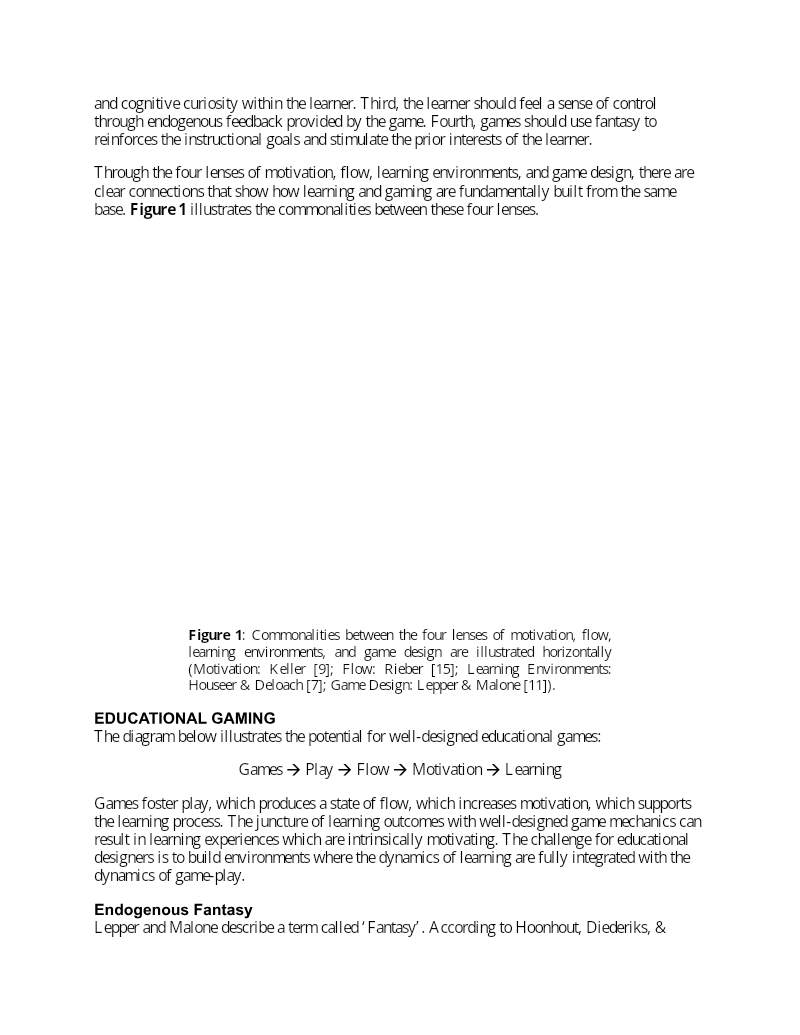
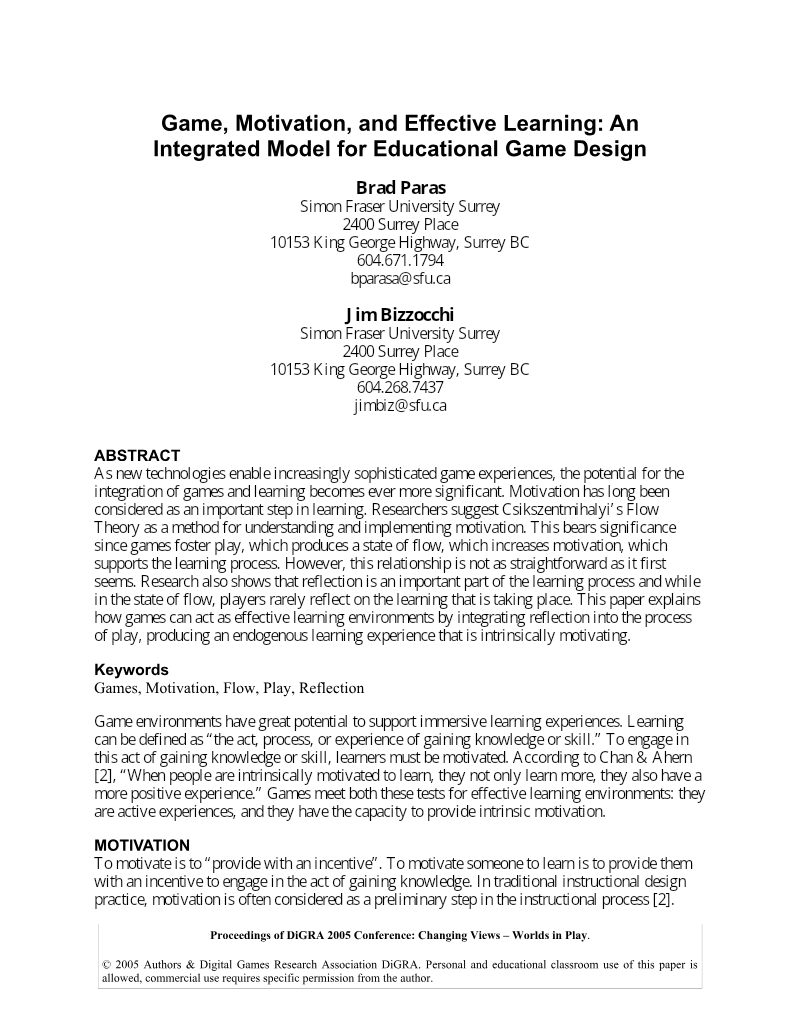
This paper presents a theoretical framework for designing educational games that produce intrinsically motivated learning.
- Educational games can produce intrinsically motivated learning through a chain of play leading to flow, flow increasing motivation, and motivation supporting learning, but this chain is not automatic.
- Players in a flow state rarely reflect on what they are learning, so the authors argue reflection must be embedded within gameplay so learning happens inside the immersive 'magic circle' rather than interrupting it.
- The framework integrates Keller's ARCS model (attention, relevance, confidence, satisfaction), Csikszentmihalyi's flow theory, Norman's seven requirements for effective learning environments, and Lepper and Malone's principles of challenge, curiosity, control, and fantasy.
The Nip and the Bite
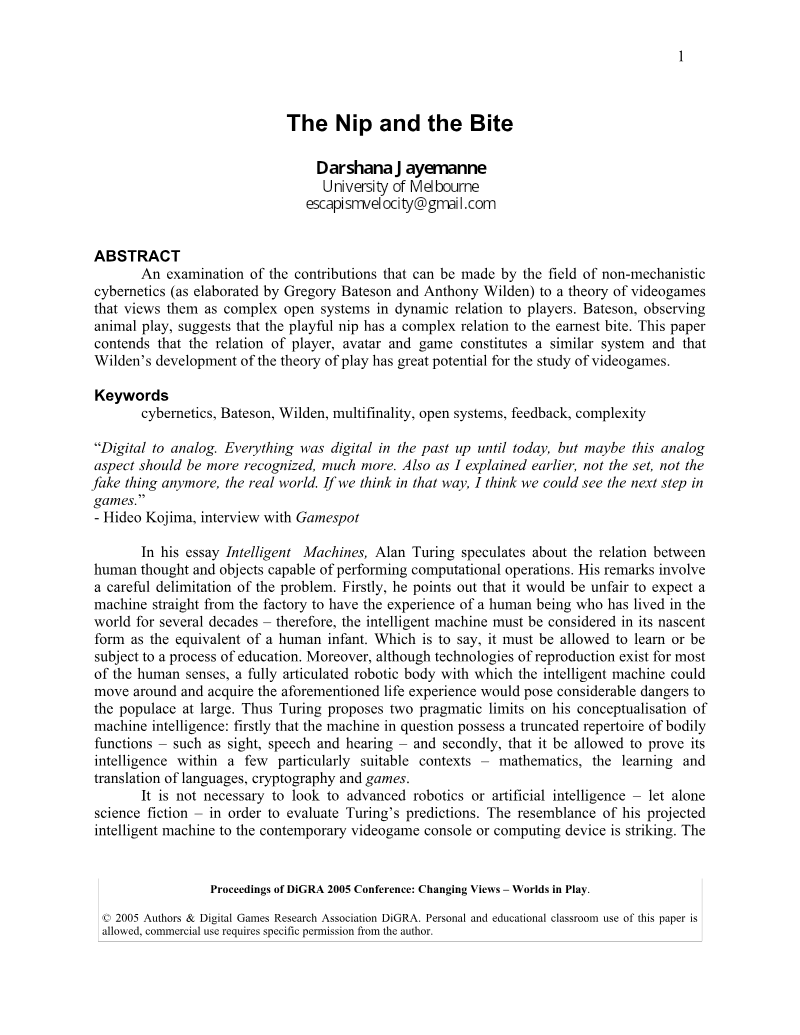
Darshana Jayemanne's paper applies the non-mechanistic cybernetics of Gregory Bateson and Anthony Wilden to videogames, treating them as complex open systems in dynamic relation to their players.
- Darshana Jayemanne applies non-mechanistic cybernetics (Gregory Bateson and Anthony Wilden) to videogames, treating them as complex open systems in dynamic relation with their players.
- Bateson's concept of the "nip" in animal play-fighting, a gesture resembling a bite that metacommunicates "this is play," serves as the paper's central analogy for how games signal their own fictional framing.
- Wilden's distinction between analogue and digital communication underpins the framework, with primary digitalisation (the nip) and secondary digitalisation (negation and the emergence of a subject) describing how meaning and selfhood arise.

The Things We Learned on Liberty Island: Designing Games to Help People Become Competent Game Players
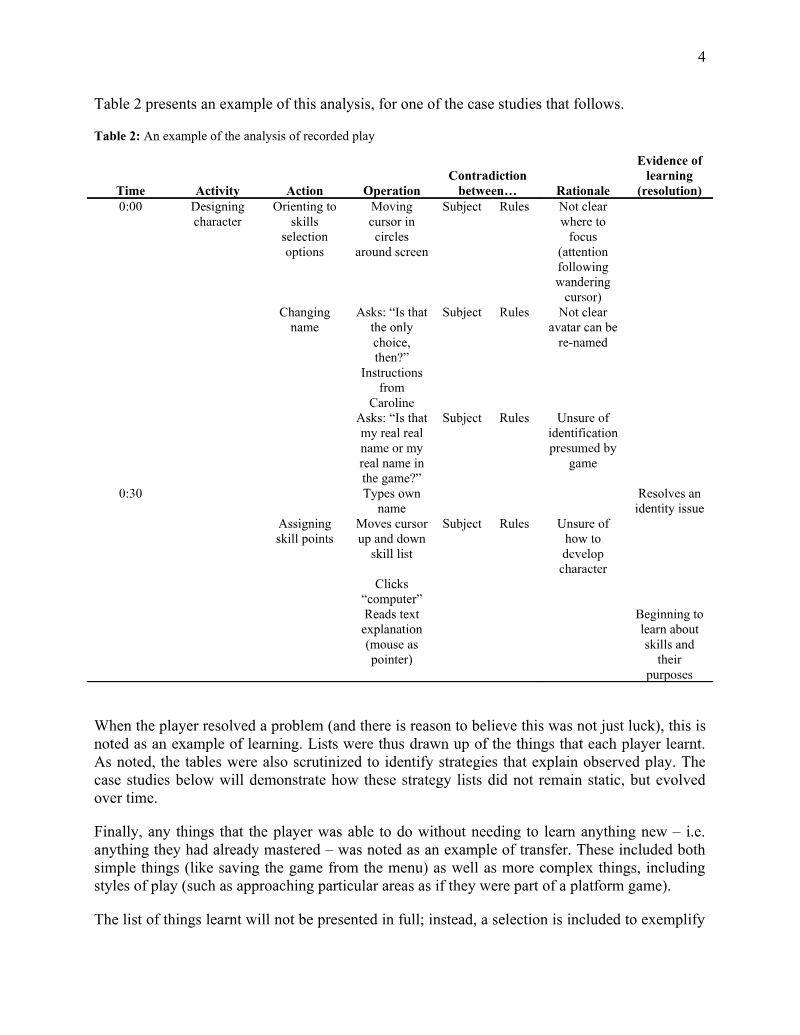
Oliver and Pelletier's study examines how players learn to become competent at video games, using a methodology grounded in Activity Theory and detailed transcripts of play rather than players' self-reports.
- Competence in video games develops through play itself, and careful transcript-based analysis of how players construct strategies can reveal which design features help or hinder playability, an observational approach the authors argue is largely absent from games studies.
- In a two-player case study of the 2000 action-adventure game Deus Ex, players identified 10 strategies for the training level and 12 for the first mission, and the game proved considerably more complex than the pilot game Harry Potter and the Philosopher's Stone, which required only six.
- The player who completed the training level transferred skills such as searching bodies, jumping, and aiming, but failed to transfer disarming gas bombs and noticing datacubes, and misapplied some tactics in fast combat.

Extending Soft Models to Game Design: Flow, Challenges and Conflicts
This paper proposes applying Checkland's Soft Systems Methodology (SSM) to computer game design as a structured tool for formulating challenges and conflicts.
- The paper proposes applying Checkland's Soft Systems Methodology (SSM) to game design as a structured way to generate original mechanics, arguing that designers, especially newcomers, tend to rely on familiar mechanics from earlier titles.
- Although games are not soft systems in the strict sense, the authors argue a game level can be modelled as an imaginary social system and analysed with SSM concepts and procedures.
- The paper cites an industry statistic that 71.4% of gamers play because games are challenging, and argues that conflict intensifies challenge by opposing player objectives.

Motivations of Play in MMORPGs
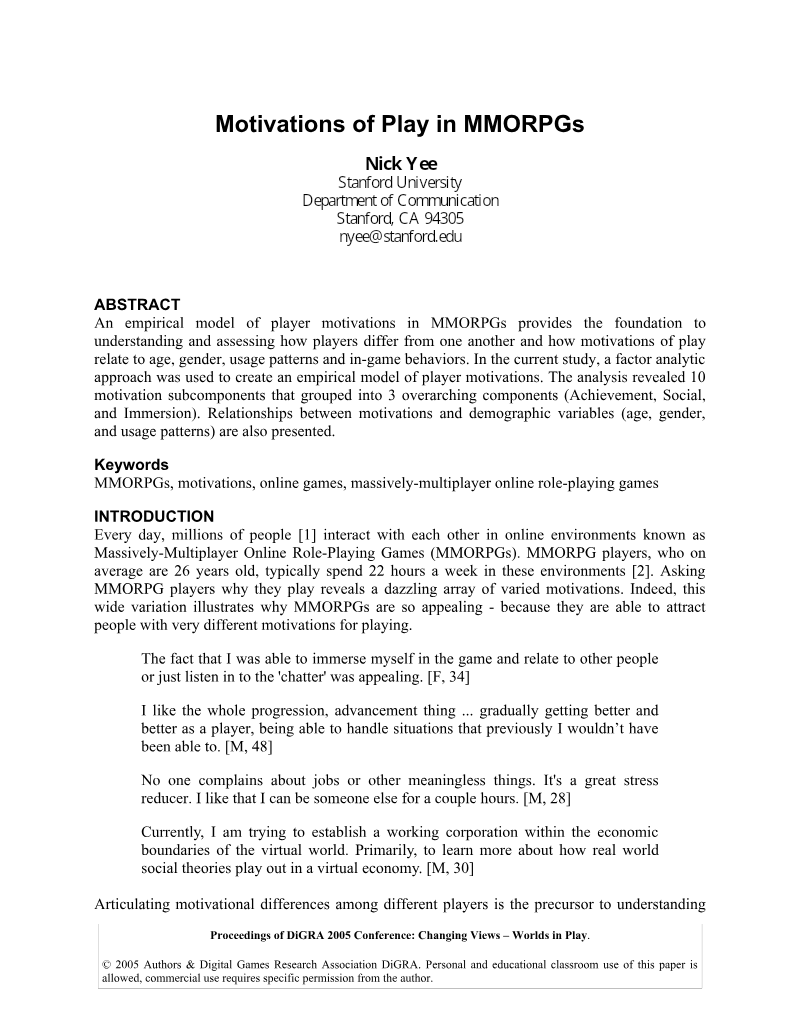
Nick Yee's study develops an empirical model of player motivations in massively multiplayer online role-playing games (MMORPGs), aiming to replace the theoretical taxonomy of Richard Bartle's Player Types with a data-driven framework.
- Nick Yee's factor analysis of a 3,000-player survey across EverQuest, Dark Age of Camelot, Ultima Online, and Star Wars Galaxies replaces Bartle's forced player-type taxonomy with a continuous profile of motivations.
- The model identifies 10 motivation subcomponents grouping into three overarching components: Achievement (Advancement, Mechanics, Competition), Social (Socializing, Relationship, Teamwork), and Immersion (Discovery, Role-Playing, Customization, Escapism).
- The three main components are largely uncorrelated (r's under .10), meaning a player scoring high in one domain does not necessarily score low in another, so players are better described by motivation profiles than single archetypes.
Simulating the Storytelling Qualities of Life: Telling Stories with the Sims
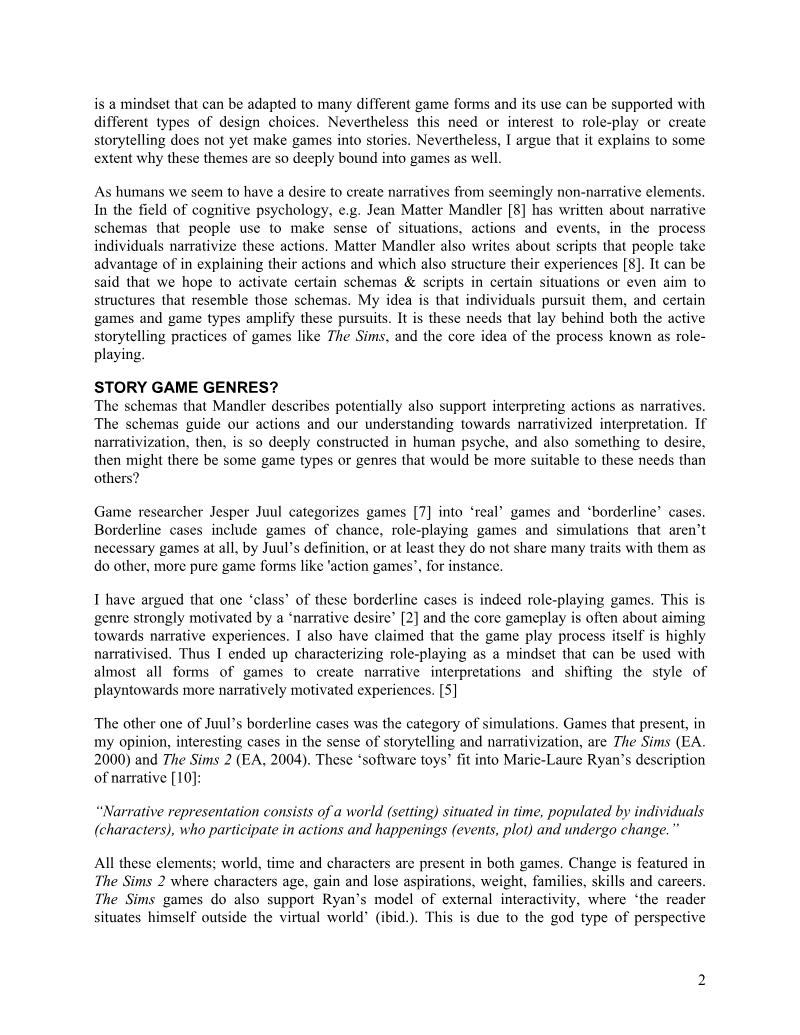
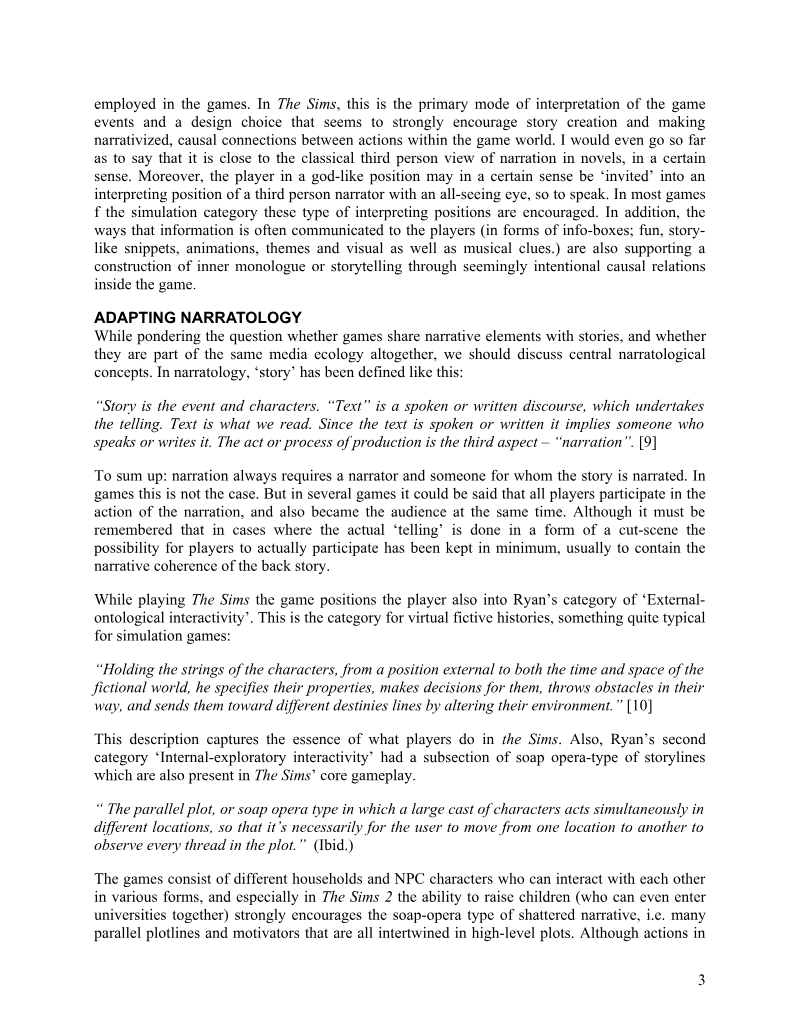
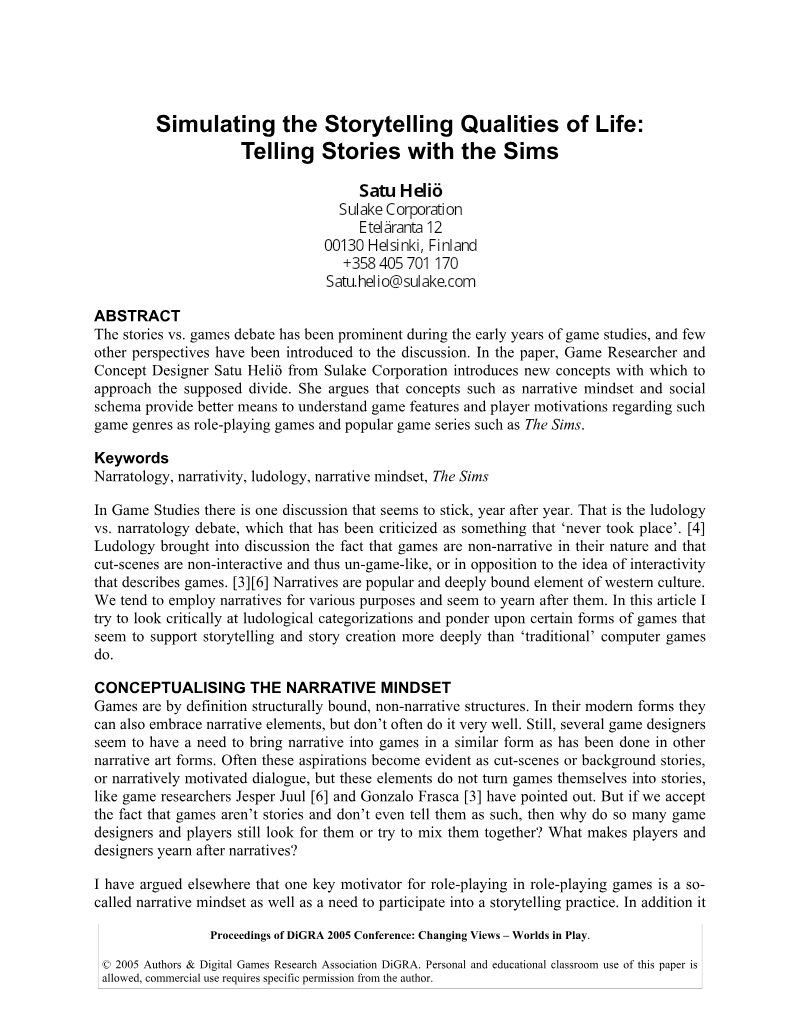
Satu Heliö's paper, presented at the DiGRA 2005 conference, addresses the long-running ludology versus narratology debate in game studies by proposing that the "narrative mindset" and social schemas offer a more useful framework for understanding player motivation than a strict divide between stories and games.
- Heliö argues that narrativization is a deeply embedded human cognitive tendency, drawing on cognitive psychology research into narrative schemas and scripts, and that certain game forms amplify it rather than games being inherently narrative.
- The paper proposes the 'narrative mindset' and social schemas as a more useful framework than a strict ludology-versus-narratology divide for understanding player motivation.
- The Sims (2000) and The Sims 2 (2004) are identified as 'borderline cases' in Jesper Juul's taxonomy and are presented as especially suited to storytelling, with their god-like external perspective inviting a third-person narrator's interpretive stance.
Pretty Good for a Girl: Gender, Identity and Computer Games
Catherine Beavis's 2005 DiGRA paper, "Pretty Good for a Girl: Gender, Identity and Computer Games," argues that gendered identities are not fixed in advance but are actively formed within particular game-playing contexts, and that generalizing about games and gender obscures this process.
- Gendered identities in gaming are not fixed in advance; they are actively formed within particular game-playing contexts, so generalizing about games and gender obscures this process.
- The study is a small, qualitative, interpretive two-site design (a Melbourne Year 8 English unit and five South East Asian women aged 18 to 22 in an all-girls Counter-Strike clan at a LAN café), so its findings are not statistical and are limited in geography, age, and sample size.
- Students' expertise and strategies for learning games (persistence, trial and error, using tutorials or cheats, giving up) varied more with experience and interest than with gender, although boys were more often familiar with games.
Online Gaming as a Virtual Forum
Matthew Payne's essay argues that Horace Newcomb and Paul Hirsch's 1994 framework, which treats television as a cultural forum rather than a site of ideological indoctrination or a simple media effect, offers a useful starting point for understanding online multiplayer gaming.
- Matthew Payne argues that Newcomb and Hirsch's 1994 framework, which treats television as a cultural forum rather than an ideological or effects-based medium, is a useful starting point for studying online multiplayer gaming.
- The essay contends that videogame scholarship, like early television studies, has been dominated by effects research and content analysis, and that a forum-based approach better captures the social meaning of play.
- Players are framed as active participants in cultural dialogue rather than isolated or passive consumers, and gaming is positioned as a medium long dismissed as childish or low-art.
The Pleasures and Practices of Virtualised Consumption in Digital Spaces
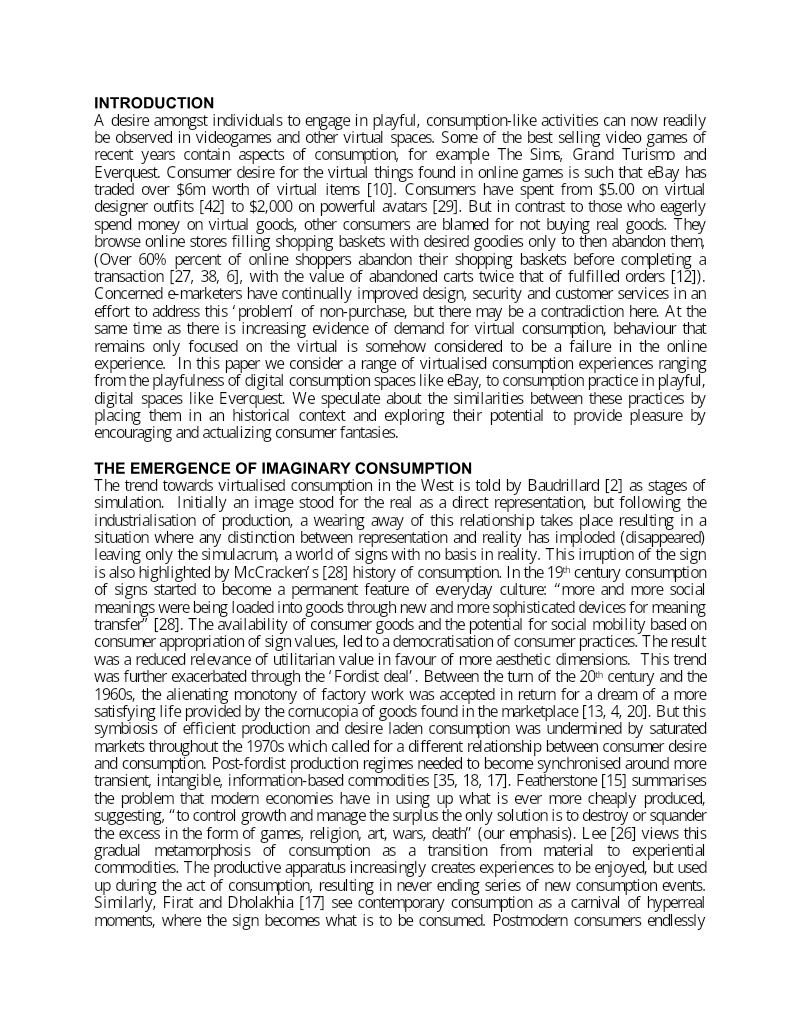
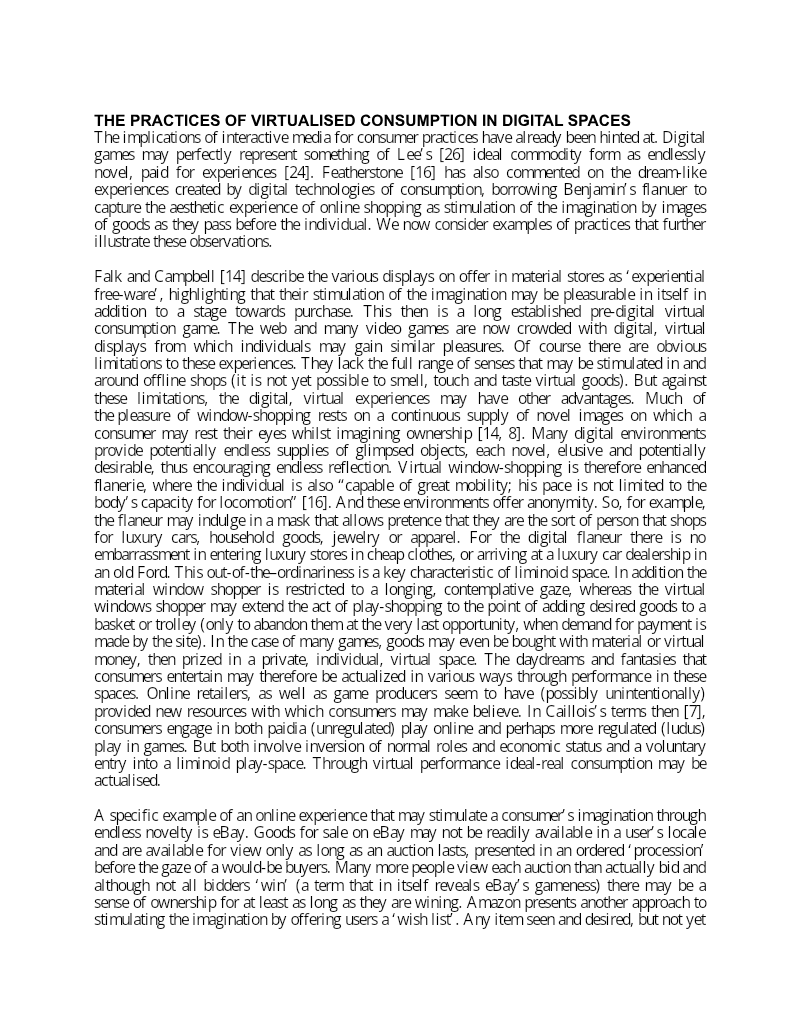
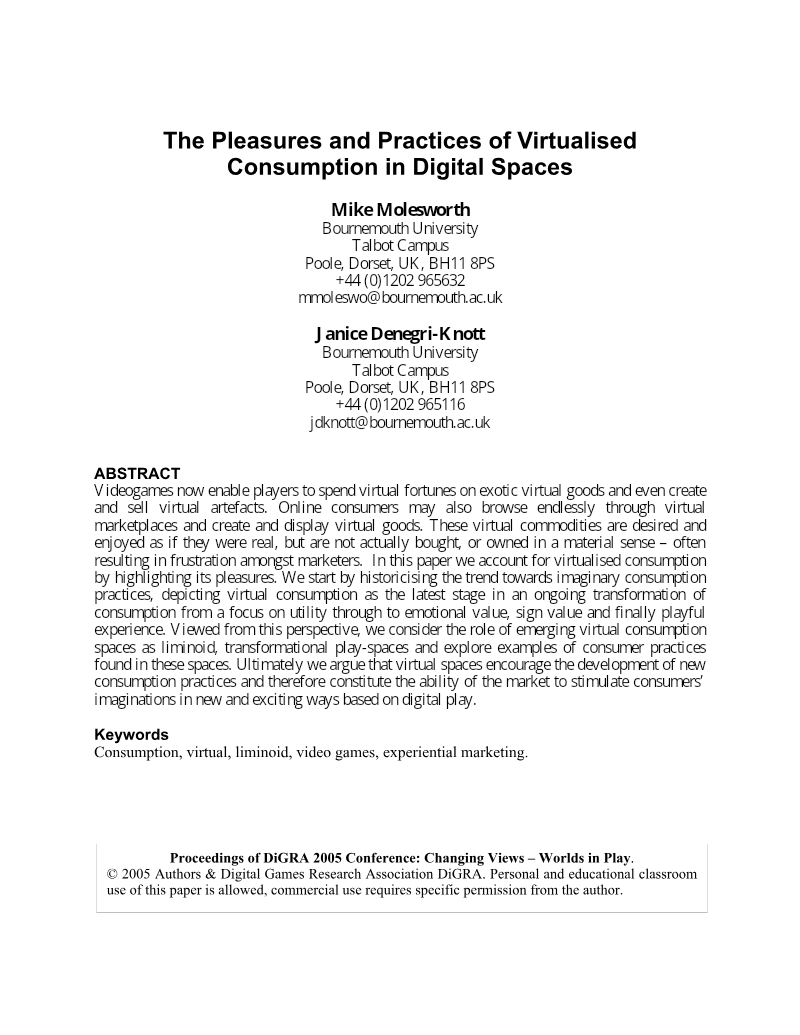
This conceptual paper, presented at the DiGRA 2005 conference, argues that virtualised consumption, such as buying virtual goods in games, browsing virtual marketplaces, and displaying digital possessions, should be understood as a legitimate and pleasurable form of consumption rather than a failure of marketing.
- The paper argues that virtualised consumption, such as buying virtual goods and browsing virtual marketplaces, should be treated as a legitimate, pleasurable form of consumption rather than a failure of marketing.
- Its central thesis frames virtual consumption as the latest stage in a historical shift from utility toward emotional, sign-based, and playful experience, with digital spaces acting as liminoid play-spaces where imagination is stimulated and partly actualised.
- The authors contend that cart abandonment is a misreading of consumers who gain satisfaction from imaginative engagement with goods they never intend to buy, rather than a sign of lost sales.
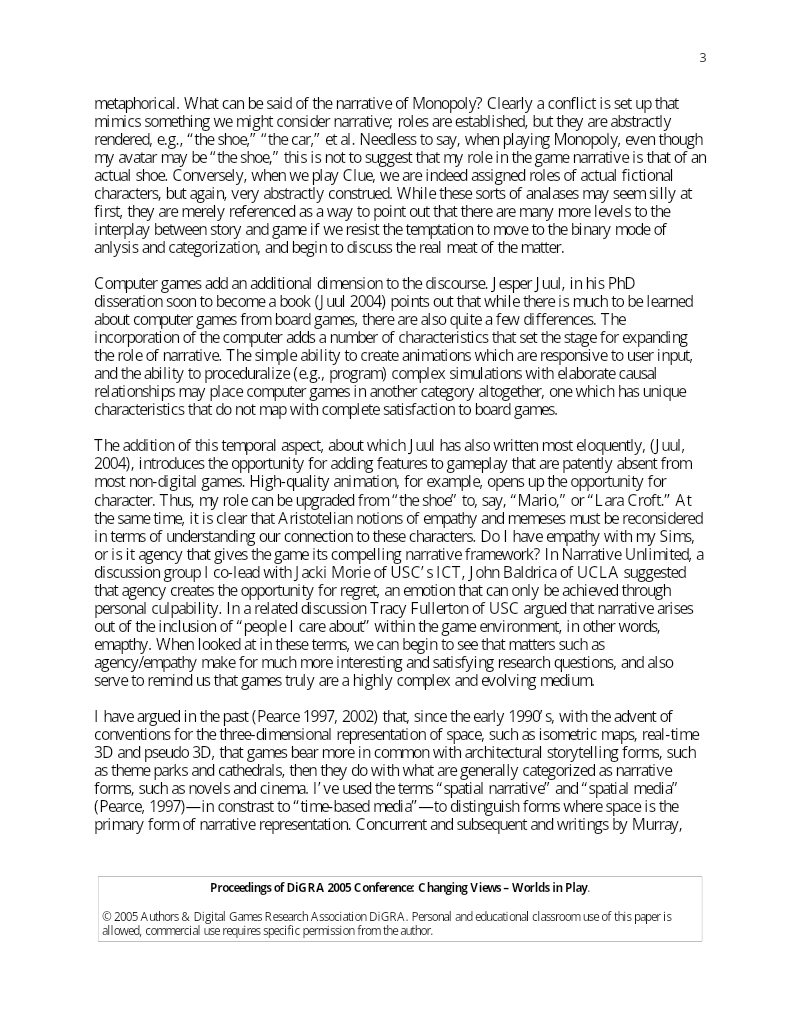
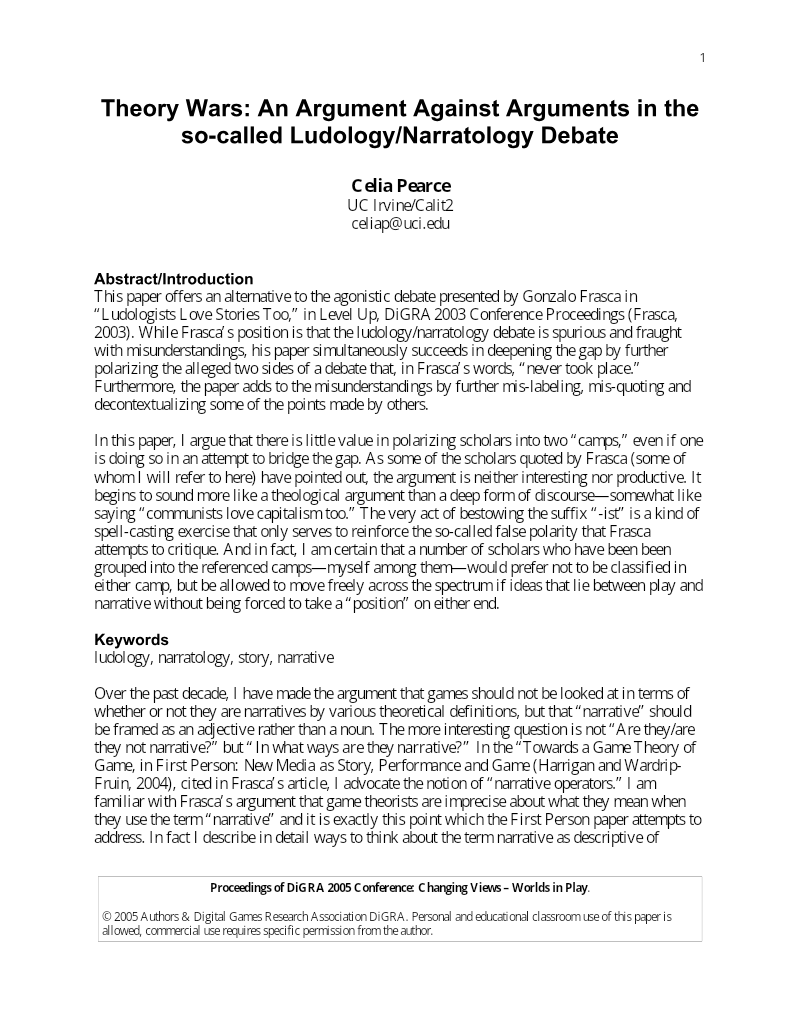
Theory Wars: An Argument Against Arguments in the So-Called Ludology/Narratology Debate
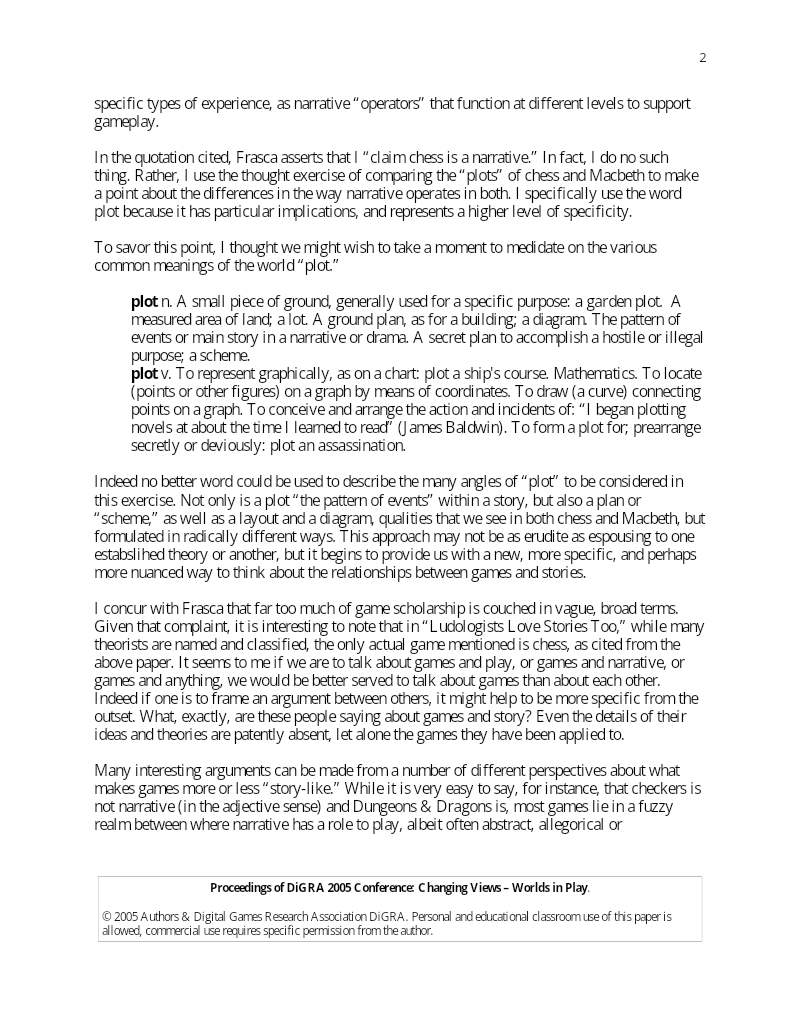
Celia Pearce's paper "Theory Wars" responds to Gonzalo Frasca's 2003 essay "Ludologists Love Stories Too," which argued that the ludology/narratology debate was largely a misunderstanding.
- Celia Pearce's "Theory Wars" responds to Gonzalo Frasca's 2003 essay "Ludologists Love Stories Too," arguing that Frasca's essay deepens the ludology/narratology divide by polarizing scholars into opposing camps and mislabeling their positions.
- Pearce contends that attaching the "-ist" suffix to researchers creates a false binary, and that many scholars would prefer to move freely between play-centered and narrative-centered perspectives.
- Her central proposal is to reframe "narrative" as an adjective rather than a noun, shifting the question from whether games are narratives to in what ways they are narrative.
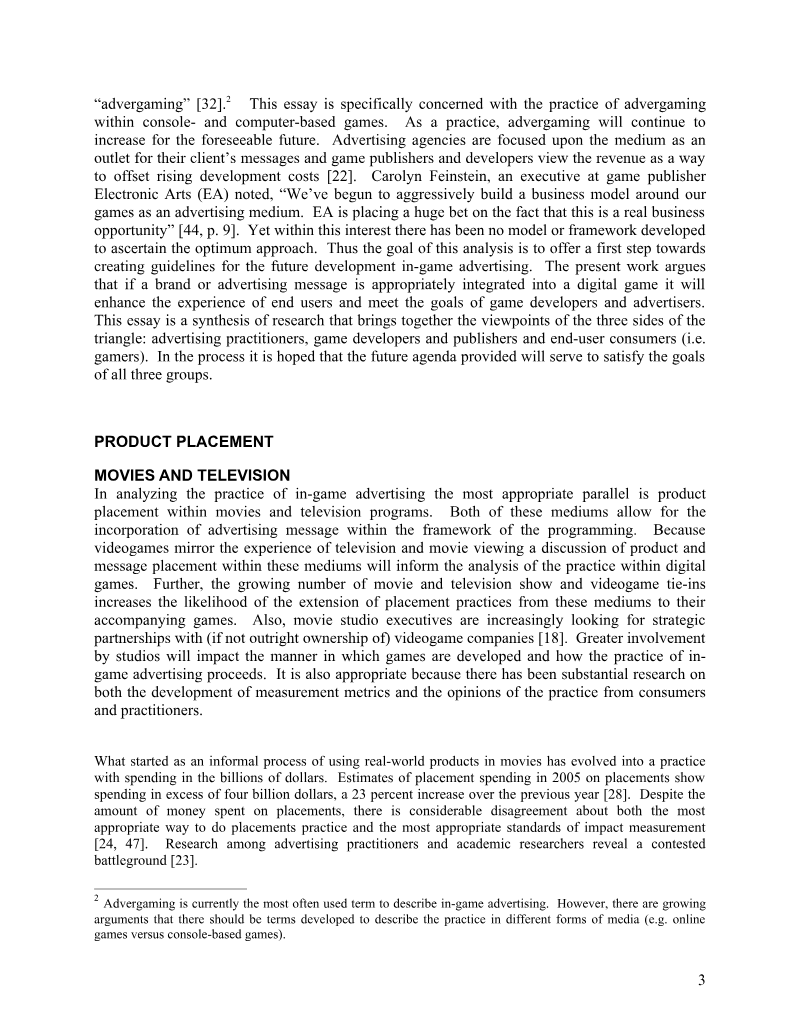
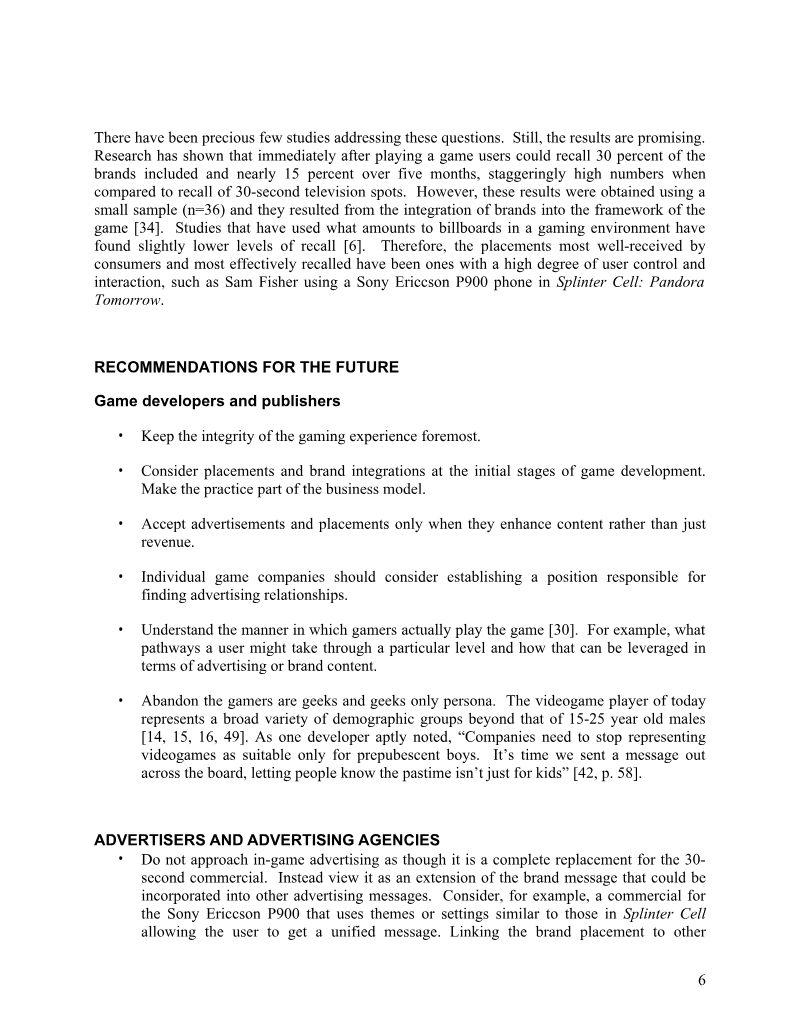
The Sponsored Avatar: Examining the Present Reality and Future Possibilities of Advertising in Digital Games
This paper examines advertising within digital games, both current practice and future possibilities, including full sponsorship, product placement, brand integration, and cross-promotion with other entertainment media.
- Advertising spending is shifting away from traditional television commercials toward placements in entertainment, with one cited beverage company redirecting more than $300 million in annual spending.
- Game-based advertising remained a small share of revenue relative to film and television, with projections of roughly $260 million by 2008, though agencies increasingly seek game placements and some have created dedicated game advertising divisions.
- Players generally accept in-game advertising, mostly because it enhances realism, but they worry that placements may feel incongruous and detract from the experience.