
DiGRA
The Digital Games Research Association: the international association of academics and professionals who study digital games. Its Digital Library holds the proceedings of the DiGRA conferences since 2002.
Documents
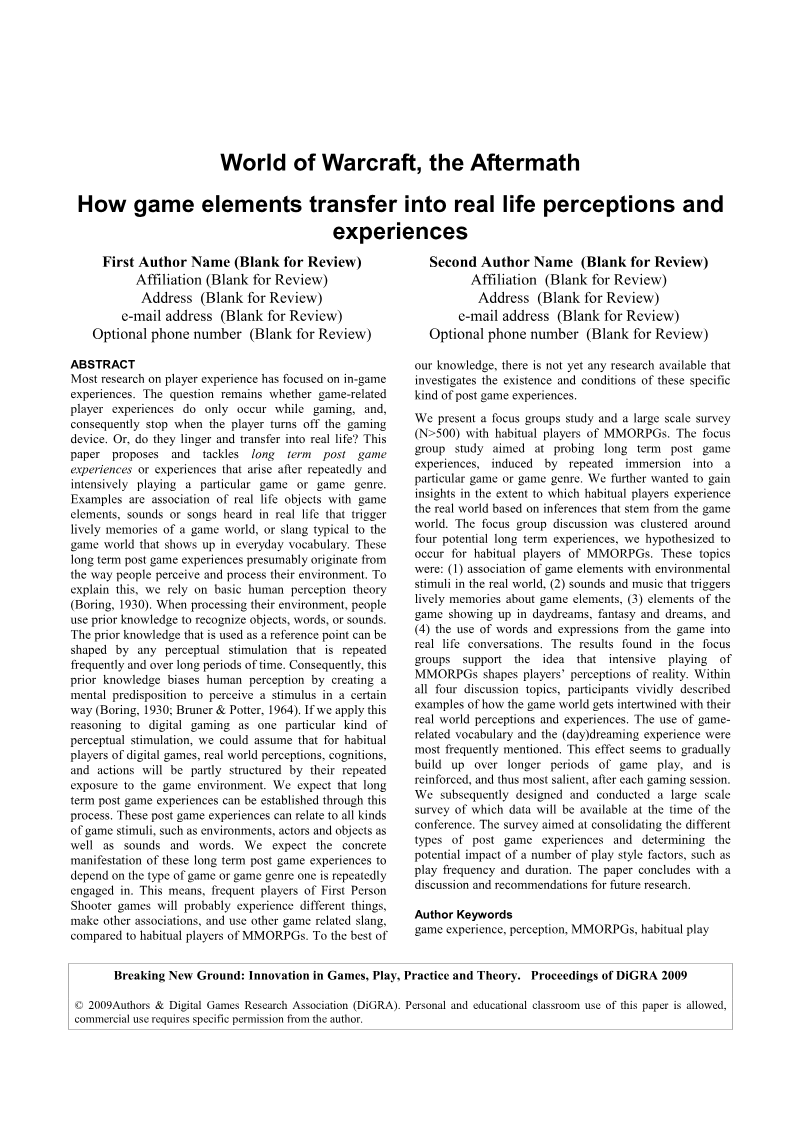
World of Warcraft, the Aftermath: How Game Elements Transfer into Real Life Perceptions and Experiences
This paper investigates whether the experiences of habitual players of massively multiplayer online role-playing games (MMORPGs) persist beyond the act of play and shape how players perceive their everyday environment.
- The paper proposes that intensive, repeated immersion in MMORPGs can produce lasting "post game experiences" that persist beyond play, such as associating real-world objects with game elements, game imagery surfacing in daydreams and dreams, and using game slang in everyday conversation.
- The authors ground this in basic perception theory: frequently repeated stimuli build prior knowledge that biases how people recognize and interpret later stimuli.
- A two-stage design was used: focus groups first explored four hypothesized categories of post game experience, then a survey of more than 500 habitual MMORPG players aimed to consolidate these categories and test how play frequency and session duration relate to their occurrence.
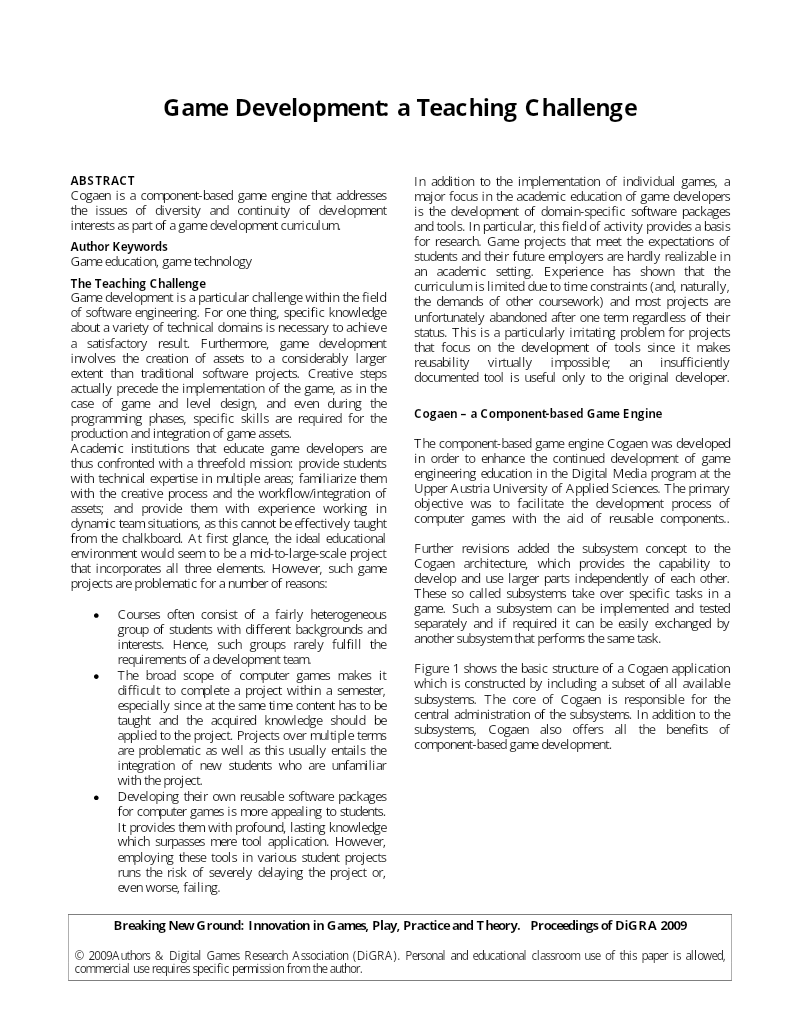
Game Development: A Teaching Challenge
The document examines the pedagogical difficulties of teaching game development in academic settings and proposes a component-based game engine, Cogaen, as a partial solution.
- Academic game development programs face a threefold mission: teaching technical expertise across multiple domains, familiarizing students with the creative process and asset workflows, and providing experience in collaborative team environments.
- Delivering this mission through a single mid-to-large-scale student project is problematic because course groups are heterogeneous in background, the breadth of game development rarely fits one semester, and multi-term projects suffer continuity problems as new students join.
- Student projects, especially tool-development projects, are often abandoned after one term, which makes their reuse nearly impossible.
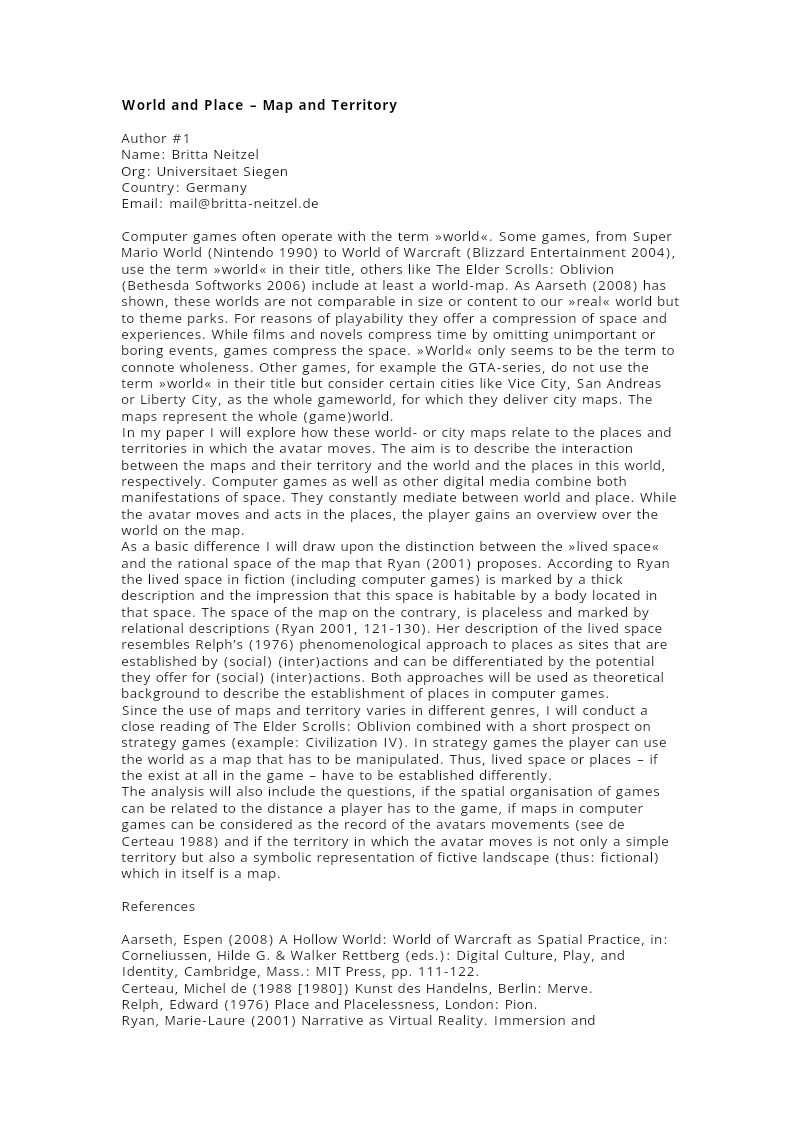
World and Place: Map and Territory
This paper, authored by Britta Neitzel of the Universität Siegen, examines how world maps and city maps in computer games relate to the places and territories through which avatars move.
- Games continually mediate between the map, which gives the player an overview of the world, and the lived places where the avatar acts, a tension that is the paper's central proposition.
- The author distinguishes lived space, thickly described and habitable by a body, from the rational, placeless space of the map defined through relational descriptions, grounded in Marie-Laure Ryan's account of narrative space and Edward Relph's phenomenology of place.
- The analysis rests mainly on a close reading of The Elder Scrolls: Oblivion, with a shorter consideration of the strategy game Civilization IV, whose contrast is central to the argument.
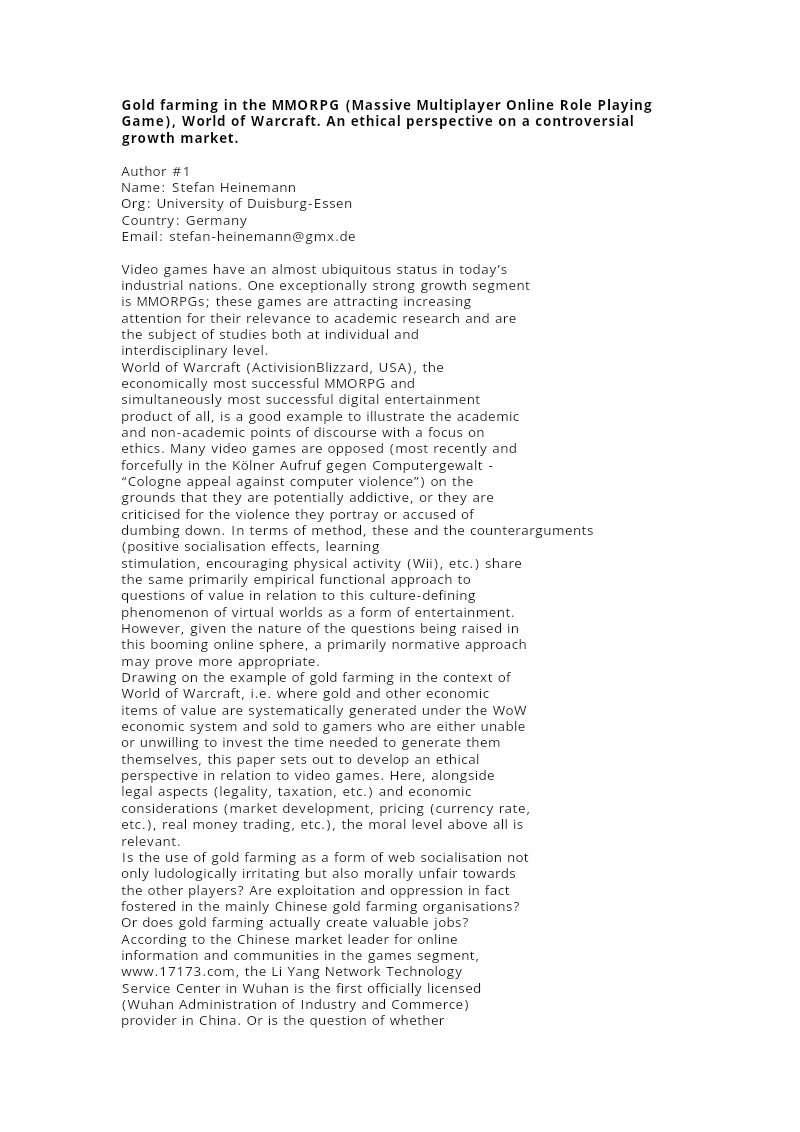
Gold Farming in the MMORPG World of Warcraft: An Ethical Perspective on a Controversial Growth Market
This paper examines gold farming in World of Warcraft, the practice of systematically generating in-game currency and items under the game's economic system and selling them for real money to players who prefer not to invest the time themselves.
- The paper frames gold farming in World of Warcraft as a fundamentally normative question requiring ethical rather than purely functional analysis, using it as a test case for broader issues in virtual economies and the commodification of online life.
- The central ethical debate pits critics, who argue gold farming is unfair to other players and fosters exploitation, against proponents, who cite employment created in developing economies, particularly the largely Chinese farming operations supplying the market.
- The author argues game developers have an ethical obligation to design economic systems that either accommodate or prevent real-money trade, treating this as a matter of corporate ethics as well as player conduct.
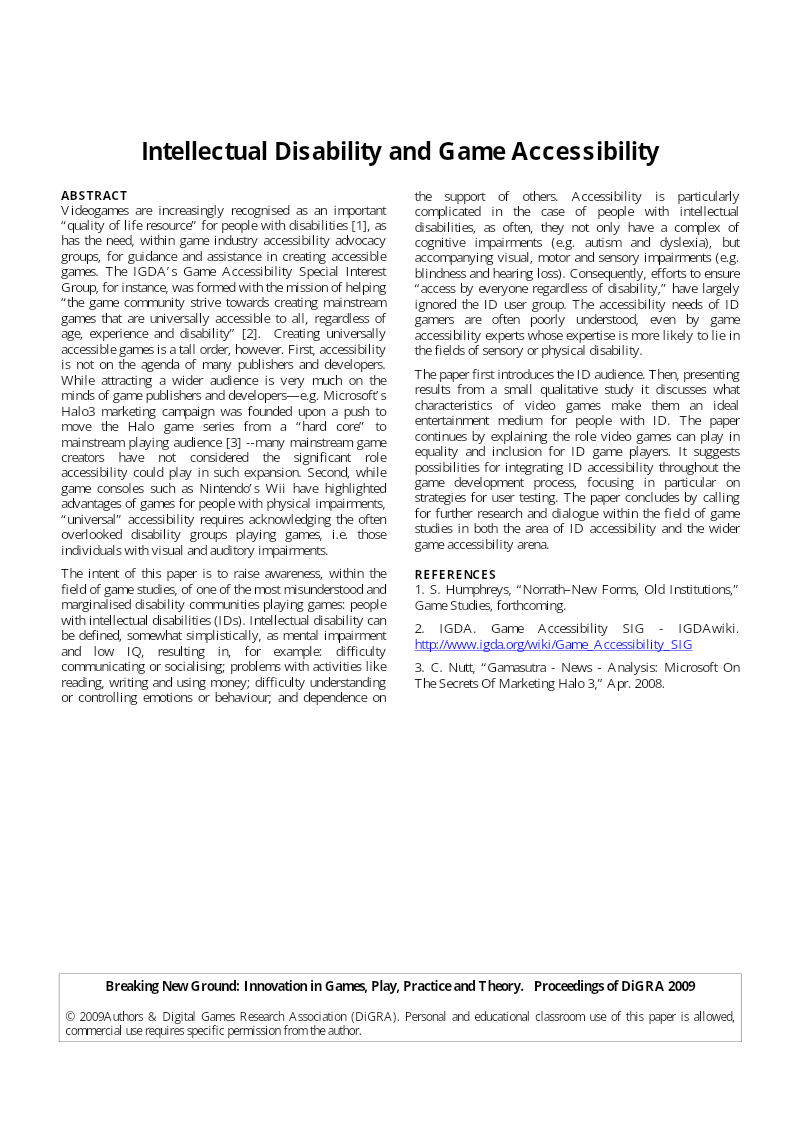
Intellectual Disability and Game Accessibility
This paper, presented at the DiGRA 2009 conference, argues that people with intellectual disabilities (ID) are a misunderstood and largely overlooked group within game accessibility efforts.
- Accessibility advocacy has concentrated on sensory and physical impairments, leaving people with intellectual disabilities (ID) largely overlooked in game design.
- The author argues that 'universal' accessibility cannot be achieved without explicitly addressing ID players, since cognitive disability frequently co-occurs with visual, motor, or sensory impairments.
- Many developers and publishers lack the expertise or commercial motivation to account for cognitive disability in their games.
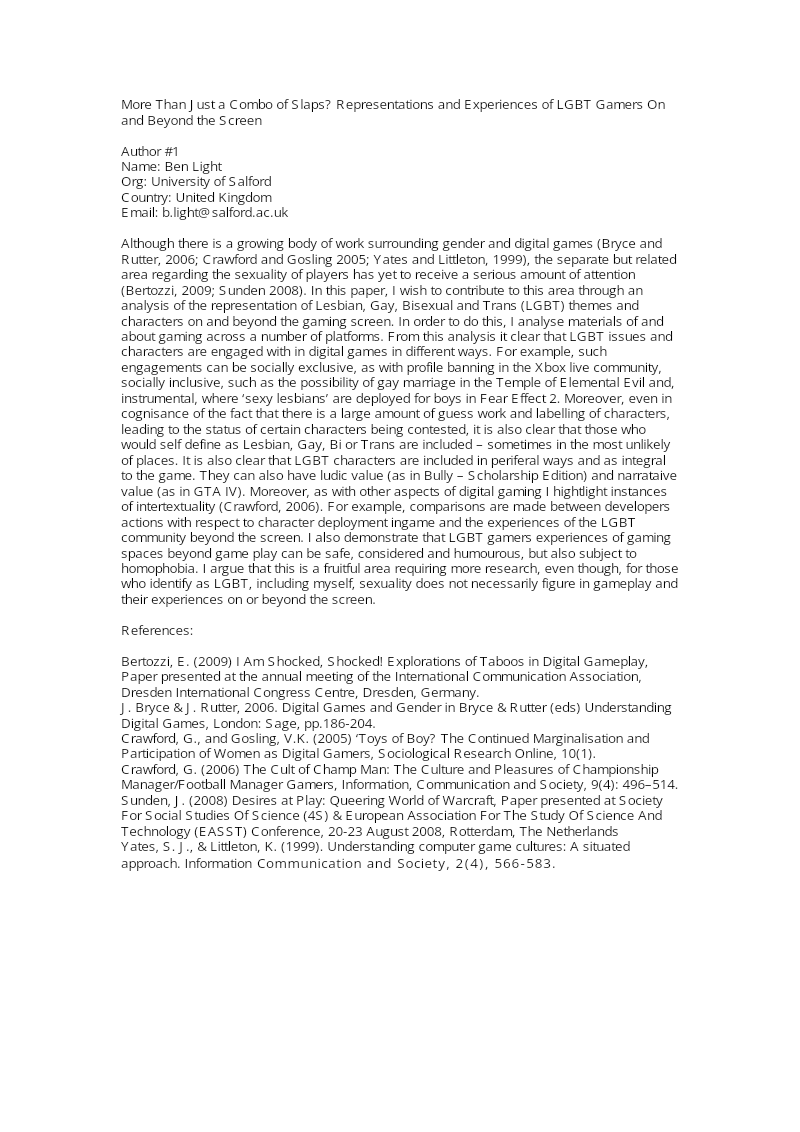
More Than Just a Combo of Slaps? Representations and Experiences of LGBT Gamers On and Beyond the Screen
Ben Light's paper examines how lesbian, gay, bisexual, and trans (LGBT) themes and characters appear in digital games, and how LGBT gamers experience gaming spaces both on and beyond the screen.
- Ben Light's paper addresses a gap in game studies: the sexuality of players has received far less scholarly attention than gender, and LGBT themes in games are examined through how they are engaged with by players and developers.
- The paper identifies three distinct modes of LGBT content engagement: socially exclusive (e.g., profile banning on the Xbox Live community), socially inclusive (e.g., the possibility of same-sex marriage in Temple of Elemental Evil), and instrumental (e.g., sexualized lesbian characters in Fear Effect 2 aimed at male players).
- LGBT-identifying characters appear in both peripheral and integral roles, sometimes in unexpected titles, and many of their sexual identities are inferred or labelled by players and developers, leaving their status contested.
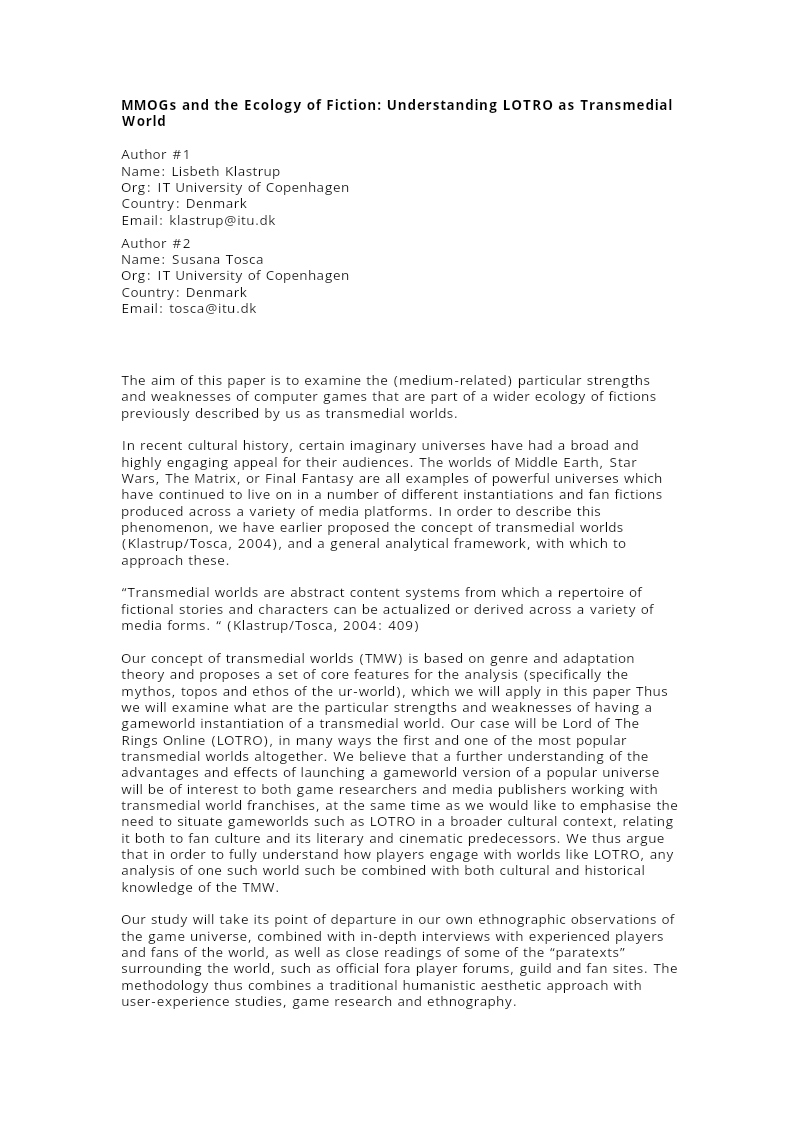
MMOGs and the Ecology of Fiction: Understanding LOTRO as Transmedial World
This paper by Lisbeth Klastrup and Susana Tosca examines Lord of the Rings Online (LOTRO) as a gameworld instantiation of a transmedial world, a concept they previously defined as an abstract content system from which fictional stories and characters can be actualized across multiple media forms.
- LOTRO is analysed as a gameworld instantiation of a transmedial world: an abstract content system from which stories and characters can be actualized across multiple media, which the authors Lisbeth Klastrup and Susana Tosca previously defined.
- The framework centres on three core features of the source world, its mythos, topos, and ethos, and examines how players respond when the game departs from these canonical elements.
- Key analytical concepts are credibility, immersion, interpretation, and realignment, partly drawn from Wolfgang Iser's theory of repertoire and gaps as adapted to games by Tosca.
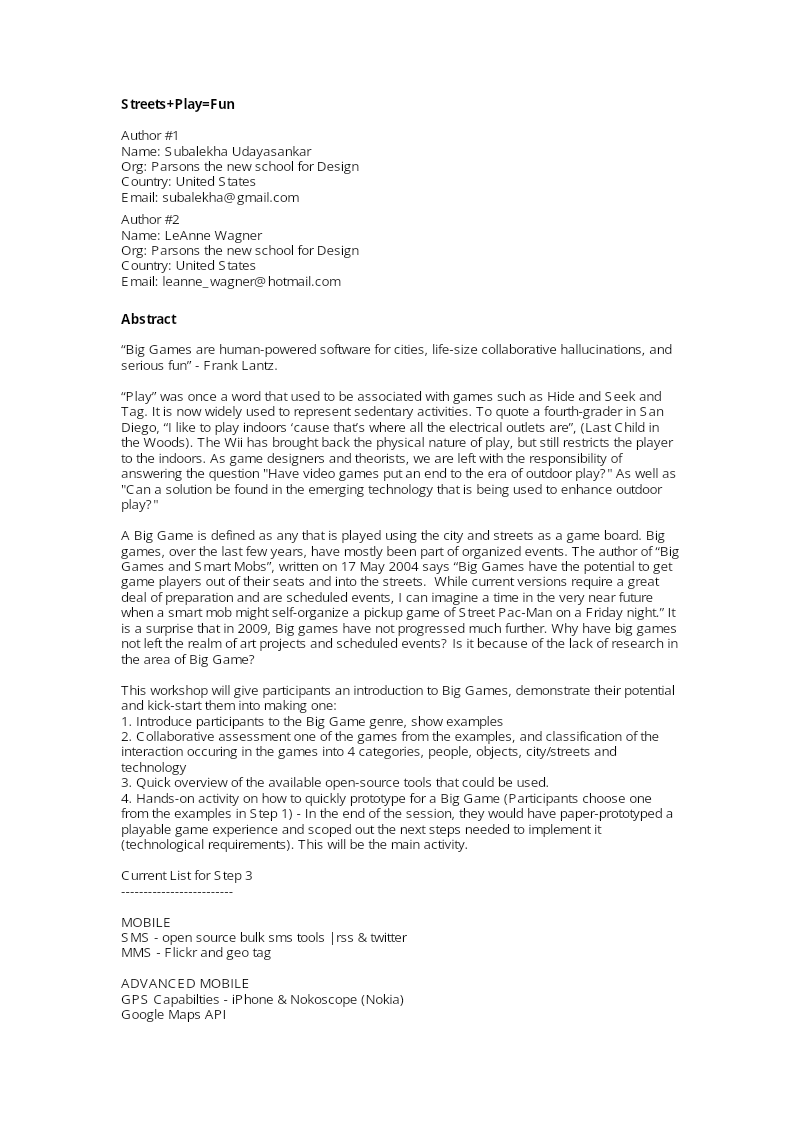
Streets + Play = Fun
"Streets + Play = Fun" is a workshop proposal and abstract by Subalekha Udayasankar and LeAnne Wagner, graduate researchers in the MFA Design and Technology program at Parsons The New School for Design.
- The report argues that play has become associated with sedentary, indoor activity and asks whether video games have ended the era of outdoor play and whether mobile and location-based technologies can restore it.
- Its central proposal is the "Big Game," defined as any game played using the city and streets as a game board.
- Despite predictions in 2004 that Big Games would soon self-organize into spontaneous street games, they have largely remained confined to organized art projects and scheduled events.
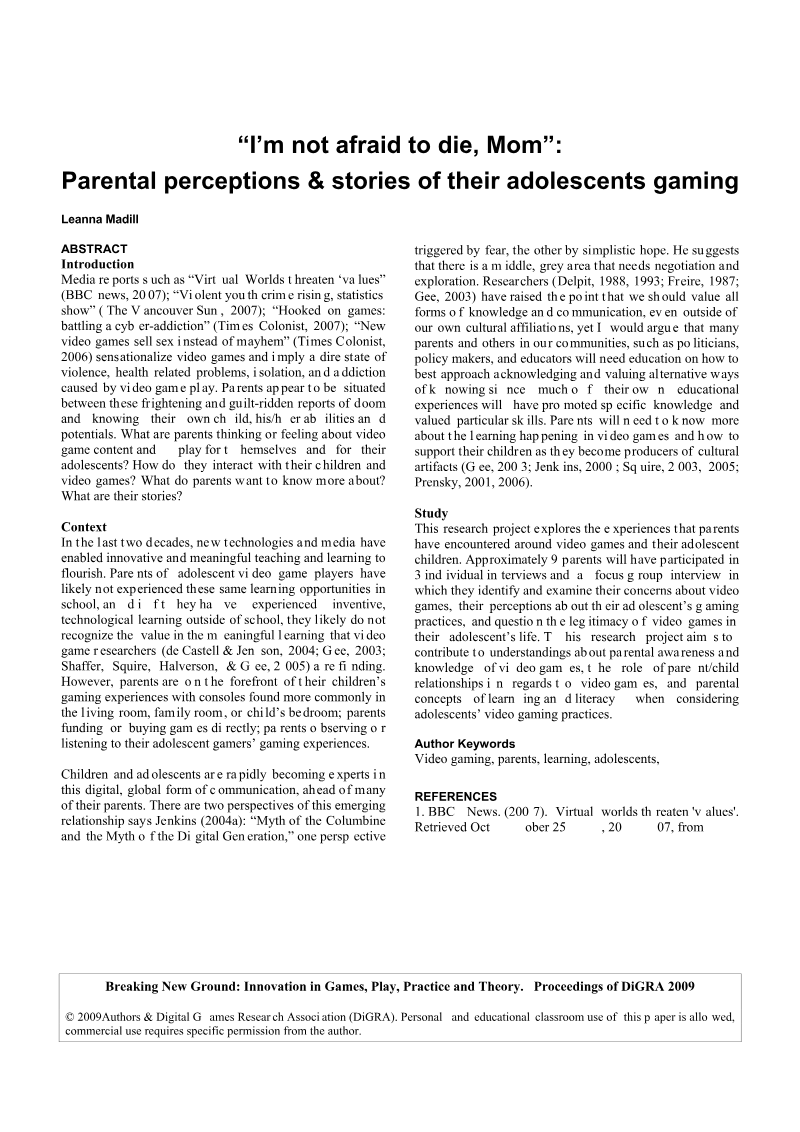
"I'm Not Afraid to Die, Mom": Parental Perceptions and Stories of Their Adolescents Gaming
This study by Leanna Madill examines how parents perceive and describe their adolescents' video game play, responding to a media landscape that often frames gaming through alarmist narratives about violence, addiction, and social isolation.
- The study examines how parents perceive their adolescents' video game play, seeking a middle ground between fearful alarmism about violence, addiction, and isolation and uncritical optimism about gaming.
- The research treats video games as a legitimate form of learning and cultural production, arguing that parents who lack firsthand experience with informal digital learning need a better understanding of it to support their children.
- The project is a small qualitative study of approximately nine parents of adolescent gamers, using three individual interviews per participant plus one focus group interview.
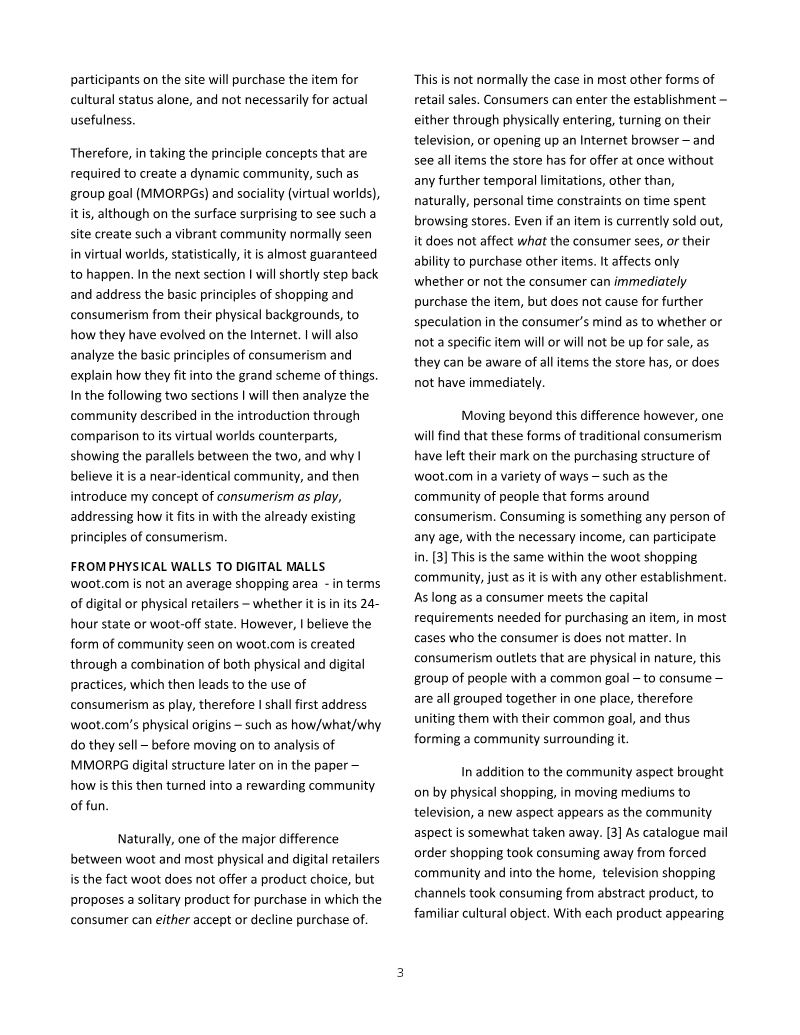
Take One or Three for the Team: Consumerism as Play
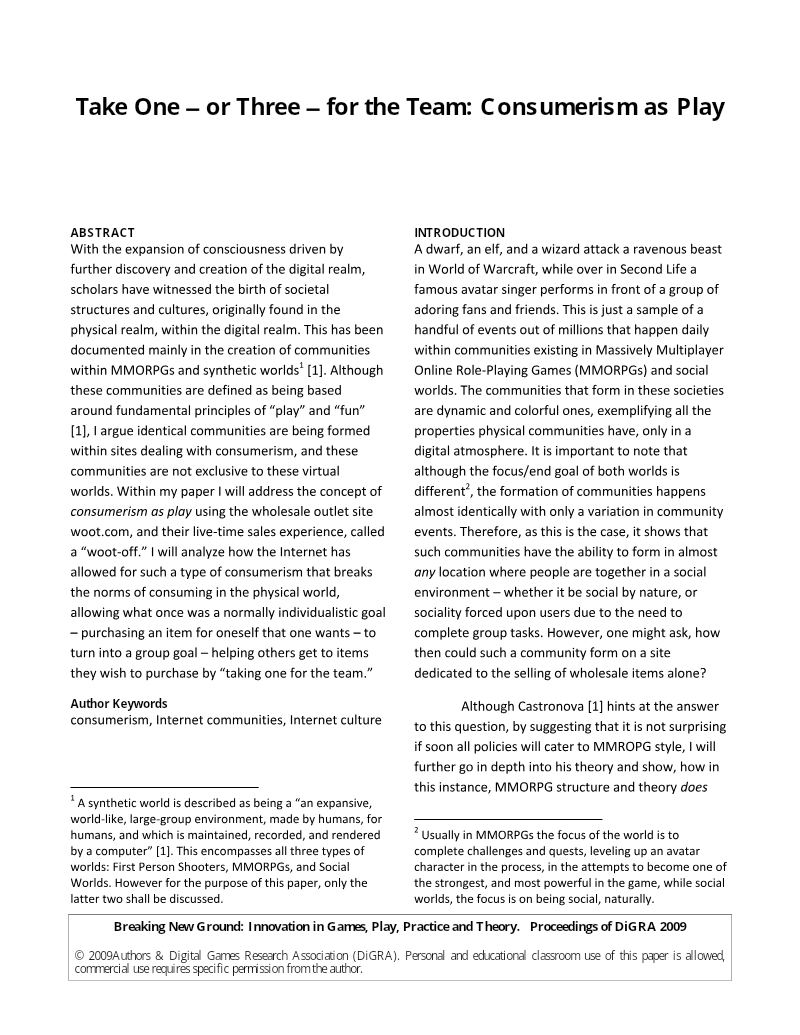
The paper argues that the community surrounding woot.com's live "woot-off" sales events mirrors the social structures of massively multiplayer online role-playing games and virtual worlds, differing mainly in context.
- The paper argues that woot.com's live "woot-off" sales events resemble MMORPG and virtual-world social structures, with the one-product-at-a-time model turning individual purchases into a shared group goal, so that consumerism operates as play.
- Using Holt's four-part framework (experience, integration, classification, and play), the author contends that consumption on woot.com generates social status, shared history, and in-group culture.
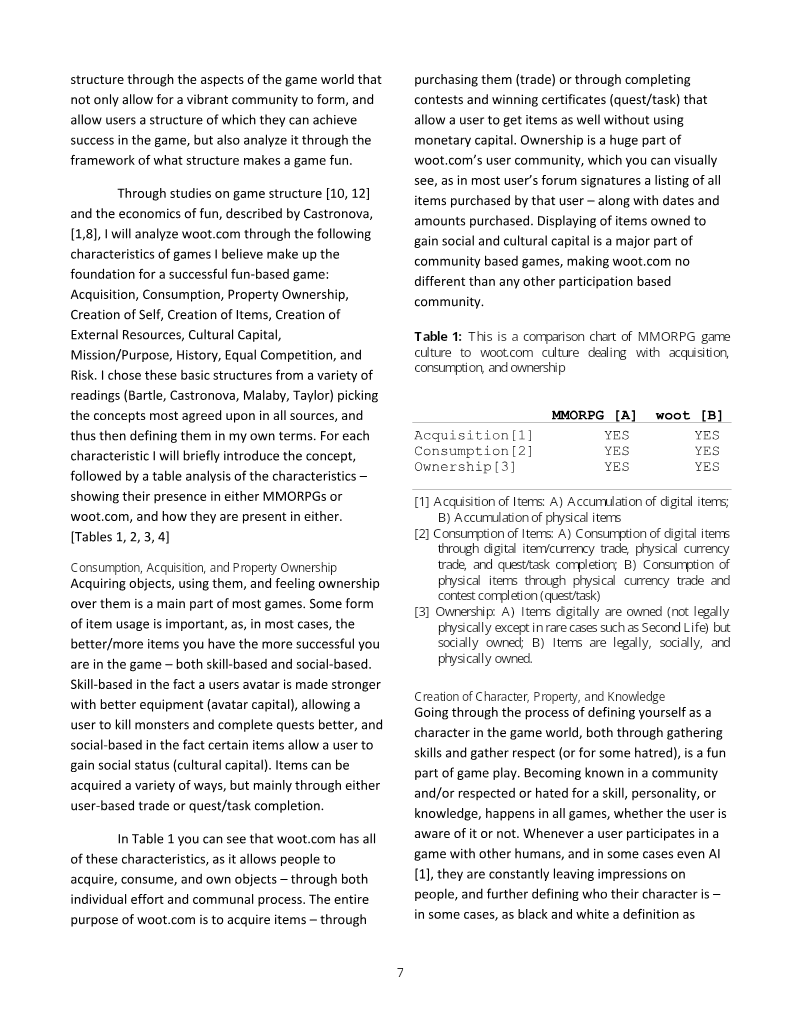
- Comparative tables suggest woot.com matches most MMORPG characteristics, including acquisition, consumption, ownership, cultural capital, mission, history, competition, and risk, but lacks item creation.
The Troubled Transition to Game Study Projects
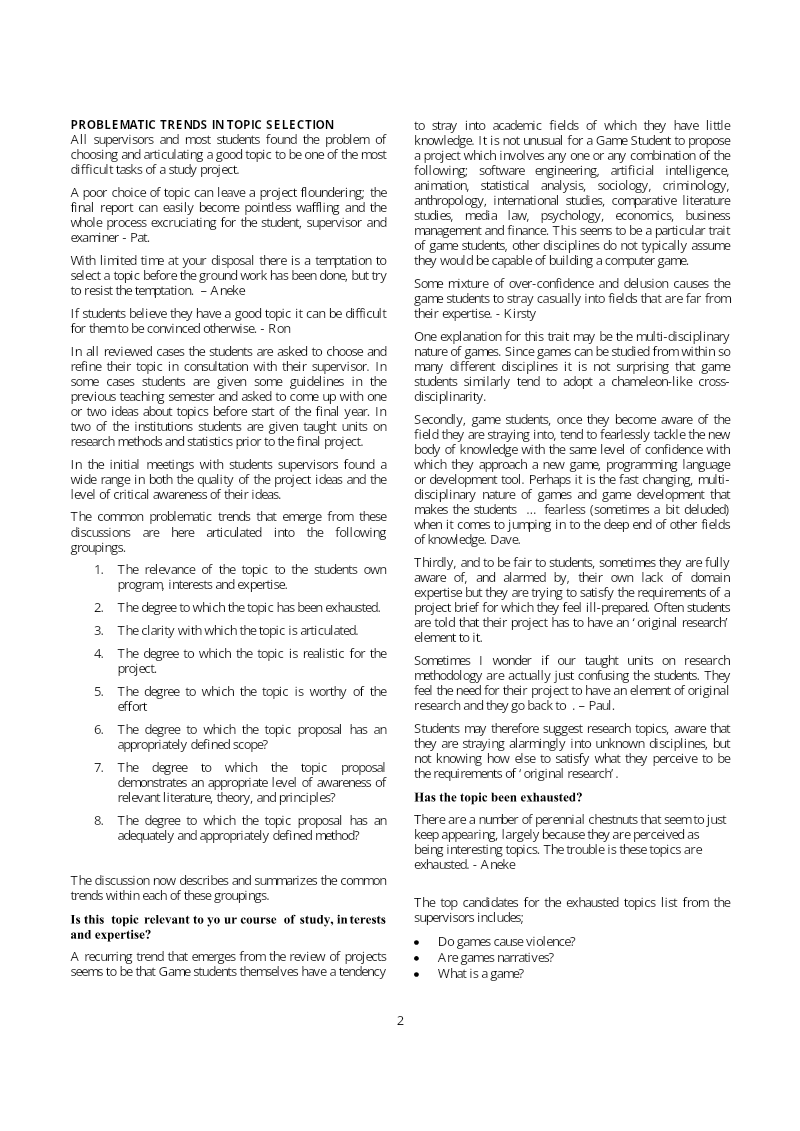
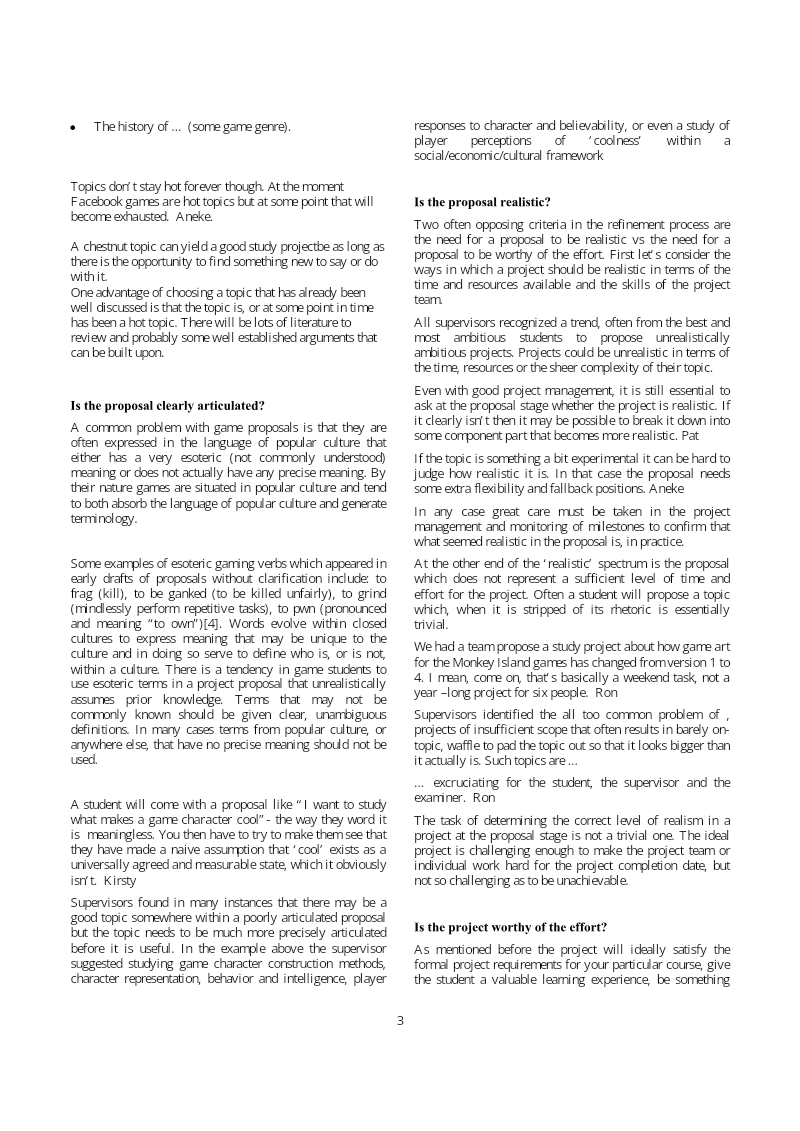
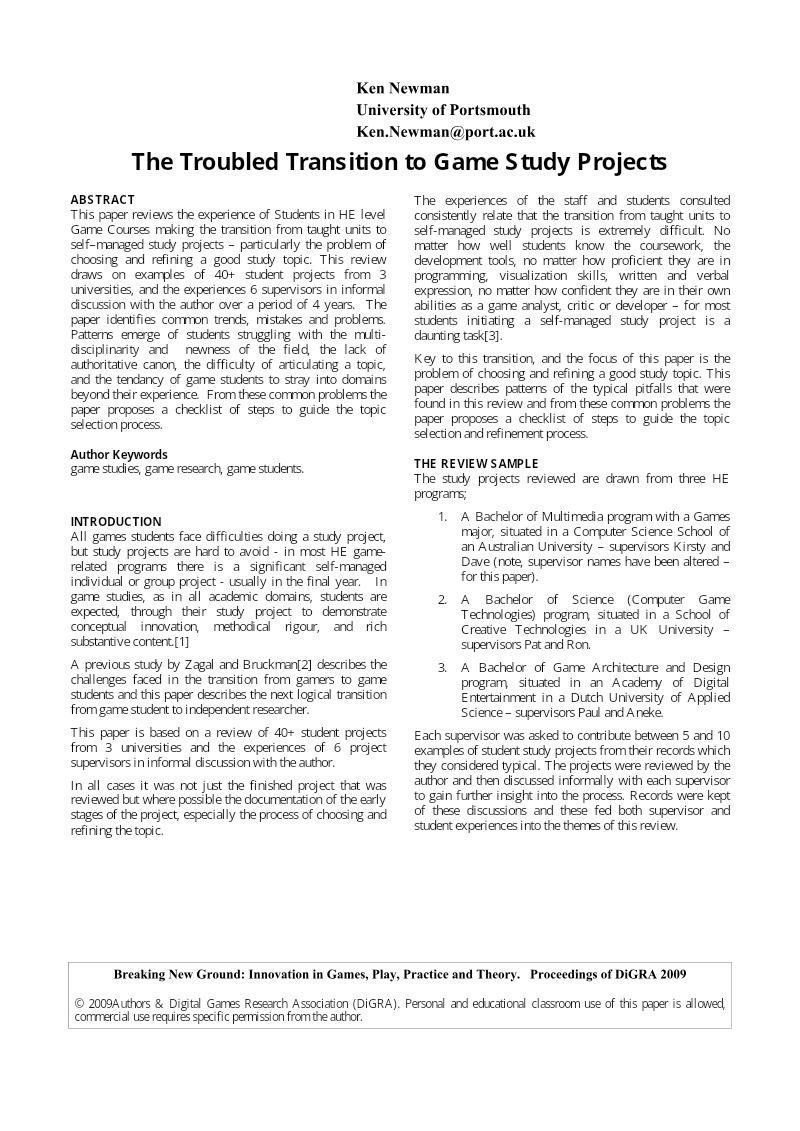
Ken Newman's paper examines why students in higher education game programs find the transition from taught units to self-managed study projects so difficult, with the choice and refinement of a research topic identified as the central challenge.
- The central challenge for students moving from taught units to self-managed game study projects is choosing and refining a research topic, based on analysis of more than 40 student projects from universities in Australia, the UK, and the Netherlands.
- Students frequently propose topics outside their expertise, such as sociology, economics, or psychology, often with unwarranted confidence.
- Common topic pitfalls include choosing exhausted subjects (such as whether games cause violence), proposing projects that are unrealistically ambitious or too trivial, and articulating proposals in informal game-culture terminology.
Playing, Dashing, and Working: Simulated Productive Play in the Diner Dash Games
The document under consideration is a collection of four papers from the DiGRA 2009 conference proceedings, all exploring how gender, productivity, and leisure intersect in digital play.
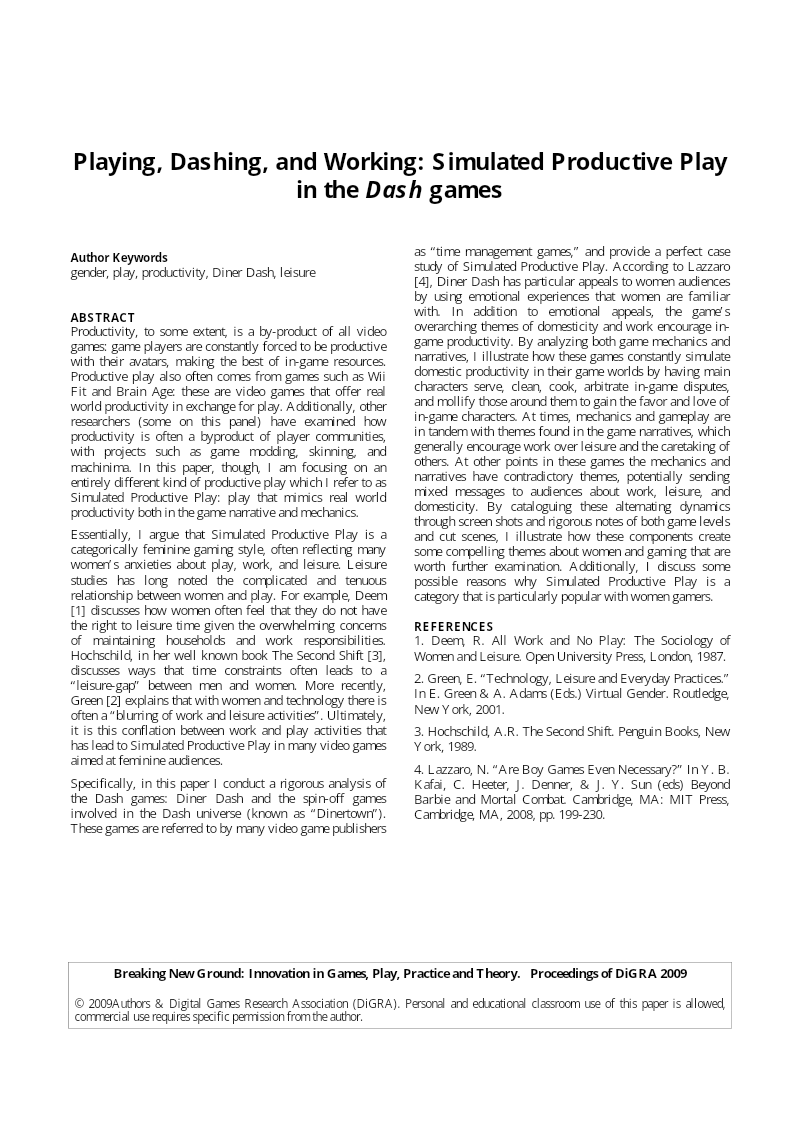
- Simulated Productive Play, as introduced in the first paper, describes games such as Diner Dash and its spin-offs that stage domestic labor like serving, cleaning, and cooking, often reflecting women's anxieties about leisure time.
- The first paper frames these dynamics using sociological concepts of the "leisure gap" and the "second shift," linking game design to the unequal distribution of leisure and household work.
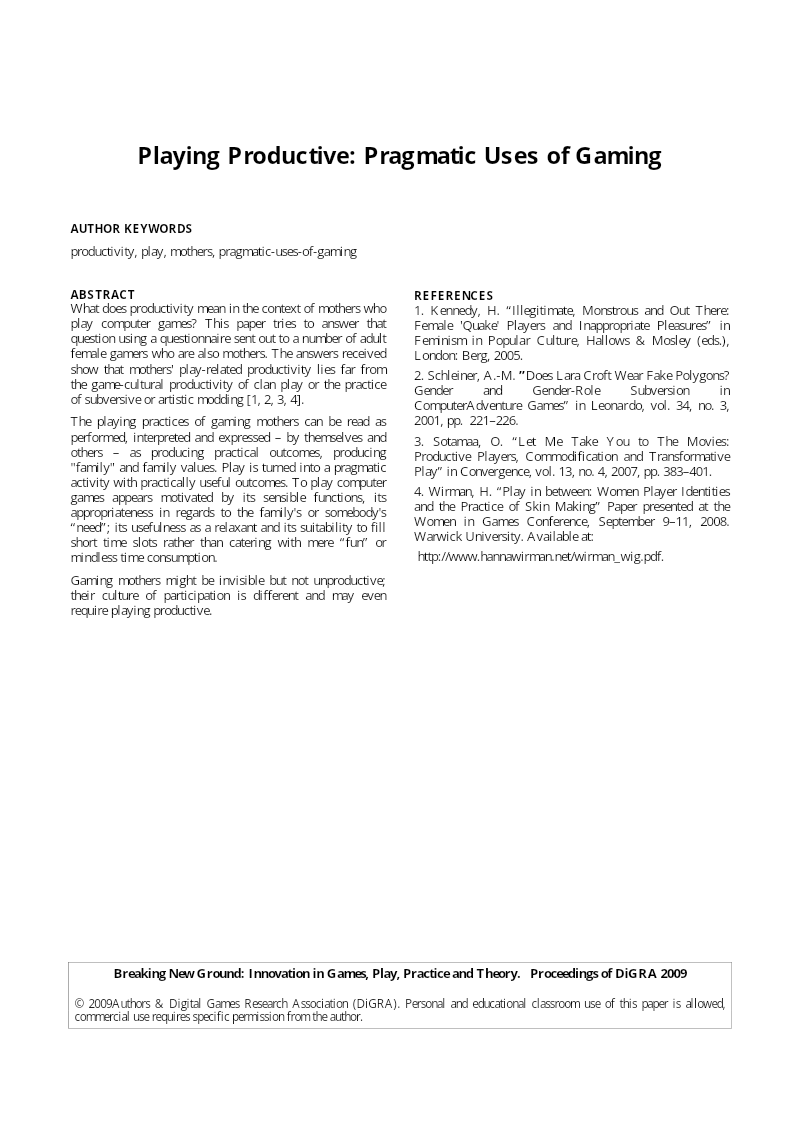
- A survey of female gamers who are also mothers finds their play is pragmatic, oriented toward family needs, relaxation, and short time slots rather than mere entertainment.