
DiGRA
The Digital Games Research Association: the international association of academics and professionals who study digital games. Its Digital Library holds the proceedings of the DiGRA conferences since 2002.
Documents
Balance Boards and Dance Pads: The Impact of Innovation on Gendered Access to Gaming
This paper examines how innovations in game interfaces, controllers, and play locations shape gendered access to gaming, arguing that access is a central dimension of the assemblages of production, culture, marketing, content, and mechanics that determine play preferences and genre choices.
Towards a Socio-Cultural Cartography of In-Game Protests
This paper by Dean Chan proposes an interpretive framework for mapping the socio-cultural dimensions of in-game protests, arguing that these acts of activism within virtual worlds merit analysis on their own terms rather than as mere extensions of offline political movements.
Abstractions of a Meaningless Act: (Spending) Time in the Gaming World
This document is a short theoretical proposal by Vanessa Long of Brunel University, UK, examining how video games depict familiar real-world activities such as spending money, transporting oneself, trading goods, and making contact with others.
Where the Women Are(n't): Gender and a North American 'Pro-Gaming' Scene
This paper examines how gender is enacted and policed within North American competitive gaming, using doctoral ethnographic research on a community of Halo 3 players followed to a local LAN tournament, the 2008 Major League Gaming (MLG) Toronto Open, and the 2008 World Cyber Games in Cologne, Germany.
It's in the Game and Above the Game: An Analysis of the Players of Sports Videogames
This paper examines how players of sports videogames relate to the games they play, arguing that the experience extends well beyond the act of play itself into social and cultural domains.
Levels of Complexity: Cultural Diversity, Politics and Digital Games
This paper examines whether the concept of cultural diversity, which has a long history in traditional media and national cultural policy, can meaningfully be applied to digital games.
- The paper argues that cultural diversity, a concept rooted in traditional media and national cultural policy, must be rethought for digital games shaped by global production networks, transnational audiences, and user-generated content.
- European policymakers increasingly treat digital games as a cultural industry deserving public support, but the author contends that existing national policy frameworks are poorly matched to how games are produced and consumed.
- Support mechanisms cited include the French tax credit system and dedicated schemes in the United Kingdom, Germany, and Scandinavia, while Canada, South Korea, and China are noted as competitive pressures on European game industries.
Tabletop Augmented Reality Games: Play Outside the Display
This paper from Georgia Institute of Technology examines handheld augmented reality (HAR) games, arguing that recent gains in mobile processing and graphics have made it possible to blend large-scale AR techniques with handheld game design.
Keeping It Reel: Is Machinima a Form of Art?
Champion's paper, presented at DiGRA 2009, asks whether machinima, films produced inside game engines, can be regarded as art.
The Cheating Assemblage in MMORPGs: Toward a Sociotechnical Description of Cheating
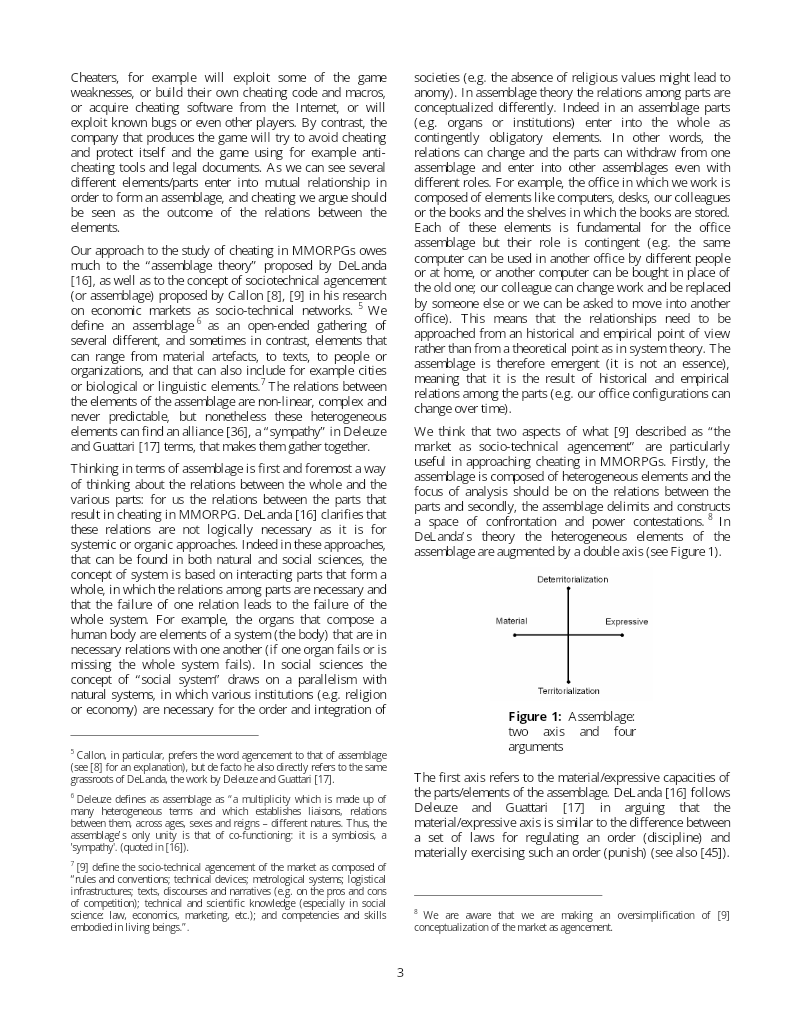
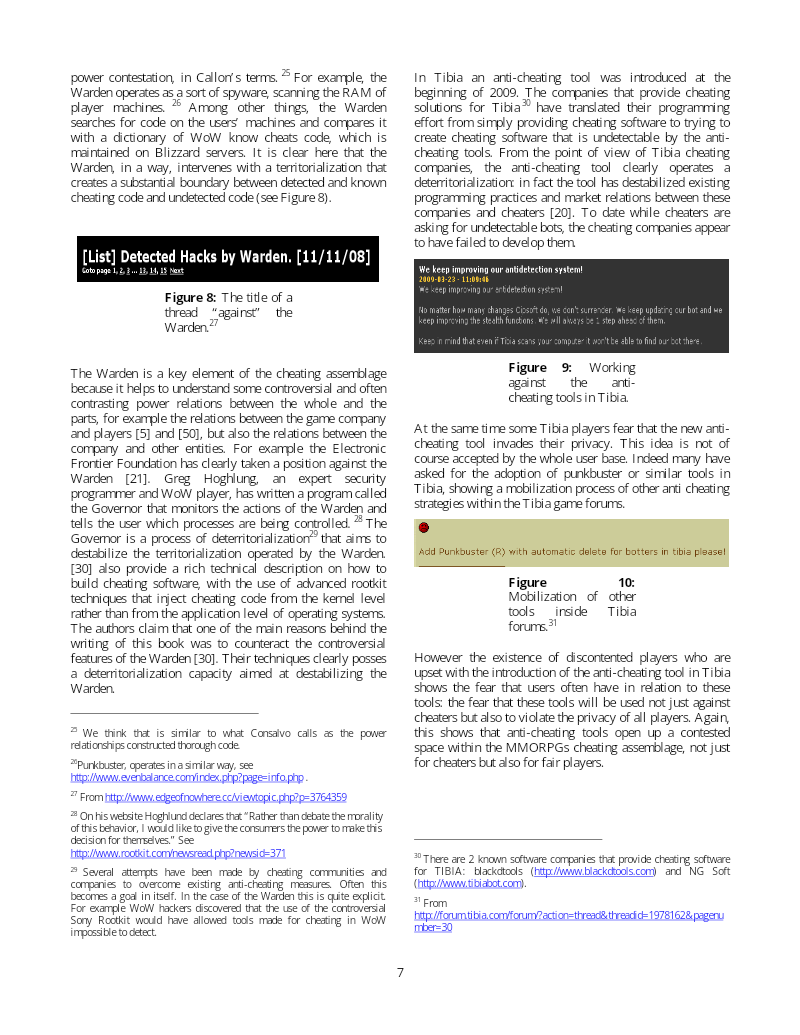
This paper reframes cheating in massively multiplayer online role-playing games (MMORPGs) as a sociotechnical assemblage rather than a simple set of player actions that confer unfair advantage.
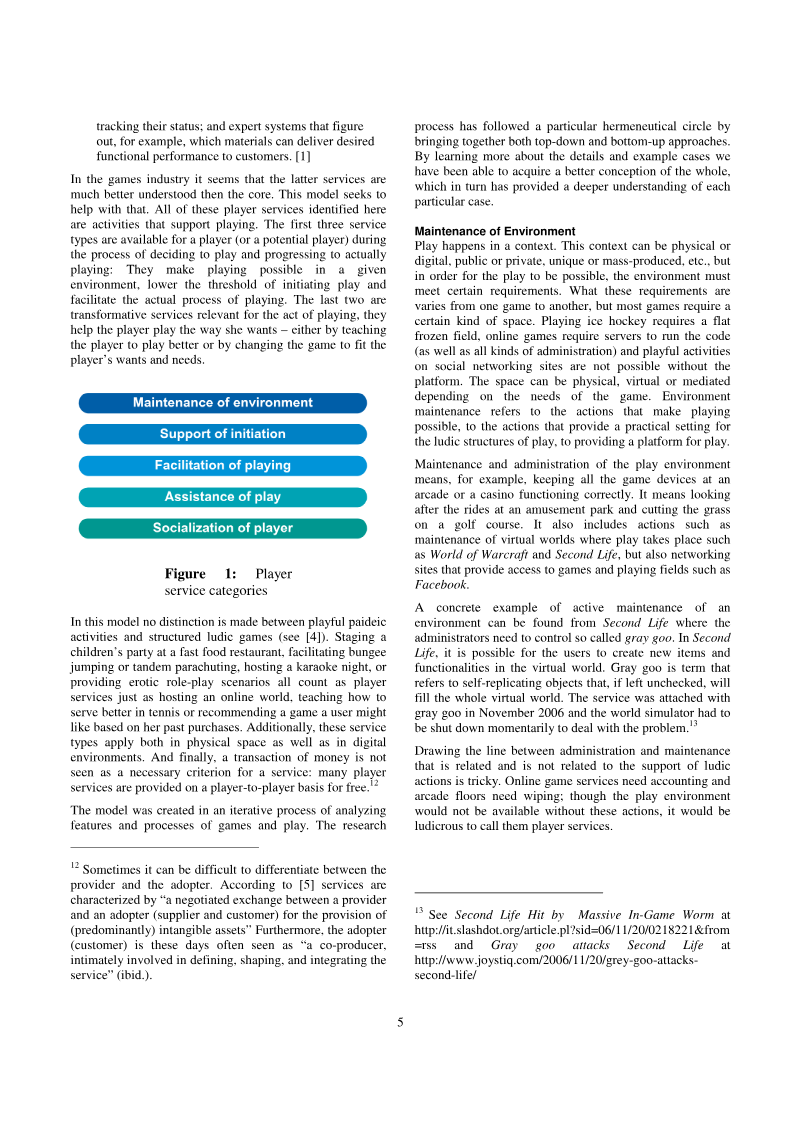
Commoditization of Helping Players Play: Rise of the Service Paradigm
The game industry's shift from selling fixed products to delivering ongoing services is the central subject of this analysis, which situates the transformation within broader post-Fordist patterns of commodification.
The Gigue Is Up: High Culture Gets Game
"The Gigue Is Up: High Culture Gets Game" examines whether Baroque music education can succeed when delivered through interactive game design rather than conventional instruction.
From Simulation to Imitation: New Controllers, New Forms of Play
This paper, by Jennifer Jenson and Suzanne de Castell, argues that the recent proliferation of new game controllers, such as the Wii remote, plastic guitars, microphones, dance pads, and the Nintendo DS touch screen, marks an epistemological shift in digital gameplay from simulation toward imitation.