1 free read left. Create a free account for unlimited reading + AI research.
Create free accountWhitepaper DiGRA
1 free read left. Create a free account for unlimited reading + AI research.
Create free accountWhitepaperDiGRA
The player gains an overview of the world from the map, while the avatar acts within lived places. The paper treats this tension as its central proposition.
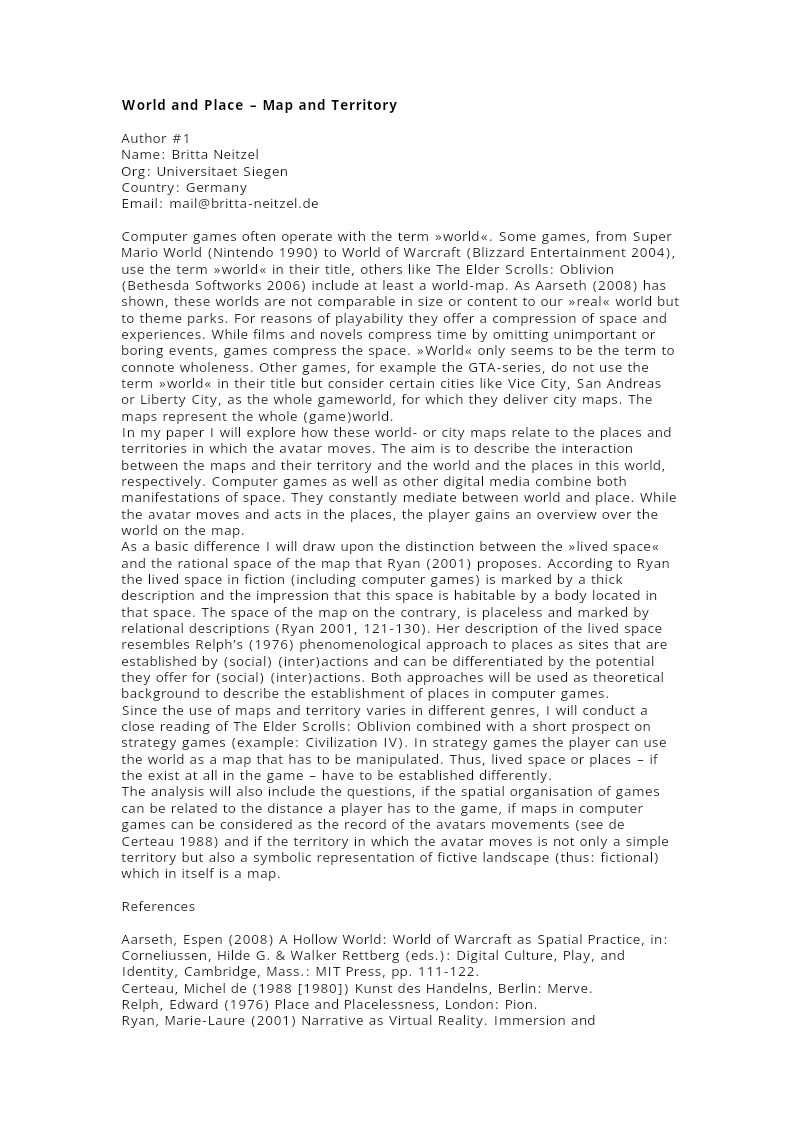
This paper, authored by Britta Neitzel of the Universität Siegen, examines how world maps and city maps in computer games relate to the places and territories through which avatars move. Its central proposition is that games and other digital media continually mediate between two manifestations of space: the world as represented on a map, from which the player gains an overview, and the lived places in which the avatar acts. The author frames the discussion around the distinction between lived space, which is thickly described and experienced as habitable by a body, and the rational, placeless space of the map, which is defined through relational descriptions. Two theoretical foundations support this distinction: Marie-Laure Ryan's account of narrative space and Edward Relph's phenomenological view of places as sites shaped by social interaction and the potentials they afford.
The paper's analysis rests on a close reading of The Elder Scrolls: Oblivion, supplemented by a shorter consideration of the strategy game Civilization IV. The contrast between these genres is central to the argument, since strategy games treat the world primarily as a map to be manipulated, which suggests that lived space or places, where they exist at all, must be established in fundamentally different ways. The work situates its claims within debates about the compression of space in games, noting that virtual worlds such as World of Warcraft resemble theme parks more than the real world in size and content, a point drawn from earlier scholarship by Espen Aarseth.
The author also poses several open questions that structure the inquiry. These include whether the spatial organization of games relates to the distance a player maintains from the game, whether in-game maps can be understood as records of the avatar's movements in the manner proposed by Michel de Certeau, and whether the territory an avatar traverses is merely a physical territory or also a symbolic, fictional representation of landscape that itself functions as a map. The document is a theoretical and analytical essay rather than an empirical study, and it draws its scope from a limited set of titles across genres, relying on interpretive reading rather than survey or quantitative data.
Each row is a game or company this document names, each column a document, oldest first. A mark means that document names it. Select a row to see those documents.
DiGRA · 2016
DiGRA · 2016
DiGRA · 2016
DiGRA · 2016

DiGRA · 2016
DiGRA · 2016
DiGRA · 2016
DiGRA · 2016
DiGRA · 2016
DiGRA · 2016
DiGRA · 2016

DiGRA · 2016