
DiGRA
The Digital Games Research Association: the international association of academics and professionals who study digital games. Its Digital Library holds the proceedings of the DiGRA conferences since 2002.
Documents


"You Can't Help Shouting and Yelling": Fun and Social Interaction in Super Monkey Ball
This paper by Lisbeth Klastrup examines how social interaction contributes to the experience of fun in multiplayer console gaming, using Super Monkey Ball as its case study.
- Console multiplayer play happens in shared living-room settings close to other players, resembling television viewing as a domestic social activity, which encourages sociability distinct from isolated PC gaming.
- Fun in the study emerges from oscillating between mastering a game's rules and staying absorbed in its world, with games acting as "affective alliances" around shared, time-limited experiences.
- A pilot study of nine participants (aged 20 to 30) in groups of experienced players, inexperienced players, and a contrasting male group found all experienced players wanted to play again and most inexperienced players did too.

Vertigo and Verticality in Super Monkey Ball
This paper by Troels Degn Johansson examines Super Monkey Ball (SMB) through the lens of its verticality, arguing that the game's distinctive vertical design, together with the frequent experience of falling and failing, gives it an allegorical and rhetorical dimension beyond its surface as a light party game.
- The paper argues that Super Monkey Ball's vertical design and frequent falling and failing give it an allegorical and rhetorical dimension beyond its surface as a light party game.
- Its cute monkey imagery, caricatured infantile behavior, and playful treatment of physical insufficiency invite a lighter mode of play that appeals to both non-gamers and hardcore players.
- The analysis rests mainly on the author's own play experience and an informal empirical study of test players, supplemented by one observation from a related study in the same collection, so the evidence base is modest.

Play in Cultural Environments
"Play in Cultural Environments" examines games that deliberately erode the "magic circle," the conceptual frame separating play from everyday life.
- The report argues that boundary-blurring games erode the "magic circle" separating play from everyday life, raising fundamental questions about games' artificiality and their relationship to lived reality.
- Games that mix freely with players' surroundings can generate forms of play more culturally relevant than those confined within traditional boundaries.
- Microsoft's web-based alternate reality game A.I.: Artificial Intelligence distributed puzzles across fan sites, used weekly episodic updates, and incorporated real-world rallies.
Approaches to Computer Game Design: Characters and Conflict
This paper examines how computer games generate action, arguing that action is the defining feature of games from the player's perspective and that it can be created and directed through well-defined characters with conflicting needs and motivations.
- Action is presented as the defining feature of games from the player's perspective, and it can be created and directed through well-defined characters with conflicting needs and motivations.
- Players perceive a game as logically coherent only when character motivations are consistent with the game's structure; the design of characters, expectations, and space must work together to guide meaningful engagement.
- Player expectations shape interpretation and behavior, including an assumed 'expectation of gaming' that a game should be interesting, challenging, and actionable, plus expectations driven by genre and intermediality.
I Have No Words & I Must Design: Toward a Critical Vocabulary for Games
Greg Costikyan's essay makes the case that game design needs a precise critical vocabulary, arguing that the term "gameplay" is too vague to guide analysis or practice.
- Game design needs a precise critical vocabulary, since the vague term "gameplay" fails to guide either analysis or practice; the essay proposes organizing discussion around interaction, decision-making, and goals.
- Interaction becomes purposeful only when organized around goals, and games are distinguished from static puzzles and non-game systems by internal meaning that arises from their own structure rather than the real world.
- Games are defined by struggle rather than competition, since obstacles can take many forms (opposing players, computer opponents, puzzles, social or environmental barriers), and a game lacking meaningful struggle becomes dull.
Introduction: All Your Base Are Belong to Us
This introduction to the Computer Games and Digital Cultures (CGDC) conference proceedings, written by Frans Mäyrä of the University of Tampere, argues that digital games have moved from marginal enclaves into a mainstream cultural form worth serious scholarly attention.
- Digital games are cited as a twenty-billion-dollar worldwide industry, a scale that the author uses to argue they have moved from marginal enclaves into a mainstream cultural form deserving serious scholarly attention.
- The author points to the spread of multiplayer networking, mobile gaming, and augmented-reality concepts as evidence of games' expanding reach, while noting that games are becoming more ambitious artistically yet retain a counter-cultural, "low culture" character.
- Game studies is presented as a young, interdisciplinary field still defining its identity, with growing university programs in games technology and research cited as a sign of its maturation.
iDTV Gamers: The Emergence of a New Community?
Interactive digital television (iDTV) gaming in the United Kingdom is examined as the emergence of a distinct and growing viewer community, one that departs from the traditional image of the PC or console gamer.
- Roughly 40% of UK homes now have interactive digital television (iDTV), and 44% of digital consumers play games on it, with NTL's games channel drawing older, family-oriented, and lower socio-economic audiences.
- iDTV gaming is characterised by short "dipping" sessions alongside television viewing and a preference for simple, family-friendly titles, making it an extension of household TV habits rather than a dedicated pastime.
- A Netpoll study of 50 homes identified three iDTV player types: Generation I teens, Early Clickers, and Daytime Dabblers.
Console Games in the Age of Convergence
Console gaming's history since the 1980s, as this analysis traces it, has moved through a repeating cycle of convergence, divergence, and convergence again, with each phase shaped as much by institutional strategy as by raw technical capability.
- Console gaming has cycled through repeated phases of convergence and divergence since the 1980s, with each phase shaped by institutional strategy as much as by technical capability.
- Nintendo held over 80 percent of the US console market and about 90 percent of Japan's in 1989, before Sony's CD-ROM-based PlayStation entered in 1995 and captured over 20 percent of the games market by 1996 through aggressive pricing and a larger software library.
- Sega withdrew from hardware after the Dreamcast's online strategy failed amid slow modem speeds and weak uptake of its service, while Sony's PlayStation came to dominate the late-1990s and early-2000s market.

The Similar Eye: Proxy Life and Public Space in the MMORPG
Across its argument, this work contends that massively multiplayer online role-playing games, despite their rhetoric of alternative universes, function as genuine public spaces.
- The report argues that MMORPGs such as EverQuest, Ultima Online, Anarchy Online, and Star Wars Galaxies function as genuine public spaces, countering theorists like Richmond, Davidson, and Gibson who deny that virtual environments can support authentic public interaction.
- Its central mechanism is oppositional game design: dividing the world into safe cities, dangerous wilderness, and quest zones, with the environment acting as antagonist, creates functional dependence on other players, which the author identifies as the foundation of community.
- Drawing on de Certeau's strategies and tactics, along with the figures of the crowd and the flâneur, the analysis holds that public space emerges through player improvisation within designed frameworks rather than from the designed structure alone.
In Defense of Cutscenes
Rune Klevjer's essay "In Defense of Cutscenes" mounts a theoretical argument against radical ludology, the position that narrative elements in games are irrelevant ornaments layered over play.
- Klevjer's essay argues against radical ludology, the view that narrative in games is an irrelevant ornament, and instead holds that cutscenes are an integral part of the gaming experience where narration and play can coexist.
- Klevjer contends that game events are inherently representational and rhetorical 'symbolic actions,' which gives narrative framing a legitimate role in shaping how players understand their activity.
- The essay addresses the 'paradox of make-believe' in story-based games such as Grand Theft Auto III, where players want both open-ended agency and a pre-written narrative, and argues cutscenes resolve this tension through genre-based framing.
Towards Communicative, Collaborative and Constructive Multi-Player Games
Tony Manninen's work argues that multiplayer games are often mechanically shallow and that academic theory and industry practice remain poorly connected.
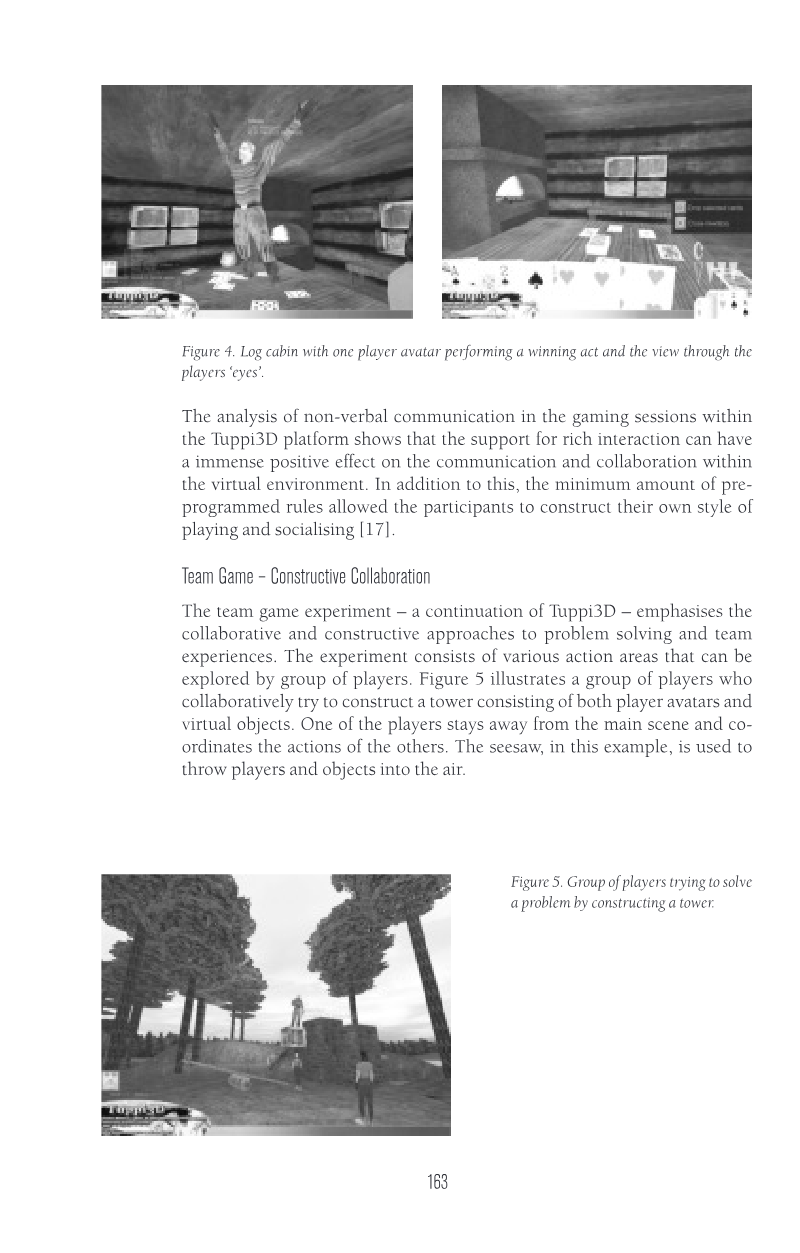
- The central finding is that participants communicate effectively in virtual environments when systems offer multiple communication channels in a "memorable, yet invisible" manner, with non-verbal communication identified as a key design priority.
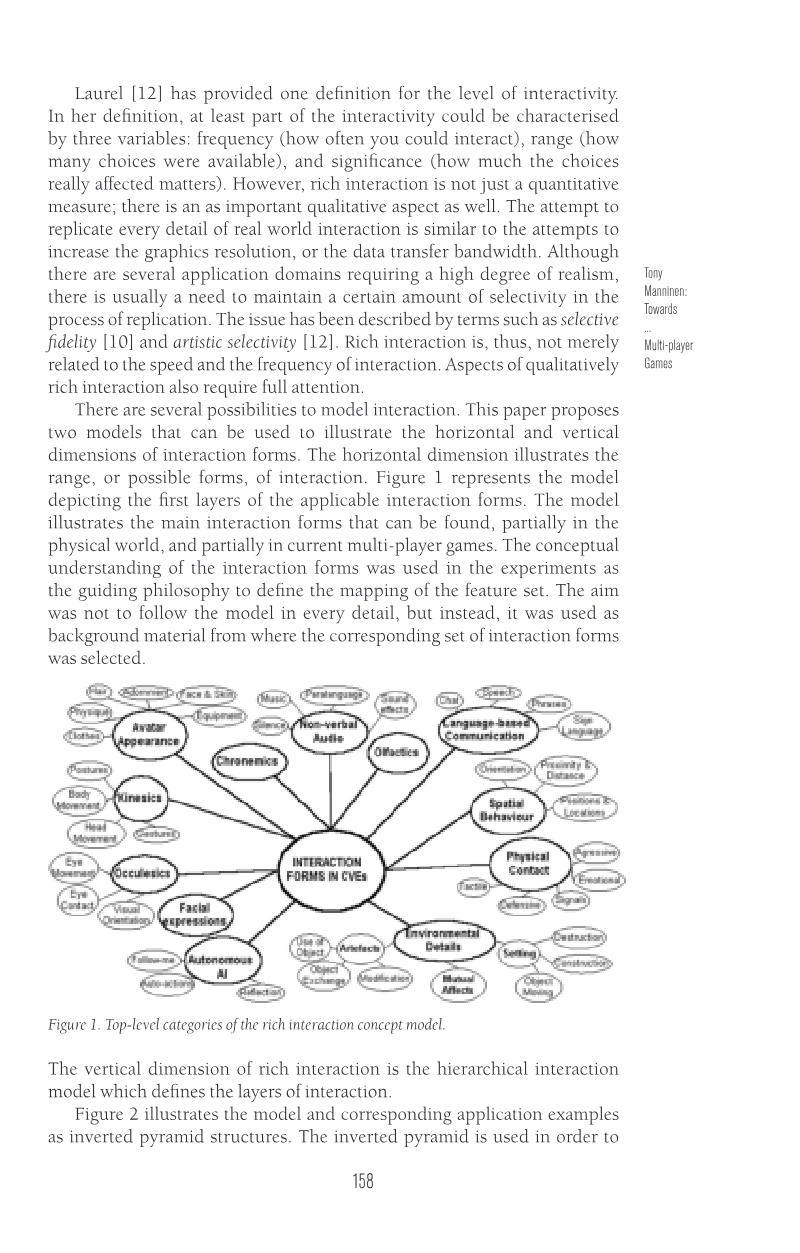
- The author proposes two models of "rich interaction": a horizontal concept model describing forms of interaction and a vertical hierarchical model structuring them, aimed at making multiplayer games more communicative, collaborative and constructive.
- The work argues that multiplayer games are often mechanically shallow and that academic theory and industry practice remain poorly connected, partly because commercial secrecy limits researchers' access to industry data.
Gran Stylissimo: The Audiovisual Elements and Styles in Computer and Video Games
Aki Järvinen's "Gran Stylissimo" offers a framework for analyzing the audiovisual appearance of computer and video games, proposing that their styles can be classified into three categories: photorealism, caricaturism, and abstractionism.
- Järvinen's framework classifies game audiovisual style into three categories (photorealism, caricaturism, and abstractionism) and defines its elements as dimensionality, point of perception, visual outlook, and soundscape, arguing these matter more for understanding games than conventional genre labels alone.
- Games differ from film because players manipulate and simulate environments, which gives sound a functional role: diegetic sound grounds the player in the space and gives feedback on actions, while nondiegetic sound can be anchored to locations to build mood.
- Game aesthetics circulate constantly with film, as shown by Max Payne borrowing the 'bullet time' effect from The Matrix, so game styles cannot be analysed in isolation.