
DiGRA
The Digital Games Research Association: the international association of academics and professionals who study digital games. Its Digital Library holds the proceedings of the DiGRA conferences since 2002.
Documents



On the Border: Pleasure of Exploration and Colonial Mastery in Civilization III Play the World
Sybille Lammes's analysis of Civilization III: Play the World argues that the game presents exploration and expansion as a colonialist progression, moving from "nature" toward a Western, white, male-centred "civilization."
- Sybille Lammes argues that Civilization III: Play the World frames exploration and expansion as a colonialist progression from "nature" toward a Western, white, male-centred "civilization," drawing on postcolonial and science studies.
- The analysis reads the game's intro cinematics (such as the Tower of Babel imagery) and setup options, including the framing of "Barbarians" as nature-bound and non-Western cultures as rivals, as naturalising links between expansionism, science, masculinity, and whiteness.
- The core claim is that the game's border expansion mirrors European colonial attitudes, with colonies serving as resource extraction zones for the homeland and "othered" peoples and territories subject to control.

Women Just Want to Have Fun: A Study of Adult Female Players of Digital Games
Aphra Kerr's study examines how adult women in Ireland come to play digital games and sustain that play despite a gaming culture that has long been framed as male.
- Social networks, rather than individual initiative alone, are the main force shaping how adult women first enter digital gaming and how they keep playing, with early exposure through brothers, fathers, or friends and access to shared or borrowed consoles as the principal routes in.
- Despite Sony's marketing and redesign claims of gender neutrality, female ownership of the PlayStation 2 reached only 6.7 percent of registered PAL-territory owners, compared with 11.1 percent in Japan.
- The study attributes the PlayStation 2's limited female uptake to a continued focus on hardcore male gamers, price sensitivity among women, and manufacturers' reliance on registered-user data that cannot capture people playing on borrowed hardware.

Representation of Gender and Ethnicity in Digital Interactive Games
This content analysis by Jansz and Martis examines how gender and ethnicity are portrayed in digital interactive games, an area the authors describe as understudied relative to film and television.
- Male characters still outnumbered females in the analyzed games, 13 of 22 characters, yet leading roles were evenly split between men and women, a shift from earlier research that found men dominating games with women in minor stereotypical roles.
- Female supporting characters were never shown in submissive positions, a notable departure from prior studies of game representation.
- Most characters were Caucasian (about 55 percent overall), and leading characters were predominantly white, indicating ethnic representation remained narrow.


Power and Control of Games: Children as the Actors of Game Cultures
Ermi and Mäyrä's study examines the appeal and regulation of digital games among 10- to 12-year-old children in Finland, with research conducted in 2003.
- Children aged 10 to 12 in Finland are portrayed as active, articulate participants in game culture rather than passive or vulnerable consumers, according to a 2003 study drawing on a survey of 284 children and parents plus fifteen family interviews.
- Imaginary worlds are the most compelling draw of digital games because they make experiences possible that would otherwise be out of reach, with novelty, adventure, persistence, a balance of challenge, and humour as other major sources of engagement.
- Game appeal stems from several interacting qualities, including fun, puzzle-solving, achievement, building and controlling fictional worlds, and audiovisual quality, and interest often links to children's existing hobbies, showing games are woven into broader leisure and creative lives.

Supporting Visual Elements of Non-Verbal Communication in Computer Game Avatars
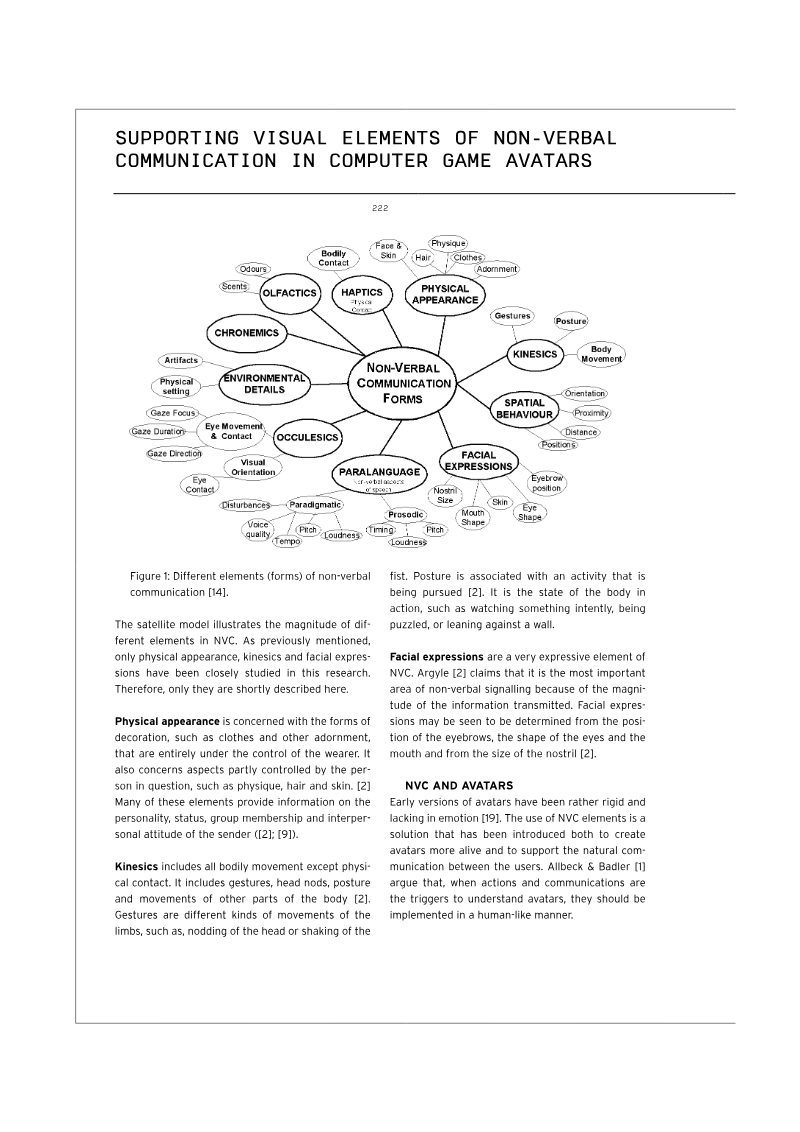
This paper presents a three-layer model for systematically designing the visual elements of non-verbal communication (NVC) in avatars for multiplayer computer games.
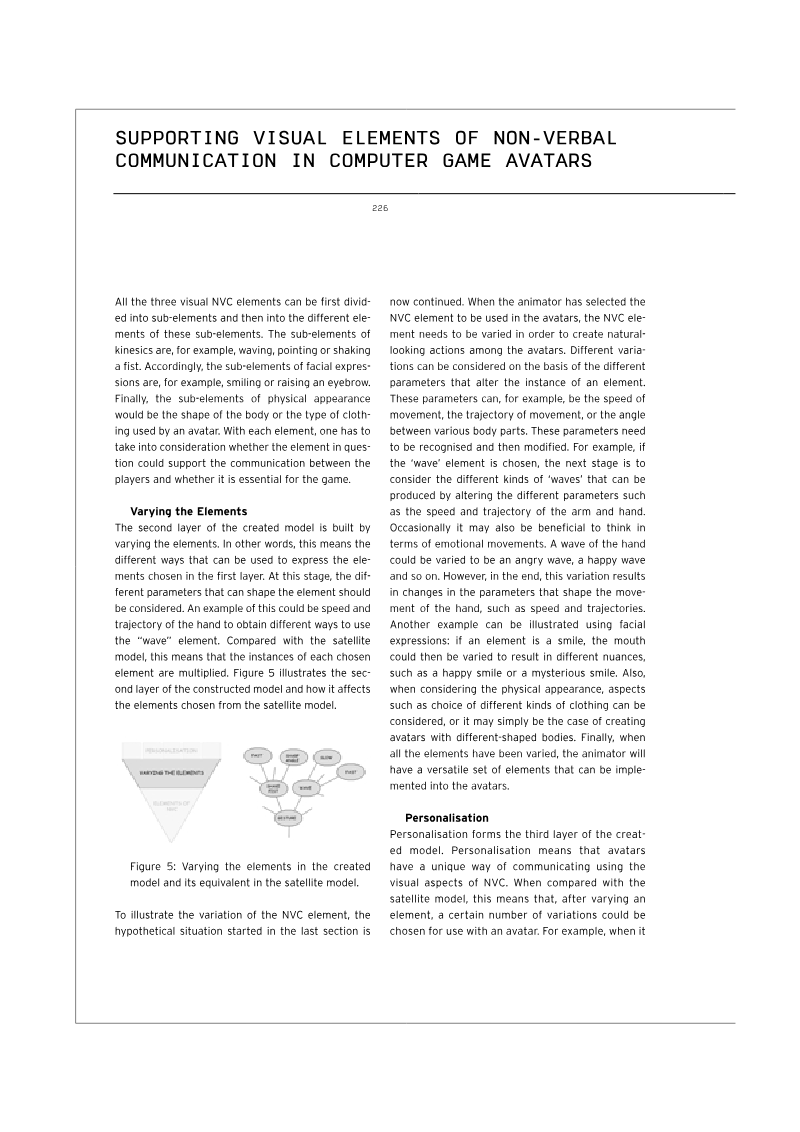
- The paper proposes a three-layer model for designing visual non-verbal communication in multiplayer game avatars, guiding designers to select NVC elements, vary them through parameters such as movement speed and trajectory, and personalise avatars so each has a distinguishable communicative identity.
- The study covers physical appearance, kinesics (bodily movement and gesture), and facial expressions, while eye movement and gaze were excluded due to limitations in the experimental technology.
- Adding NVC elements increased players' opportunities to convey and receive messages, varying them enabled richer and subtler expression, and personalisation made avatars more recognisable and prevented identical actions from appearing across different avatars.

Enhancing Gameplay: Challenges for Artificial Intelligence in Digital Games
Darryl Charles's paper argues that rapid growth in computing power gives game designers a timely opportunity to pursue radical advances in artificial intelligence rather than incremental refinements.
- The paper argues that rapid growth in computing power gives game designers a timely opportunity to pursue radical AI advances rather than incremental refinements, and that AI innovation is essential to avoid industry stagnation and establish games as a serious artistic medium.
- Current titles still rely largely on established techniques such as finite-state machines, A pathfinding, and scripting, with designers prioritizing the appearance of intelligence over realistic behavioral models.
- The paper identifies three priority areas for innovation: storytelling (especially player-driven narratives in MMORPGs), dynamic online learning (illustrated by the rare example of Black & White), and emotional expression, where real-time character animation lags well behind pre-rendered film.



A Joint Study of Super Monkey Ball: Keep the Monkey Rolling: Eye-Hand Coordination in Super Monkey Ball
This pilot study, part of a larger joint examination of Super Monkey Ball conducted by researchers at the Center for Computer Games Research at the IT University of Copenhagen, investigates whether eye-hand coordination is linked to computer game skill and whether avid gamers possess superior eye-hand coordination.
- The study is an exploratory pilot from the Center for Computer Games Research at the IT University of Copenhagen, examining whether eye-hand coordination relates to computer game skill and whether avid gamers have superior coordination.
- The research found no reliable link: the data did not substantiate a connection between computer game skill and eye-hand coordination, though the author noted the claim cannot be dismissed outright.
- The empirical component was very small, involving seven boys aged 10 to 13 from an urban after-school centre in Copenhagen, tested with the Test of Visual-Motor Skills before or after a Super Monkey Ball play session.


Computer Games and Violence: Is There Really a Connection?
This study examines whether violent video games are uniquely associated with violent behaviour among adolescents, drawing on a representative sample of 9,887 Norwegian youth aged 13 to 18 surveyed in 2002 through the Young in Norway study.
- The bivariate correlation between violent video games and violent behaviour among 9,887 Norwegian youth aged 13 to 18 (r ≈ .22–.23) drops substantially once gender is added, to about .15 for first-person shooters and .18 for action games.
- In multivariate models controlling for age and gender, the association between first-person shooters and violent behaviour largely disappears, except among 8th graders, while action games remain a significant predictor across all age groups.
- All game variables together explained only about 4 to 9 percent of the variance in violent behaviour, with the largest shares found in the oldest age groups.

Wargaming and Computer Games: Fun with the Future
Patrick Crogan's essay traces the history of wargaming to argue that modern computer games carry forward a distinctive relationship to the future, one rooted in the Enlightenment project of rational prediction and control.
- Patrick Crogan argues that modern computer games extend a relationship to the future rooted in the Enlightenment project of rational prediction and control, with the core activity being modelling and simulation.
- Narrative and cultural 'texture' are treated as marginal in games because the central pleasure lies in modelling complex systems, a claim that positions the essay within the ludological tradition while challenging its positivist tendencies.
- Wargaming is traced from Helwig's 1780 squared-board game through Reisswitz's 1824 Kriegsspiel, which impressed the Prussian military and was adopted into officer training, and on through postwar American military and research simulation.

Player Character Design Facilitating Emotional Depth in MMORPGs
This work proposes that massively multiplayer online role-playing games can achieve deeper emotional immersion by giving player characters a "virtual mind," a prosthetic consciousness that moves beyond the combat statistics and generic classes that dominate the genre.
- The report argues that individually authored MMORPG characters cannot scale to thousands of players, so emotional depth must come from a generative system rather than hand-crafted content.
- It proposes a "virtual mind" for player characters, replacing conventional numerical levelling with "being-values" organized around a Mind System, Story Daemons, and a Metaphysics System, developed within the Purgatory Engine and Ouroboros project at the Interactive Institute's Zero Game Studio.
- The mind model layers a two-dimensional affect framework (emotion, mood, sentiment, personality) over a Five Factor trait structure and Maslow's being-values, modeling Ekman's eleven emotions plus "pain".

Computer Games and the Complexity of Experience
This paper by Chiel Kattenbelt and Joost Raessens argues that computer games are typically analyzed through a sensory-motor model borrowed from classical cinema, one that privileges the actuality and causality of action and an Aristotelian, action-driven dramaturgy.
- The paper argues that computer games are typically analyzed through a sensory-motor model borrowed from classical cinema, which privileges action, causality, and an Aristotelian action-driven dramaturgy, and that this framing fails to capture the full complexity of experience both represented in games and lived by players.
- Kattenbelt and Raessens draw on Peirce's categories of firstness (feeling), secondness (action and resistance), and thirdness (reflection), and on Deleuze's movement-image, time-image, and thought-image, to build a framework for analyzing the emotional, volitional, and cognitive dimensions of play.
- The authors propose three player subject positions relative to a game's represented world: the lyric (emotional and affective), the dramatic (action-oriented and sensory-motor), and the epic (reflective and contemplative).

The Appeal of Cute Monkeys
Susana Pajares Tosca's study examines why the monkey characters of Super Monkey Ball, namely MeeMee, GonGon, Baby, and AiAi, have achieved popularity despite the game offering no story.
- The monkey characters of Super Monkey Ball (MeeMee, GonGon, Baby, and AiAi) remain popular despite the game offering no story, with their appeal grounded primarily in iconic, kitsch-tinged cuteness drawn from Japanese design traditions.
- The study places the monkeys in an "iconic" category alongside Hello Kitty, arguing that such characters succeed through a combination of cuteness and caricature rather than gameplay or narrative alone.
- The monkeys' appeal depends not only on visual design but also on gameplay and on their role as a social "mask" among players, according to the study's central conclusion.