
DiGRA
The Digital Games Research Association: the international association of academics and professionals who study digital games. Its Digital Library holds the proceedings of the DiGRA conferences since 2002.
Documents
Team Structure in the Development of Game-Based Learning Environments
This study examines how development teams for digital game-based learning environments should be organized, arguing that such projects demand multidisciplinary expertise spanning learning theory, game design, art, programming, testing, and subject-matter knowledge, along with meaningful user participation.
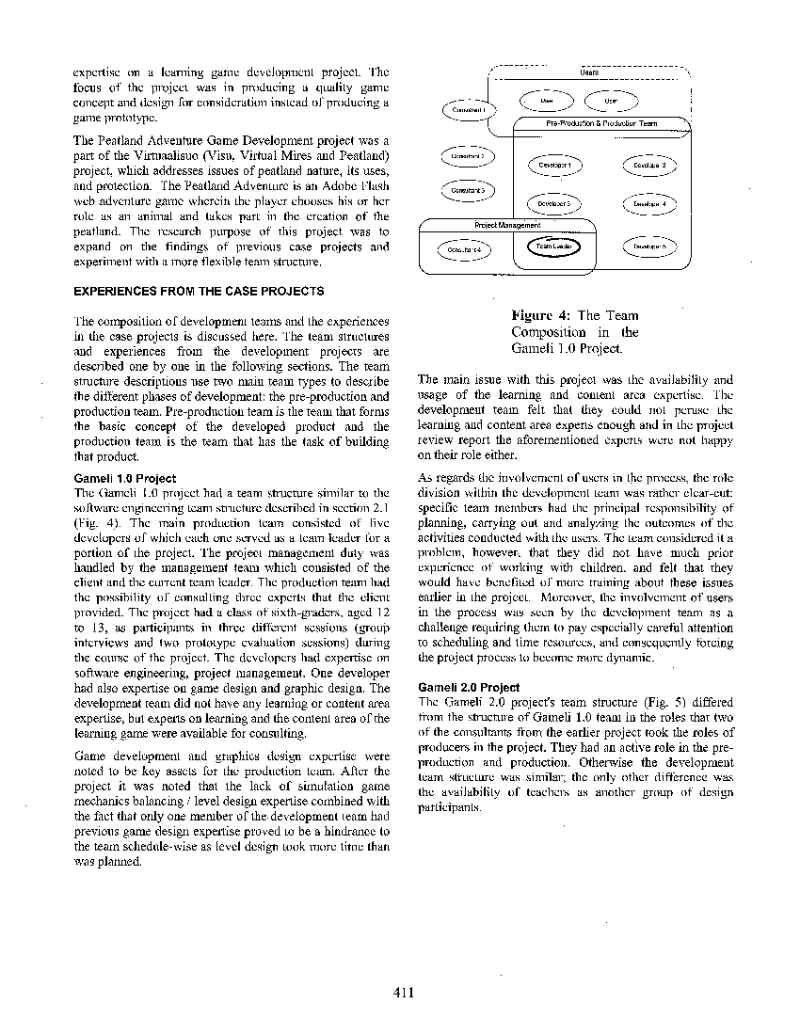
- Learning, content-area, and game-design expertise was frequently insufficient or underused across three case projects (Gameli 1.0, Gameli 2.0, and the Social Responsibility and Peatland Adventure projects), with learning and content experts often relegated to consultancy roles rather than responsible positions.
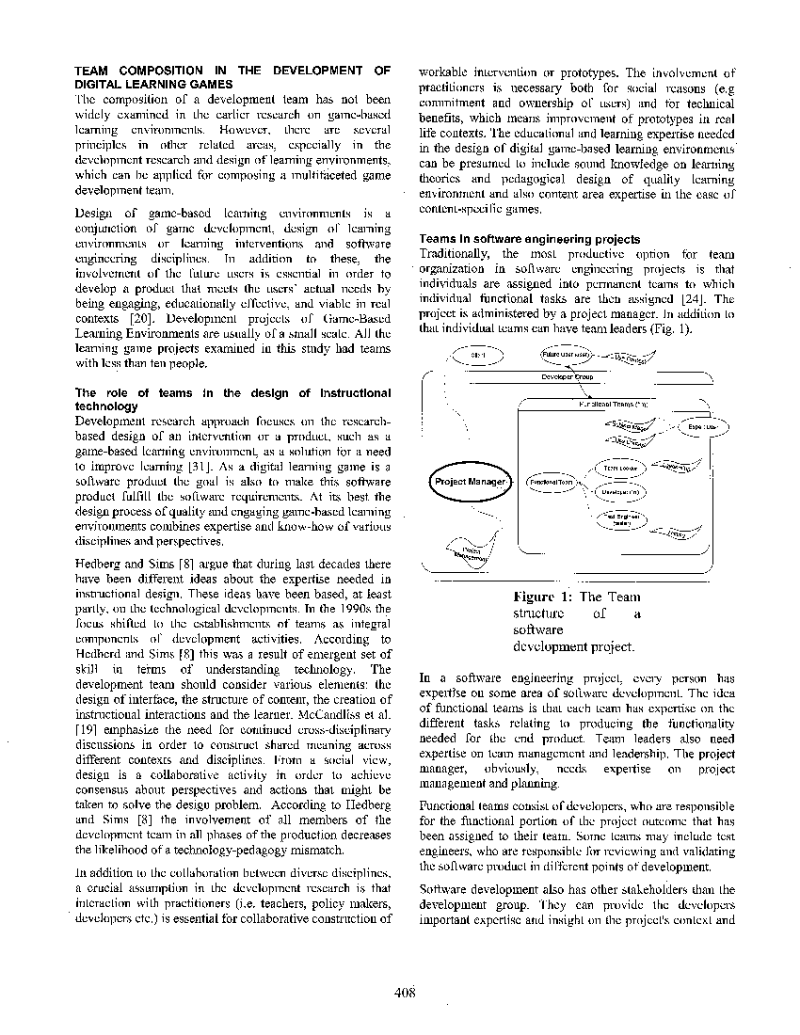
- The authors propose a general early-stage team structure comprising a management team, pre-production and production teams that include game design and software engineering expertise, and a design partner team representing end users.
- Pre-production is framed as the period for building shared understanding of project goals and common ground for implementing the final product, which underpins the argument for giving learning and content experts substantive roles from the outset.
Gameplay Design Patterns for Believable Non-Player Characters
This paper argues that believable non-player characters in games depend on players adopting an intentional stance toward them, a condition that requires qualities such as self-awareness, self-impelled action, emotional expression, natural language use, and persistent traits.
- Believable NPCs depend on players adopting an intentional stance toward them, which requires qualities such as self-awareness, self-impelled action, emotional expression, natural language use, and persistent traits.
- The authors argue that gameplay believability must stay consistent with narrative believability, and they propose new gameplay design patterns, in the format of Lankoski and Björk's existing collection of nearly 300 patterns, to fill the gaps they identify.
- A close case study of Claudette Perrick, a shopkeeper in The Elder Scrolls IV: Oblivion, shows partial believability: she displays initiative and goal-directed responses to theft and a basic sense of self, but fails to react to unwitnessed thefts, ignores physical disruptions, shows no lasting physical consequences, and cannot meaningfully alter her life trajectory.
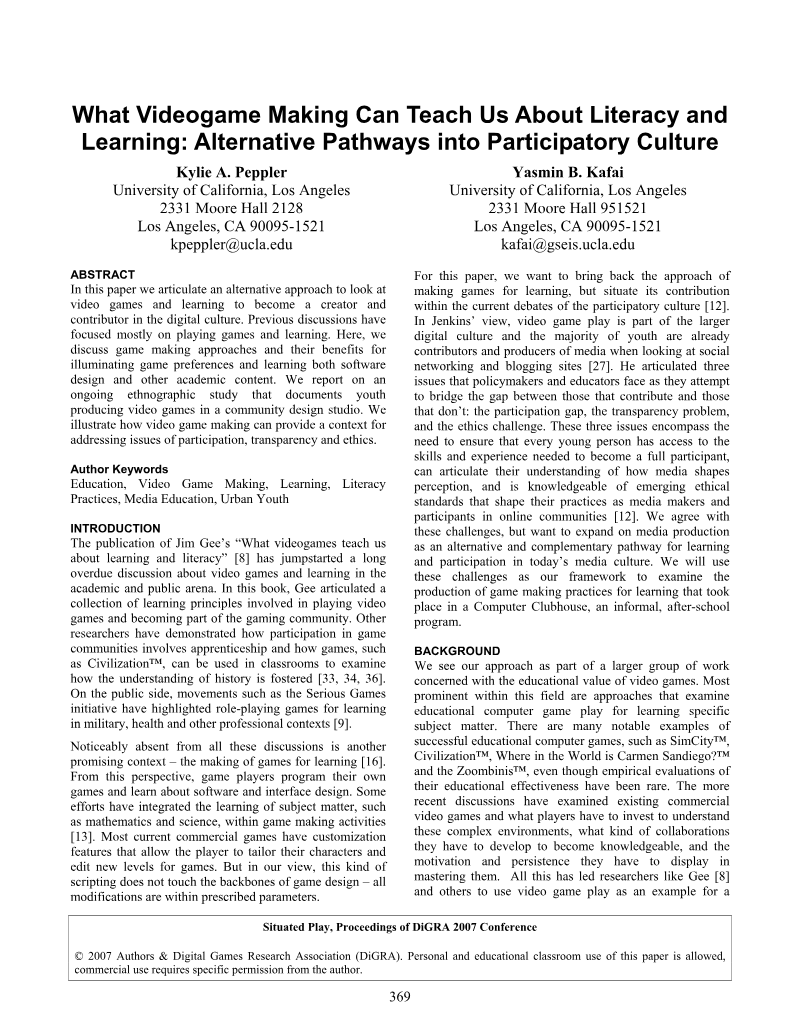
What Videogame Making Can Teach Us About Literacy and Learning: Alternative Pathways into Participatory Culture
Youth video game making in a Los Angeles Computer Clubhouse serves as the basis for an argument that building games offers an alternative route into participatory culture, one that addresses the participation gap, the transparency problem, and the ethics challenge identified in Jenkins' work.
- The study argues that building video games offers an alternative route into participatory culture, cultivating design skills and critical awareness as a counterpoint to passive media consumption, and addressing the participation gap, transparency problem, and ethics challenge identified in Jenkins' work.
- An archival analysis of 11,926 files collected over two years at a Los Angeles Computer Clubhouse found Scratch was the most-used design software, accounting for 643 files or 5.3 percent of the total after excluding saved web images, which dominated the corpus.
- Preliminary indications suggest programming complexity and community expertise grew in the second year, though the authors stress these trends are provisional because analyses of programming sophistication remain ongoing.
A Method for Discovering Values in Digital Games
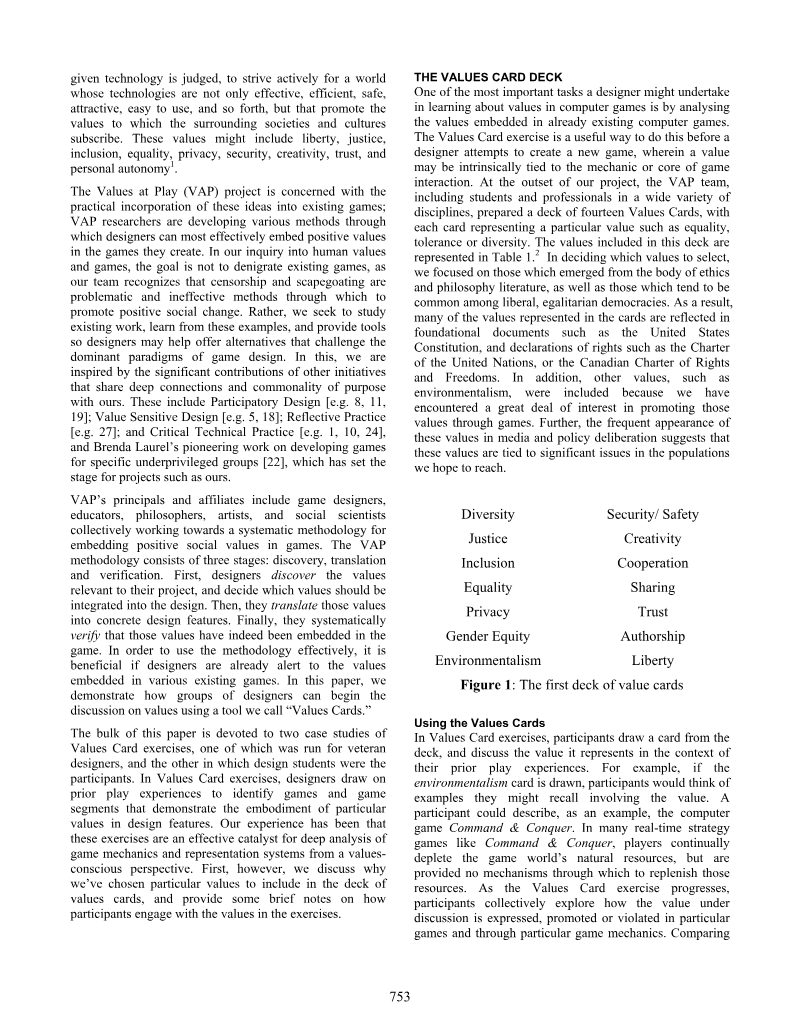
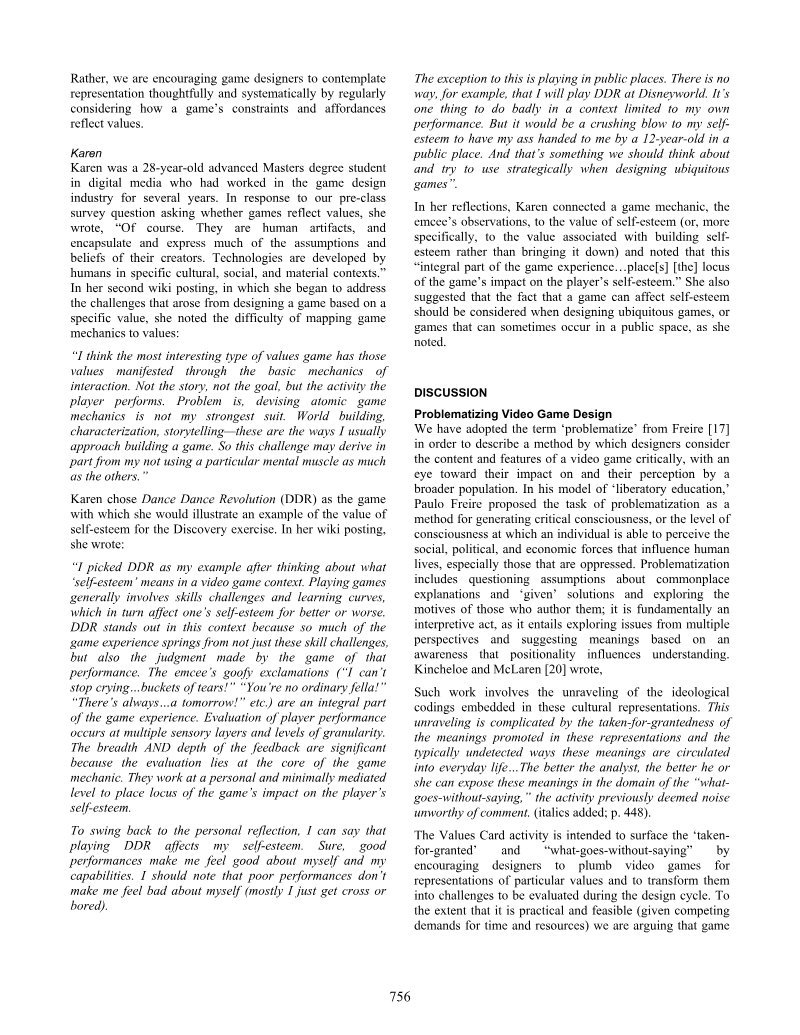
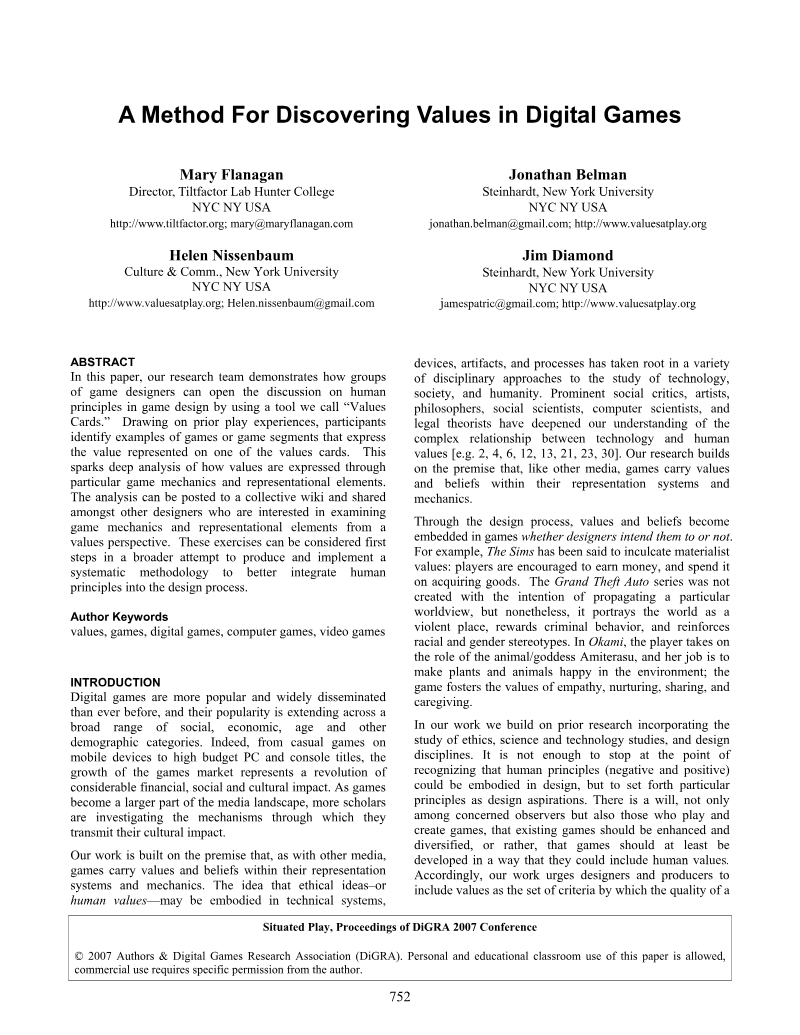
"A Method for Discovering Values in Digital Games" presents the Values Cards exercise, a practical tool that helps game designers identify and discuss human values such as equality, justice, generosity, and competition that are embedded in game mechanics, representation, and players' prior experiences.
- Games inevitably embed human values such as equality, justice, generosity, and competition, in their mechanics, representation, and the prior experiences players bring, much as other media do.
- The Values Cards exercise is presented as a practical tool that lets game designers identify and discuss these embedded values, and it is positioned as the first step in the broader Values at Play methodology of discovery, translation, and verification.
- Designers can gain conscious control over the values their games convey by examining both the positive and negative expressions of those values.


Pervasive Persuasive: A Rhetorical Design Approach to a Location-Based Spell-Casting Game for Tourists
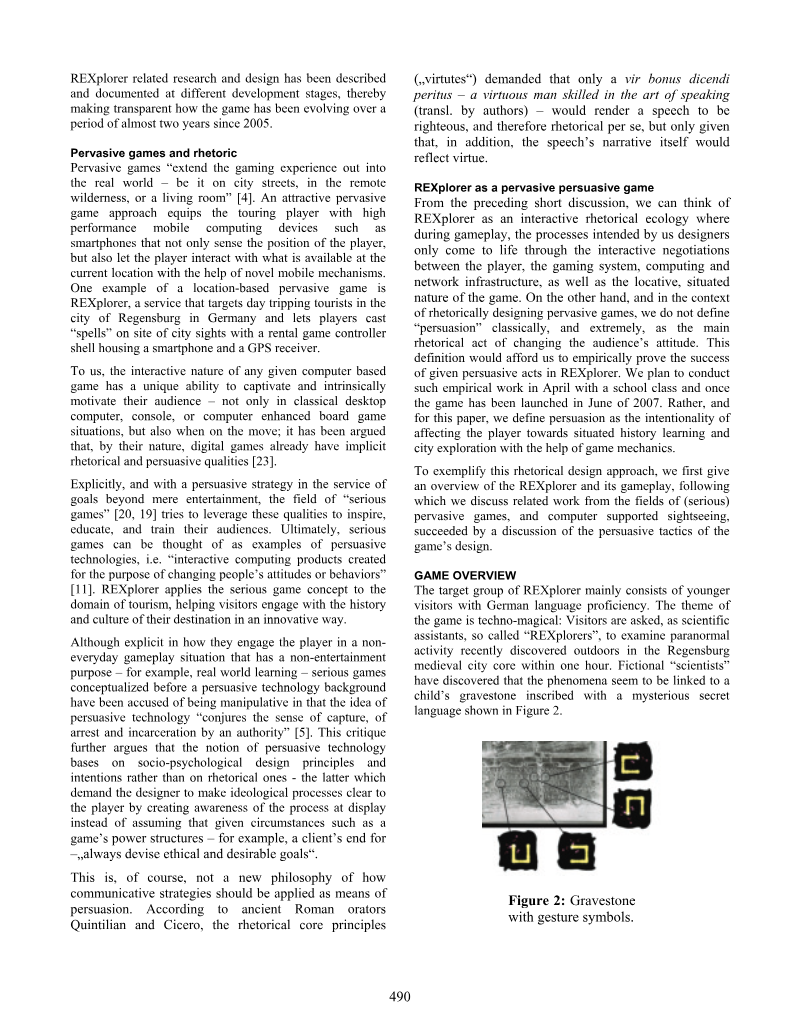
"Pervasive Persuasive" presents REXplorer, a location-based pervasive spell-casting game launched in June 2007 in Regensburg, Germany, and argues for a rhetorical design approach to persuading tourists toward situated history learning and city exploration.
- REXplorer, a location-based pervasive spell-casting game, launched in June 2007 in Regensburg, Germany, using the city's roughly 1,000 medieval and Gothic landmarks (many UNESCO-listed) as its stage to persuade tourists toward situated history learning and exploration.
- The authors define persuasion as the intentional shaping of player behavior and build their "pervasive persuasive tactics" on formal and dramaturgical design rather than on conventional game mechanics alone.
- The design uses a GPS-equipped smartphone in a shell with a custom gesture-based detector device, a personalized geo-weblog, and a walkable city-core layout in which 29 paranormally charged sites serve as graph vertices, with an on-screen control fallback for older players.

Human, All Too Non-Human: Coop AI and the Conversation of Action
Bart Simon's paper examines how cooperative artificial intelligence in contemporary digital games, particularly Activision's Call of Duty 2, reshapes the relationship between players and machines compared with the competitive human-versus-computer framing established by chess and the 1997 Deep Blue–Kasparov match.
- Simon argues that single-player games often preserve a "humanist remains" by hiding machine labor behind an illusion of individual human mastery, whereas cooperative AI foregrounds a "conversation of actions" in which players must continually track and adapt to non-human comrades.
- The paper frames cooperative AI as a move toward critical posthumanism, drawing on Haraway, Latour, Hayles, and Baudrillard, and uses Mori's uncanny valley to describe the unsettling yet productive tension it creates.
- Simon contends that cooperative AI opens exploratory space that competitive, Turing-style AI (exemplified by chess and the 1997 Deep Blue–Kasparov match) has largely closed off.
Ghastly Multiplication: Fatal Frame II and the Videogame Uncanny
This paper offers a close-play and close-reading analysis of Fatal Frame II: Crimson Butterfly, a 2003 PlayStation 2 survival horror game developed by Tecmo, to argue that the videogame uncanny is produced not merely by borrowing literary or filmic techniques but through the interplay of operational demands and affective…
- The videogame uncanny, per this paper, arises not just from borrowed literary or filmic techniques but from the interplay of operational demands (controls, camera, mechanics) and affective experience, producing a distinctly ludic form of the familiar made unfamiliar.
- Using Fatal Frame II: Crimson Butterfly (Tecmo, 2003, PlayStation 2) as its case study, the authors show how camera-based combat, shifts between third- and first-person perspectives, and restricted movement during camera mode generate uncanny effects.
- The twin avatars Mio and Mayu and the Crimson Sacrifice ritual, in which one twin kills the other, are read as doubles that mirror the player's own uncertain identification with the avatar.
Mapping Time in Video Games
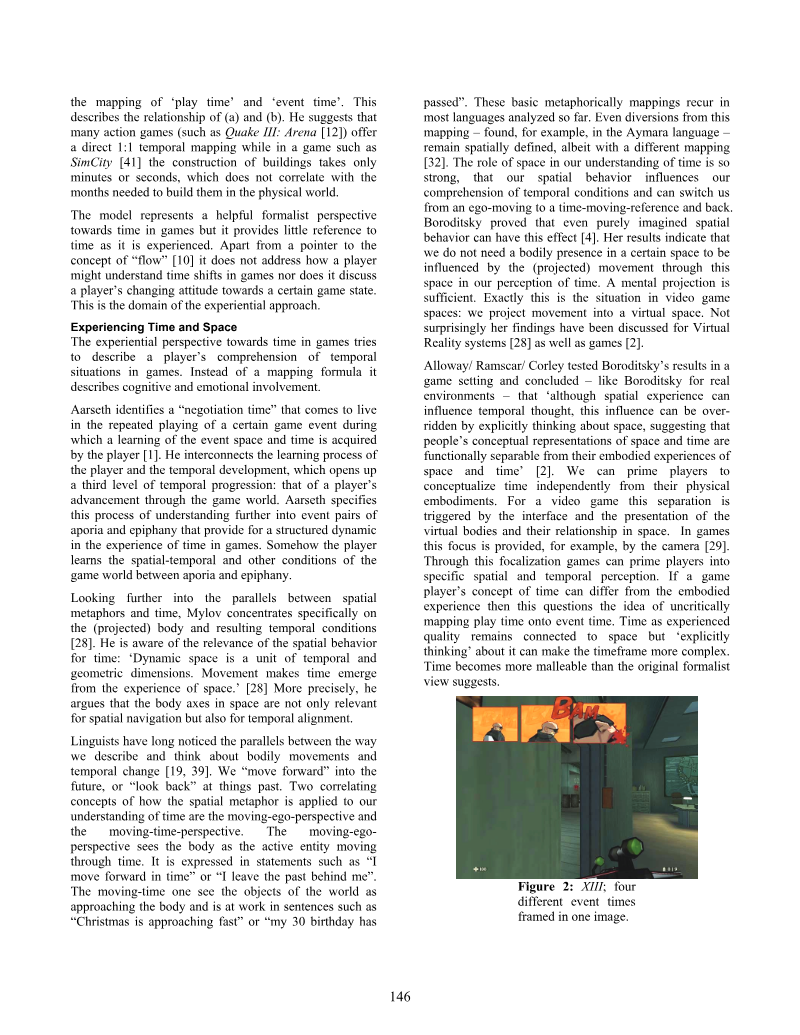
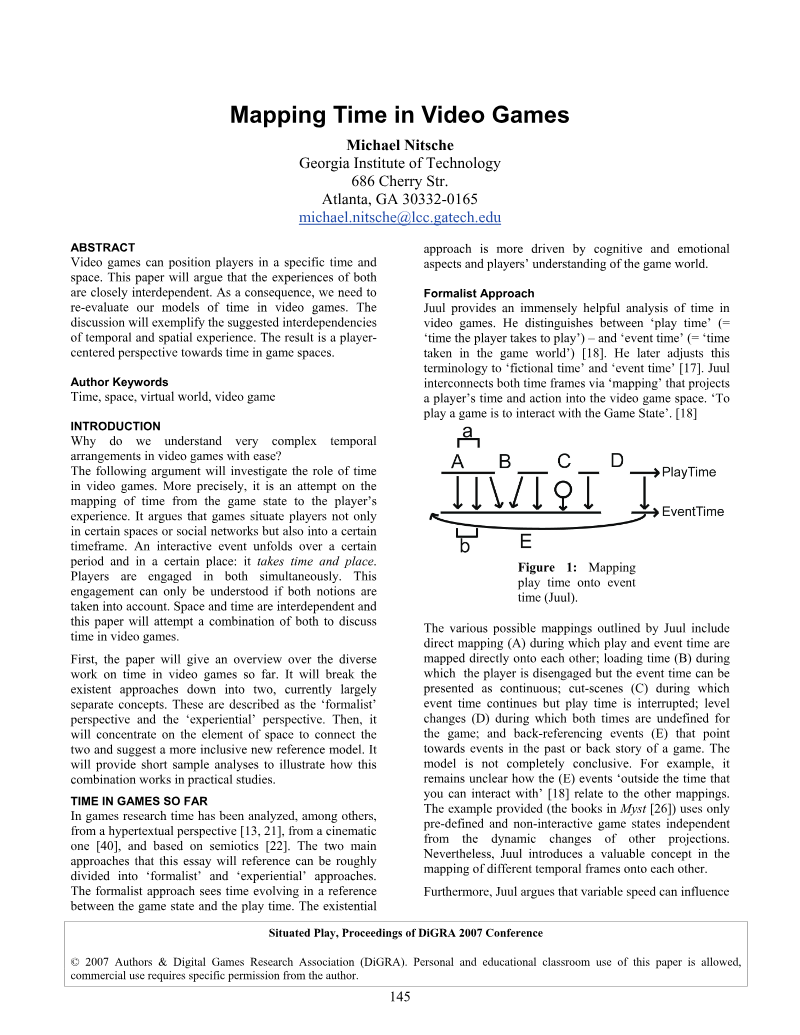
Michael Nitsche's paper "Mapping Time in Video Games" argues that players are situated in both space and time when playing, and that our understanding of temporal structures in games depends on our comprehension of their spatial relationships.
- Michael Nitsche's paper argues that players are situated in both space and time during play, and that understanding temporal structures in games depends on understanding their spatial relationships.
- The paper proposes combining the formalist model (Jesper Juul's mapping of play time onto event time, including direct mapping, loading time, cut-scenes, level changes, and back-referencing) with the experiential model (Espen Aarseth's negotiation time and players' cognitive and emotional engagement with temporal situations).
- Space is identified as the connecting element between the formalist and experiential models, with players projecting movement into virtual spaces so that consistent spatial layout keeps complex temporal arrangements legible.


Understanding Pervasive Games through Gameplay Design Patterns
The 2007 study "Understanding Pervasive Games through Gameplay Design Patterns" examines how pervasive games, those that extend play into everyday physical and social spaces, can be characterized and organized through a shared vocabulary of design patterns.
- The study analyzed 120 pervasive game examples against 75 gameplay design patterns, of which 53 were newly developed for pervasive contexts and 24 carried over from an earlier study of mobile games.
- Rather than classifying games by genre, the authors used a bottom-up approach, grouping patterns with a custom clustering program and treating cluster names as hypotheses about each group's core character.
- The resulting cluster hierarchy maps the pervasive game design space, with GPS Games the most distinct grouping, separated mainly by its lack of social-interaction patterns.



Designing a Game to Model Consumer Misbehavior
This paper argues that computer games, grounded in game design theory, offer a controlled, ethical, and engaging means of studying consumer misbehavior, a phenomenon driven largely by emotion that is difficult to examine through self-reports, direct observation, or role-play.
- The paper proposes a graphical, single-player game as a controlled, ethical way to study consumer misbehavior, a largely emotion-driven phenomenon that is hard to examine through self-reports, direct observation, or role-play.
- The design relies on real-time constraints, a clear winning state, and deliberately withheld information or feedback to induce stress and frustration that may provoke misbehavior.
- Emotionally responsive, context-specific non-player character dialogue is intended to sustain realism, while strong immersion and player control are meant to keep participants engaged.


Peep-Boxes to Pixels: An Alternative History of Video Game Space
Philip Sharp's "Peep-Boxes to Pixels: An Alternative History of Video Game Space" argues that video game arcades emerged from the convergence of leisure practices, technological innovation, and cultural identity rather than from a single line of technical progress.
- Philip Sharp argues that video game arcades arose from the convergence of leisure practices, technological innovation, and cultural identity rather than a single line of technical progress, with roots in nineteenth-century optical toys such as Dutch peep-boxes and Japanese magic lanterns, plus pinball and pachinko.
- Sharp contends Japan absorbed Western mechanical and optical devices and framed them as commercial leisure spaces, a pattern he sees continuing in modern arcades, while Japan's arcade and pachinko culture endured in contrast to the American shift toward home gaming and family entertainment centers.
- The report situates arcades within a recurring history of moral panic over amusement spaces, citing American pinball bans as an early stigma that anticipated later reactions to video game arcades.
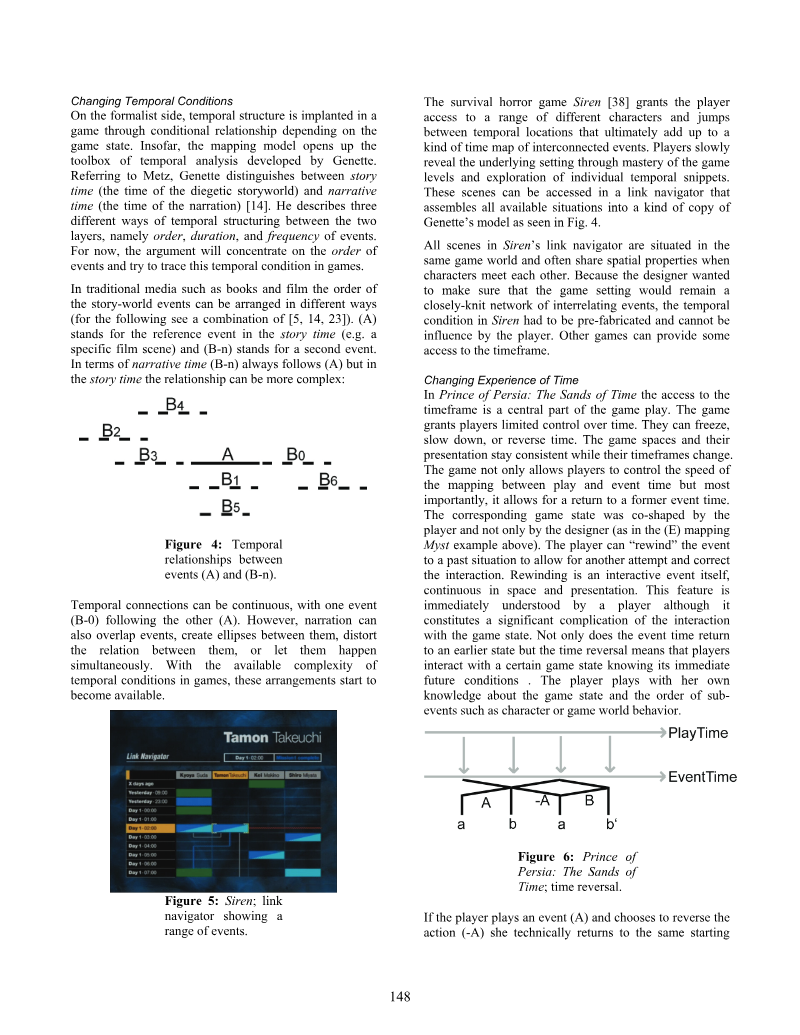
Temporal Frames: A Unifying Framework for the Analysis of Game Temporality
"Temporal Frames" proposes a formal analytical tool for studying how time operates in games, grounded in a relationist view in which temporal properties arise from relationships among events rather than from time as an independent container.
- Games rarely operate within a single temporal frame; the authors identify four recurring frames (real-world time, gameworld time, coordination time, and fictive time) that often coexist or succeed one another, and meaningful analysis depends on identifying each and how they interact.
- The paper critiques the familiar real-time versus turn-based binary as obscuring distinct temporal phenomena produced by frame interactions, and reconceives both as interactions between frames rather than fixed categories.
- Sequential and embedded arrangements of temporal frames generate temporal anomalies such as temporal bubbles, warping, and non-uniform temporality, illustrated with cases from Final Fantasy XII, Animal Crossing, Civilization, and Grand Theft Auto III.