1 free read left. Create a free account for unlimited reading + AI research.
Create free accountWhitepaper DiGRA
1 free read left. Create a free account for unlimited reading + AI research.
Create free accountWhitepaperDiGRA
The study argues that a game town's boundary is defined less by physical layout than by system-level rules governing what the player can do there. Those rules decide whether the player can be attacked, trade with vendors, or rest safely.
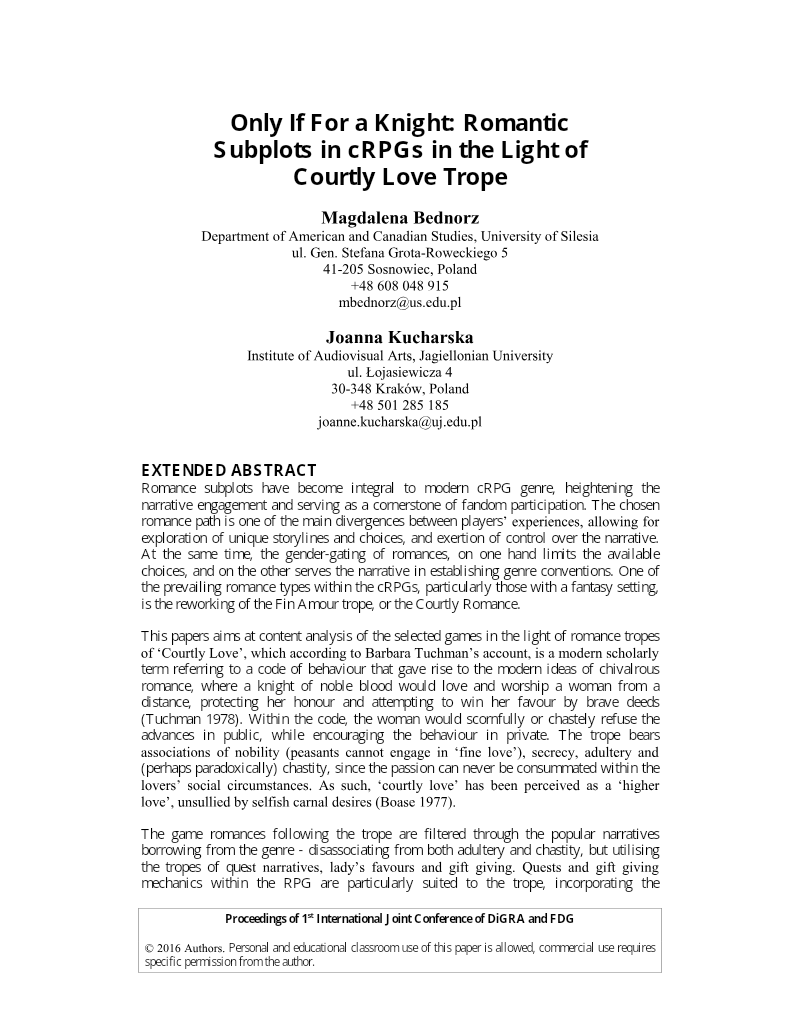
This study examines how neomedieval fantasy roleplaying games define the boundaries of their cities, arguing that these boundaries are constructed primarily through non-spatial, system-level rules rather than topography. Drawing on a three-level model of aesthetic, user interface, and system layers, the analysis positions the city as a socio-cultural space set apart from a hostile "not-city" outside. Its central thesis holds that what makes a town a town is not how it looks but what the game permits the player to do there, such as whether they can be attacked, trade with vendors, or rest safely. Aesthetics and interface cues then reinforce or blur that functional distinction.
Several comparative findings anchor this argument. Diablo II's Tristram and Travincal appear urban yet operate as hostile wilderness, while the Rogue Encampment and Harrogath share identical functionality but differ in how their visual design sharpens or softens the line between settlement and wilderness. The work further contends, building on Aarseth's quest-structure theory and Spearing's city/wilderness binary, that borders are repeatedly transgressed through a cycle of leaving, venturing out, and returning. Examples from Diablo, The Elder Scrolls, Baldur's Gate, Dragon Age, and Dark Souls illustrate how frontier boundaries expand through fast-travel and how serial quest games deploy city access as a progression reward.
The final section extends this reasoning by treating game cities as both quest hubs and quest destinations, with their borders functioning as markers of progression rather than simple barriers. Anor Londo in Dark Souls, gated by system-level restrictions and tied to the game's halfway milestone, and Dragon Age: Origins, where hub access itself is earned as a reward, serve as principal illustrations. The study concludes that because such boundaries are digitally constructed rather than topographically determined, they are especially revealing of player position and experience, and that analyzing them deepens understanding of how cities operate in fantasy roleplaying games more broadly.
DiGRA · 2026
DiGRA · 2016