
DiGRA
The Digital Games Research Association: the international association of academics and professionals who study digital games. Its Digital Library holds the proceedings of the DiGRA conferences since 2002.
Documents
On Striated Wilderness and Prospect Pacing: Rural Open World Games as Liminal Spaces of the Man-Nature Dichotomy
The document, "On Striated Wilderness and Prospect Pacing: Rural Open World Games as Liminal Spaces of the Man-Nature Dichotomy," examines how rural open-world video games construct and mediate players' experiences of nature.
- Marc Bonner argues that rural open-world games such as Horizon Zero Dawn and Assassin's Creed Origins carry a long Western tradition of staging a constructed, pristine 'striated wilderness,' tracing its lineage to Puritan man-nature dichotomy thinking, colonial terra nullius logic, and the U.S. Wilderness Act of 1964.
- The paper's core concept, 'prospect pacing,' describes how staggered horizons and vantage points structure navigation and evoke a tourist-style romantic gaze, offering players an illusion of free, smooth roaming while channeling them through designed patterns, waypoints, and markers.
- Drawing on historical scholarship, Bonner notes the Americas were far more densely populated before European contact than romantic wilderness imagery suggests, with indigenous populations falling by roughly 90 percent through disease.
Stasis and Stillness: Moments of Inaction in Videogames
Scully-Blaker's 2018 DiGRA paper examines moments of inaction in videogames, proposing a distinction between stasis, which arises from game mechanics, and stillness, a voluntary inaction rooted in aesthetics.
- Scully-Blaker's DiGRA 2018 paper distinguishes two forms of videogame inaction: stasis, produced by game mechanics (designed or player-injected), and stillness, produced by aesthetics.
- Injected stasis, where players halt their inputs to observe outcomes, often exposes design shortcuts or weak artificial intelligence, as seen in Man vs Wild and Mario Party 2, but its critical intent is usually undercut by entertainment-driven sharing contexts.
- Stillness can be encouraged through design, such as Animal Crossing discouraging running and inviting players to sit, but it cannot be forced, which is the key distinction between the two categories.
Good Game Feel: An Empirically Grounded Framework for Juicy Design
The document establishes an empirically grounded framework for "juicy design" and "good game feel" in video games, aiming to provide a more precise and actionable definition for these often vaguely understood concepts.
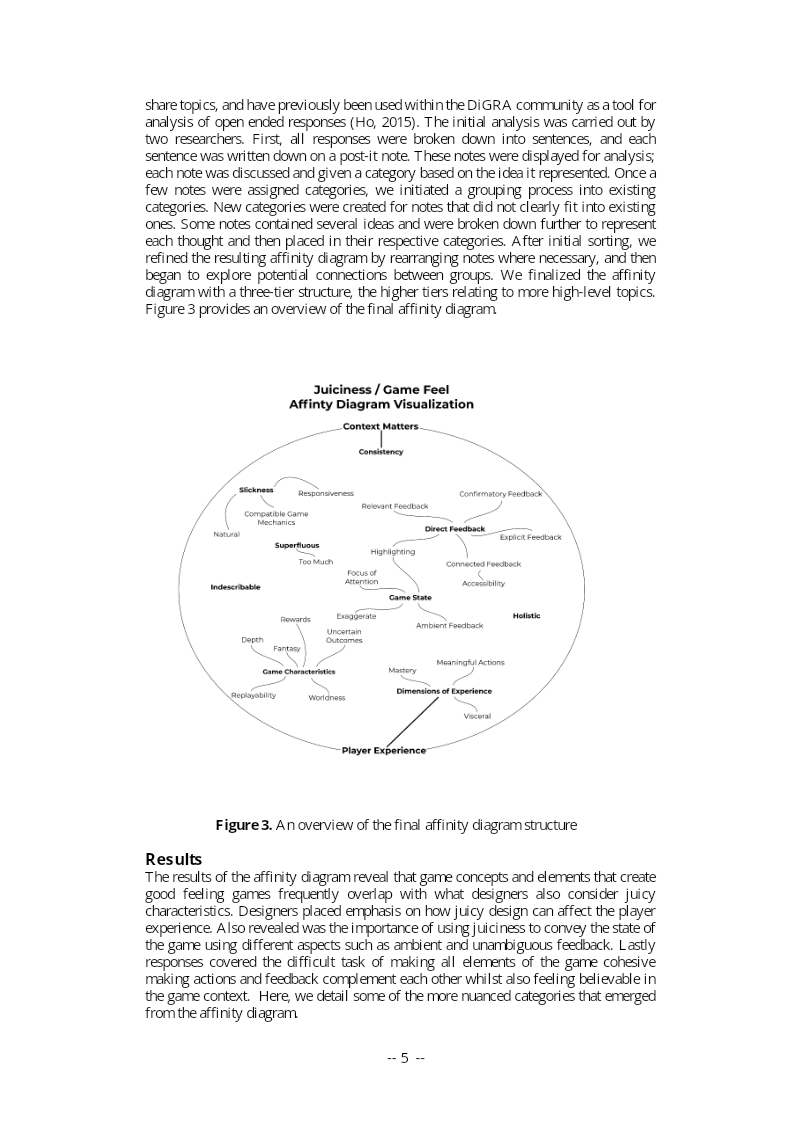
- The paper addresses the vague definition of "juicy design" by grounding it in a survey of 17 professional game developers, whose responses were organized via an affinity diagram into categories such as game characteristics, dimensions of experience, direct feedback, redundancy, and slickness.
- Developers stressed that juice must be integrated holistically with all game elements and matched to genre, since feedback alone is insufficient; effective feedback is exaggerated, multimodal, relevant, and non-overwhelming.
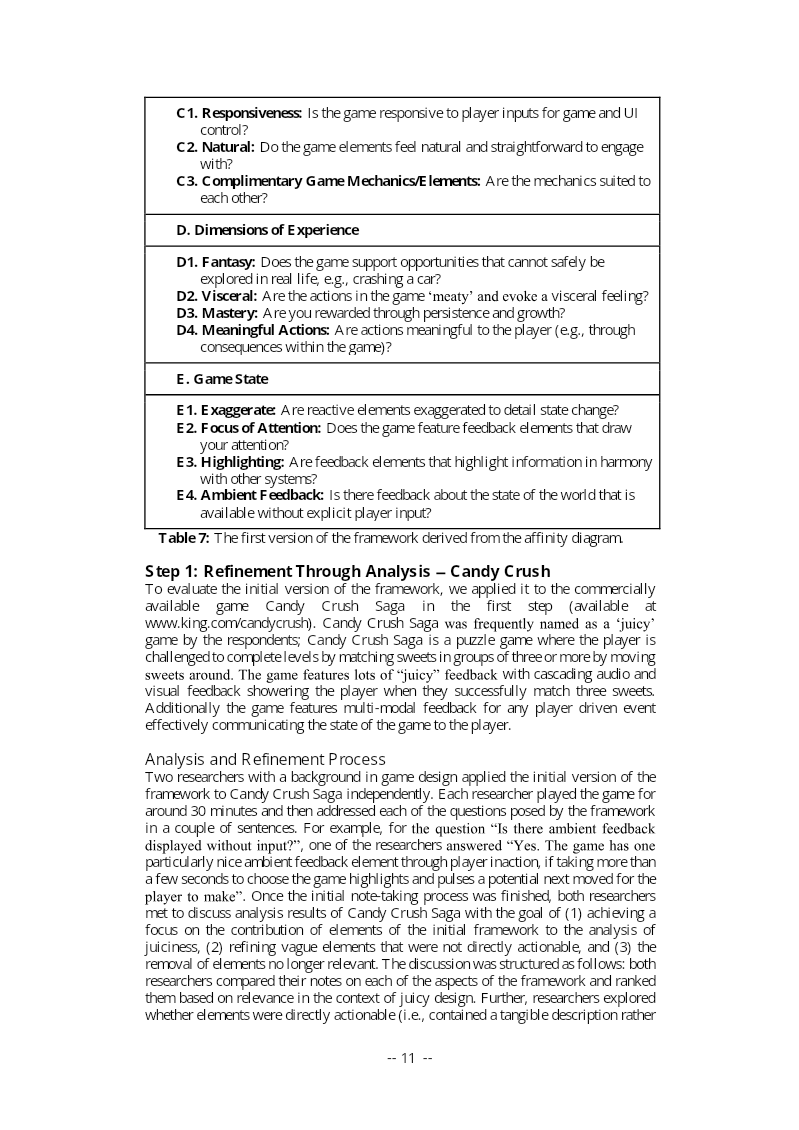
- The final analytical framework has three parts (Game Characteristics, Game State, and Direct Feedback) and 11 actionable questions, refined through two rounds of case analysis of Candy Crush Saga and Downwell.
Video Games, Learning, and the Shifting Educational Landscape
Hong-An Wu's paper examines how video games are reshaping the educational landscape in the United States, arguing that gameplay can be understood as a form of literacy learning and that games expand conventional notions of learning beyond the classroom.
- The paper argues that gameplay functions as a form of literacy learning, with players decoding and encoding multimodal meaning through James Paul Gee's concept of semiotic domains, and that skills from 'domain mapping' can transfer to other contexts.
- Its central claims rest mainly on theoretical framing and prior qualitative research rather than new quantitative data, so the evidence base is largely conceptual.
- Affinity groups are presented as informal learning environments where participatory learning, pooled specialist knowledge, peer feedback, and peer-to-peer apprenticeship develop skills, with players increasingly acting as 'prosumers' who produce mods and fan art.
Scarcity and Survival Horror: Trade as an Instrument of Terror in Pathologic
Survival horror games frequently employ resource scarcity to cultivate vulnerability, yet most titles ultimately provide players with reliable economic systems that facilitate predictable progression.
- Survival horror games, such as the 2005 title Pathologic by Ice-Pick Lodge, subvert the standard gaming loop of work, reward, and reinvestment by introducing extreme scarcity and unpredictable economic systems.
- Unlike conventional games where in-game economies provide reliable progress and agency, Pathologic uses an unstable, fluctuating market to force players into agonizing trade-offs between short-term survival and long-term goals.
- In Pathologic, time is treated as a critical, scarce resource; players have only twelve in-game days to complete objectives, creating a high-pressure environment where failure to manage time results in the loss of narrative and gameplay content.
Glitch Horror: BEN Drowned and the Fallibility of Technology in Game Fan Fiction
The document examines "glitch horror" as an emerging transmedia genre that capitalizes on anxieties surrounding technological fallibility, using the creepypasta "BEN Drowned" as a central case study.
- The report defines an emerging "glitch horror" subgenre whose dread comes from real, familiar technological frustrations such as corrupted saves, broken rules, and games behaving in unintended ways, rather than from supernatural invention alone.
- Its central case study, BEN Drowned (a 2010 4chan creepypasta about a haunted Majora's Mask cartridge), is analysed as a key example of how players' close identification with their avatars intensifies unease at malfunctioning technology.
- The analysis draws on Freudian and Mori-derived theories of the uncanny to argue that recognizable malfunctions provoke deep, involuntary unease in players.
Playing with Patriarchy: Fatherhood in BioShock: Infinite, The Last of Us, and The Witcher 3: Wild Hunt
The document examines the portrayal of fatherhood and masculinity in three prominent video games: BioShock: Infinite, The Last of Us, and The Witcher 3: Wild Hunt.
- The paper argues that violence is the central device through which all three games reconcile hegemonic masculinity with the father role, claiming and sustaining a paternal bond that is not biological.
- Each game pairs its protagonist with an 'anti-father' (Comstock, David, and the Bloody Baron) whose excessive, inward-directed violence and community leadership serve to define what acceptable paternity looks like.
- The author concludes that the distance between protagonist and anti-father, combined with fatherhood consecrated through violence, tends to reinforce patriarchal models rather than prompt critical reflection.
If You Are Feeling Bold, Ask for $3: Value Crafting and Indie Game Developers
Consalvo and Paul introduce "value-crafting," a concept extending Browne's "indie labor" and Paul's "theorycrafting," to describe how independent developers use experimentation, data, and metrics to determine what their games are worth, how to price them, and how to market them, often while bearing heavy personal financial risk.
- Indie games have no industry-standard price point, with prices ranging from free to roughly $30 and developers debating between $5, $10, or free-to-play, often based on anecdote rather than consistent evidence.
- Indie success has shifted from simply making a good game toward "value-crafting," which relies on analytics, pricing research, community engagement, and sustained marketing.
- By 2014 and 2015 Steam dominated indie sales, often accounting for the large majority of units sold, with Valve taking 30 percent of revenue.
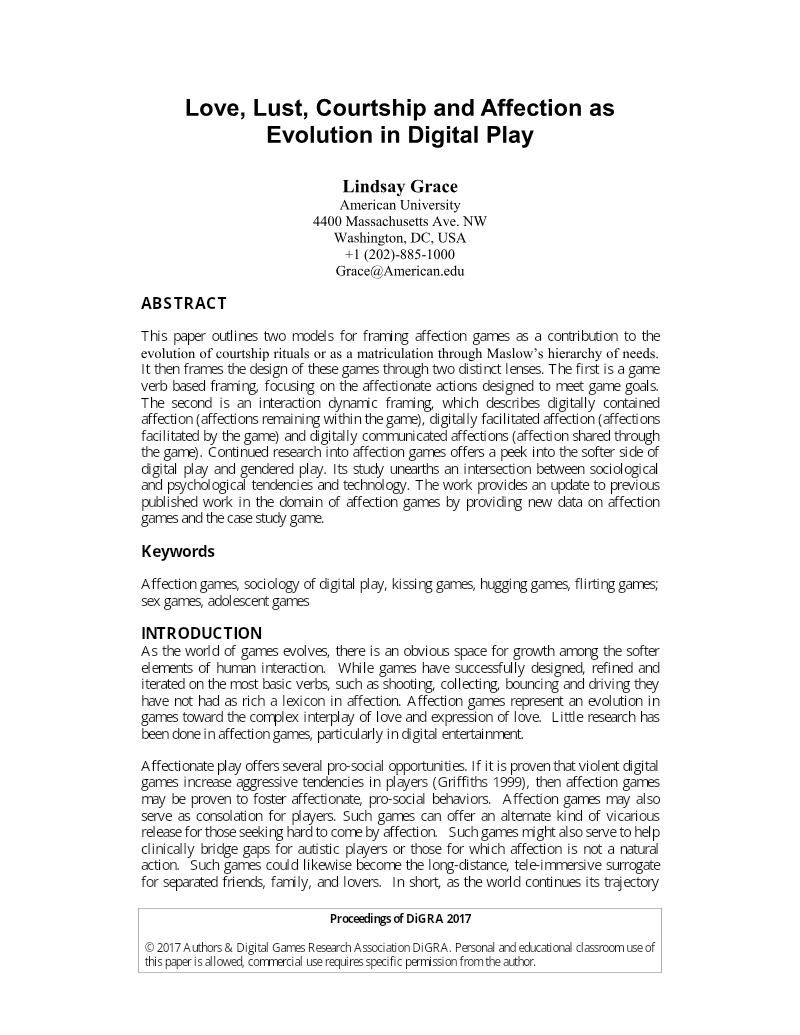
Love, Lust, Courtship and Affection as Evolution in Digital Play
This analysis explores the evolving landscape of affection games, proposing two primary frameworks for understanding their design and player engagement: as an evolution of courtship rituals or as a progression through Maslow's hierarchy of needs.
- Affection games (digital play centered on kissing, hugging, flirting, and romantic interaction) are framed as an underexplored genre deserving scholarly attention, grounded in courtship research and Maslow's love-and-belonging tier.
- Kissing is the dominant in-game verb in affection games, rising from 209 titles on Google Play and Kongregate in 2015 to 264 in 2017, and it is the only verb showing consistent growth on Google Play.
- Anecdotal reports suggest some adolescents use affection games to rehearse kissing before attempting it offline, but the report notes that systematic evidence for this is absent.
Playing With(out) Power: Negotiated Conventions of High Performance Networked Play Practices
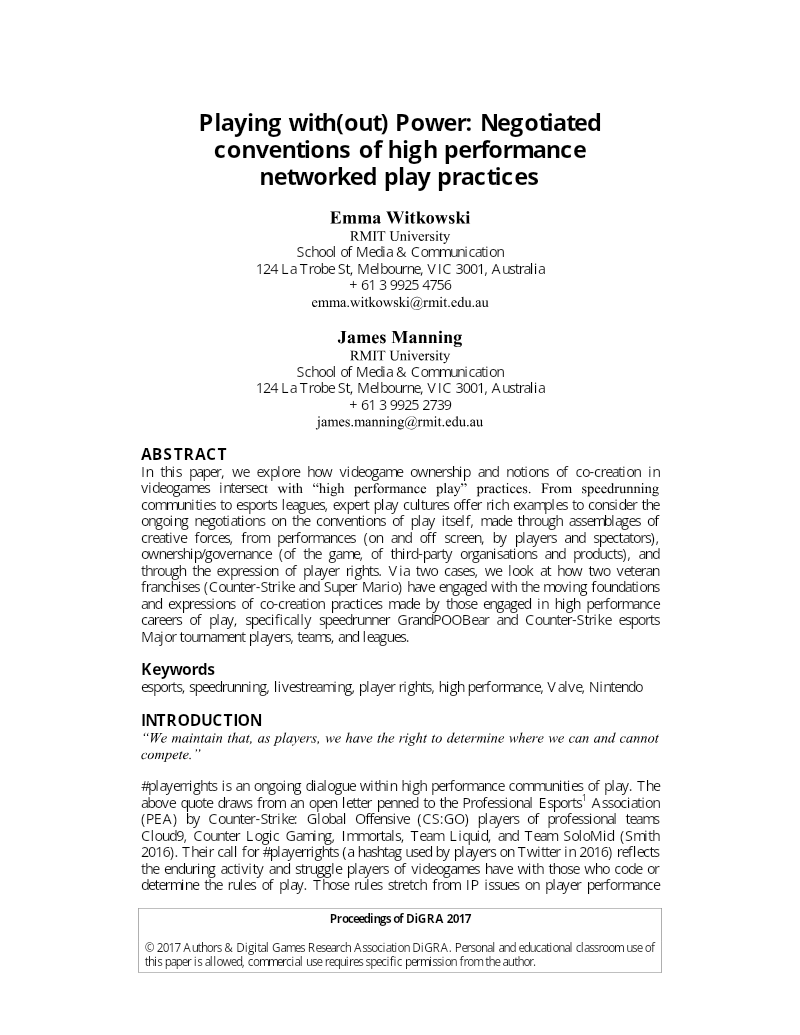
The document examines the complex and often contentious relationship between game developers and high-performance players in networked play practices such as speedrunning and esports.
- The paper's central argument is that competitive players (speedrunners and esports professionals) hold a precarious position, as their careers depend on franchises they do not control, and power imbalances persist even when publishers promote co-creation rhetoric.
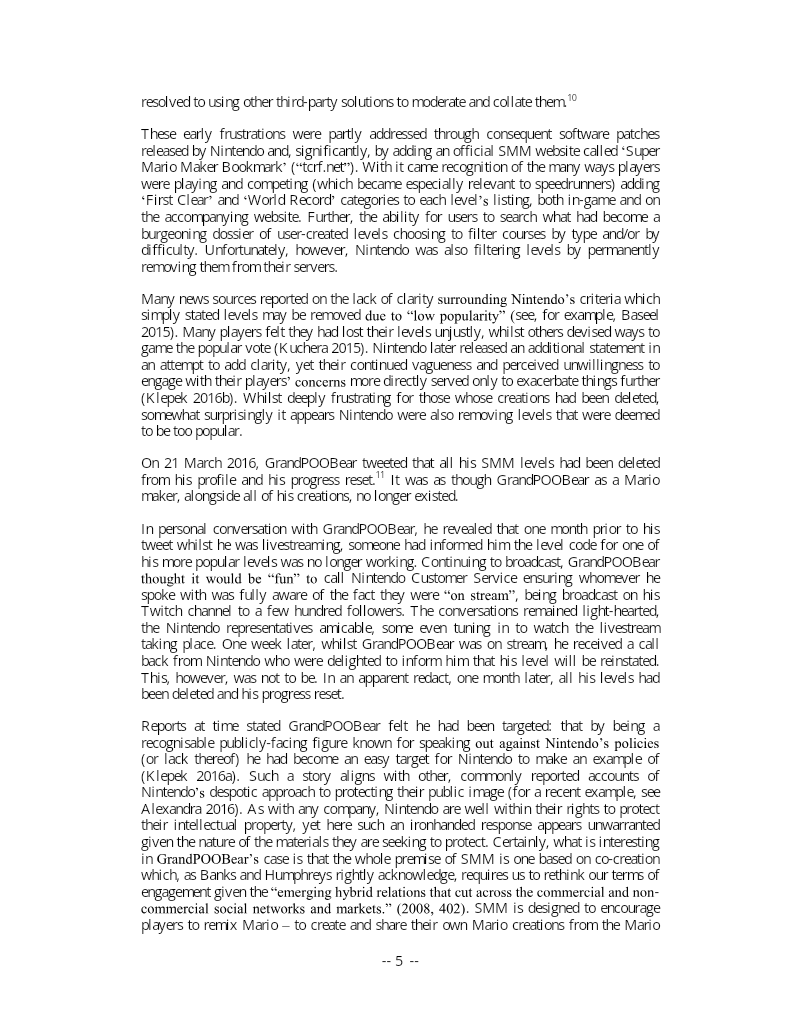
- Super Mario Maker level removals and the 2016 deletion of speedrunner GrandPOOBear's creations and progress by Nintendo, following inconsistent customer-service exchanges, serve as key case studies of opaque publisher control.
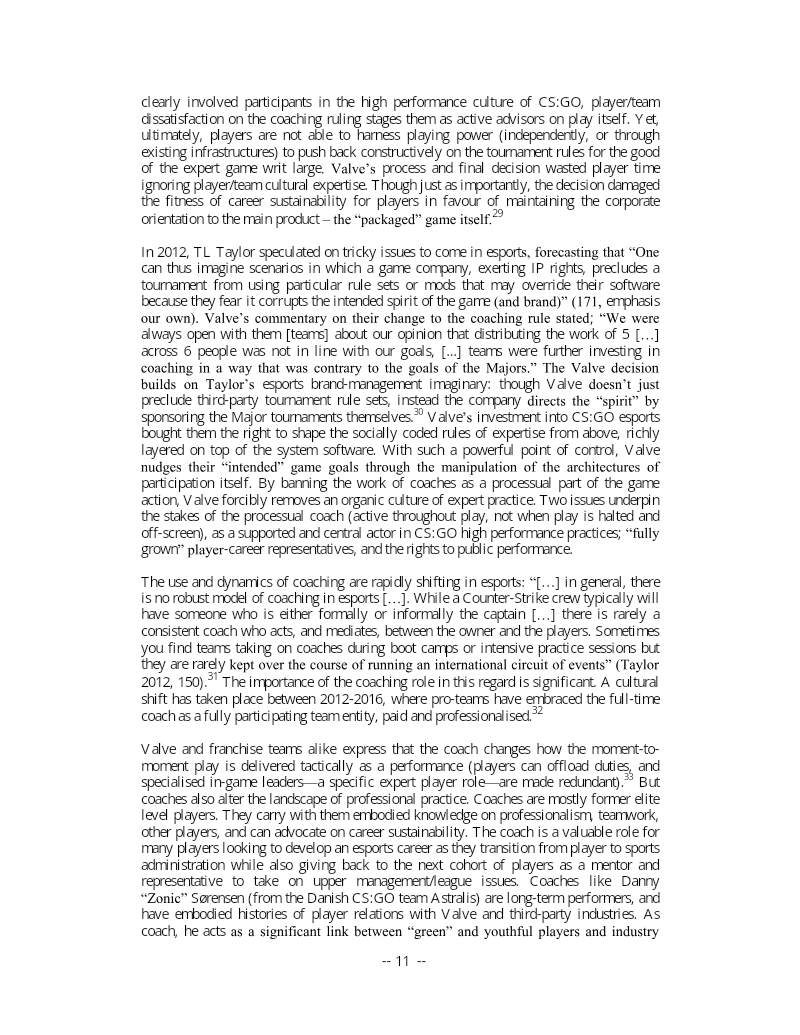
- Valve's 2016 ban on in-game coaching at major CS:GO tournaments is read as an exercise of developer control over competitive conditions that diminished player expertise and career sustainability.
Heritage Destruction and Videogames: A Perverse Relation
The document examines the ethical implications of depicting destroyed heritage sites in video games, using the National and University Library in Sarajevo and its representation in Sniper: Ghost Warrior 2 as a primary case study.
- The 1992 destruction of Sarajevo's National and University Library (Vijećnica) was deliberate, an attack on collective memory and multicultural identity, and its later reconstruction shifted its meaning toward ethnic fragmentation.
- Sensitive historical content is especially vulnerable to trivialization when placed in interactive entertainment, and the authors judge the pedagogical potential of such titles to be real but limited.
- In Sniper: Ghost Warrior 2, the Vijećnica is rendered as a recognizable heritage site while largely omitting its political and symbolic significance, partly due to first-person shooter gameplay demands and realist simulation's poor handling of change over time.
I Predict a Riot: Making and Breaking Rules and Norms in League of Legends
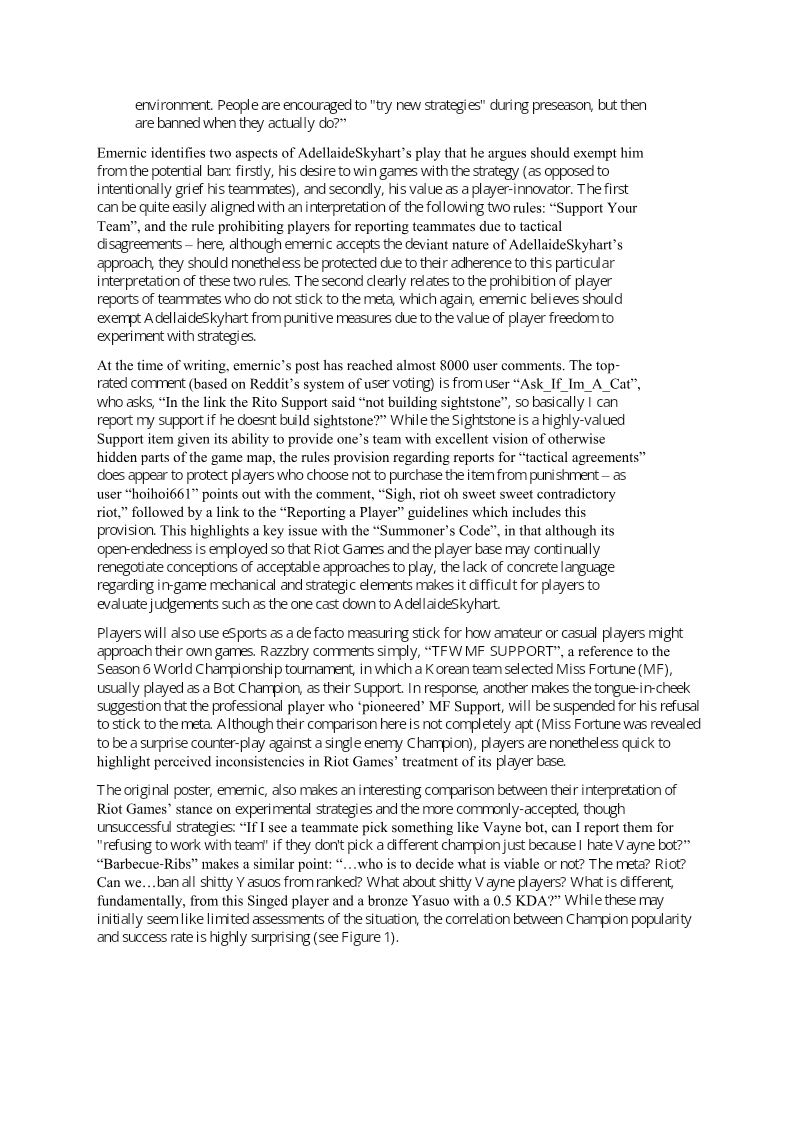
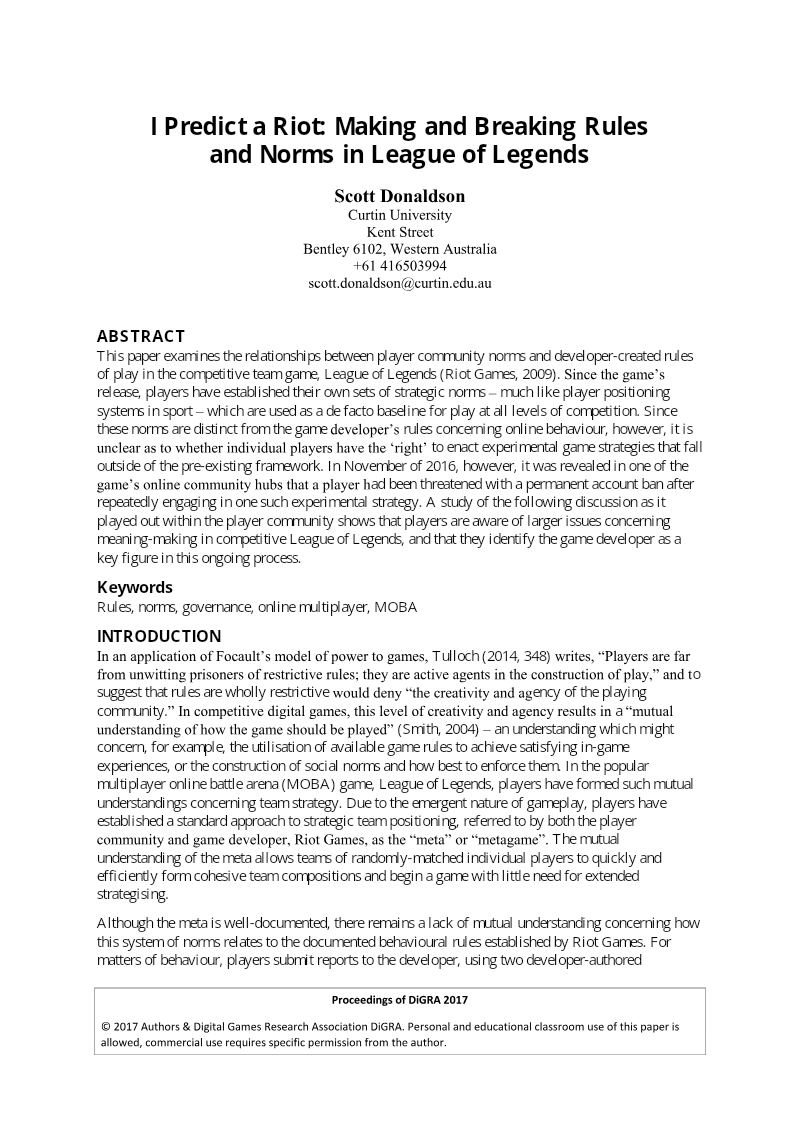
This analysis explores the dynamic interplay between player-established strategic norms, often referred to as the "meta," and developer-enforced rules within the online multiplayer game League of Legends.
- Riot Games' vague and sometimes contradictory conduct rules left League of Legends players without a shared understanding of what counts as reportable "greed play," so players themselves must interpret deviance, and enforcement based on these unclear standards shapes how the community defines legitimate play.
- The pivotal case involved player AdellaideSkyhart, who used Singed in the Support role to roam and disrupt enemies; threatened with a permanent ban in November 2016, the player was ultimately banned in 2017, becoming a focal point for a community divided between strategic innovation and a predictable, enjoyable match.
- A similar punitive case in February 2017 suggests the tension between developer rulings and player expectations remains unresolved.
Do you work at DiGRA? Get a free report of how these documents are read and cited here.