
DiGRA
The Digital Games Research Association: the international association of academics and professionals who study digital games. Its Digital Library holds the proceedings of the DiGRA conferences since 2002.
Documents
Play to Win, Profit & Entertain: A Study of Double Performance as Athlete and Streamer
This study examines the dual roles of professional esports athletes who also engage in live streaming, analyzing how these distinct performances contribute to their overall brand and career.
- The study argues that competing as an esports athlete and broadcasting as a live streamer demand distinct competences shaped by different forms of mediation, and that the streamer persona ultimately serves the professional persona rather than the reverse.
- Based on a single case study of a Brazilian League of Legends player, the analysis compares 10 matches from the 2017 Campeonato Brasileiro de League of Legends (CBLoL) with 10 Twitch live streams.
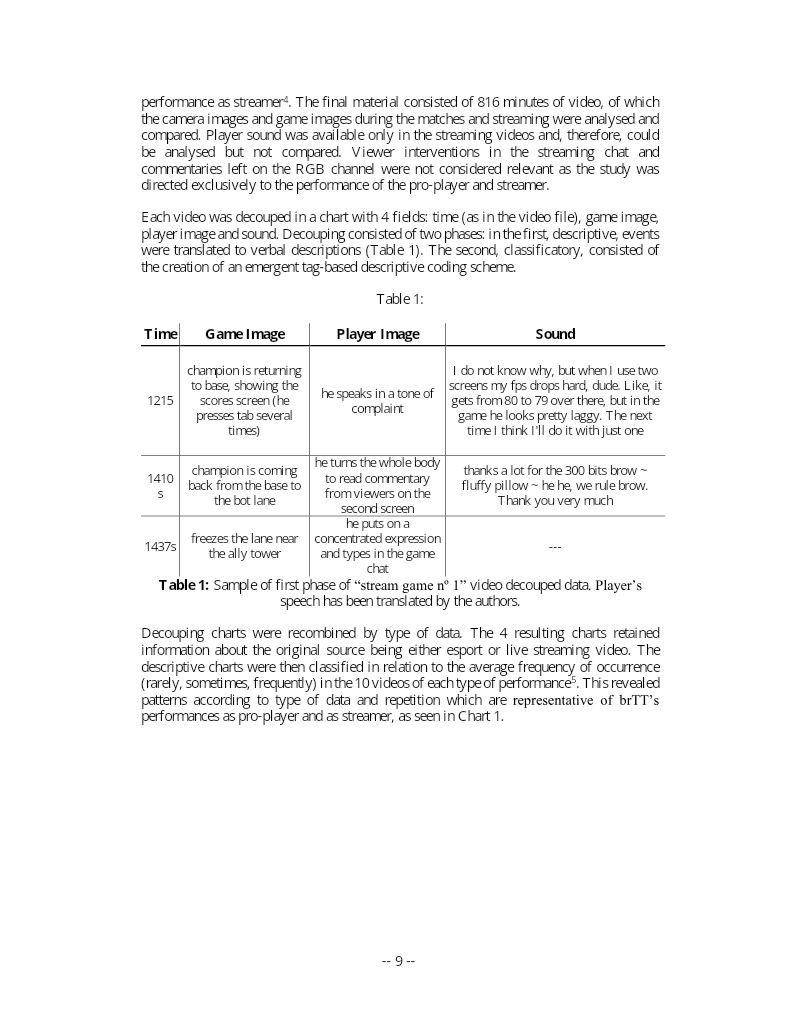
- In competition the player shows strong expressive control, with restrained body language, team-oriented composure, and rare displays of emotion.
Preliminary Poetics of Procedural Generation in Games
The document, "Preliminary Poetics of Procedural Generation in Games," establishes a critical framework for analyzing the aesthetic principles and player experiences derived from procedural content generation (PCG) in games.
- The paper argues that existing taxonomies of procedural content generation describe how generators are built but not why they produce particular aesthetic effects, and proposes a poetics to fill that gap.
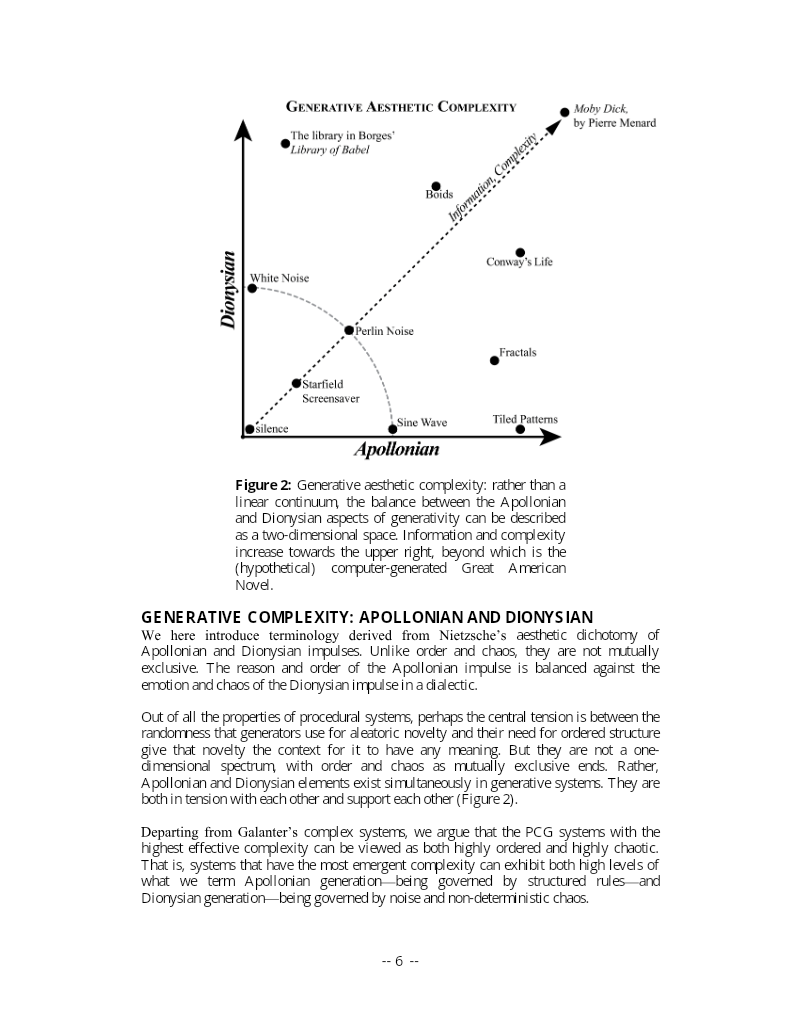
- It introduces the Apollonian (rule-governed coherence) and Dionysian (chaotic, noise-driven variation) as non-exclusive aesthetic qualities, so the most sophisticated generators can exhibit both at once within a multidimensional space rather than a single continuum.
- Aesthetic effects arise from the balance between randomness (Perlin noise, dice rolls, shuffles) and structural order (e.g., cellular automata like Conway's Life), with perception shaped by tension among repetition, gestalt, and individual artifacts.
The City in Singleplayer Fantasy Role Playing Games
This paper examines how cities function in single-player fantasy role-playing games, including Baldur's Gate, Oblivion, Dragon Age: Origins, Skyrim, and The Witcher 3.
- RPG cities are designed as figural centres, often placed at the climax of the player's journey, and their political, economic, and religious roles reinforce this pivotal status.
- The paper argues that a city's meaning in single-player fantasy RPGs lies more in the functions it offers and the embodied spatial practices it affords the player-avatar than in its visual appearance.
- Four recurring spatial tropes structure the analysis: centring, inside/outside demarcation, movement, and encounter, which together shape how players experience habitation.
"A Pure Meritocracy Blind to Identity": Exploring the Online Responses to All-Female Teams in Reddit
Esports audiences' attitudes toward women are examined through 952 Reddit comments, 910 from r/leagueoflegends and 42 from r/GlobalOffensive, responding to Team YP's 2015-2016 announcements of sponsored all-female Counter-Strike: Global Offensive and League of Legends teams.
- Commenters on r/leagueoflegends and r/GlobalOffensive (952 Reddit comments analysed by Siutila and Havaste) overwhelmingly described esports as a meritocracy "blind to identity" while viewing all-female teams with suspicion.
- The dominant community view was that a sponsorship by a pornography company was a publicity stunt that damaged perceptions of women players, and that all-female teams' low rankings and rule-based exclusion from top competitions made them ineligible for higher-tier play.
- Many commenters asserted women showed less skill, though some cited Ratan et al. (2015), which found men and women acquire League of Legends skill at equal rates when time played is controlled.
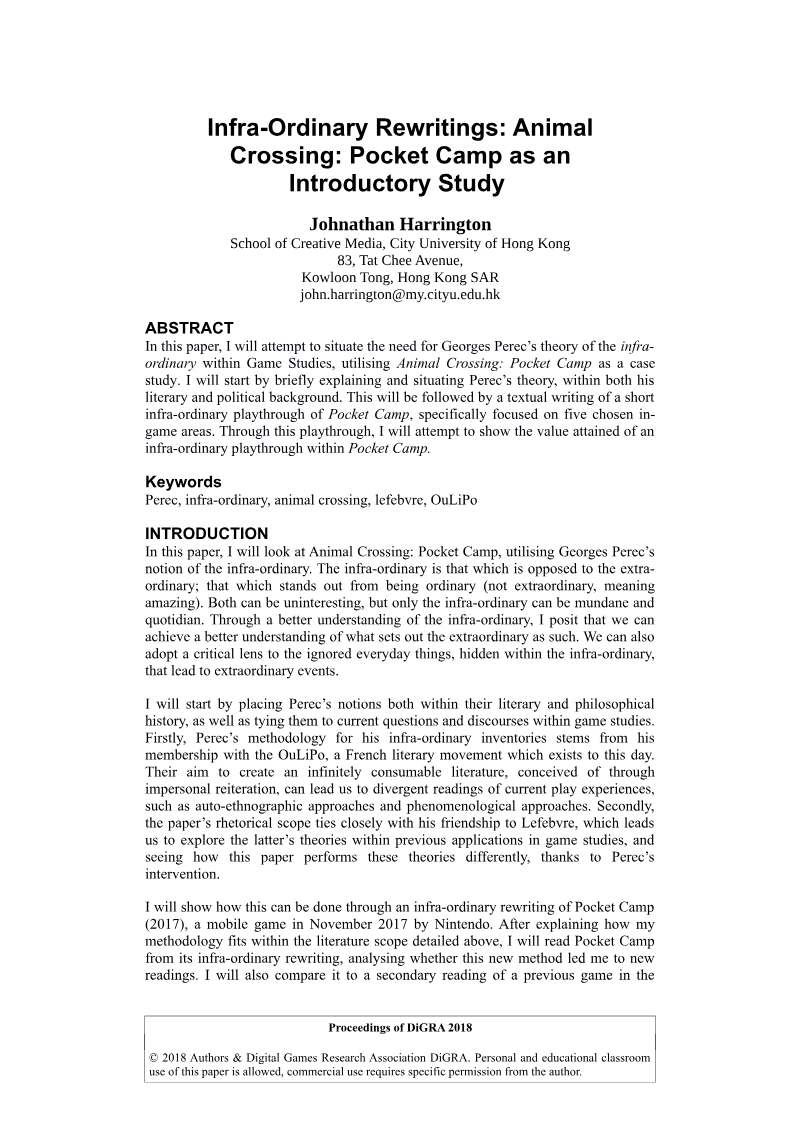
Infra-Ordinary Rewritings: Animal Crossing: Pocket Camp as an Introductory Study
Johnathan Harrington's 2018 DiGRA paper proposes Georges Perec's "infra-ordinary," the mundane and habitual details overlooked in favor of the extraordinary, as a method for studying games, using Animal Crossing: Pocket Camp as an introductory case.
- Johnathan Harrington applies Georges Perec's concept of the "infra-ordinary" (the mundane, habitually overlooked texture of everyday life) to games, situating the method within the OuLiPo movement and Henri Lefebvre's theory of space.
- The central finding is that the background elements of Animal Crossing: Pocket Camp are non-ergodic, meaning they do not respond to player input, and function as products of spatial practice rather than interactive systems.
- Background assets such as repeated floor and tree patterns, non-functional benches and drinks, and foreign-script text quietly support the game's core interactive events, with foreign-script text marking the player as an exotic presence.
Overwatch as a Shared Universe: Game Worlds in a Transmedial Franchise
The document analyzes the Overwatch franchise to propose a revised understanding of multi-platform narratives, moving beyond the traditional concept of a "transmedial world."
- Joleen Blom argues that transmedia storytelling theory (Jenkins, Klastrup and Tosca, Wolf, Ryan) does not adequately account for games, and uses Blizzard's Overwatch franchise to propose a different framing.
- The paper's central thesis is that Overwatch's game, comics, and short films do not form a single coherent transmedial storyworld; instead the franchise is a "shared universe" whose connections are constructed imaginatively by players, drawing on Benedict Anderson's concept of imagined communities.
- Following Aarseth, the paper contends that game arenas are objectively explorable, rule-bound, and often isolated and non-cumulative, so maps do not build into a continuous geography as fictional storyworlds do.
Markers of Subjective Perception in Larp
Mochocki's paper extends Jan-Noël Thon's framework of subjective representation, originally developed for film, comics, and video games, to live-action role-playing (larp).
- Mochocki argues that spatial point-of-view goes unmarked in larp because players physically inhabit their characters' perspectives, so subjectivity markers in larp signal only other forms of subjectivity, and the paper adds a fourth, "metasymbolic" marker category to cover what Thon's film/comics/video-game framework misses.
- The paper stresses player-character perceptual unity and warns that mishandled subjectivity markers cause metalepses, breaches of diegetic coherence.
- Narratorial markers (generated by gamemasters or players, including metatechniques like the monologue box) and content markers (live acting and tangible elements introduced by the gamemaster) each carry their own metaleptic risks for perceptual unity.
Avatars, Gender and Sexuality for Brazilian Players on Rust
This study explores Brazilian players' identification with avatars in the massively multiplayer online game Rust, specifically examining the interplay of gender and sexuality.
- Players largely treated avatars and their characters as distinct entities, distinguishing them mainly through customization and control, and showed no strong preference for particular avatars or evidence that avatar gender shaped behavior or identification.
- Gender and sexuality still structured social interaction in Rust: women were more cautious around male avatars, and avatar gender shaped how other players responded, with female avatars eliciting more cooperation and male avatars provoking more reactivity.
- A clear divergence appeared between participants' stated reasons for gender swapping and their stated reasons for choosing gendered avatars, suggesting that stated motivations and actual practices did not match.
Presence at History: Toward an Expression of Authentic Historical Content as Game Rules and Play
The document proposes a significant evolution in historical game design, advocating for developers to adopt a historian's methodology, employing practice-led research to integrate authentic historical content directly into game rules and player experiences.
- Game developers are increasingly acting as historians, using practice-led research to build authentic historical experiences instead of treating the past as decorative backdrop.
- The authors argue that a newer wave of historical games pursues authenticity as living socio-cultural systems rather than mere accuracy of surface detail.
- Some recent titles embed historical research directly into rules and mechanics: Assassin's Creed: Origins was built with Egyptologists and linguists, 1979 Revolution: Black Friday drew on more than forty interviews with people who were present, and Kingdom Come: Deliverance reconstructed combat from medieval fighting manuals with martial arts experts.
Localization from an Indie Game Production Perspective: Why, When and How?
This analysis explores the strategic approach to localization among independent game developers, examining the motivations, methodologies, and outcomes within resource-constrained environments.
- Steam's Simplified Chinese share rose from 8.97% in December 2016 to 63.9% in December 2017, a rapid market shift that motivated the study of how indie developers handle localization.
- Indie developers pursue localization chiefly to broaden audience reach rather than for immediate financial return, and resource constraints largely determine which localization decisions they make.
- Swedish developers often recognized localization's value only after early-access feedback revealed a global player base, and several said deferring it, due to assumptions about English proficiency or limited resources, led to later rework.
Fragmentation: Between Expansion Packs and Episodic Video Games
Online distribution platforms such as Xbox Live, PlayStation Network, and Steam moved the games industry from selling products to providing services, and that shift made downloadable content a central means of extending a game's life.
- The report argues that the shift to downloadable content and digital storefronts (Xbox Live, PlayStation Network, Steam) has turned the games industry from a product-based model into a service-based one.
- Its central thesis is that expansion packs and episodic releases share a common serial logic: both fragment a game's experience over time, delay gratification, and extend a title's lifespan like serialized media.
- The author distinguishes extensive DLC, which expands the original narrative (e.g., BioShock Infinite's Burial at Sea), from supplementary DLC, which adds gameplay without extending the story, but treats both as forms of the same fragmented structure.
Is My Avatar MY Avatar? Character Autonomy and Automated Avatar Actions in Digital Games
The paper "Is My Avatar MY Avatar?
- Willumsen argues that the question of whether an avatar's action expresses player agency or a fictional character's independent will can be analyzed through two separately measured dimensions: avatar control and character complexity.
- The central claim is that avatar control and character complexity are not zero-sum, so they must be assessed independently before being compared.
- The framework distinguishes 'automated avatar actions' (mechanical behaviors handled by the game so players can focus on play) from 'character autonomy' (moments where character complexity is foregrounded while player control is deliberately reduced).
Do you work at DiGRA? Get a free report of how these documents are read and cited here.