
DiGRA
The Digital Games Research Association: the international association of academics and professionals who study digital games. Its Digital Library holds the proceedings of the DiGRA conferences since 2002.
Documents
Towards Design Principles for Humor in Interactive Emergent Narrative
The document, "Towards Design Principles for Humor in Interactive Emergent Narrative," investigates the integration of humor into dynamic, player-influenced digital stories.
- Humor in interactive emergent narrative is framed as a 'pleasant surprise' that can be analyzed and systematically generated, reframing it from a purely subjective response into a formalizable property of interactive systems.
- The authors distinguish plot-based humor, which alters the story's overall progression, from discourse-based humor, which changes only how events are told, and find that classical humor theories (incongruity, benign violation, relief, superiority) mostly apply at the discourse level, leaving plot-level humor neglected.
- The central claim is that humor emerges when players test a system's limits without breaking it, producing 'aha moments' of delight, illustrated with case studies from The Stanley Parable, Sunspring, and Middle Earth: Shadow of War.
Aesthetics and Cosmetic Microtransactions in Path of Exile
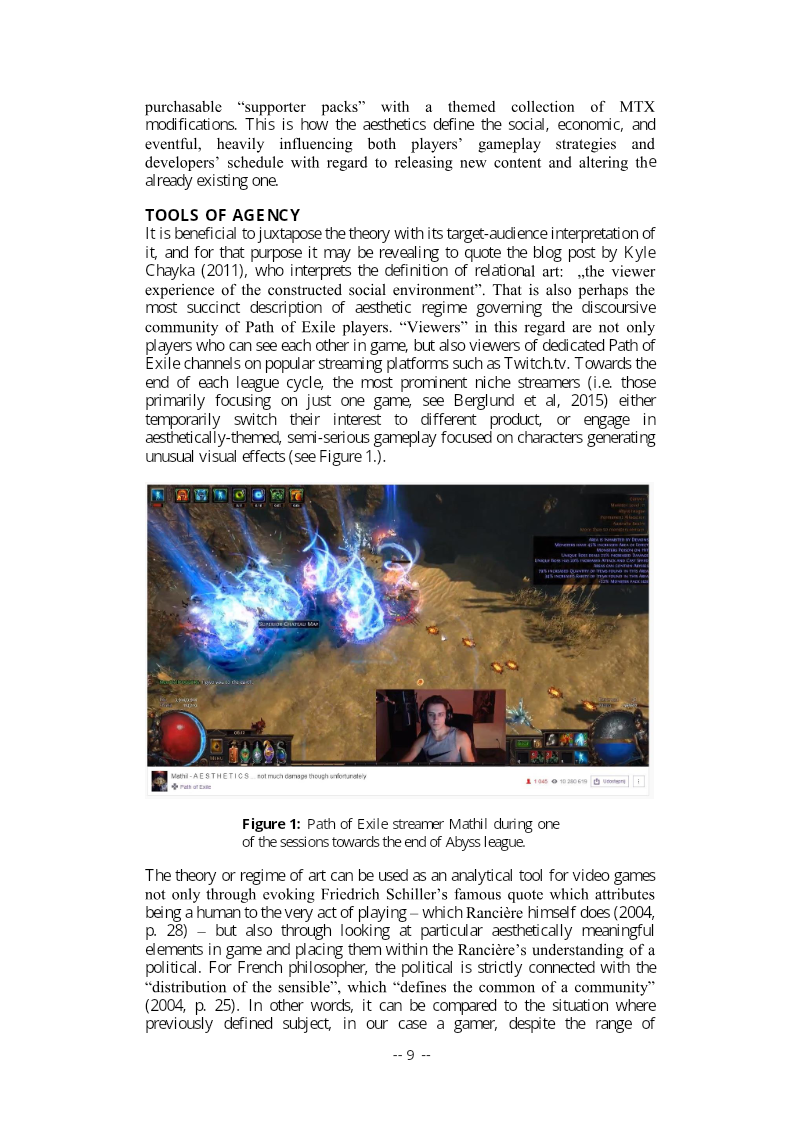
A study on Path of Exile's aesthetic and cosmetic microtransactions reveals their profound impact beyond mere monetization, positioning them as critical elements influencing player behavior, identity, and the game's post-release development cycle.
- Cosmetic microtransactions in Path of Exile are formally disconnected from game mechanics yet meaningfully shape play practices and sustain the game's post-release lifecycle, according to six months of participatory observation of in-game data, forums, and Reddit.
- The paper identifies three roles for cosmetics: social signifiers, incentives that motivate continued play, and tools of agency outside the core gameplay frame.
- Rare cosmetics serve as the principal tangible incentive in the late-game reward structure around reaching level 100, and acquiring different cosmetics is unevenly difficult.
Ethics at Play in Undertale: Rhetoric, Identity and Deconstruction
"Ethics at Play in Undertale: Rhetoric, Identity and Deconstruction" examines how the video game Undertale employs ethical choices to shape player identity and deconstruct traditional role-playing game (RPG) conventions.
- Frederic Seraphine argues Undertale is a deliberately ethical, rhetorical, and deconstructive text whose mechanics steer players toward nonviolence and reflection on the moral weight of their actions, framed through procedural rhetoric and Derridean différance.
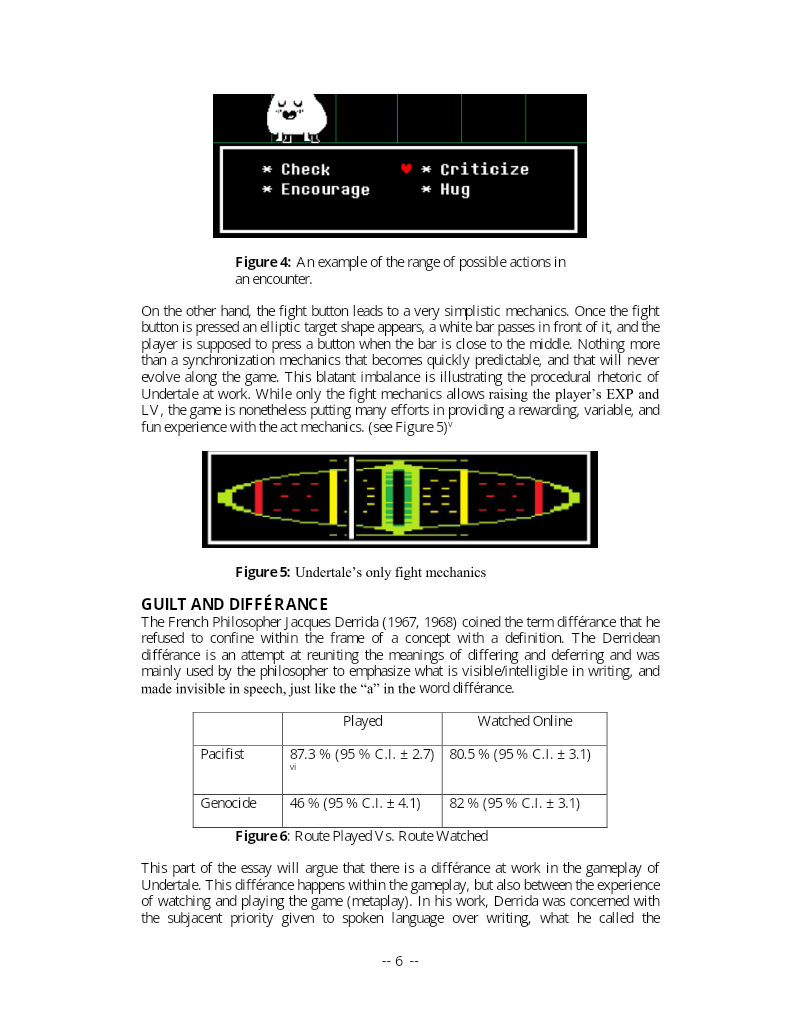
- Completion rates diverge sharply: 87.3% of players finished the pacifist route versus 46% for the genocide route, based on a survey of 560 fandom participants plus scraped YouTube comments.
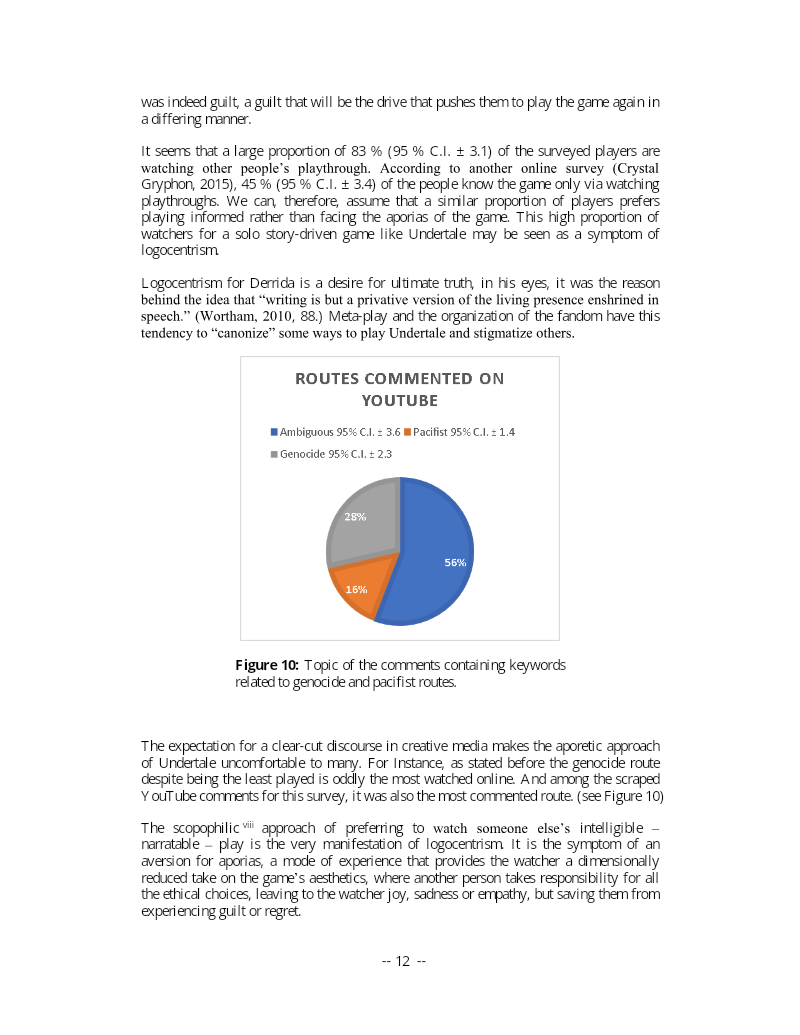
- Play and watch behavior diverge: 83% of respondents watched others play the genocide route and 45% knew the game only through such content, which the author links to avoidance of its emotionally dissonant experience and to logocentrism.
Wrecking the Game: The Artist as Griefer
"Wrecking the Game: The Artist as Griefer" explores how contemporary artists appropriate and subvert video game mechanics to create artistic interventions, effectively transforming ludic spaces into contemplative ones.
- Fantacci argues that artists like Kent Sheely, Marque Cornblatt, Justin Berry, and Alan Butler practice 'anti-game' subversion by repurposing a game's designed rules and affordances as 'griefers' rather than by editing code or visuals, halting goal-driven play to create unexpected meanings.
- The analysis frames these interventions as destructive-creative: they first dismantle standard gameplay and then build a new artistic grammar from the same materials, a dual process the author links to Dada and Situationist strategies.
- Theoretically, the work draws on Galloway's counter-gaming and Schleiner's concept of ludic mutation, situating the practice within a lineage of avant-garde art movements and game studies.
Free-to-Play or Pay-to-Win?: Casual, Hardcore, and Hearthstone
The analysis, titled "Free-to-Play or Pay-to-Win?: Casual, Hardcore, and Hearthstone," examines how free-to-play (F2P) monetization models, specifically exemplified by Hearthstone, redefine the traditional casual versus hardcore gamer dichotomy.
- The central thesis is that free-to-play models with microtransactions for randomized card packs create a "pay-to-win" dynamic, in which spending money tends to move players from casual toward hardcore engagement, using Blizzard's Hearthstone as the primary case study.
- Hearthstone had over 70 million registered accounts as of Blizzard's 2017 report, and an analyst estimated its monthly revenue at over $25 million.
- Randomization mitigates the most extreme pay-to-win effects, but expansions, metagame shifts, and a daily quest system still pressure casual players to either spend money or devote substantial daily time to stay competitive.
Bleed-In, Bleed-Out: A Design Case in Board Game Therapy
This paper explores design considerations for "Mind Shadows," a therapy board game aimed at helping players collaboratively understand and cope with emotionally complex real-life issues.
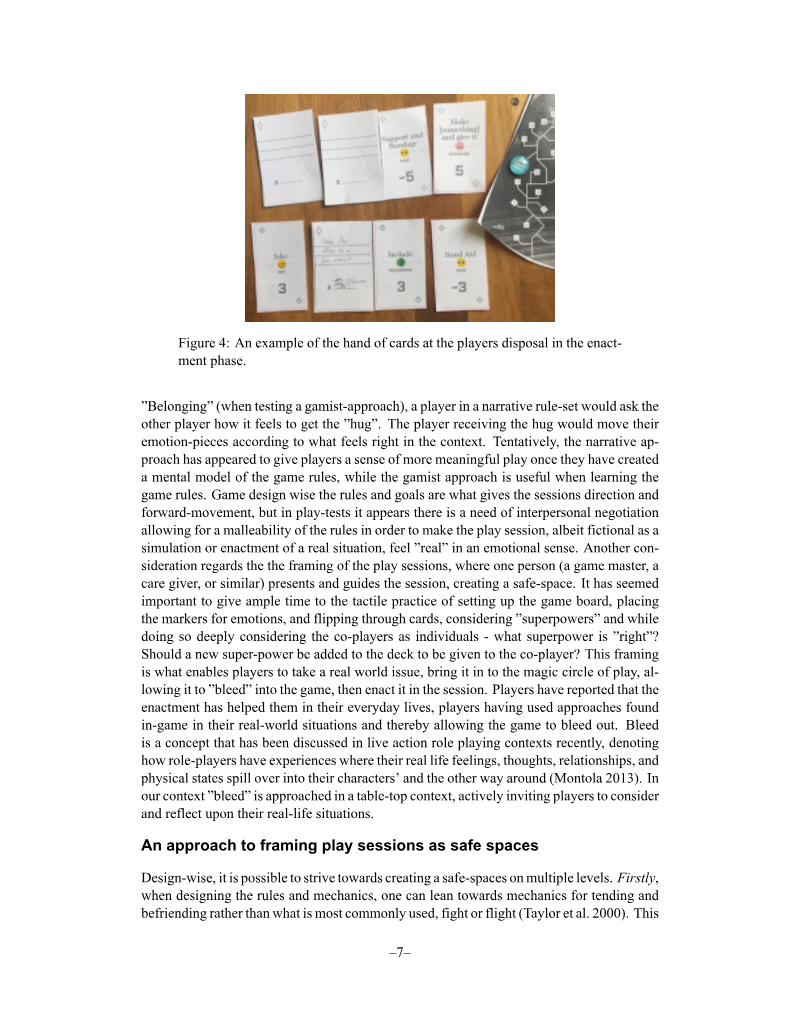
- The paper presents design considerations from the ongoing development of Mind Shadows, a two-to-three-player therapeutic board game in which players bring real-life emotional difficulties into a framed play session to understand and cope with them cooperatively.
- The author argues tabletop play can offer a structured, safe space to describe and examine personal problems in a way similar to everyday conversation with a trusted friend.
- The design draws on the concept of 'bleed,' where real-life feelings and relationships spill into play and vice versa, alongside Goffman's frame analysis, the magic circle, and Hollander's three-phase psychodrama curve.
Indie Game: The Movie: The Paper - Documentary Films and the Subfield of Independent Games
This paper examines documentary films about independent game developers, arguing that such films play a significant role in constructing the cultural meaning of "indie" games, a term that remains ill-defined in both popular and academic discourse.
- The paper argues that documentary films about independent game developers play a significant role in constructing the cultural meaning of "indie" games, a term that remains ill-defined in both popular and academic discourse, drawing on Bourdieu's field theory and Fairclough's critical discourse analysis.
- The analysis rests on a corpus of four documentaries released between 2012 and 2017, selected for variety in subject matter, distribution, and release timing, and the author frames these films as contributing to the symbolic capital of independent developers and delimiting indie games as a space of heightened artistic value.
- The films consistently portray independent developers as passionate, creatively driven auteurs while casting major commercial studios in a negative light.
Design Concepts for Empowerment through Urban Play
The document, "Design Concepts for Empowerment through Urban Play," establishes a conceptual framework to enhance the design and analysis of urban games aimed at fostering civic engagement.
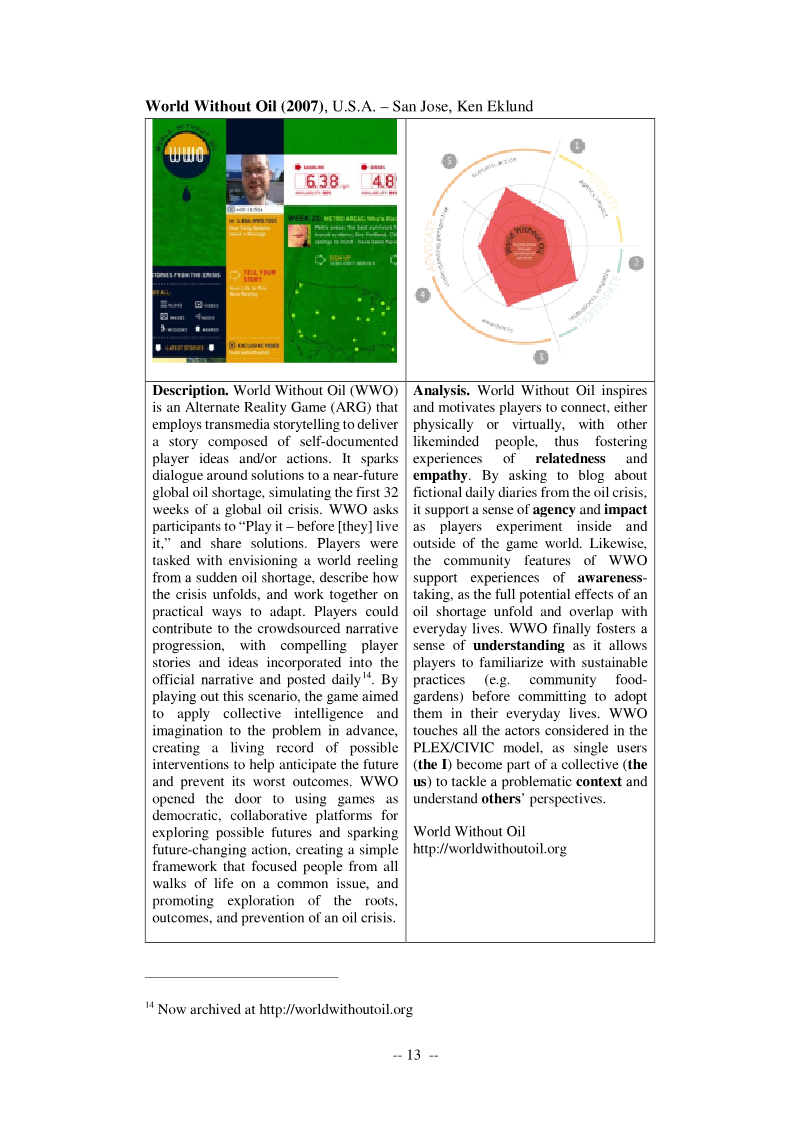
- The urban play field lacks a shared vocabulary linking game design, urban planning, and civic engagement, and the report proposes an experience-based framework to fill that gap.
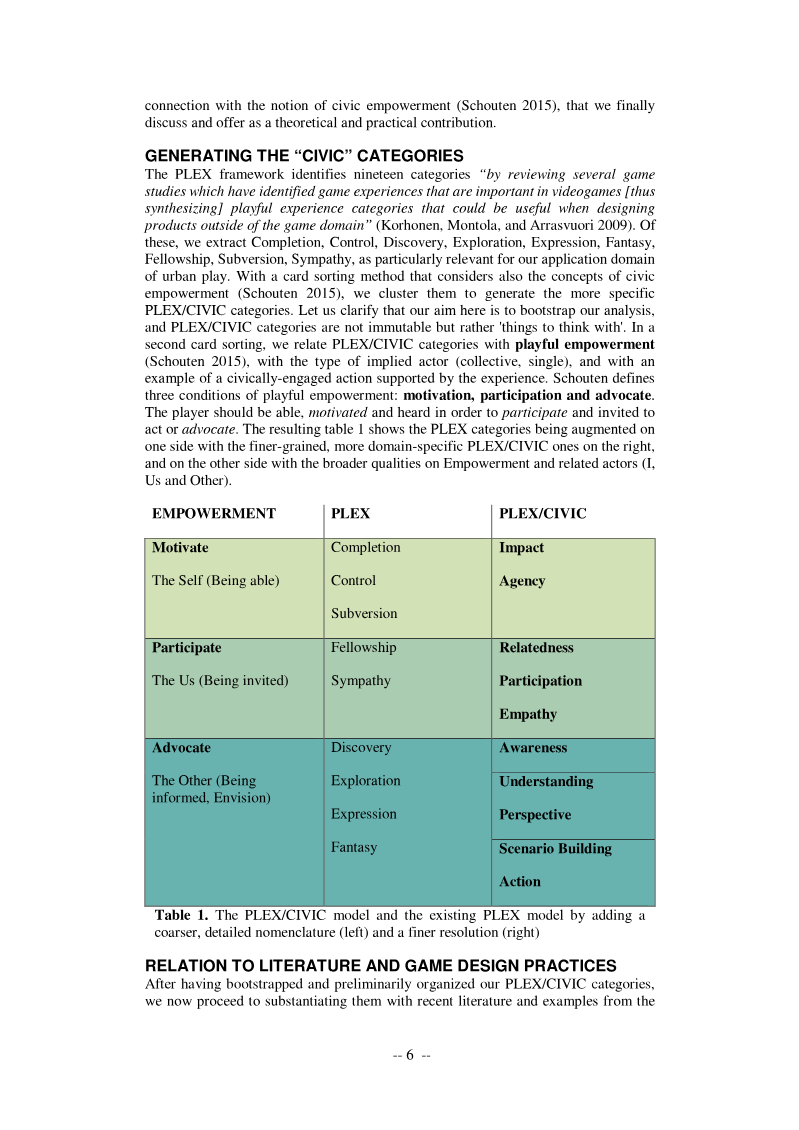
- The authors extend the existing PLEX model into a PLEX/CIVIC framework, adapting nine playful experience categories (Completion, Control, Discovery, Exploration, Expression, Fantasy, Fellowship, Subversion, Sympathy) to civic empowerment and linking it to Schouten's conditions of motivation, participation, and advocacy.
- The framework is explicitly provisional: it rests on qualitative, descriptive analysis rather than empirical testing, and the authors call for user testing and validation before it can be considered robust.
Antimimetic Rereading and Defamiliarization in Save the Date
Alex Mitchell argues that the visual novel Save the Date (2013) breaks players' expectation of self-contained play sessions, and that this defamiliarizes the act of rereading, producing "poetic gameplay" and an "unnatural literary game."
- The report argues that Save the Date (Paper Dino Software, 2013) uses cross-session memory to defy players' expectation that each play session stands alone, producing what the author calls "antimimetic" rereading and poetic gameplay.
- Changes across replays, such as new warnings about a peanut allergy or the option to skip the date, are read as evidence of accumulated player knowledge that draws attention to the act of rereading itself.
- The game's self-reflexive techniques, including a player character who seems to retain knowledge between sessions and metalepsis that repeatedly breaks the fourth wall, initially weaken emotional investment in Felicia but shift players from puzzle-solving toward reflective engagement.
A Character in Your Hand: Puppetry to Inform Game Controls
The document proposes a novel approach to virtual reality (VR) game control design by leveraging traditional puppetry control schemes.
- Puppetry offers a practical design model for VR character controls because puppets and game characters both sit between imagined and factual worlds, inviting players to project themselves into them.
- VR controllers excel at tracking position and orientation but lack the finger-level precision that detailed puppet manipulation demands, which drove the authors to develop tailored control schemes.
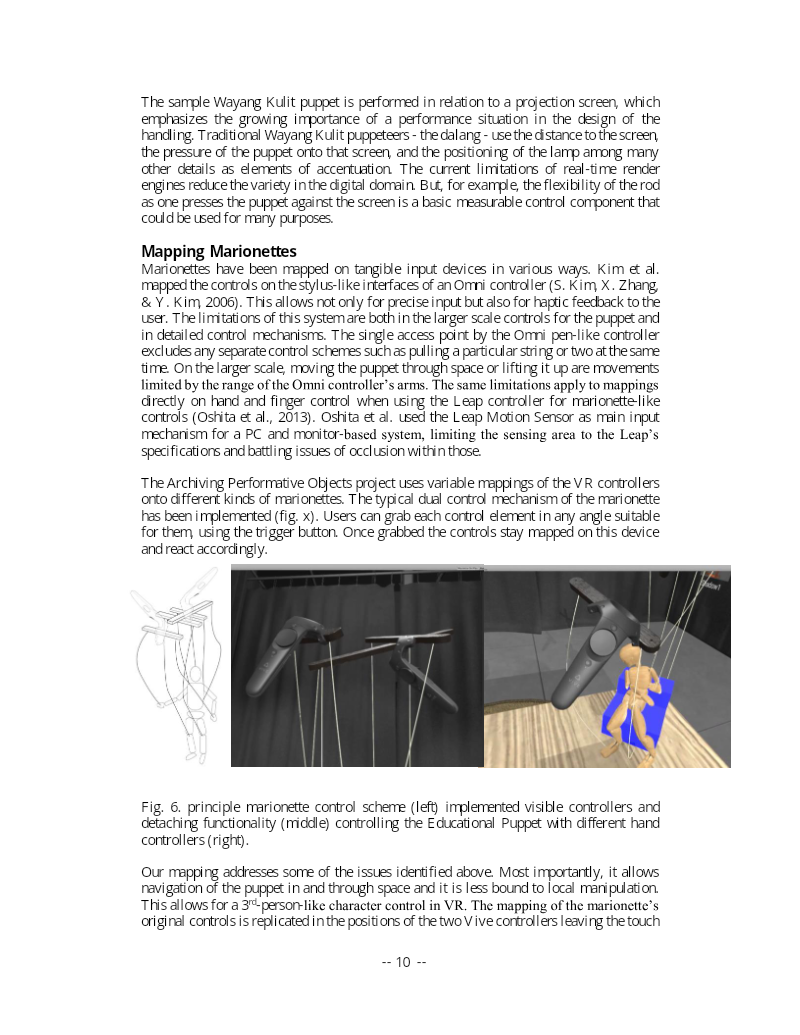
- The authors mapped traditional rod, marionette, and hand puppet control mechanisms, drawn from the Center for Puppetry Arts archive, onto HTC Vive controllers using Kaplin's distance model as their design logic.



Contextualizing Pathological Gaming: A Proof-of-Concept Study
This study critically examines the effectiveness of current screening tools for "pathological gaming," specifically Gentile's (2009) questionnaire, by applying it to individuals engaged in professional gaming.
- The study argues that Gentile's (2009) 11-item pathological gaming questionnaire, largely adapted from substance-abuse criteria, may not measure what it intends and risks labeling healthy, committed players as problematic.
- Four eSports players and streamers completed the instrument and then explained their answers in semi-structured interviews, revealing specific points of misfit between the items and their lived experience.
- Ambiguous wording caused misinterpretation: the two-part "try to play less" item led one participant to answer "No" because they had never tried to cut down, not because they were unable to.

Exploring Cultural Differences in Game Reception: JRPGs in Germany and Japan
Cultural frames of reference shape how players and critics evaluate Japanese role-playing games, according to a qualitative comparison of German and Japanese reception of Persona 5 and Trails of Cold Steel I and II.
- German and Japanese Amazon ratings diverge sharply for Trails of Cold Steel (4.8 in Germany vs. 3.4 in Japan), while Persona 5 holds a consistent 4.3 on both storefronts.
- German professional and user reviews largely overlap in topics and evaluations, but German user content is more varied and more frequently negative than the professional coverage.
- German players frequently criticize the absence of German localization and Persona 5's length and save-point design, concerns rarely central to Japanese discourse.
Do you work at DiGRA? Get a free report of how these documents are read and cited here.