1 free read left. Create a free account for unlimited reading + AI research.
Create free accountArticle DiGRA
1 free read left. Create a free account for unlimited reading + AI research.
Create free accountArticleDiGRA
This study examines how German and Japanese players and professional critics evaluate three Japanese role-playing games: Persona 5, and the two entries of The Legend of Heroes: Trails of Cold Steel. Drawing on grounded theory and qualitative content analysis of German gaming media articles, German and Japanese user reviews, and comments, the authors argue that cultural background shapes how players assess and discuss games. Persona 5 is treated as a critically and commercially successful title, while the Trails series is positioned as niche, a contrast that is reflected in review data, where Trails of Cold Steel scores notably higher on German Amazon (4.8) than on Japanese Amazon (3.4), while Persona 5 holds a consistent 4.3 across both storefronts.
The central finding is that German professional and user reviews largely overlap in topics and evaluations, but German user content is more varied and more frequently negative. German players stand out for criticizing the absence of German localization and Persona 5's length and save-point design, concerns that are rarely central in Japanese discourse. Japanese reviewers, by contrast, are more critical of Trails' story, characters, and social-link mechanics, which German reviewers tend to praise, and they engage more closely with mechanical details such as Persona 5's combat button mapping, a topic German reception largely omits.
The comparison of user vocabulary reinforces these divergences. German reviewers favor the terms "story" and "gameplay," whereas Japanese reviewers prefer "scenario" and "system." The authors connect the near-universal praise for Trails in Germany to a smaller, more cohesive German fan base, and they relate the Japanese critical stance to the cultural weight of the "media mix" framework, suggesting that the two audiences hold fundamentally different expectations for narrative and content length.
The study concludes that culture-specific frames of reference meaningfully shape game evaluation. Its scope is limited to three titles and two national audiences, so the authors caution that the findings are not readily generalizable, and the work is positioned as a contribution to understanding cross-cultural player reception in the JRPG genre.
Each row is a game or company this document names, each column a document, oldest first. A mark means that document names it. Select a row to see those documents.



DiGRA · 2018



DiGRA · 2018



DiGRA · 2018

DiGRA · 2018

DiGRA · 2018



DiGRA · 2018



DiGRA · 2018



DiGRA · 2018



DiGRA · 2018

DiGRA · 2018



DiGRA · 2018
DiGRA · 2018
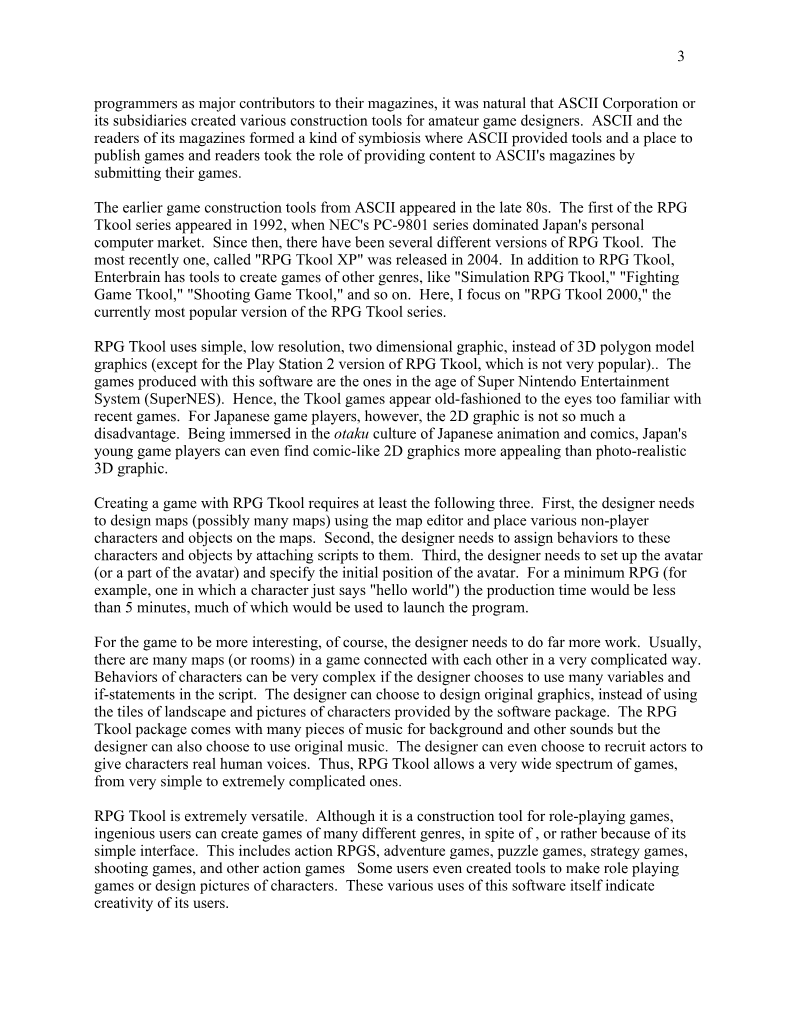
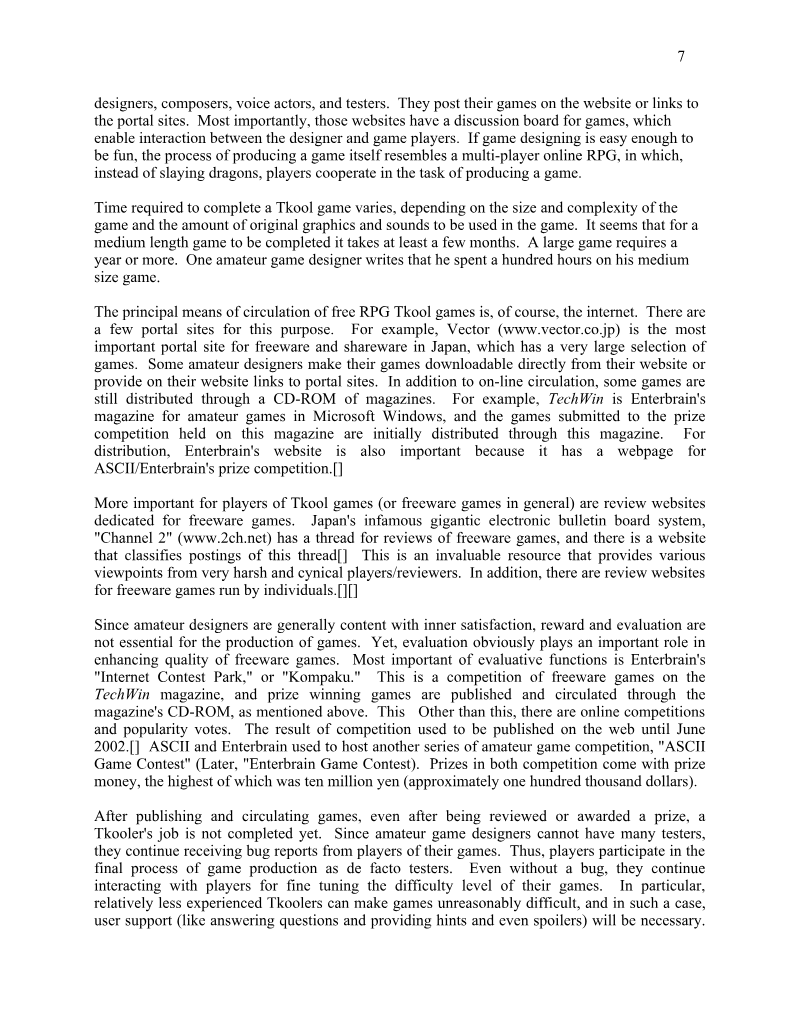
DiGRA · 2005