
DiGRA
The Digital Games Research Association: the international association of academics and professionals who study digital games. Its Digital Library holds the proceedings of the DiGRA conferences since 2002.
Documents
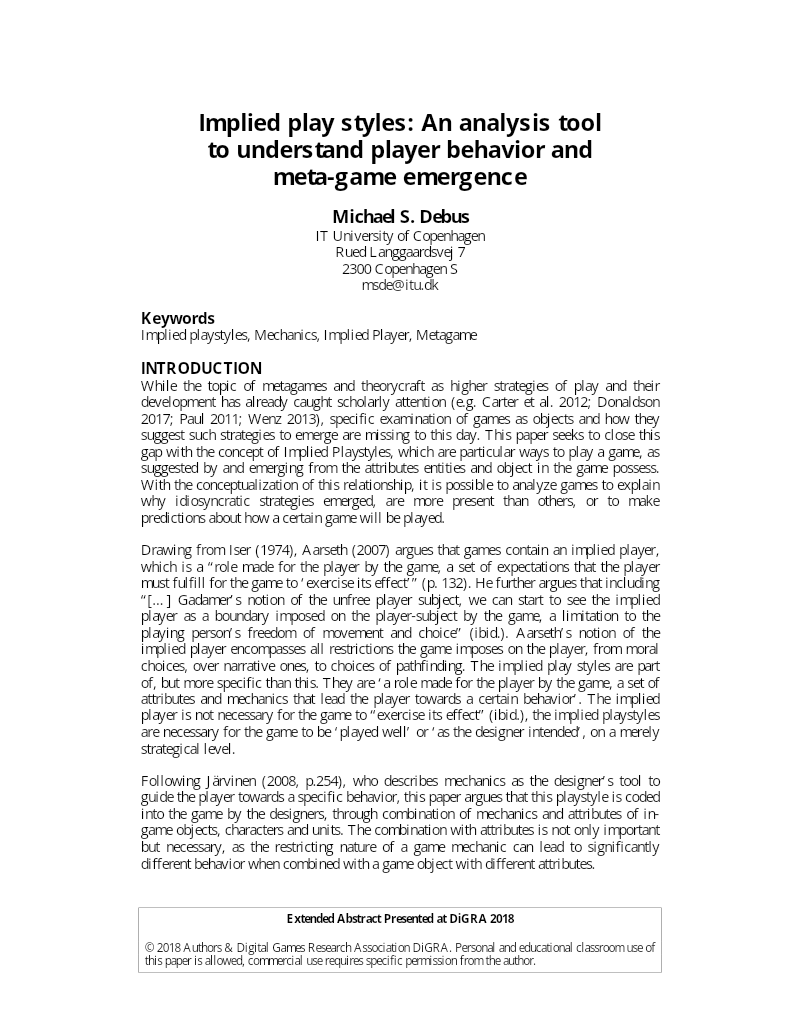
Implied Play Styles: An Analysis Tool to Understand Player Behavior and Meta-Game Emergence
The document introduces the concept of "Implied Playstyles" as an analytical tool to understand player behavior and the emergence of meta-games.
- Implied playstyles are proposed as a narrower construct than general player freedom: the strategic behaviors a game must elicit for it to be played "well" or as its designers intended, building on Iser's implied reader and Aarseth's implied player.
- Designers encode implied playstyles through the combination of mechanics and object attributes, so the same mechanic can produce markedly different behavior depending on the properties of the objects it acts upon.
- The framework is illustrated with units from StarCraft II: Legacy of the Void and Sins of a Solar Empire, each featuring three visually and mechanically distinct factions, selected partly because the author is familiar with them.
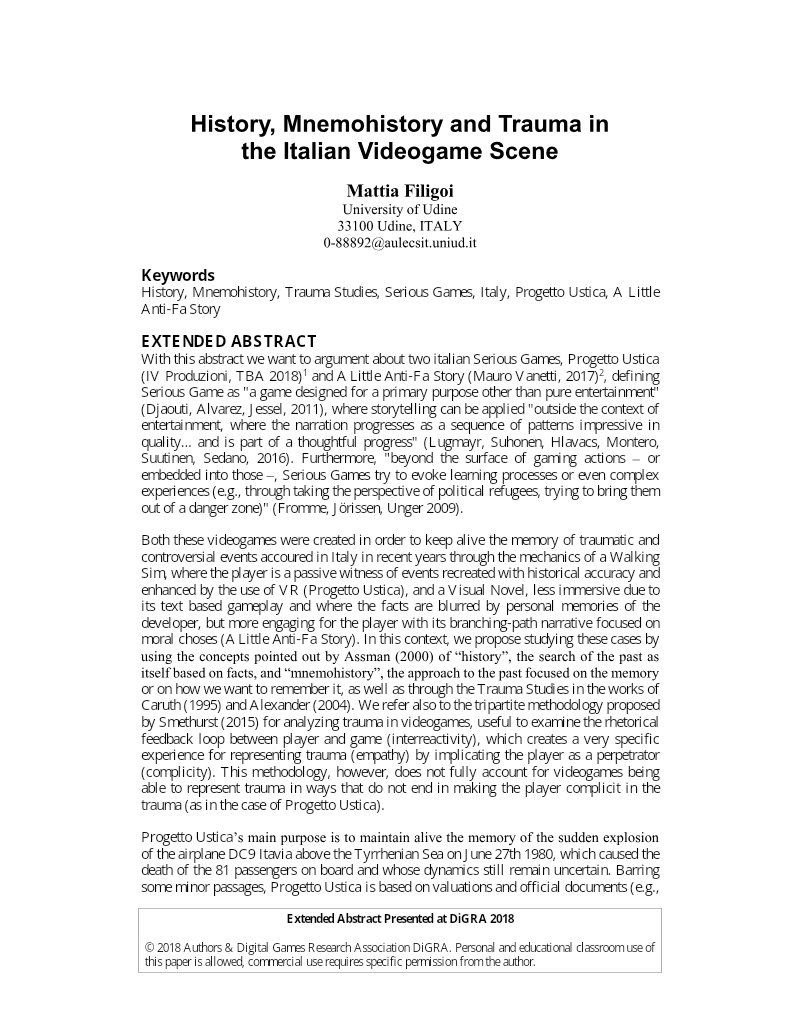
History, Mnemohistory and Trauma in the Italian Videogame Scene
Italian serious games can preserve and reshape the memory of traumatic national events, and this extended abstract examines two cases to show how.
- The paper argues that two Italian serious games, Progetto Ustica and A Little Anti-Fa Story, use interactive storytelling to preserve collective memory of traumatic and controversial events, and that existing trauma-in-games frameworks such as Smethurst's model of interreactivity, empathy, and complicity do not fully capture the range of ways games can represent trauma.
- Progetto Ustica, a walking simulator with VR elements, recreates the 1980 explosion of Itavia flight DC9 over the Tyrrhenian Sea that killed 81 people and whose cause remains disputed, drawing on judicial documents and an engineering assessment.
- Progetto Ustica's minimal interactivity casts the player as a passive witness, and its climax experiences the explosion from within the aircraft, which the author notes avoids implicating the player in complicity and challenges the assumption that trauma representation in games must work through moral choice.
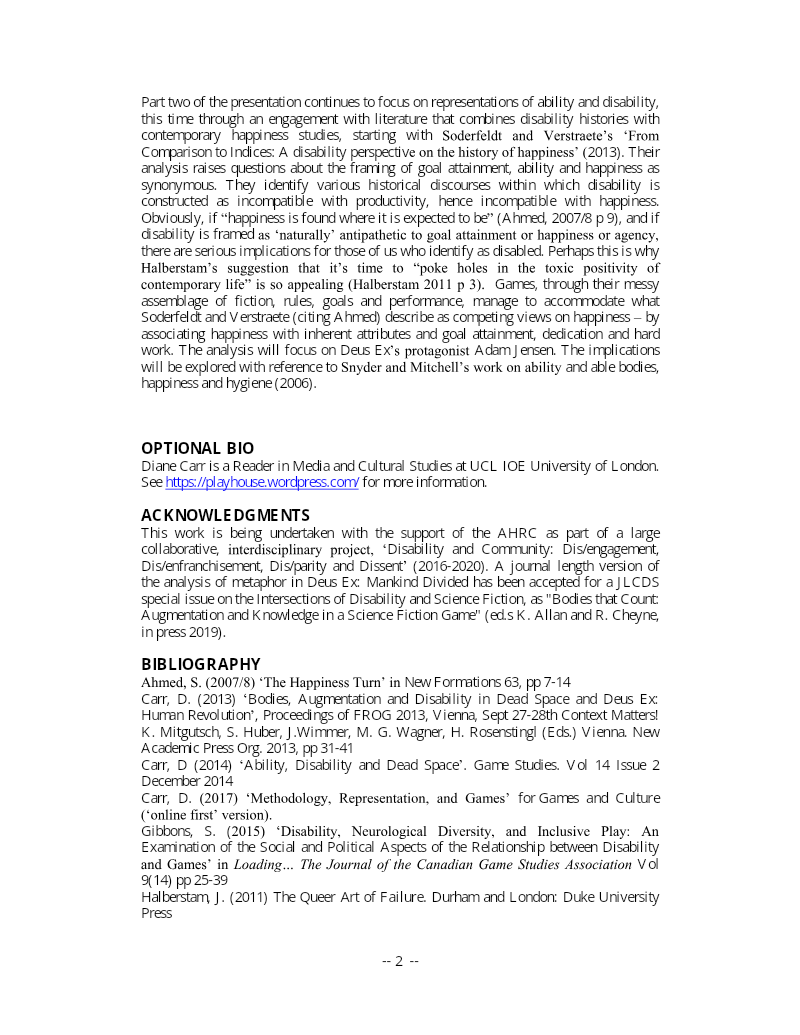
Body Count
The document, an extended abstract for a presentation titled "Body Count," explores the representation of bodies, particularly focusing on ability and disability, within video games.
- Games materialize themes in two ways: through on-screen bodies whose impairments embody the fiction's concerns, and through the game-as-played, where ability is rendered via measuring, scoring and performance.
- Drawing on Mitchell and Snyder's 'narrative prosthesis,' the author extends the concept into 'ludic and narrative prosthesis,' using Deus Ex: Mankind Divided (2016) and its traumatized protagonist Adam Jensen and dystopian Prague setting as the central case.
- The analysis challenges the 'normate' body as presumed stable when it is in fact unstable, examining how games position, sort, score and separate bodies and linking disability with gender and migrant identity through intersectionality.
Game Narrative Through the Detective Lens
Detective fiction offers a productive lens for understanding how gameplay and narrative relate in digital games.
- The paper argues the detective genre is a productive analytical lens for studying how gameplay and narrative relate, with conclusions drawn inductively from a specific corpus of detective stories and games rather than a survey of game narrative as a whole.
- Drawing on Todorov, it distinguishes the whodunit (reconstructing past events drives the mystery) from the thriller (the detective's own adventures are central), and argues both structures naturally support story-driven gameplay where players piece together events or use revealed information to solve problems.
- Examples discussed include Sherlock Holmes and Agatha Christie adaptations, plus non-detective titles such as Myst, Dear Esther, the Blackwell series, and L.A. Noire.
The Moral Calculus of Vocational Passion in Digital Gaming
The document explores the "moral calculus" that shapes players' beliefs about vocational passion in the digital games industry, arguing that this calculus justifies precarious employment conditions.
- The paper argues that players rationalize precarious, passion-driven gaming labor (esports, volunteer moderation, play-testing, aspirational job-seeking) by treating hobbies as pleasurable compensation for work's hardships, which legitimizes insecurity as a reasonable tradeoff.
- In post-Fordist creative industries like digital gaming, the compensatory relationship between leisure and livelihood makes precariousness appear a logical condition of passionate employment, a dynamic the author frames as boundary work exploiting ambiguities between vocation and avocation.
- The study draws on eighteen months of multi-sited ethnographic fieldwork across Boston, Los Angeles, Atlanta, and Reykjavik with players of an MMOG studio, supplemented by twenty in-depth player interviews and analysis of the studio's promotional, customer relations, and press materials.
The Toy Is the Message: Materiality, Imagination and Play Objects
Commercial play, games and media culture is undergoing rapid change in which the line between toys as physical objects and toys as virtual or networked media is eroding.
- The toy is argued to be a distinct, theoretically underexplored element of play culture that should be studied in its own right rather than subsumed under game studies.
- Hybrid developments such as videogame characters with physical peripherals, virtual pets, augmented-reality smartphone games, and the emerging Internet of Toys are blurring the boundary between physical toys and digital media.
- Journalistic, parental, and academic responses to these hybrid shifts tend to be anxious, often fearing that imaginative play is being narrowed by mechanistic, commodified products built around stereotyped characters and scenarios.
Blank Arcade: Exhibition of Games and Toys as Art
The Blank Arcade is a recurring exhibition of games, play art, and interactive media, organized by Lindsay Grace of American University in association with the Digital Games Research Association's annual conference.
- The Blank Arcade is a recurring games-and-play art exhibition organized by Lindsay Grace of American University in association with the Digital Games Research Association's annual conference, aiming to bring game art practice and history into the game studies community.
- Prior editions were held in Salt Lake City (2014), Lüneburg, Germany (2015), and Dundee, Scotland (2016), and the abstract proposes a 2018 edition.
- The model is designed to be sustainable for host conferences: organizers handle curation, outreach, advertising, and web hosting, while local hosts provide space, equipment, and logistics, with sponsorships sometimes covering shipping and catering.
To Hell and Back: Hellblade's Depiction of Mental Illness and Its Impact
Ninja Theory's independently published Hellblade: Senua's Sacrifice serves as a case study in how a commercial game can portray a controversial subject, psychosis, without being seen as trivializing it.
- The paper argues that Ninja Theory's Hellblade: Senua's Sacrifice (2017) makes a serious subject, psychosis, engaging without trivializing it, chiefly through artistic, educational, and documentary-style framing reinforced by consultation with mental health professionals and people with lived experience.
- The authors contend that games dealing with mental illness should be studied not only at the level of design but also through the player communities that engage with them.
- The methodology combines frame analysis (drawing on Goffman, and applied to games by Deterding) with content analysis of Ninja Theory's developer diaries and a mini-documentary included in the game.
Deepening Gameplay Experiences Through Estrangement
Game studies and design have long treated uninterrupted, absorbing play as the ideal, with flow, immersion, engagement, and even addiction all implying continuous engagement with the game.
- The paper argues that game theory has been dominated by concepts of uninterrupted absorption such as flow, immersion, engagement, and addiction, and proposes an oppositional perspective centered on estrangement, distance, reflection, and queering.
- The authors contend that interruptions in games can prompt players to step back from the fiction and view the game with an outsider's eye, and these moments need not be understood only negatively.
- The work frames the player-character relationship as the central mechanism of semiosis in games, examining conditions that draw players toward identification while sustaining critical distance.
A Comparative Study of Attachment: Fighting Games and Taekwondo in Life
This study investigates the points of connection and disconnection between digital fighting game players and analog Taekwondo practitioners, examining their attachment to these activities.
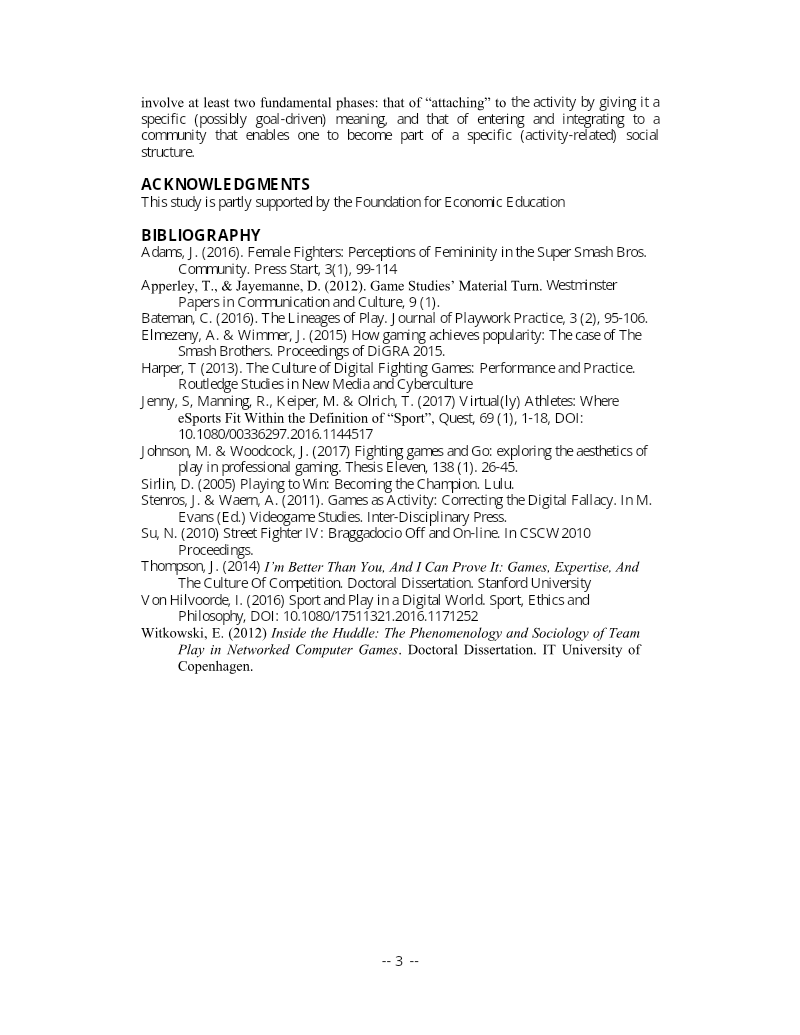
- The study is a qualitative, exploratory DiGRA 2018 comparison of how players form lasting attachments to digital fighting games versus analog taekwondo, drawing on 14 forum narratives and 15 interviews with fighting game players, plus 9 forum narratives, 8 interviews, and 14 WTF essays for taekwondo, all with multiple years of practice.
- Both groups followed parallel developmental paths: they typically started with a friend for enjoyment, then deepened commitment as skill grew, joined communities, and often moved into competition.
- Participants in both activities expressed a strong ethos of long-term commitment, framing continued participation in physical terms such as playing or practicing for as long as their wrists or bodies allowed.
Beer & Pixels: Embodiment, Drinking, and Gaming in Australia
Alcohol is a central yet underexamined thread in games culture, and this extended abstract argues that drinking practices in the Australian games industry deserve scholarly attention alongside work on player cultures, paratexts, and developer cultures.
- Alcohol is framed as a central, under-examined element of Australian games culture, with drinking and gaming treated as an entangled ecology of practices shaping players, paratexts, and developers, based on ethnography, developer and venue interviews, and event observations from 2016 to 2018.
- Alcohol-centred networking, collaboration, and personal branding have become central to developer life, especially for independent developers, so opting out carries real professional costs.
- Post-work drinks build team bonds but can strain personal relationships and exclude people with caring responsibilities, a burden falling disproportionately on women.
Non-Human Gaming: Video Games for the Post-Anthropocene
The document explores the concept of "Non-Human Gaming" as a response to the impending Post-Anthropocene era, characterized by the potential mass extinction of human life due to environmental degradation.
- Dr Paolo Ruffino's DiGRA 2018 extended abstract argues that games designed to play themselves or run with minimal human involvement form a long-standing presence in the medium, which he terms Non-Human Gaming rather than an anomaly or passing fashion.
- The paper frames Non-Human Gaming as a response to anxieties about a possible mass extinction and a coming Post-Anthropocene, and claims existing game studies frameworks built around human agency, interactivity, and skill have largely failed to address it.
- Examples cited include idle games such as Cookie Clicker and AdVenture Capitalist that progress after minimal input, No Man's Sky's algorithmically generated environments, and Screeps, where players program AI agents that act for them while offline.
Do you work at DiGRA? Get a free report of how these documents are read and cited here.