
DiGRA
The Digital Games Research Association: the international association of academics and professionals who study digital games. Its Digital Library holds the proceedings of the DiGRA conferences since 2002.
Documents
Game Jockey as an Intermediary Between DJ Practice and Video Games
The document introduces the novel concept of a "game jockey," an intermediary figure who performs live mixes of video games for an audience, drawing parallels to a DJ's practice of mixing music.
- The report proposes the "game jockey," a hybrid performer who live-mixes games for players the way a DJ mixes recorded music, adapting in real time to audience reactions.
- Its central claim is that core DJ concepts (live performance, sample culture, mixing, and remixing) can be productively mapped onto video games, supported by analogies to sports referees, TV hosts, game masters, and VJs.
- The author's Jockey–Game–Player triangular model frames the performer as an intermediary between a game system and its audience.
Is This Really Happening?: Game Mechanics as Unreliable Narrator
Roe and Mitchell argue that unreliable narration in games does not require an omniscient, personified narrator.
- The report argues that game mechanics combined with audiovisual modes can act as a non-personified "Game Narrator" capable of unreliable narration, shifting focus away from games with explicit narrators such as The Stanley Parable.
- Unreliability is generated through conflicting information, forced choices offered without context, and metaleptic breaches, leading players to repeatedly reconstruct the narrative and doubt their own actions, as seen in Tales from the Borderlands Episode 1.
- In Doki Doki Literature Club, Monika is the only character who breaches metaleptic boundaries, and her unnatural cues undermine players' initial assumptions about the game world.
Exploring How Changes in Game Systems Generate Meaning
This paper analyzes how changes in game mechanics generate meaning for players, arguing that play is essential for this interpretation and that dynamic mechanics can deliver plot points uniquely within the medium.
- The paper argues that changes in game mechanics, rather than representational elements like cutscenes or dialogue, can generate meaning and deliver plot points in ways unique to the medium, and that play is essential to interpreting those changes.
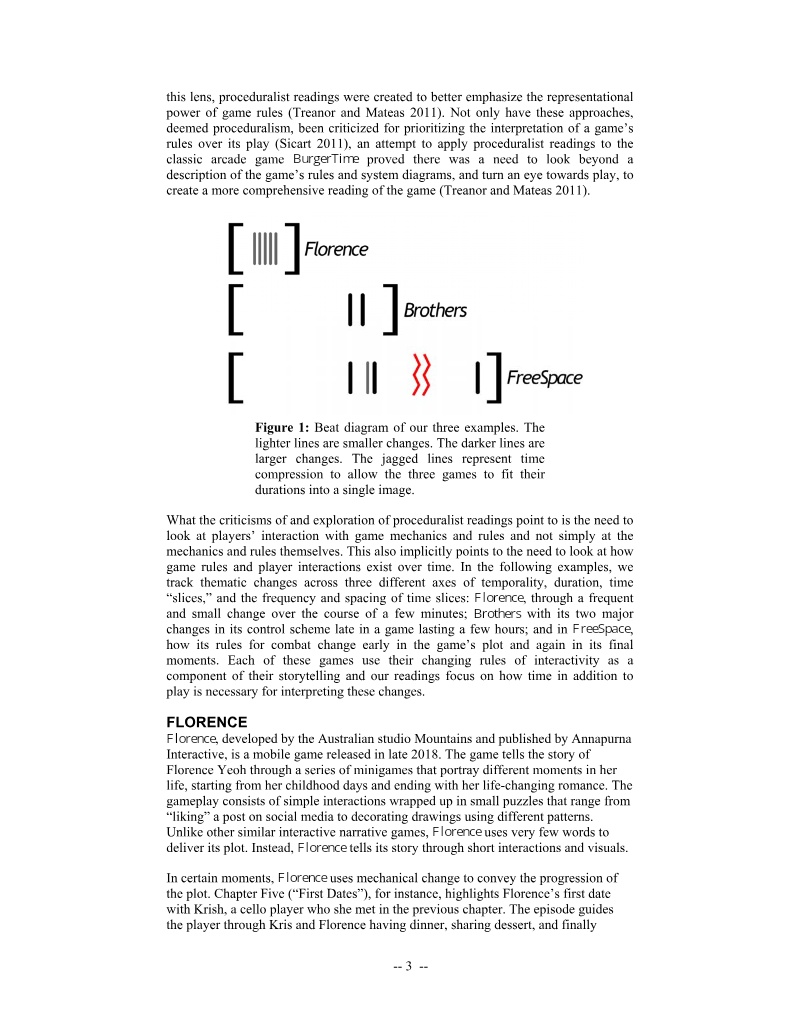
- A game's temporal structure, including the timing, frequency, and duration of mechanical shifts, shapes how players understand those changes.
- Close readings of Florence (altering a drag-and-drop puzzle mechanic across a short chapter), Brothers: A Tale of Two Sons (removing half the player's controls late in the game to mirror a sibling's death), and Descent: FreeSpace - The Great War (introducing and withdrawing targeting and shield rules across a long campaign) illustrate these ideas.
A Recipe for Disaster? The Emerging Ludo Mix and the Outsourcing of Narrative
The "ludo mix," a media mix strategy in which a game drives a broader franchise ecosystem, is examined through The Final Fantasy XV Universe, which spans a game, CGI film, anime, audio drama, novel, and DLC.
- The 'ludo mix' strategy, exemplified by Final Fantasy XV, moved core story elements out of the main game into anime, film, novels, audio drama, and DLC, which the author argues produced a narrative imbalance that contributed to the game's critical reception.
- The author questions director Hajime Tabata's stated motivations, arguing that earlier Final Fantasy titles delivered self-contained narratives through sequels, so the transmedia approach was not strictly necessary to avoid releasing the story as multiple games.
- Rising development costs and newer monetization models such as DLC and season passes are presented as drivers of narrative gaps, with the novelization of the cancelled second DLC season, The Dawn of the Future, cited as an example of story content shifted to cheaper media.
GDC vs. DiGRA: Gaps in Game Production Research
"GDC vs. DiGRA: Gaps in Game Production Research" identifies a substantial disconnect between academic game research and the practical realities of game production, particularly in content-creation domains.
- Academic game studies research on actual industry production is sparse: of roughly 2,278 initial articles reviewed from DiGRA proceedings (2006–2018), only 60 contained genuine industry empirics.
- The academic literature concentrates overwhelmingly on game design, management, and software engineering, while audio production, visual arts, narrative and writing, content-focused programming, and community management are almost entirely unexamined despite audio's prominence at GDC.
- Research on UX and programming exists but tends to approach these areas from a technical or software-engineering standpoint rather than a creative one.
The Comparative Self: Understanding the Motivation to Play and the Subsequent Video Game Use
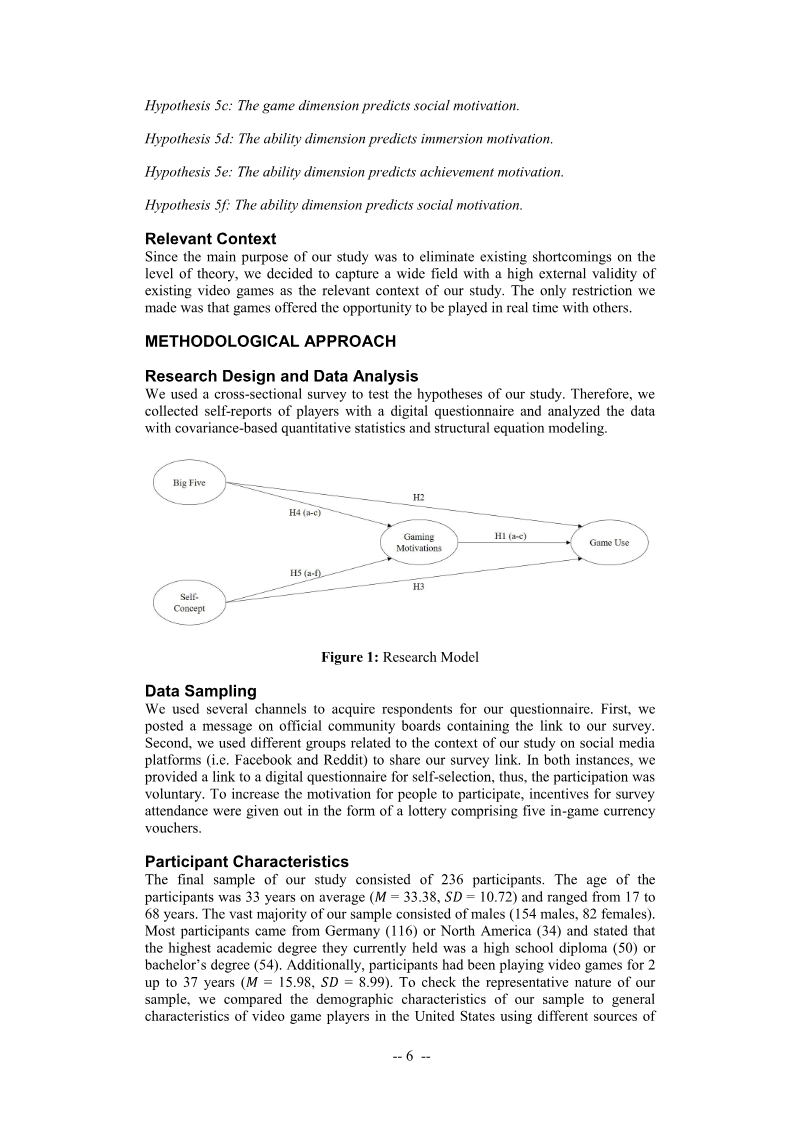
This study investigates the psychological underpinnings of video game motivation and use, proposing that a dynamic "self-concept" offers a more comprehensive explanatory framework than static personality models like the Big Five.
- A survey of 236 mostly male players (average age 33) found that a context-dependent self-concept explained about 30% of the variance in video game use, versus 25% for the stable Big Five personality model, with stronger model fit indices for the self-concept framework.
- Social motivation was the only motivation type that significantly predicted actual game use (β = .29, p < .001).
- The ability dimension of self-concept was the strongest predictor of both immersion motivation and overall game use.
Taiko no Tatsujin: Musical Literacy in the Media Mix
The document, "Taiko no Tatsujin: Musical Literacy in the Media Mix," examines how the Taiko no Tatsujin franchise cultivates musical literacy within the Japanese media mix.
- The study argues that Taiko no Tatsujin cultivates "game musical literacy," which extends beyond the functional decoding of gameplay cues to combine media literacy, ludic literacy, and knowledge of communal musical practice, framed through Christopher Small's concept of "musicking."
- The franchise operates across two cultural tracks at once: media-mix music drawn from anime, J-pop, and game soundtracks, and the traditions of taiko drumming practice.
- The analysis treats taiko as a communal, secularized "new folk performing art," with game design referencing the chū-daiko drum, its physical gestures, and matsuri festival atmosphere, including yagura bandstand imagery.
Character-Driven Narrative Engine: Storytelling System for Building Interactive Narrative Experiences
This research details a three-year methodology for developing interactive storytelling systems, primarily within an educational setting at Politecnico di Milano.
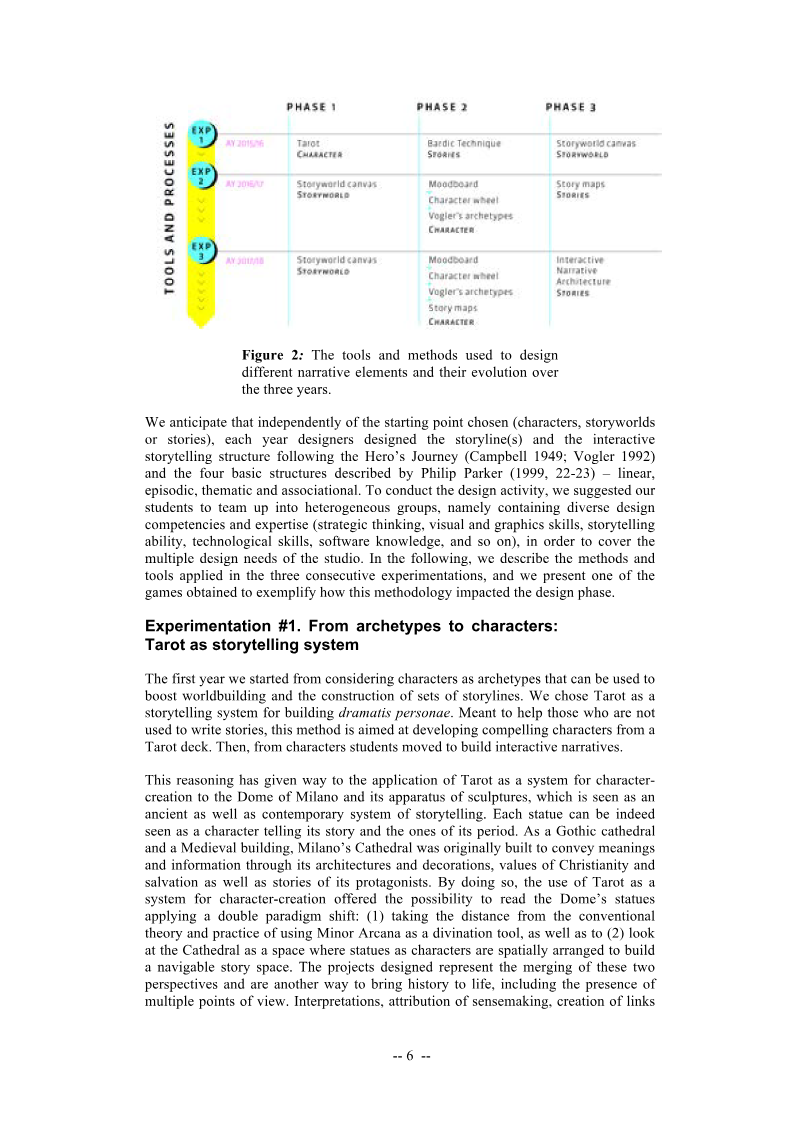
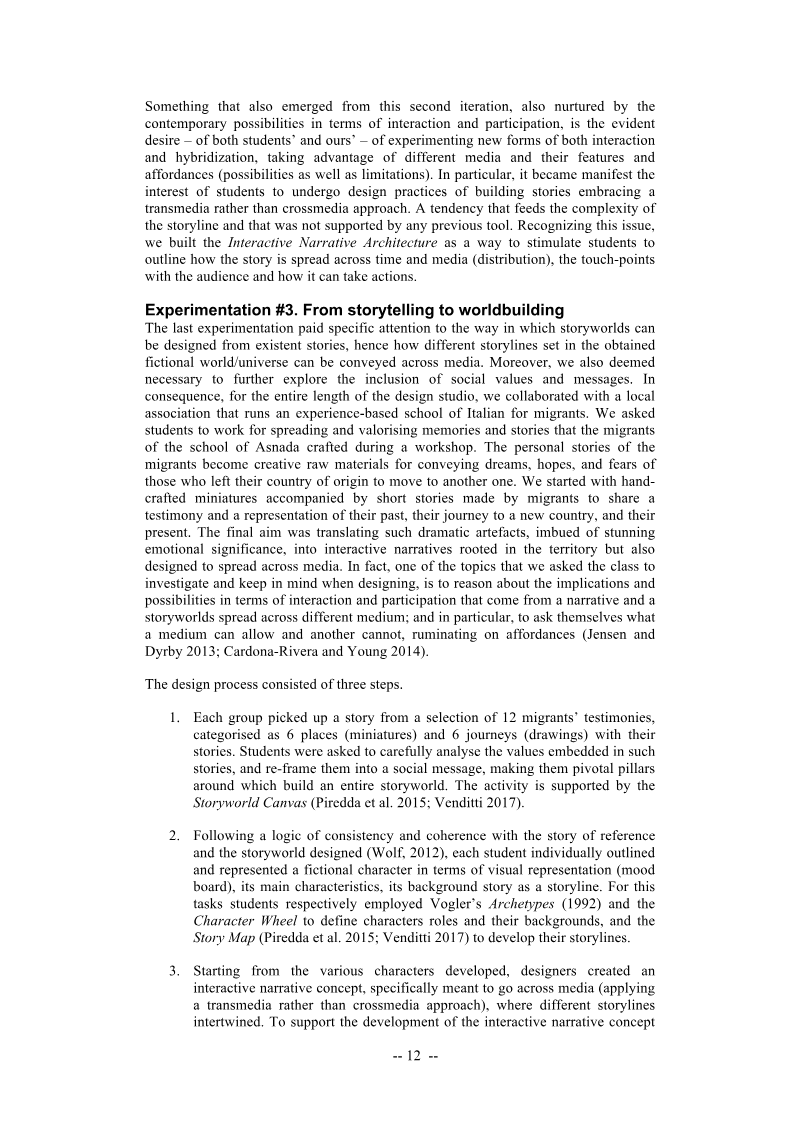
- The research program at Politecnico di Milano (2015–2017, with a fourth edition in progress) involved roughly 150 MSc design students developing interactive, character-driven narratives, with findings drawn from qualitative ethnographic observation rather than quantitative audience measurement.
- Standard character-development tools such as Vogler's archetypes, the Storyworld Canvas, and the Character Wheel helped build characters but proved insufficient for designing interactive narrative structures, prompting the authors to move beyond them.
- Beginning from existing literary sources, such as Calvino's Invisible Cities, improved the completeness and consistency of storyworlds compared with starting from Tarot-archetype characters, which students found hard to make credible.
A Taxonomy of Game Engines and the Tools that Drive the Industry
Toftedahl and Engström argue that the term "game engine" is poorly defined and that the production pipeline, rather than the engine, is the central entity in game development.
- The report argues that "game engine" is too vague a term for rigorous research and proposes defining an engine as the core product-facing engine plus its user-facing production tools, with the full production pipeline covering every connected piece of software.
- The authors cite Starbreeze's costly late switch from its in-house Valhalla engine, essentially a renderer without production tooling, to Unreal as evidence that the distinction between core engine and tooling matters in practice.
- A triple-A title such as Assassin's Creed: Odyssey involved roughly 4,388 credited staff across 55 studios and 692 or more distinct roles, a scale the authors argue no single software product can serve.
The "Not So" Beautiful Game: A Study on Brazilian Players of the Fantasy Soccer Game Cartola FC
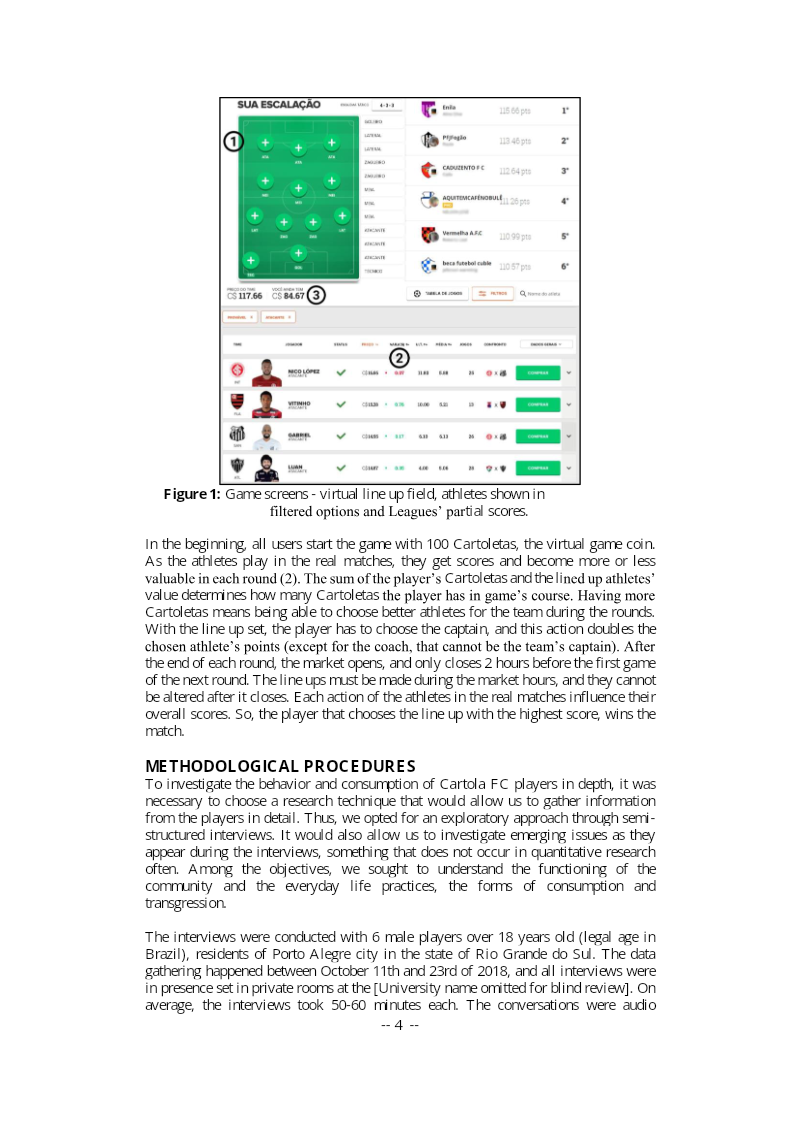
This study examines the behavior and consumption patterns of Brazilian players within Cartola FC, an online fantasy soccer game boasting 8.5 million users.
- Cartola FC is experienced as a practice that extends into everyday life, shaping how players seek information, interact with friends and colleagues, and deepen their attachment to soccer rather than functioning as a self-contained game.
- The study, based on qualitative semi-structured interviews with six male players in Porto Alegre, frames players' behavior as a distinctly Brazilian blend of a trickster-like pursuit of advantage and a warm, sociable use of play to strengthen relationships.
- Players value the PRO mode for access to more Leagues, status, and possible prizes, and the community is driven by shared soccer passion and social bonds.
Co-Constructing Virtual Identities: Insights from Linguistic Analysis
This study explores the co-construction of virtual identities for MOBA characters, specifically within Dota 2, through an analysis of linguistic behavior.
- Players' chat language in Dota 2 shifts measurably depending on the avatar they control, supporting the Proteus Effect in a naturally occurring online setting, though causal claims remain limited without experimental controls.
- The strongest linguistic variation follows community-defined roles (carry versus support) more than the game-defined Dire versus Radiant faction divide, suggesting functional roles shape behavior more than purely aesthetic distinctions.
- Hero-level differences were small but statistically significant, and analysis of individual heroes revealed larger differences than analysis of grouped categories.
Beyond the Wall: The Boundaries of the Neomedieval Town in Singleplayer Roleplaying Games
The document, "Beyond the Wall: The Boundaries of the Neomedieval Town in Singleplayer Roleplaying Games," proposes a comprehensive model for understanding how single-player RPGs define and communicate the boundaries of neomedieval towns.
- The central thesis is that a game town's boundary is defined less by its physical layout than by system-level rules governing what the player can do there, such as whether they can be attacked, trade with vendors, or rest safely.
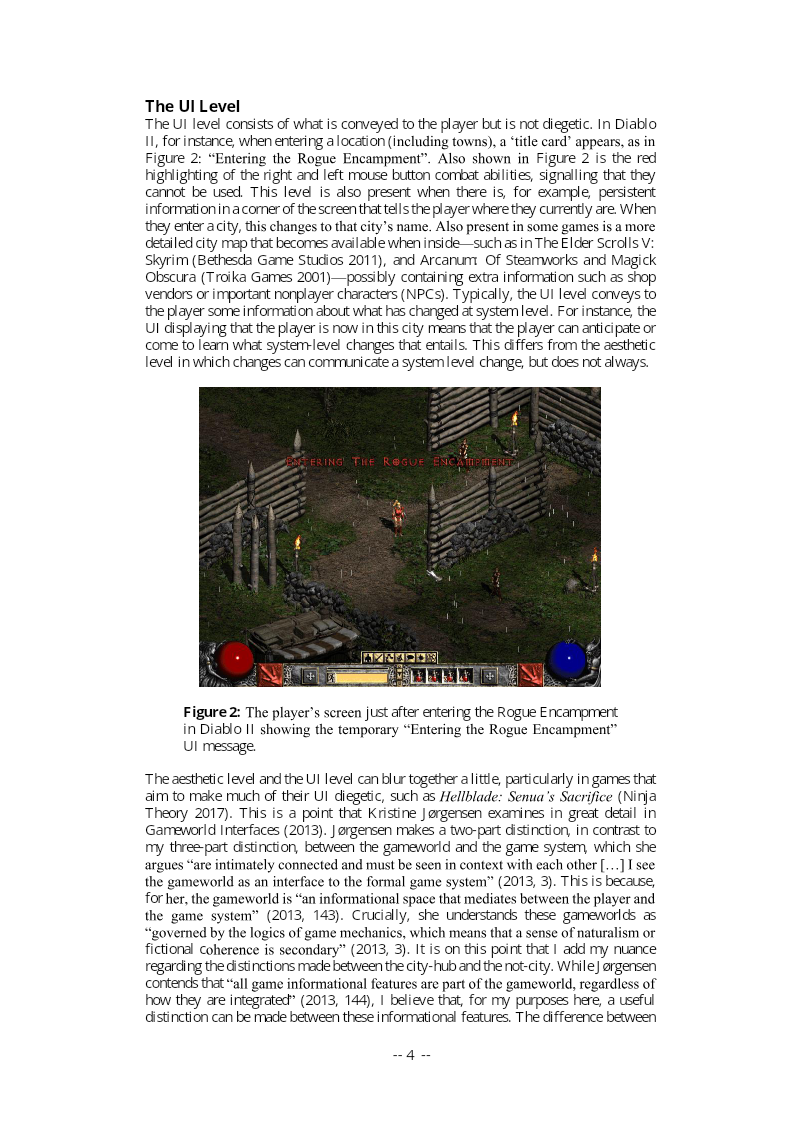
- Aesthetic and interface cues do not create the town/wilderness distinction on their own but reinforce or blur the functional rules beneath it, as shown by the Rogue Encampment and Harrogath, which share identical functionality yet differ visually in how sharply they separate settlement from wilderness.
- Diablo II's Tristram and Travincal look urban but operate as hostile wilderness, illustrating how appearance and function can diverge in game cities.
Do you work at DiGRA? Get a free report of how these documents are read and cited here.