
DiGRA
The Digital Games Research Association: the international association of academics and professionals who study digital games. Its Digital Library holds the proceedings of the DiGRA conferences since 2002.
Documents
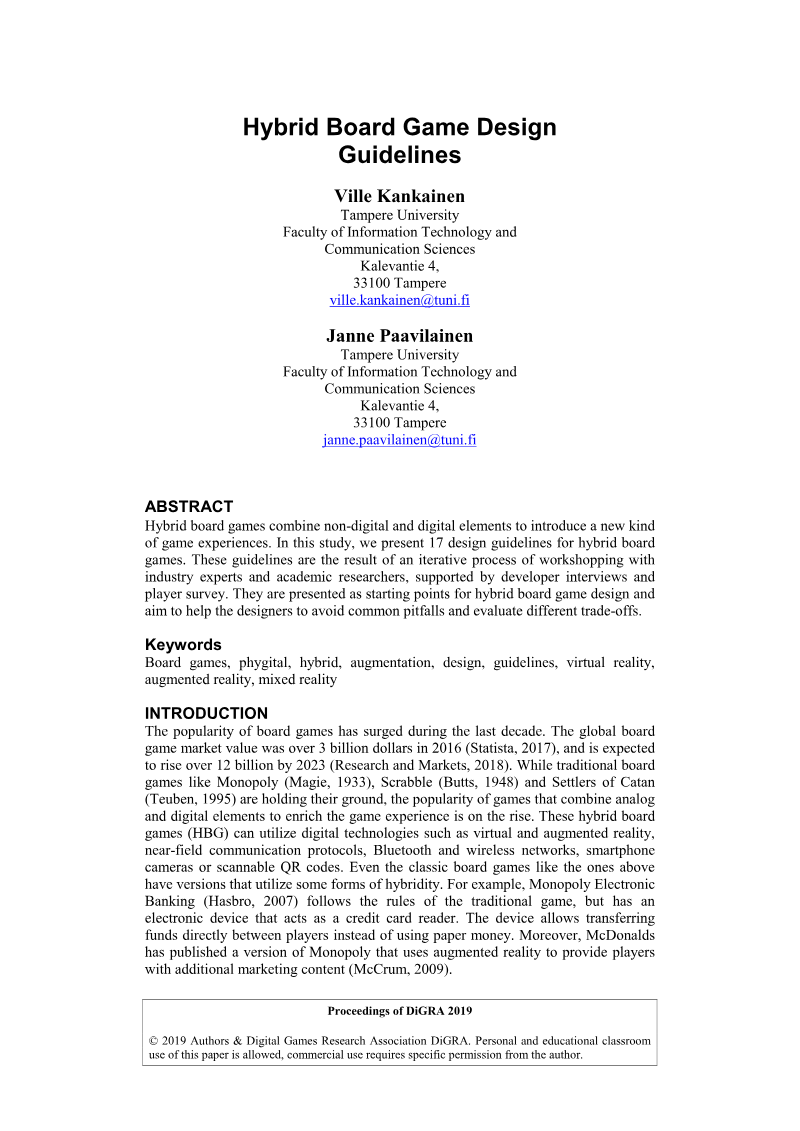
Hybrid Board Game Design Guidelines
Hybrid Board Game Design Guidelines presents a comprehensive framework for developing hybrid board games (HBGs), a market projected to exceed $12 billion by 2023.
- The guidelines are motivated by rapid market growth, with the board game market reportedly exceeding $3 billion in 2016 and projected to surpass $12 billion by 2023.
- Kankainen and Paavilainen's 'Hybrid Board Game Design Guidelines' (DiGRA 2019) present 17 guidelines for games blending analog and digital components, developed through a two-year applied-science project that evolved from an initial set of 10 to 13 and finally 17.
- The 17 guidelines cover themes including accessibility, automation, universality, obsolescence, customizability, sociability, shareability, tutorials, tangibility, parallel play, and integration, each illustrated with examples from titles such as Beasts of Balance, XCOM: The Board Game, Pandemic Legacy, and Ticket to Ride.
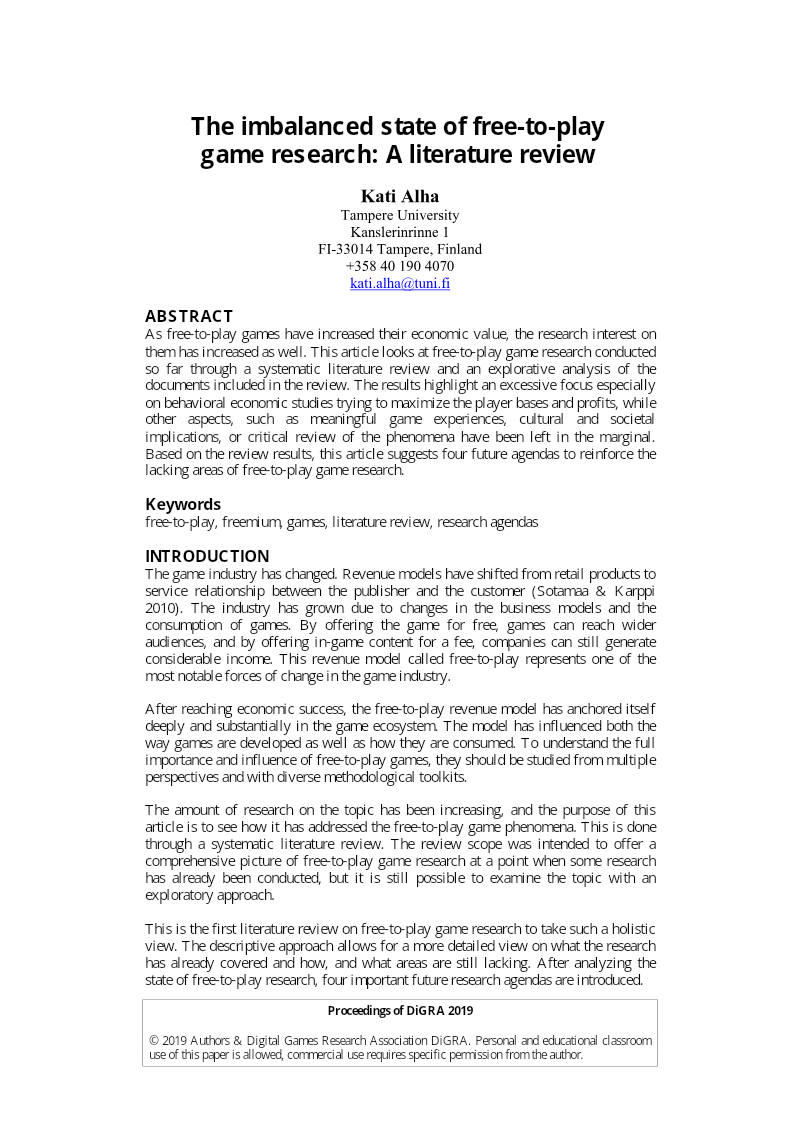
The Imbalanced State of Free-to-Play Game Research: A Literature Review
Free-to-play game research is heavily imbalanced, concentrating on quantitative efforts to predict and improve profitability while neglecting qualitative, critical, and cultural perspectives.
- The review's Scopus search identified 92 documents, with Computer Science accounting for 43.8% and quantitative methods dominating (44 of 64 method-classified studies), while North American and European bias is strong.
- Research volume on free-to-play games rose sharply around 2014 to 2015, coinciding with the model's commercial success on mobile platforms.
- Research concentrates on player churn and in-app purchasing, with about 1% of users generating roughly 85% of revenue (Voigt and Hinz, 2016) and advertising showing weak effects on retention (Burns et al., 2016).
The Politics of Game Canonization: Tales from the Frontlines of Creating a National History of Games
Glas and van Vught's paper examines how the Netherlands Institute for Sound and Vision assembled a national games canon, arguing that canonization is a politically charged process rather than a neutral act of documentation.
- Canonization of national game history is a politically charged act rather than a neutral documentation exercise, and the authors frame the Dutch case through the 'politics of acquisition', where preservation goals and socioculturally driven historiographical aims become entangled.
- The Netherlands Institute for Sound and Vision justified including games in its national collection through its 2016–2020 strategic plan, citing new media's importance for a representative record of Dutch multimedia production, and drew on populist, maturation, and instrumental arguments.
- The initial selection began with a 600-title longlist divided into five-year periods, and the resulting canon blended commercially successful titles with obscure 1980s niche games, shaped by pragmatic archival needs.
More Interaction, More Story, More Lore: Motivations Related to Game-Centric Transmedia
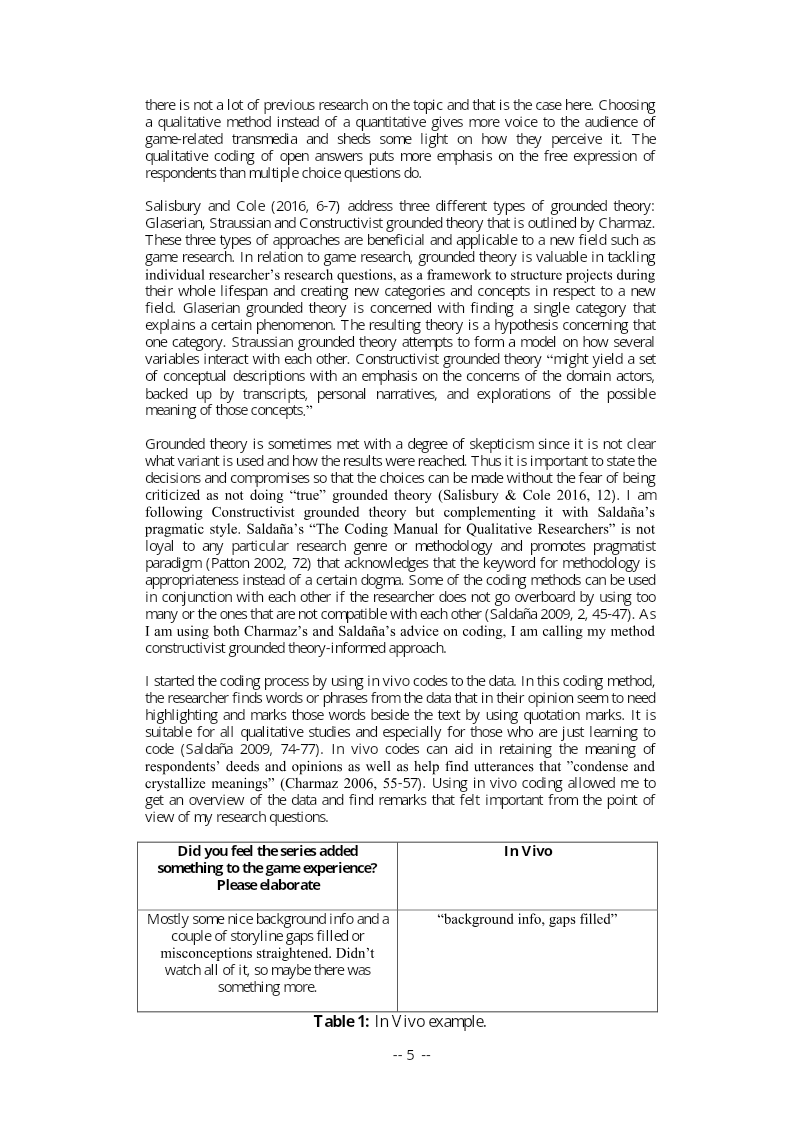
This study explores audience motivations for engaging with or avoiding game-centric transmedia, specifically using "Defiance" and "Quantum Break" as case studies.
- Game-centric transmedia audiences are driven primarily by narrative depth, immersion, character connection, and the desire to influence the storyworld, motivations that differ notably from those documented for television drama audiences.
- The study analyzed qualitative survey responses from 89 Defiance (2013) respondents and 65 Quantum Break (2016) respondents, a sample that was predominantly male and based in English-speaking countries.
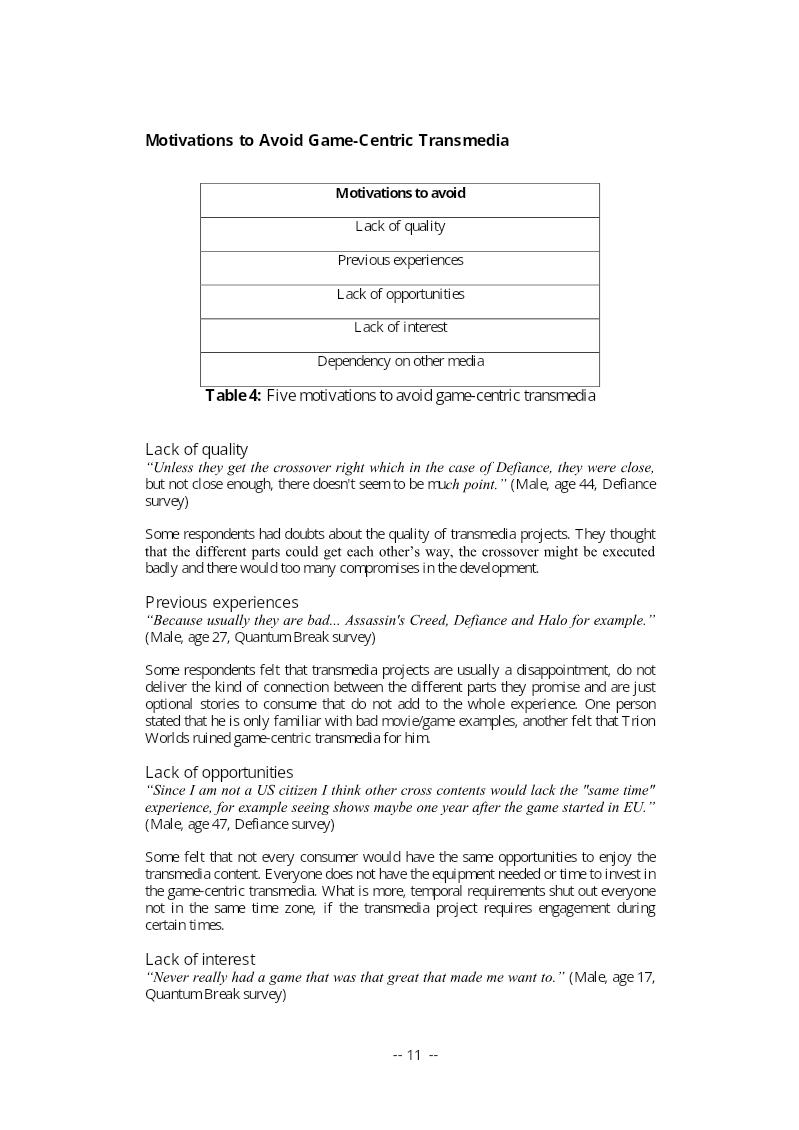
- Ten categories of motivation to consume were identified, including influencing and exploring the storyworld, storyworld expansion, quality, immersion, and media-related reasons, alongside five avoidance motivations: lack of quality, previous bad experiences, lack of opportunities, lack of interest, and dependency on other media.
"Can You Send Me a Photo?": A Game-Based Approach for Increasing Young Children's Risk Awareness to Prevent Online Sexual Grooming
The document describes the development and evaluation of "Hidden in the Park," an Augmented Reality adventure board game designed to enhance online risk awareness in children aged 8-10, specifically focusing on preventing online sexual grooming.
- The game 'Hidden in the Park' is a mixed-media board game with augmented-reality tablet components, designed to raise risk awareness about online sexual grooming among children aged 8 to 10, and it was built from an analysis of roughly 500 pages of real child-offender chat logs identifying tactics such as flattery, bribes, coercion, and threats.
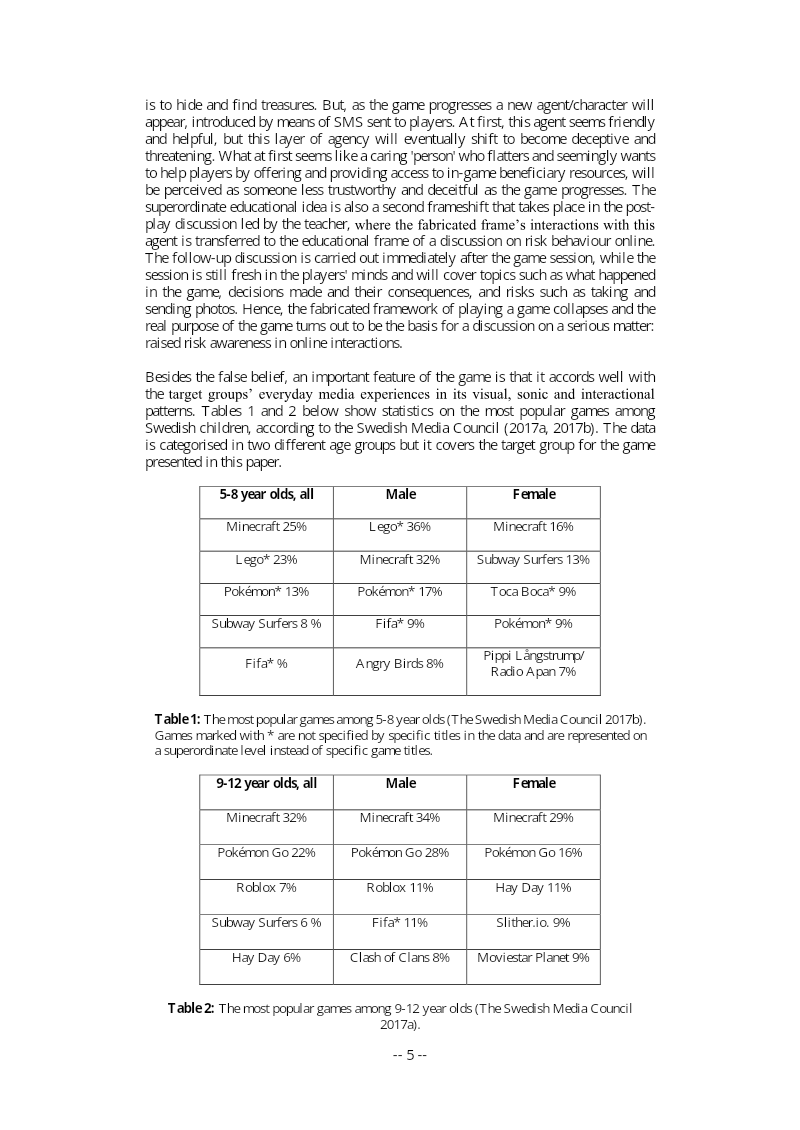
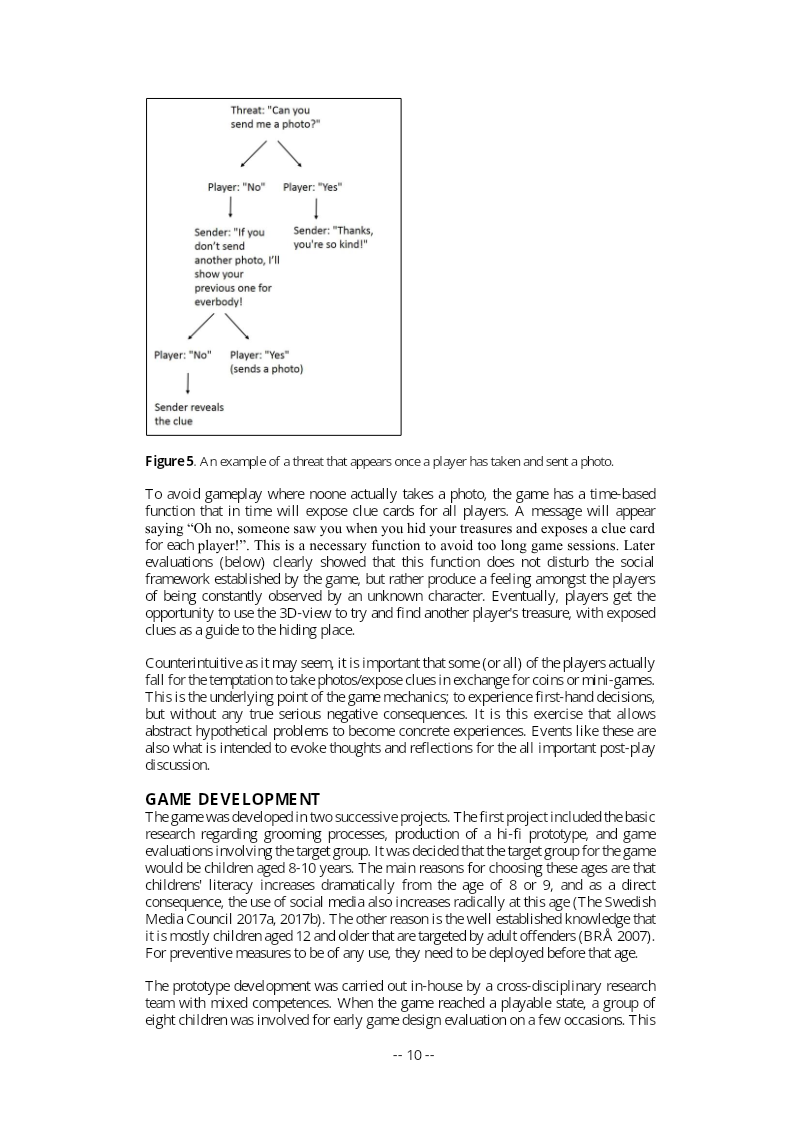
- Rather than using frightening or explicit content, the game gives children a controlled experience of a friendly digital contact who gradually turns deceptive and pressures them to share photos, followed by a structured teacher-led discussion.
- The game was evaluated with 70 children aged 7 to 12 across three Swedish schools in fall 2018, across four successive versions, with observations and group interviews showing children found it primarily enjoyable while prompting reflection on their own online behavior.
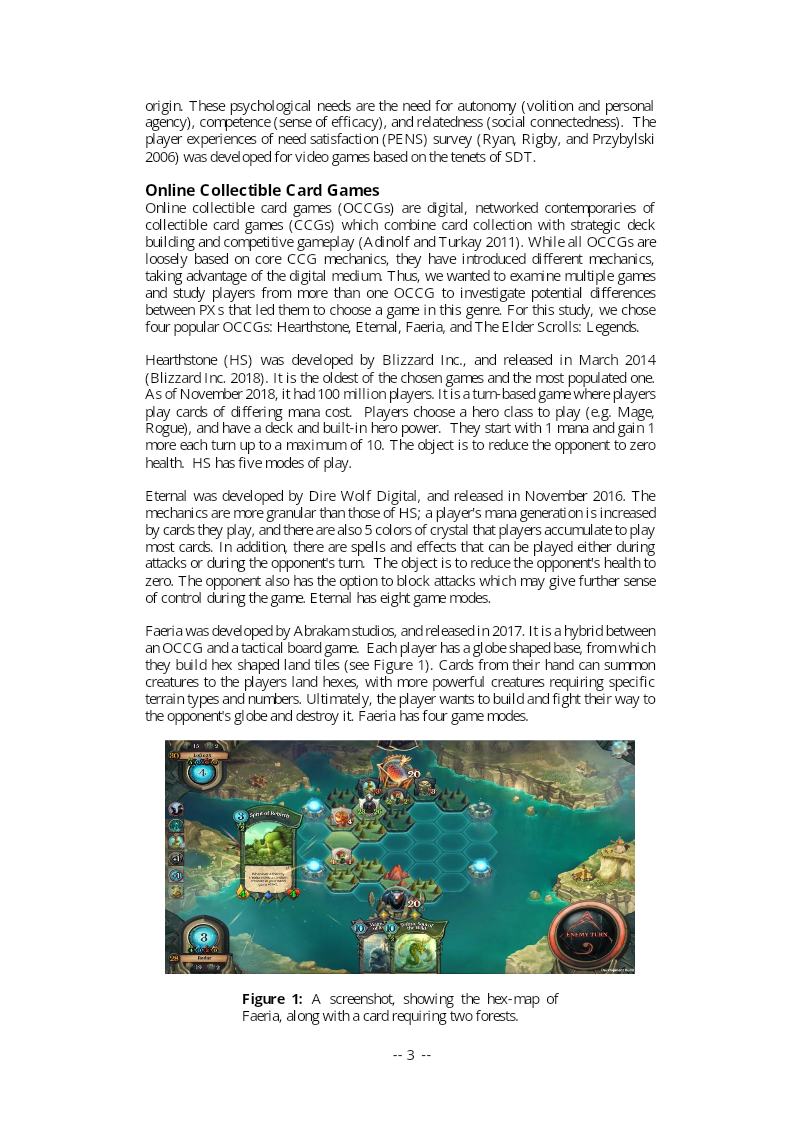
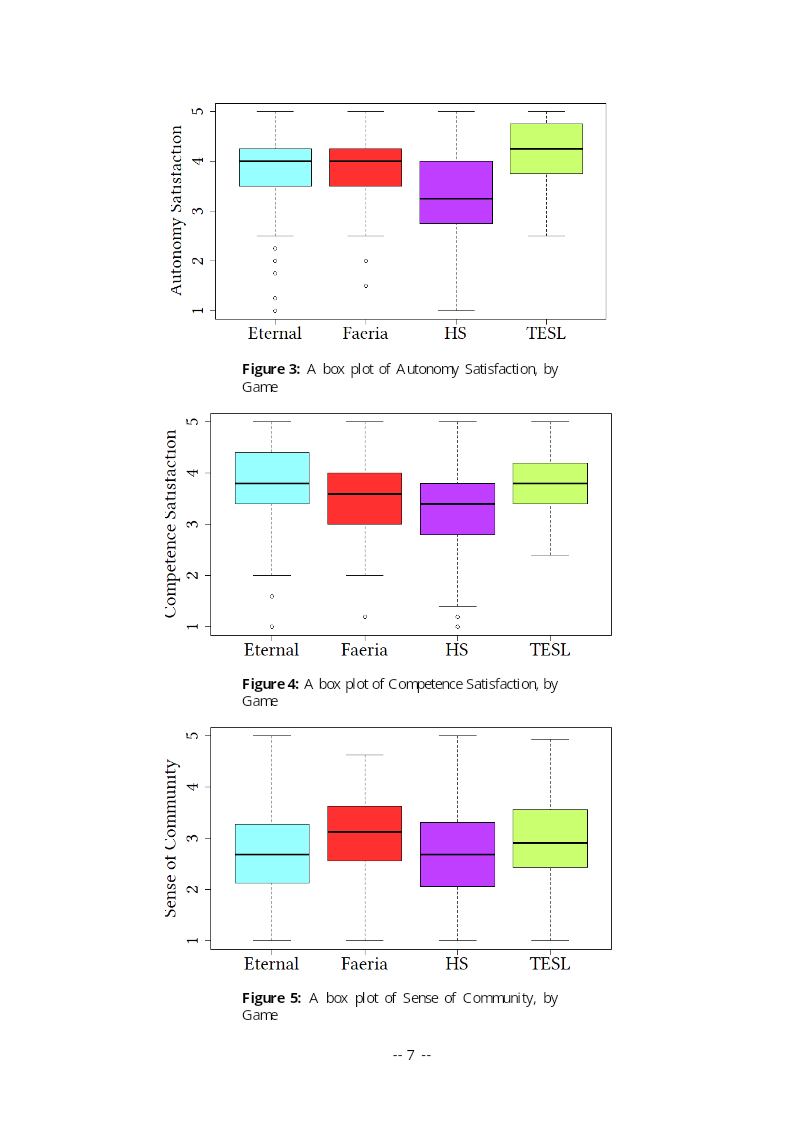
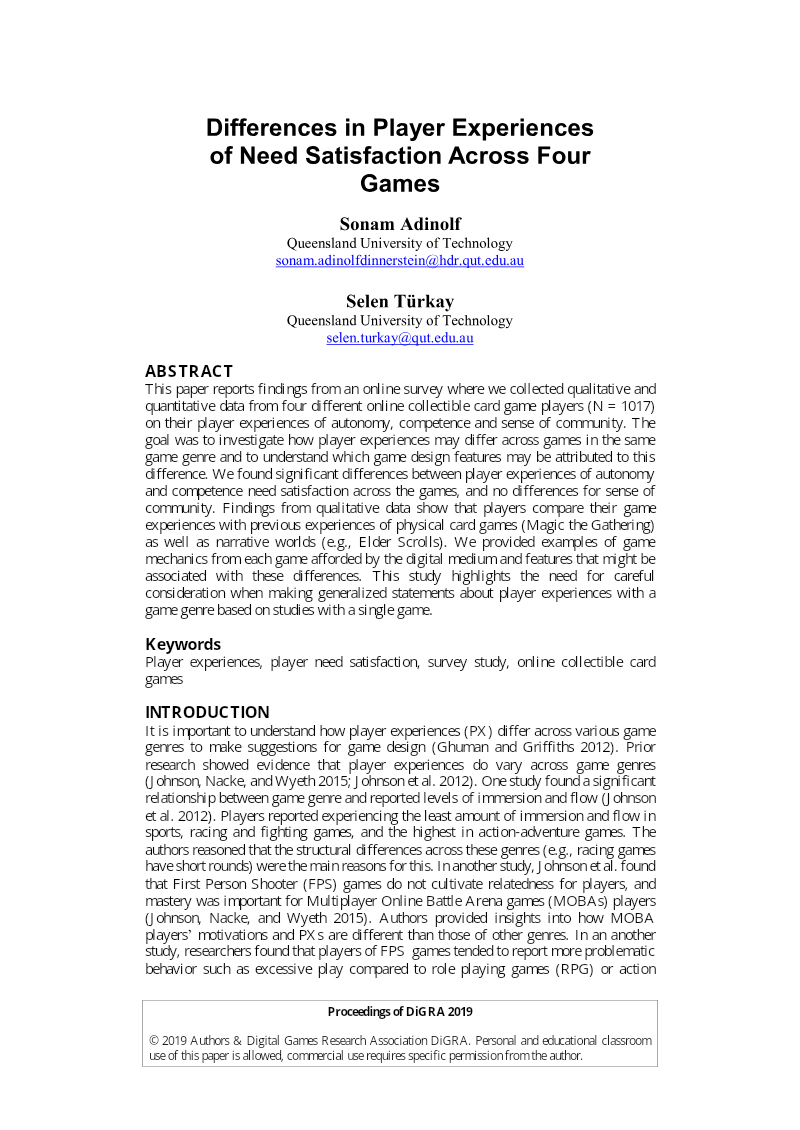
Differences in Player Experiences of Need Satisfaction Across Four Games
This study investigates differences in player experiences of psychological need satisfaction—specifically autonomy, competence, and sense of community—across four online collectible card games (OCCGs).
- The study surveyed 1,017 players of four online collectible card games (Hearthstone, Eternal, Faeria, and The Elder Scrolls: Legends) and found that player experience varies meaningfully between titles within the same genre, so findings from one game should not be generalized to the whole genre.
- Game membership explained about 13% of the variance in autonomy satisfaction and about 9% in competence satisfaction, with significant differences across games but not in sense of community.
- The Elder Scrolls: Legends produced the highest autonomy satisfaction (M = 4.1) while Hearthstone produced the lowest (M = 3.3), and Eternal players reported higher competence satisfaction than Faeria players.
Methods Beyond the Screen: Conducting Remote Player Studies for Game Design Research
The document outlines a qualitative research methodology for conducting remote player studies, specifically designed to overcome the resource limitations and observational biases inherent in traditional in-person player testing.
- Remote at-home playtesting is presented as a viable, resource-conscious alternative to lab-based player studies, especially for exploratory games whose experience depends on solitary, reflective play.
- The authors argue that a formal lab setting can distort player engagement, while a remote setting in the player's own environment can yield more natural and candid responses.
- In a two-stage study of the ambiguous walking-simulator WORLD4, the in-person lab study with seven participants generated about 34 hours of transcription and over 40,000 words, and participants found the setting unnatural and socially pressured by the researcher's presence.
Building a Gamer: Player Preferences and Motivations Across Gender and Genre
"Building a Gamer: Player Preferences and Motivations Across Gender and Genre" reveals a surprising convergence in the foundational gaming experiences and core motivations of adult players, largely irrespective of gender.
- Players across genders are far more alike than earlier research suggested: most entered gaming at comparable ages, often via family-shared consoles from Nintendo and SEGA, and share largely the same core motivations of relaxation, narrative, and overcoming challenges.
- Relaxation is the dominant reason players engage with games regardless of gender, but men more often describe gaming as a way to maintain friendships, while women's view of relaxation tends to be less social.
- Women more frequently avoid multiplayer play, citing pressure, judgment, and hostility from other players, making social dynamics in multiplayer environments a real barrier to participation.
The Mobile Suit Gundam Franchise: A Case Study of Transmedia Storytelling Practices and the Role of Digital Games in Japan
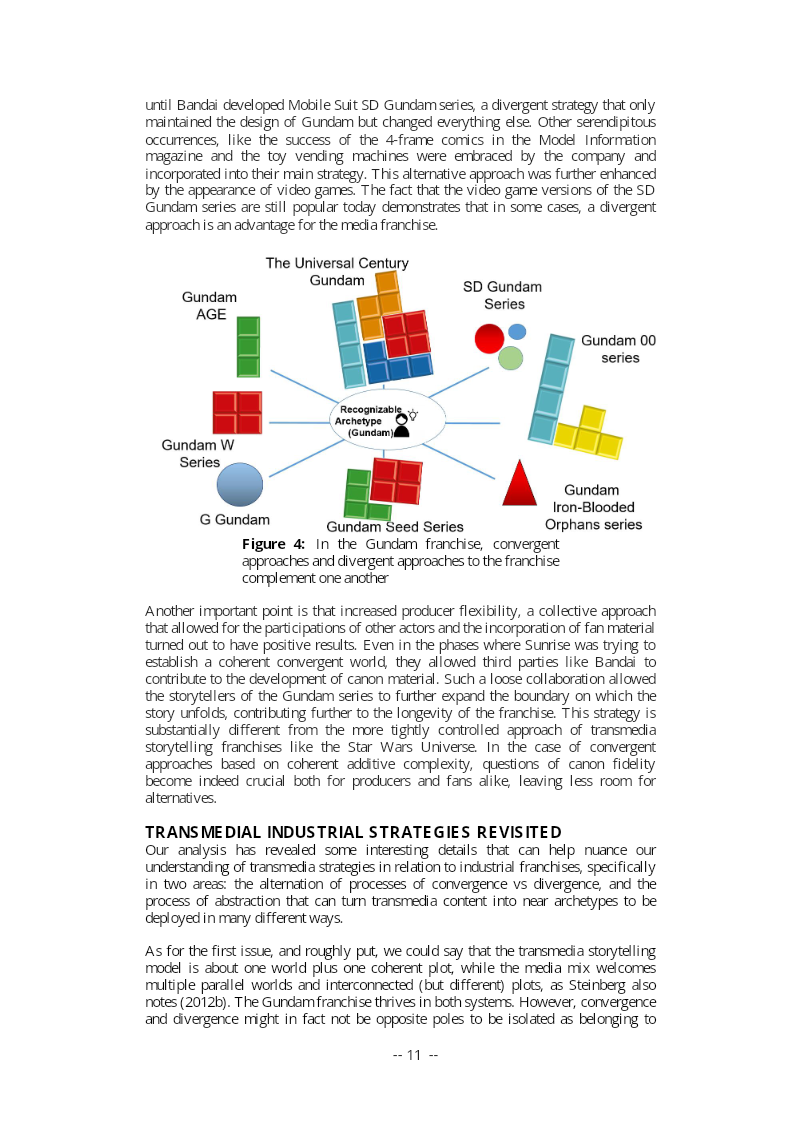
The Mobile Suit Gundam franchise exemplifies a sophisticated application of transmedia storytelling and the Japanese media mix, demonstrating how a blend of convergent and divergent strategies has driven its enduring success.
- The Gundam franchise, starting with a 1979 Japanese TV anime shaped by sponsor-driven toy marketing, was cancelled early after weak ratings and revived through Bandai's scale-model line.
- The authors argue that convergent transmedia strategies (a single continuous timeline across anime, OVAs, and novels) and divergent media-mix strategies (reinterpreting the property in new forms) are complementary rather than opposed.
- The balance between convergence and divergence shifts over a franchise's life: convergence builds a dedicated core audience early, while divergence later adds variety and reaches new demographics.
Beyond Procedurality: Situating The Witness in the Proceduralism Debate
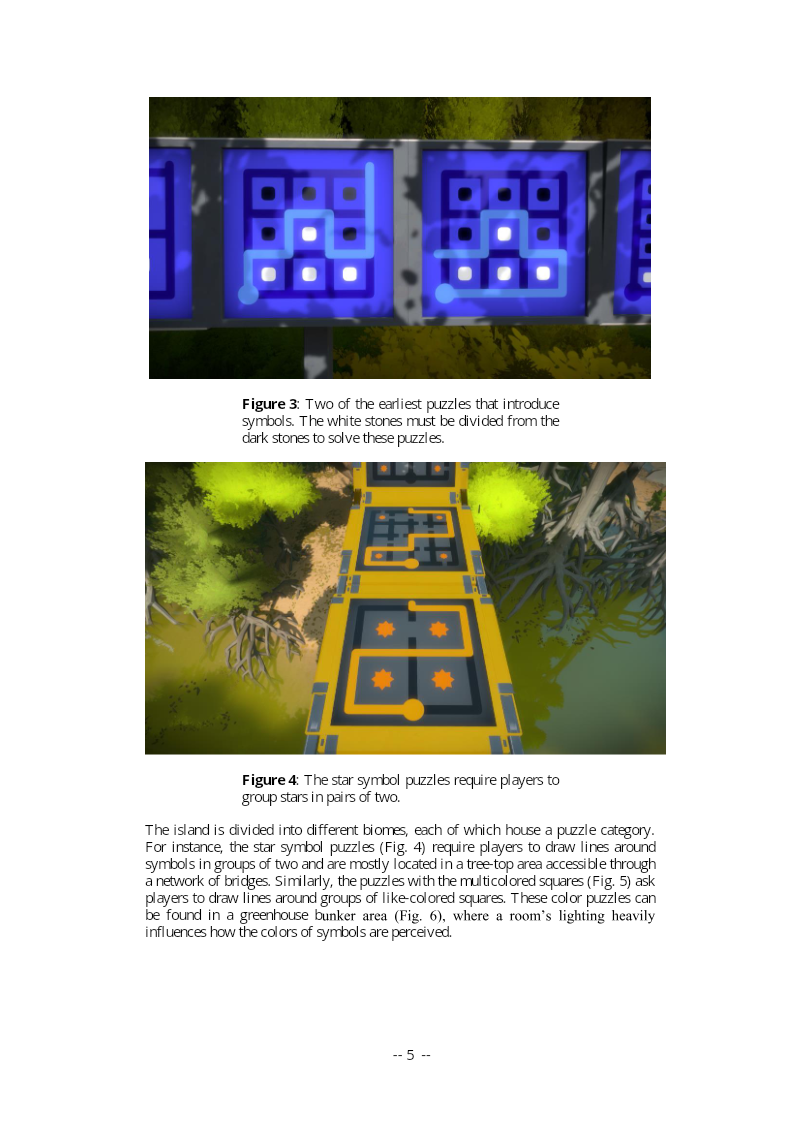
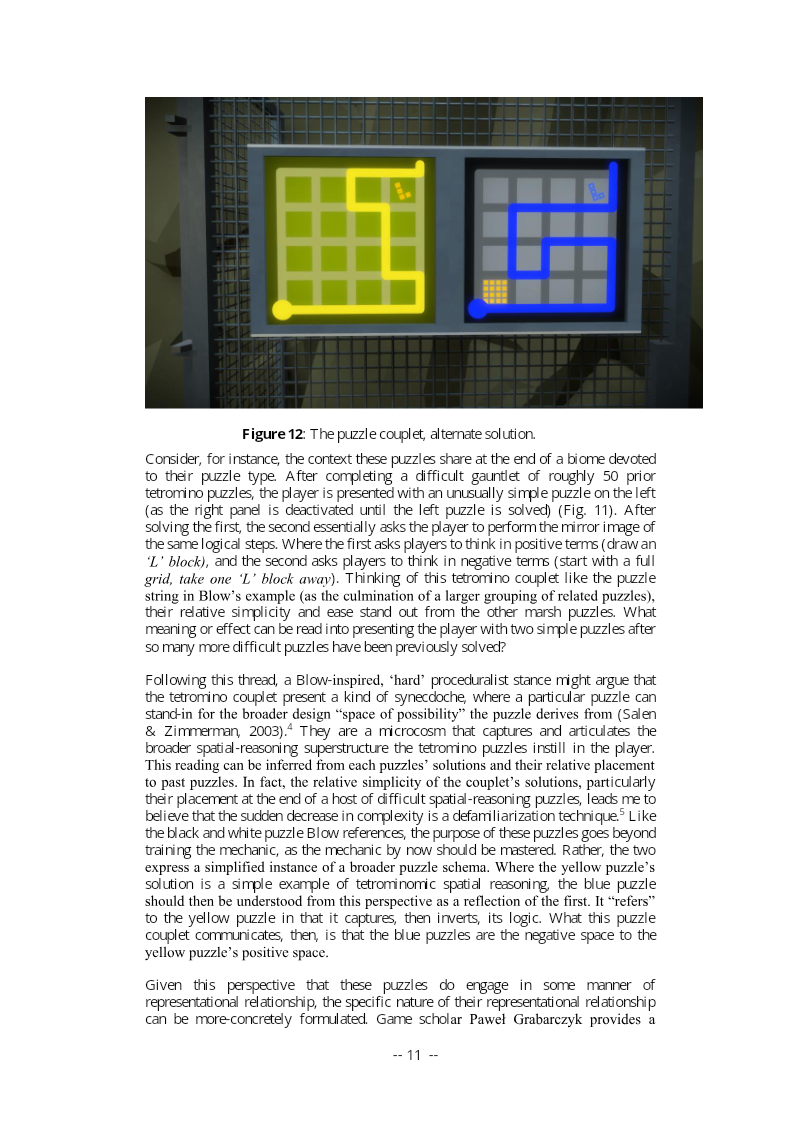
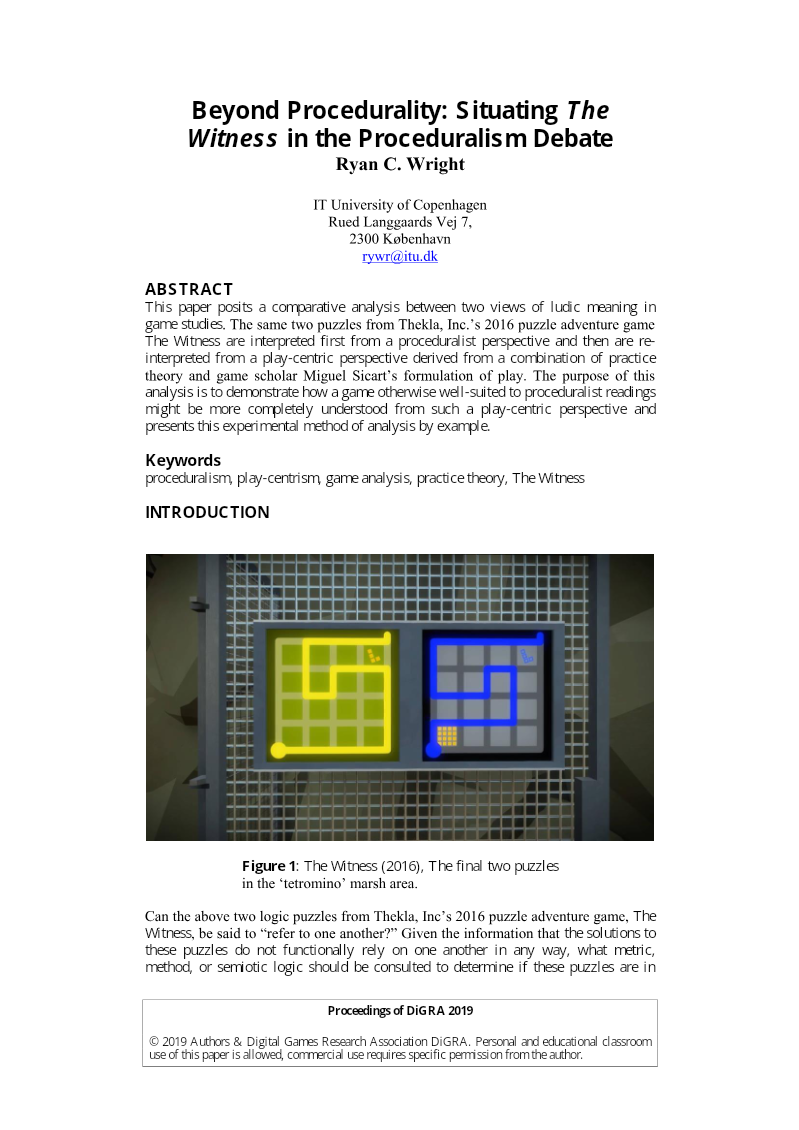
The analysis "Beyond Procedurality: Situating The Witness in the Proceduralism Debate" undertakes a comparative examination of ludic meaning, specifically using two puzzles from the game The Witness.
- Ryan C. Wright argues that the proceduralist framework for analysing video game meaning, associated with Ian Bogost, Mike Treanor, Michael Mateas and Jonathan Blow, is productive but incomplete.
- Drawing on Miguel Sicart and Catherine Bell's practice theory, Wright contends that the meaning of puzzles includes a habituated, personal and creative domain that formal rules cannot fully capture.
- The paper proposes a layered analytical approach in which formal rule analysis and play-experience analysis together account for ludic meaning, extending rather than replacing proceduralist readings.
Different Frames of Players and the Motivation of Prosocial Behaviors in Digital Games
This study explores the influence of player "frames"—interpreting a game as a rule-based system (player frame) versus an immersive world (character frame)—on motivations for prosocial behaviors within digital games.
- Empathy is a consistent predictor of in-game helping toward both non-player characters (NPCs) and player characters (PCs), mirroring real-world prosocial behavior.
- The frame players adopt (character-player versus player-player) largely does not change their emotional response, but it shapes the stated reasons for helping: character-players cite in-game events, rewards, and cooperation, while player-players emphasize game progression and concern for the human behind the avatar.
- Emotional empathy predicts helping toward PCs for both frame groups, but the effect is significantly stronger among character-players, as shown by a significant Frame × Emotional Empathy interaction.
Male and Female Game Players' Preferences for Game Characters and Real-world Personalities in Japan
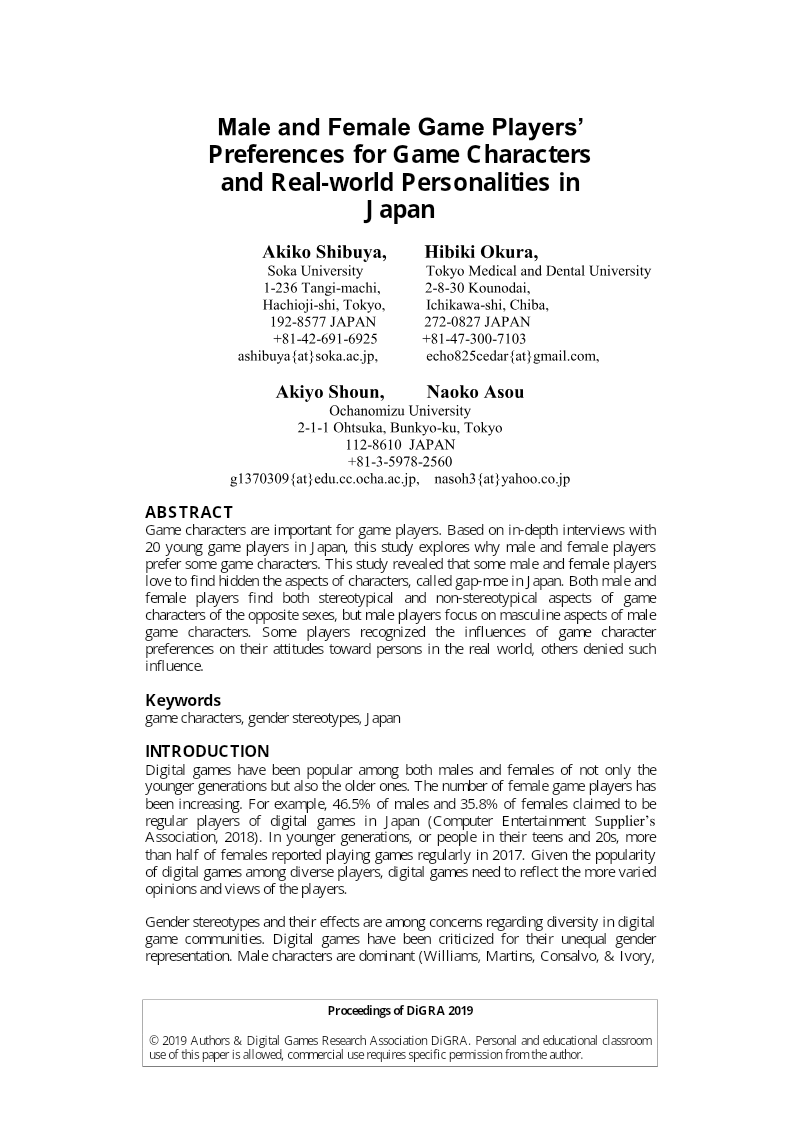
This study explores the preferences of young Japanese game players for game characters and real-world personalities, drawing insights from interviews with 20 individuals.
- Japan ranked 110th of 149 countries on gender equality in 2018, the context against which the study frames persistent underrepresentation of female characters in games.
- The study used qualitative interviews with 20 young Japanese players, evenly split between men and women, so its findings are not generalizable.
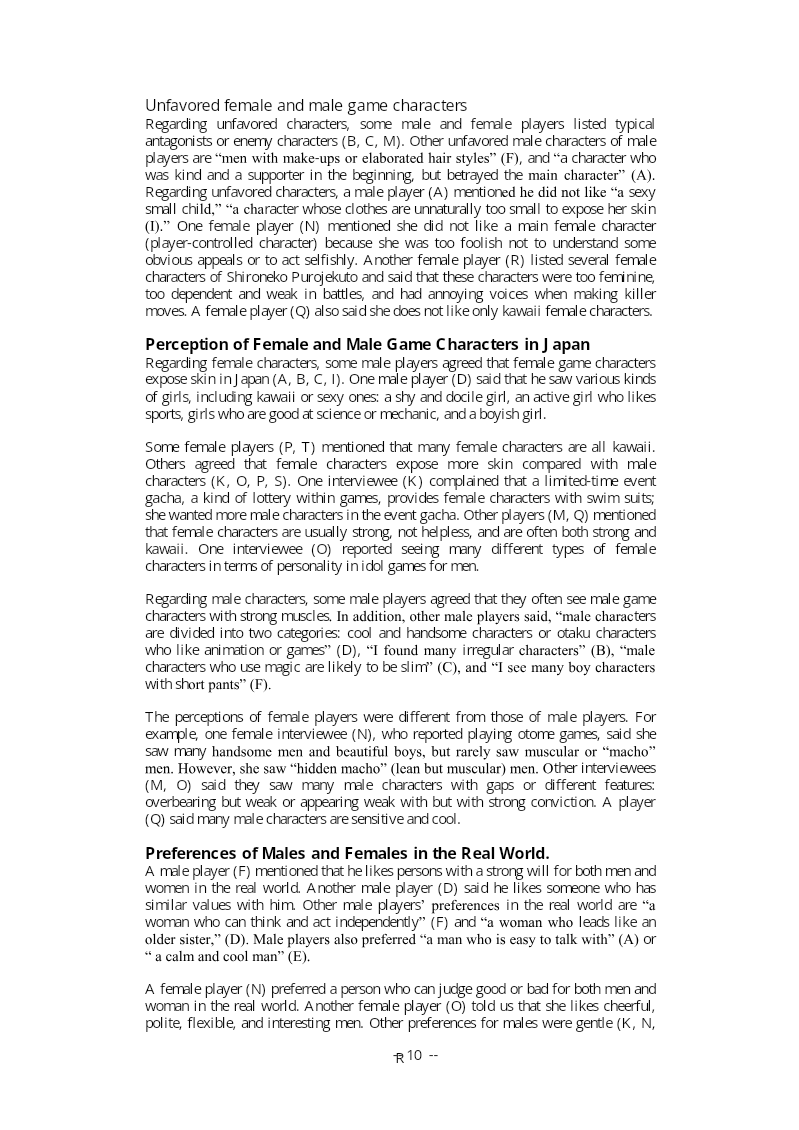
- Male players tended to prefer female characters combining feminine traits (kindness, caregiving, modesty) with masculine qualities (mental strength, coolness), while female players favored male characters with hidden depth, vulnerability, or humane qualities that often blended masculine and kawaii features.
Do you work at DiGRA? Get a free report of how these documents are read and cited here.