
DiGRA
The Digital Games Research Association: the international association of academics and professionals who study digital games. Its Digital Library holds the proceedings of the DiGRA conferences since 2002.
Documents
Romance Never Changes…Or Does It?: Fallout, Queerness, and Mods
Howard argues that the Fallout series has treated queerness shallowly and heteronormatively across its history, and that fan modding has become the primary means of correcting this.
- Kenton Howard argues that Fallout 4 permits same-sex romance but reduces companions' sexuality to a player-selected option through shallow mechanics and visuals, reinforcing heteronormativity.
- Fallout 4's romance system treats all companions identically, rewards heterosexual pairings with additional perks, and defaults its imagery to a straight male player in a heterosexual marriage.
- Critical reception ranges from praise for the expanded romance options to dismissal of queer relationships as evidence of developer laziness rather than meaningful engagement with queer experience.
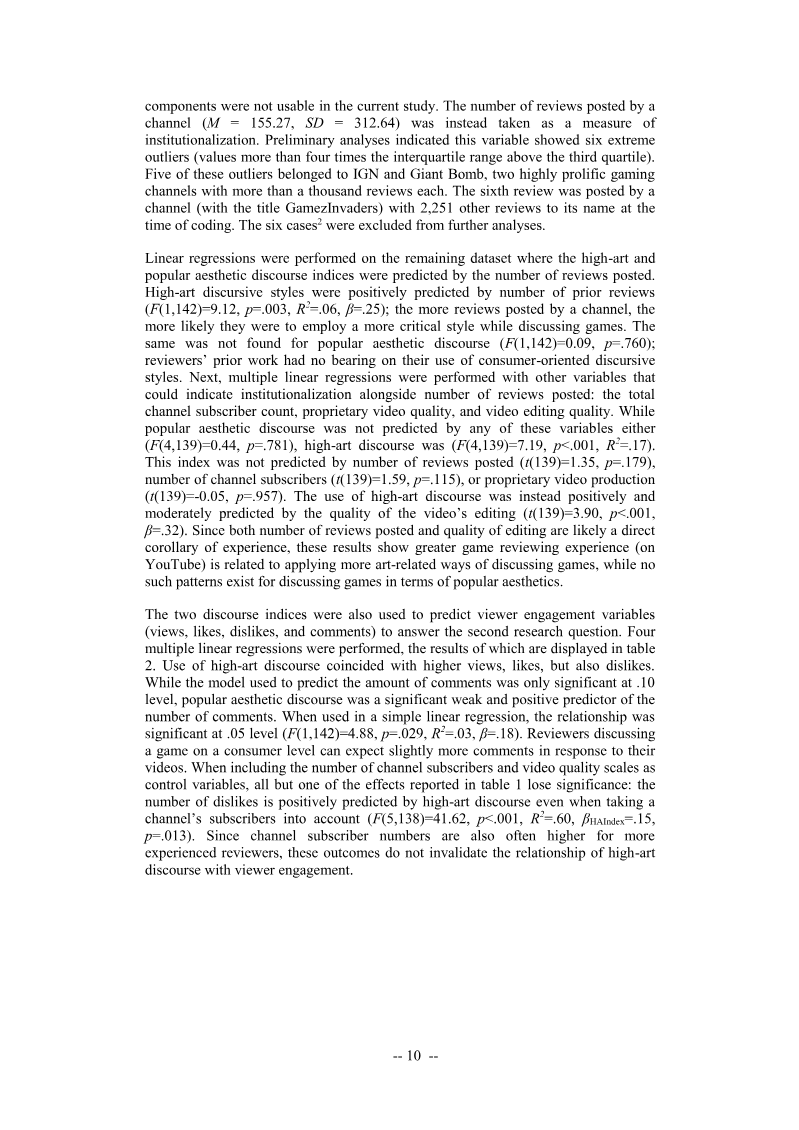
Discourse at Play: Construction and Professionalism of Video-Based Game Reviews
"Discourse at Play: Construction and Professionalism of Video-Based Game Reviews" investigates the discursive styles employed in YouTube video game reviews and their implications for the professional/consumer critic dichotomy.
- Video game reviews on YouTube partly mirror traditional professional-critic styles, but consumer-oriented reviews do not follow the discursive patterns documented for film and other established media.
- Factor analysis of 28 discourse items identified two dimensions, a high-art factor and a popular aesthetic factor, with first-person perspective and personal playing experience each appearing in 93% of reviews.
- Among 150 randomly sampled reviews of 2016 and 2017 releases, reviewers using high-art discourse tended to have posted more videos and produced better-edited content, while popular-oriented discourse showed no comparable relationship.
Polygonal Modeling: The Aestheticization of Identity
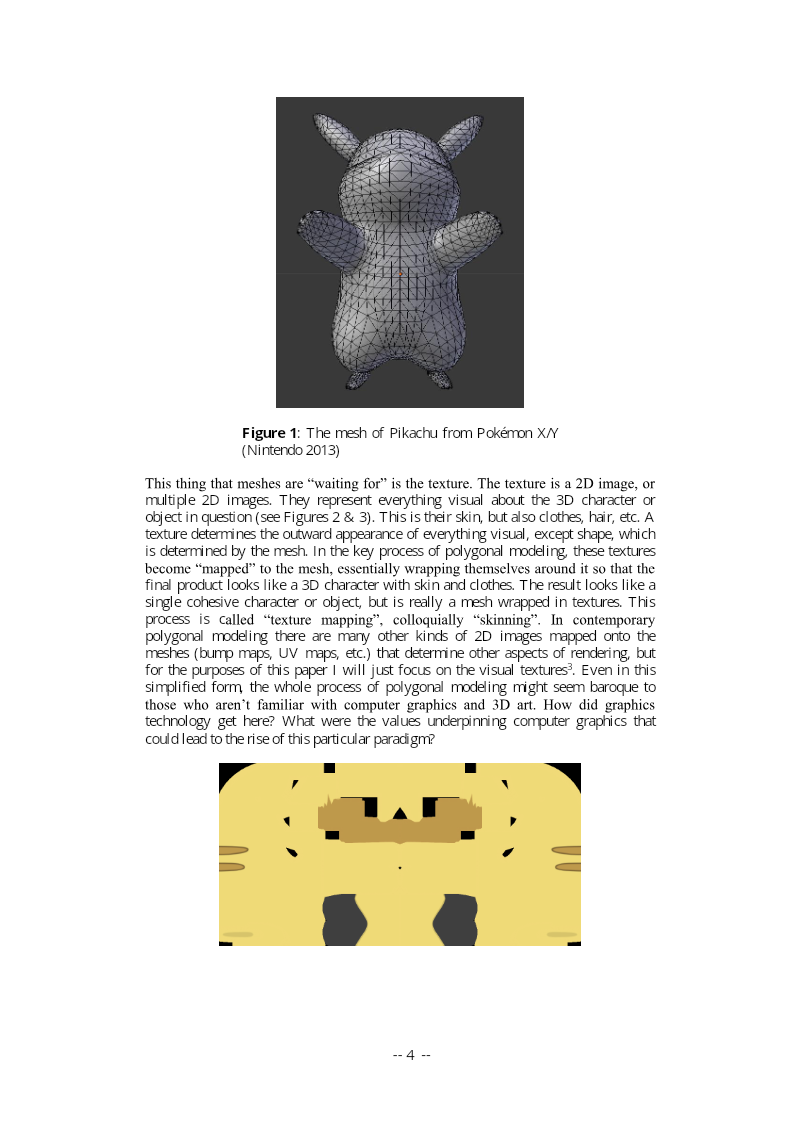
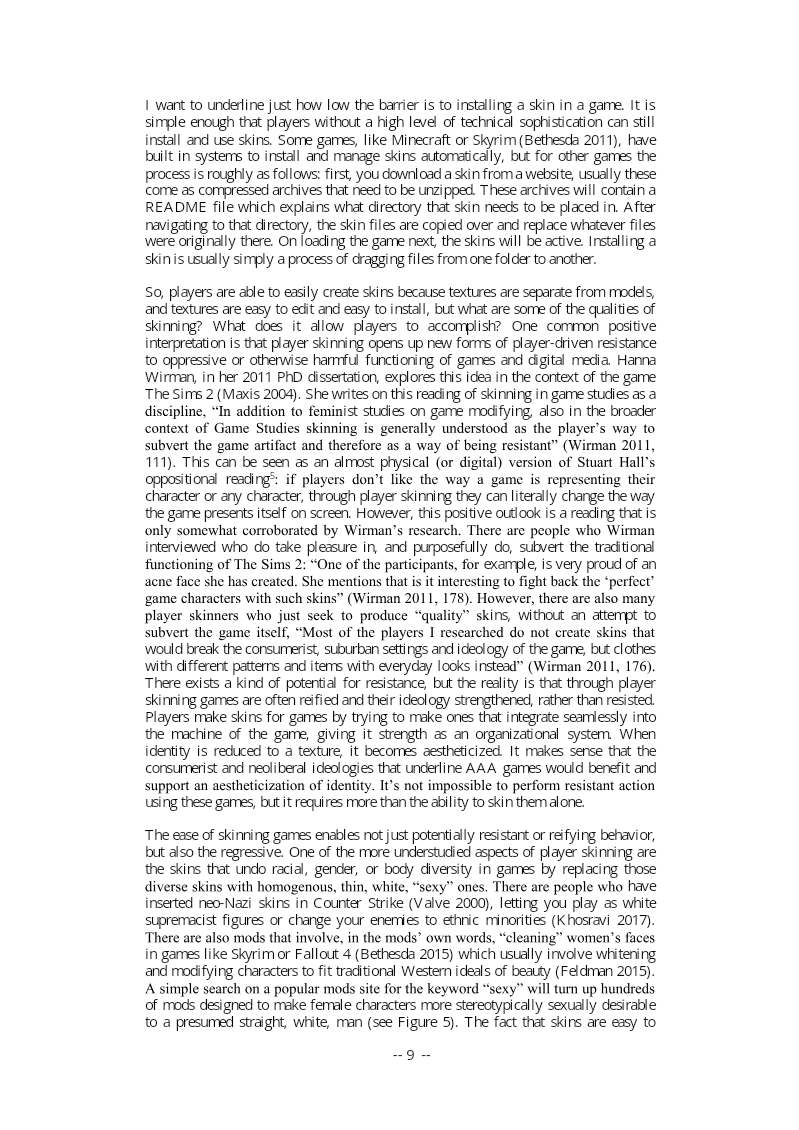
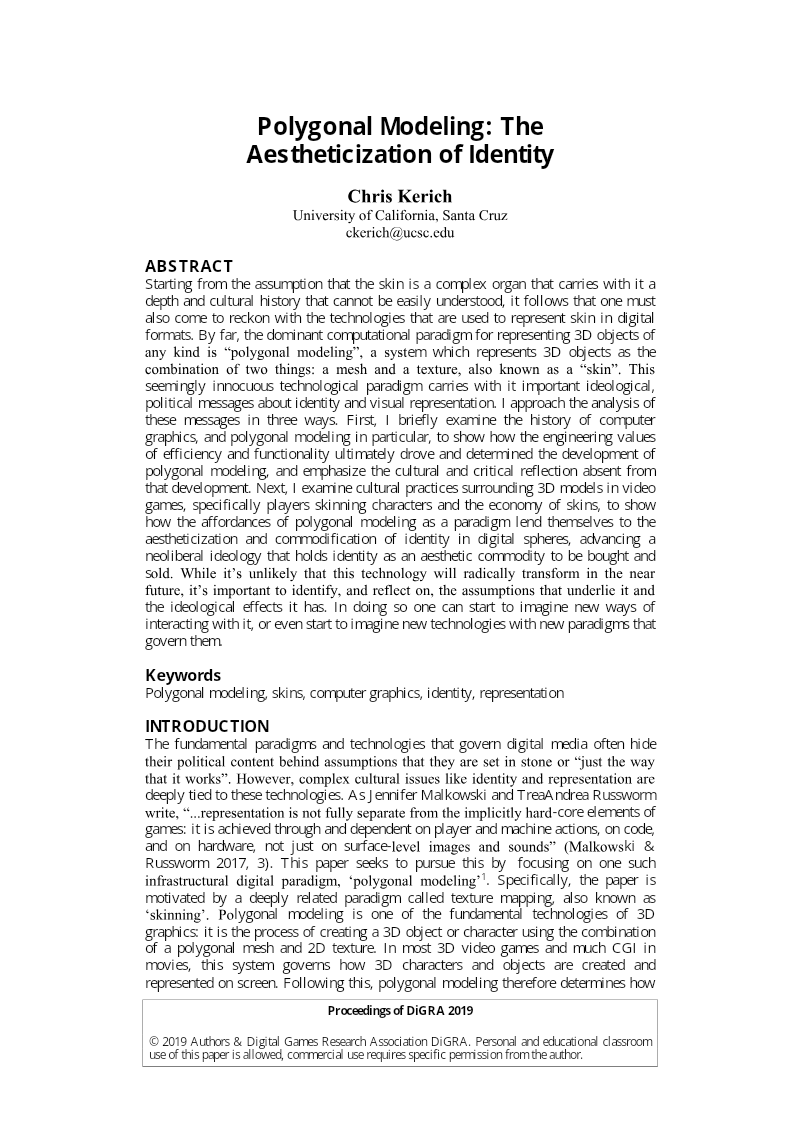
The document, "Polygonal Modeling: The Aestheticization of Identity," asserts that polygonal modeling, the prevailing method for digital 3D object representation, fundamentally shapes how identity is constructed and commodified within digital spaces, particularly in video games.
- The paper argues that polygonal 3D modeling, which wraps a mesh in a detachable skin texture, embeds reductive assumptions about identity and the body that originate in engineering culture's prioritization of functionalism, efficiency, and capitalist rationalism.
- Separating mesh from texture mirrors engineering's 'interchangeable parts' principle, making player skinning easy and reducing identity to surface, which the author links to the commodification of selfhood under a neoliberal view of identity as something to be bought and sold.
- Drawing on Wirman's research, the analysis finds that skinning enables resistant, reifying, and regressive uses alike, with regressive examples including neo-Nazi modifications and 'sexy' mods that homogenize diverse character representations.
A Typology of Rumble
Willumsen and Jaćević argue that rumble is an overlooked component of digital games, receiving little focused research because haptics lacks the established signification systems found in visuals and audio.
- Controller rumble has been ubiquitous in digital games since the late 1990s but remains overlooked in game studies and design literature, which has focused more on haptics in virtual environments and exergames.
- The study's empirical base is nine single-player action and adventure titles spanning the PlayStation 1 through PlayStation 4 generations, analysed through close play and extended sessions rather than player-response data.
- The central contribution is a two-dimensional typology classifying rumble by feedback source (environment, object, interface, or body, with body subdivided into kinaesthetic, physiological, and extrasensory) and by level of operation (ludic, dramatic, or technical), drawing on semiotic denotation and connotation.
Exploring the Effects of VR Gameplay Videos on Performance and Experience
The study examines the indirect impact of watching virtual reality (VR) gameplay videos on player performance and overall experience.
- Watching a three-minute first-person VR gameplay video significantly improved performance in the study: viewers scored a mean of 2.00 gadget (secondary-weapon) kills versus 0.38 for controls (p < .01).
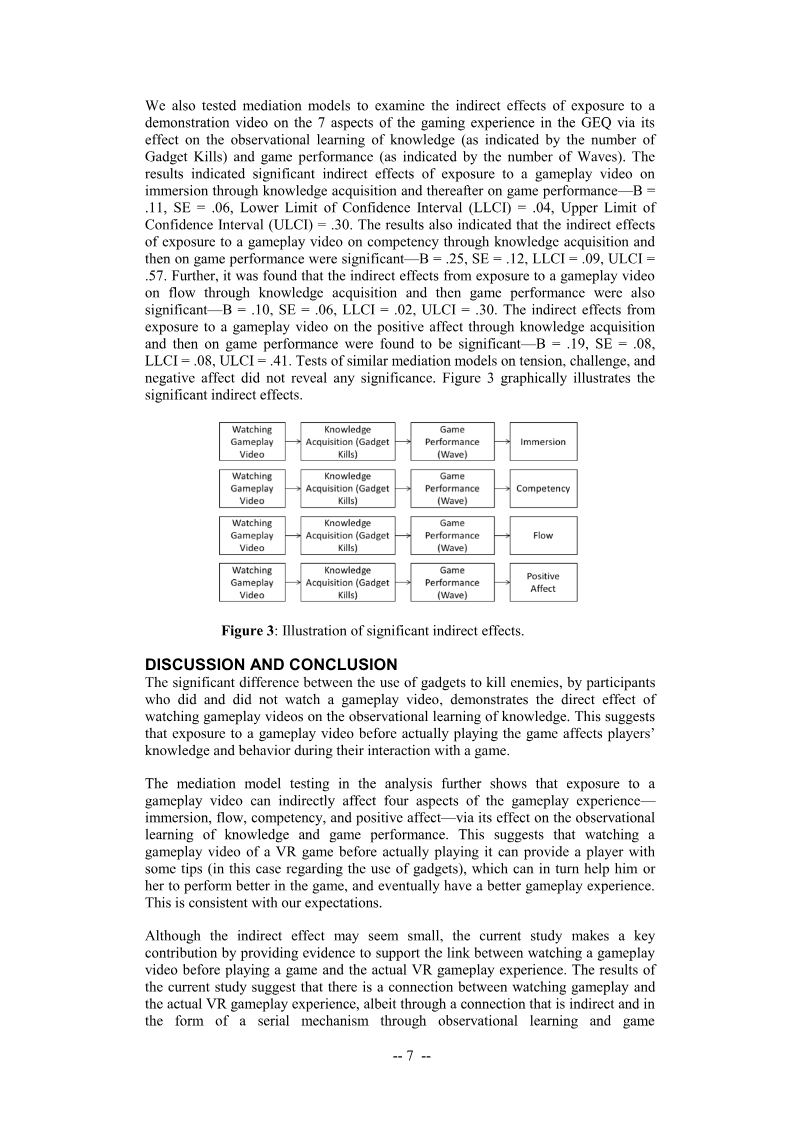
- Video exposure produced no direct effect on the seven measured aspects of game experience, but mediation analysis showed it indirectly enhanced immersion, competency, flow, and positive affect via knowledge acquisition and better in-game performance.
- Motor-skill learning, tension, challenge, and negative affect showed no significant indirect effects from watching the video, suggesting observational learning transferred knowledge more than physical skill.
The Relationship between Prior Gaming Experience and Consciousness of Computer Programming or Social Views on Information: An Empirical Study of High School Students in Japan
This empirical study examines the relationship between prior gaming experience and high school students' consciousness of computer programming and social views on information in Japan.
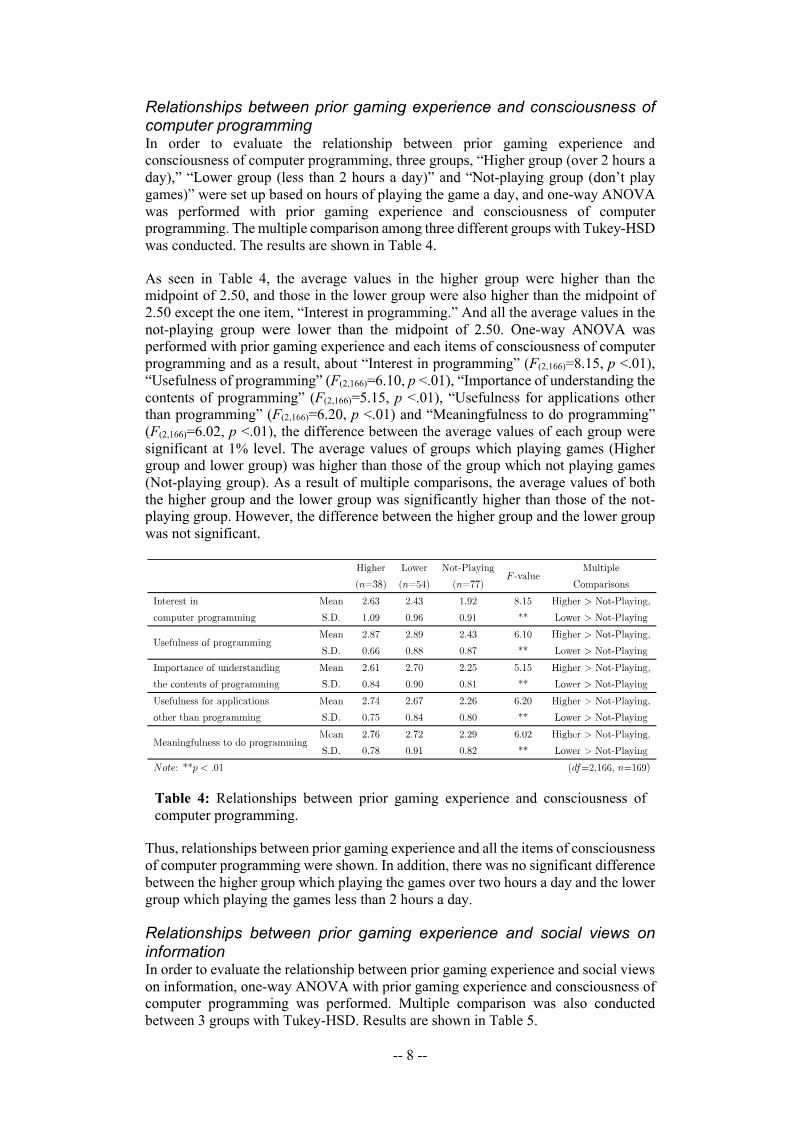
- A 2016 survey of 169 first-year Japanese high school students found that those who reported playing games, especially for more than two hours daily, showed significantly greater consciousness of programming than non-players.
- Heavier and lighter gamers did not differ significantly from each other; the difference lay between players and non-players rather than in the amount of play.
- Programming-consciousness and social-views items were positively and significantly intercorrelated (p < .01), with seventeen relationships exceeding 0.40.
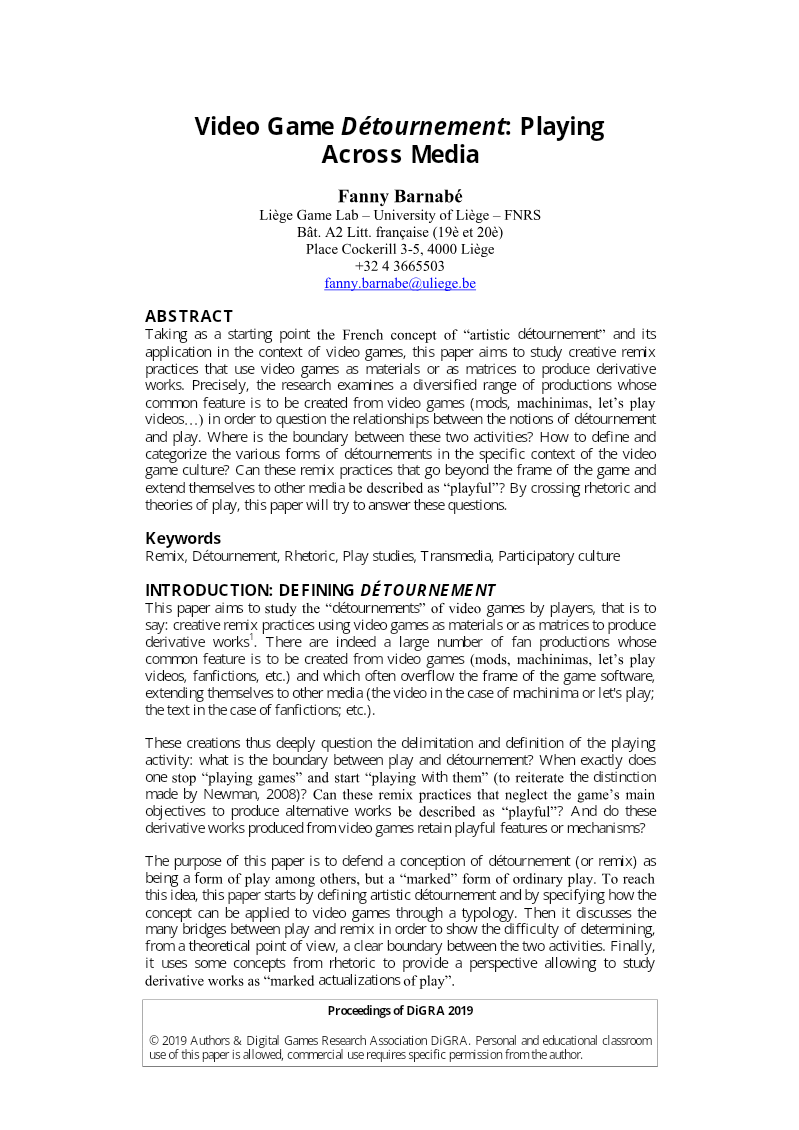
Video Game Détournement: Playing Across Media
The analysis, "Video Game Détournement: Playing Across Media," investigates the phenomenon of creative remix practices within video games, termed "video game détournement."
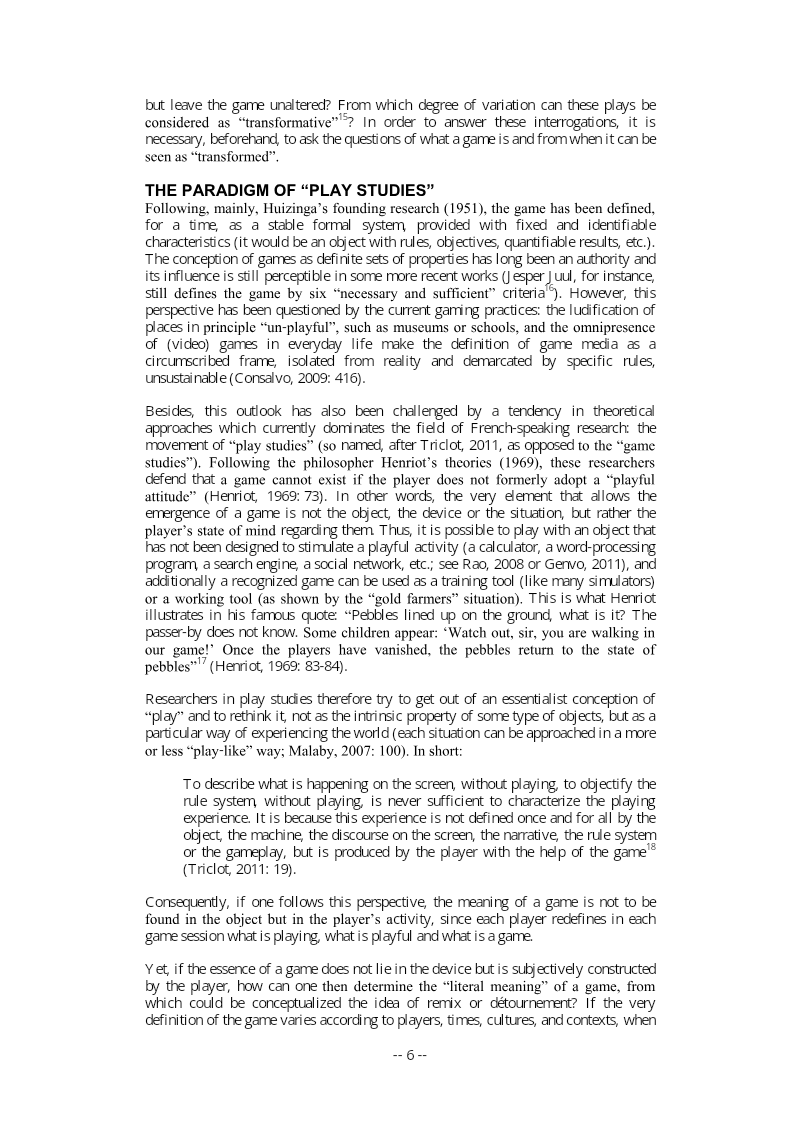
- Fanny Barnabé's paper treats video game détournement (mods, machinima, let's play videos, speedruns, fanfiction) as a marked form of ordinary play rather than a separate activity.
- The paper distinguishes two modes: "détournement of the game," which modifies the game object itself (e.g., Kaizo Mario World hacks), and "détournement by playing," which transforms meaning through performance (e.g., the Halo machinima This Spartan Life).
- Its central thesis is that the boundary between playing and remixing is theoretically hard to fix, and both can be understood through the player's playful attitude rather than the game as a stable formal system.
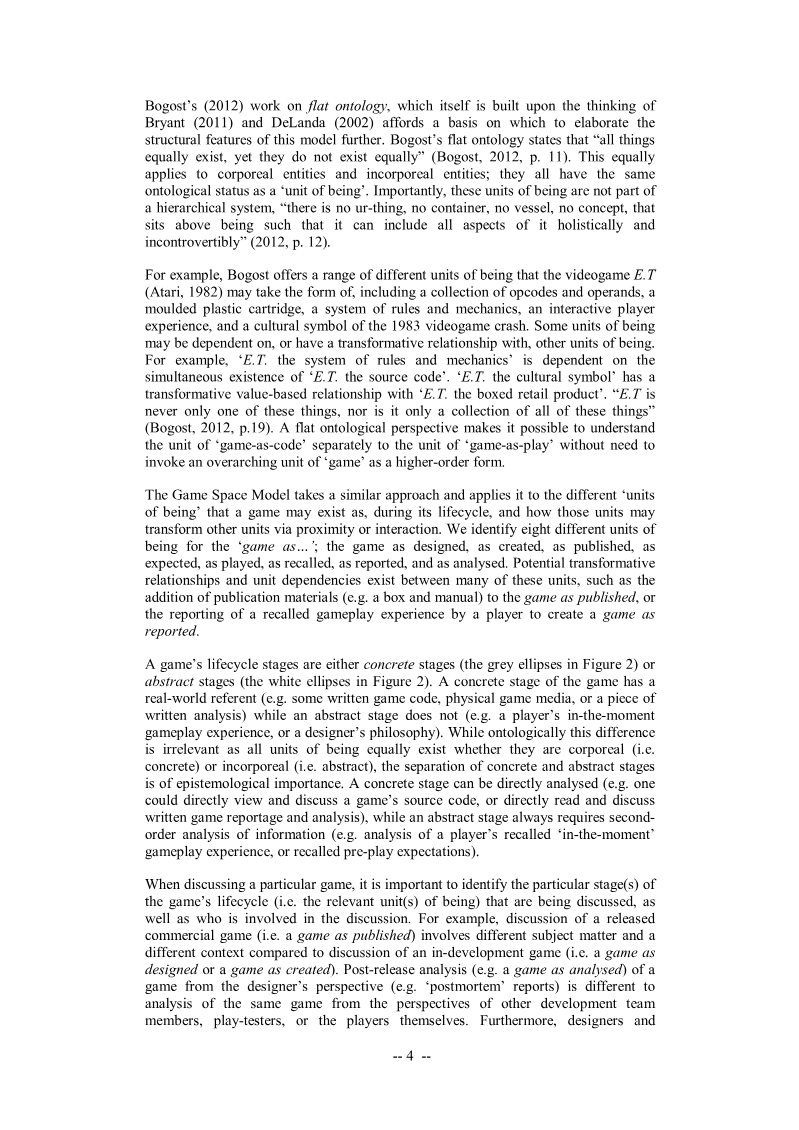
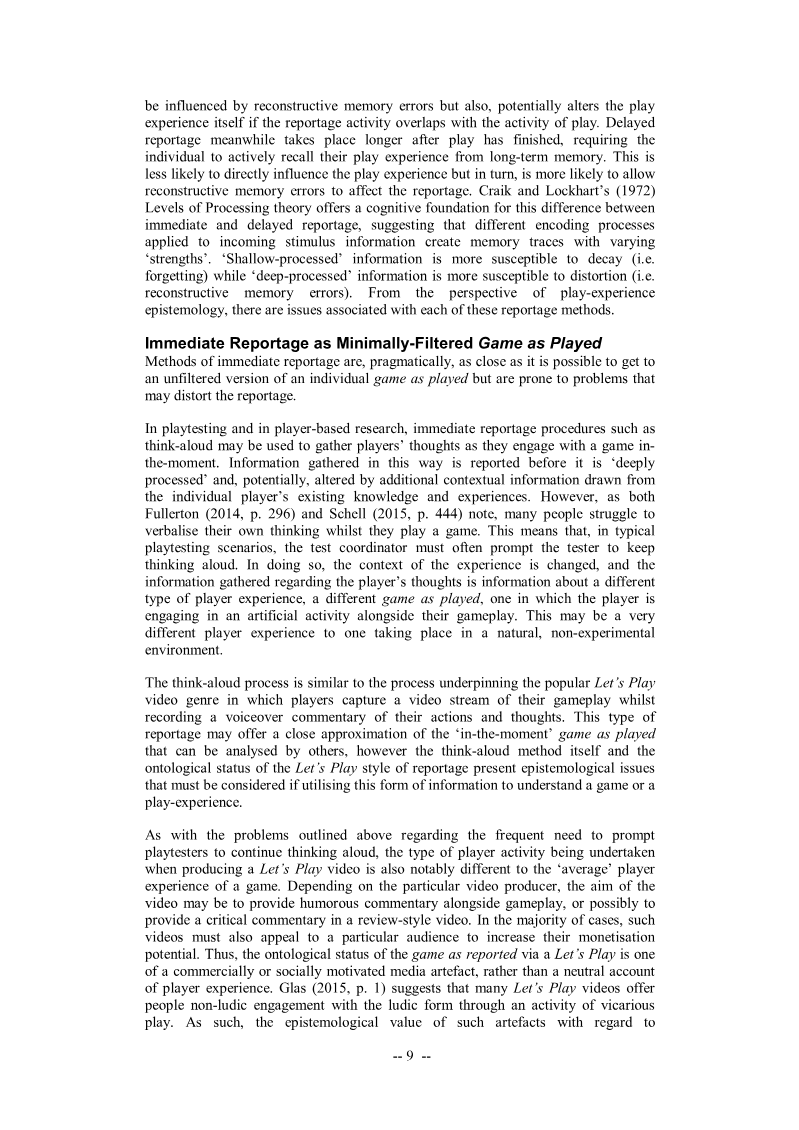
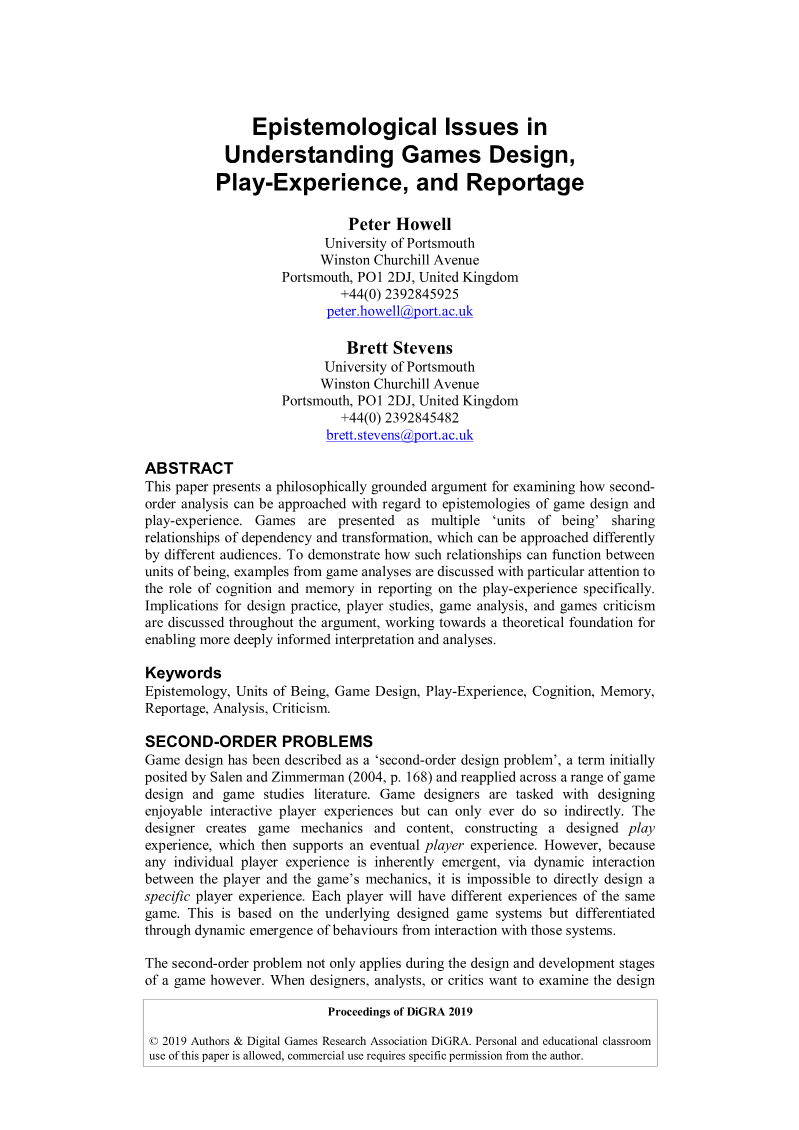
Epistemological Issues in Understanding Games Design, Play-Experience, and Reportage
The document, "Epistemological Issues in Understanding Games Design, Play-Experience, and Reportage," primarily aims to address the inherent challenges in accurately understanding and analyzing game design and player experience.
- Designing and analysing games are both 'second-order' problems: designers only indirectly shape player experience, and analysts can reach in-the-moment play only through reconstructive, error-prone memory and reportage.
- The authors propose a flat-ontology 'Game Space Model' in which a game exists as multiple linked 'units of being' (designed, created, published, expected, played, recalled, reported, analysed), and argue that critics and designers must specify which unit they mean.
- A mismatch between player expectations and actual gameplay tends to produce strongly negative post-play criticism, as seen with Amnesia: A Machine for Pigs, Brütal Legend, and No Man's Sky.
Towards an Analysis of Virtual Realism
The document undertakes a philosophical analysis of "virtual realism" within videogames and related media, aiming to provide a more robust theoretical framework for a concept often understood intuitively but lacking rigorous definition.
- The term "virtual realism" is ambiguous and should be decomposed into five distinct senses (immersion, psychological realism, depictive realism, ontological realism, and functional realism), each requiring separate evaluation rather than collapse into one notion of immersive realism.
- Immersion, the most common framing in VR discussions, is primarily attentional rather than a form of realism: it can exist without realistic content, as in the non-realistic puzzle game Tumble VR, and realism can disrupt it, as in Resident Evil 7.
- Psychological realism, drawing on the "virtual pit" experiment and reports of spatial presence, may be the predominant form of realism experienced in VR, and it does not depend on graphical fidelity.
Strategies for Endogenous Design of Educational Games
The document, "Strategies for Endogenous Design of Educational Games," addresses a critical gap in educational game development by proposing a structured system of design strategies aimed at fostering endogenous learning, where gameplay inherently integrates and emerges from the educational content.
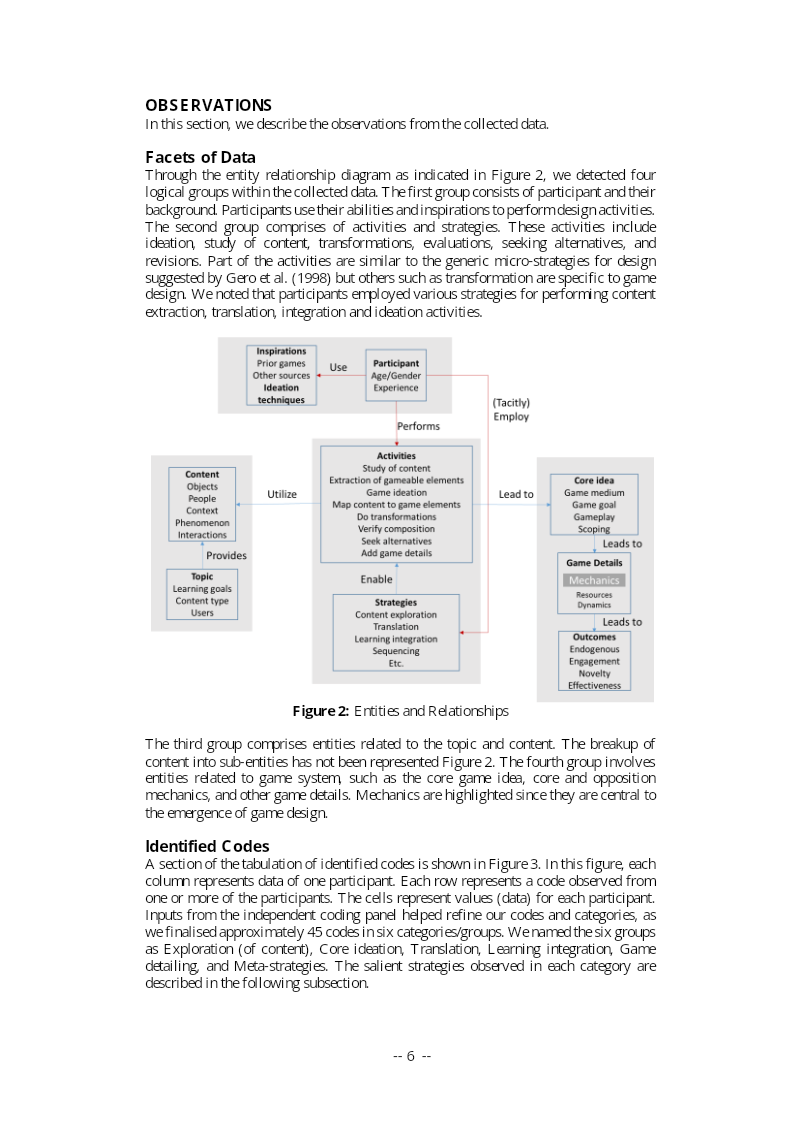
- Endogenous educational game design means embedding learning content directly into gameplay mechanics rather than attaching it externally, and this study aims to extract the tacit strategies experienced designers use to do so.
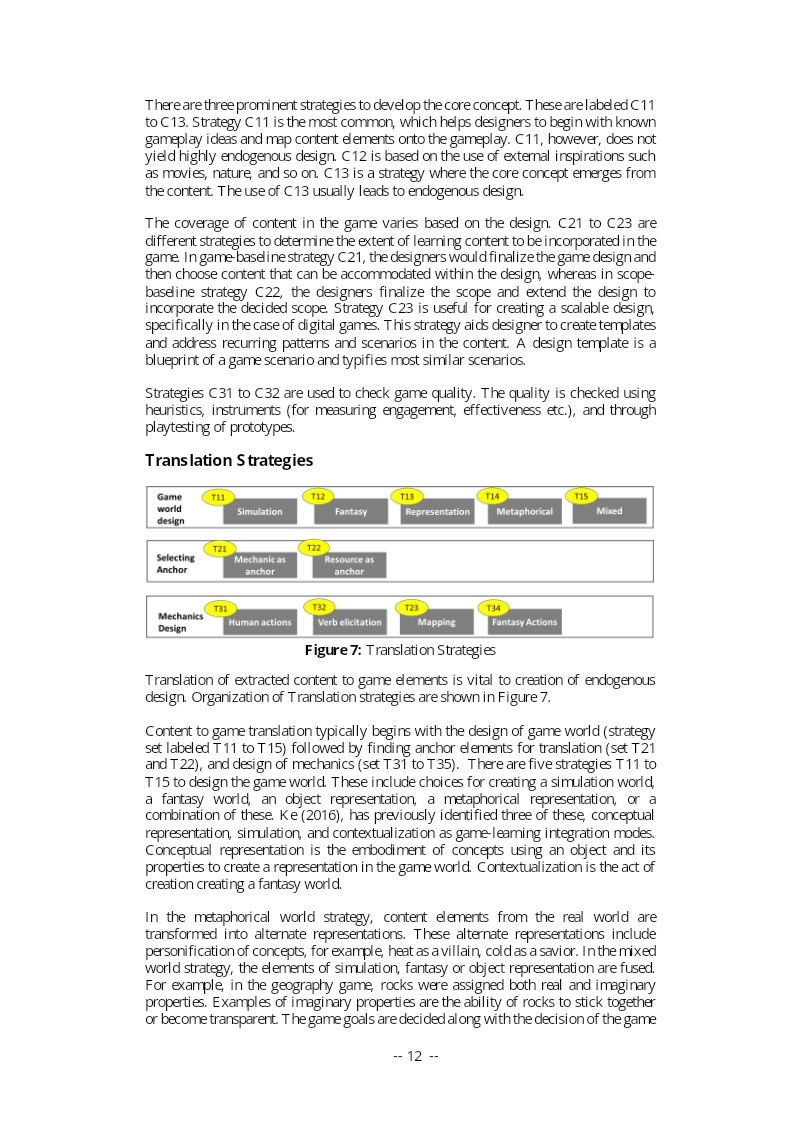
- Analysis of ten designers across twelve in-situ sessions (six middle-school topics, grades 6-9) produced roughly 45 codes organized into six strategy categories: content exploration, core ideation, translation, learning integration, game detailing, and meta-strategies.
- Novices favored original design approaches while experts favored structural similarity to existing game systems, and mechanics were the most common anchor for content.
On the De-Familiarizing and Re-Ontologizing Effects of Glitches and Glitch-Alikes
The document examines the profound impact of glitches and "glitch-alikes"—intentionally designed anomalies—within digital experiences, particularly video games, on user perception and worldview.
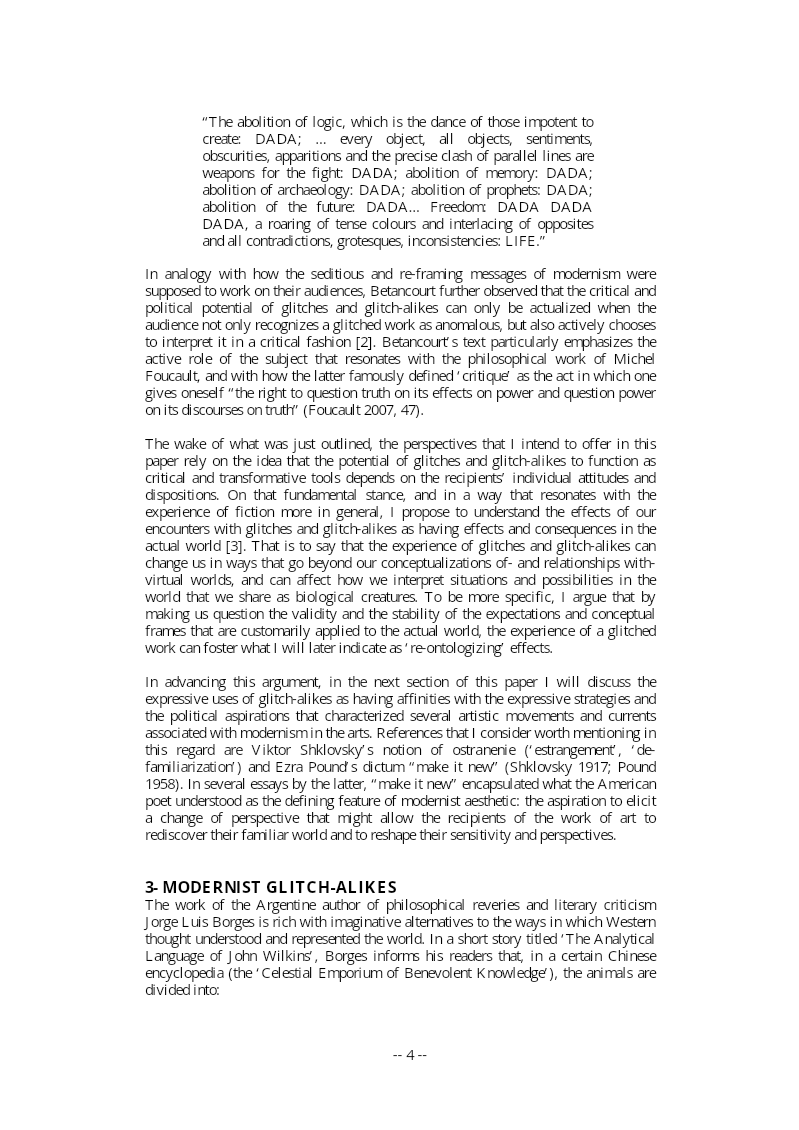
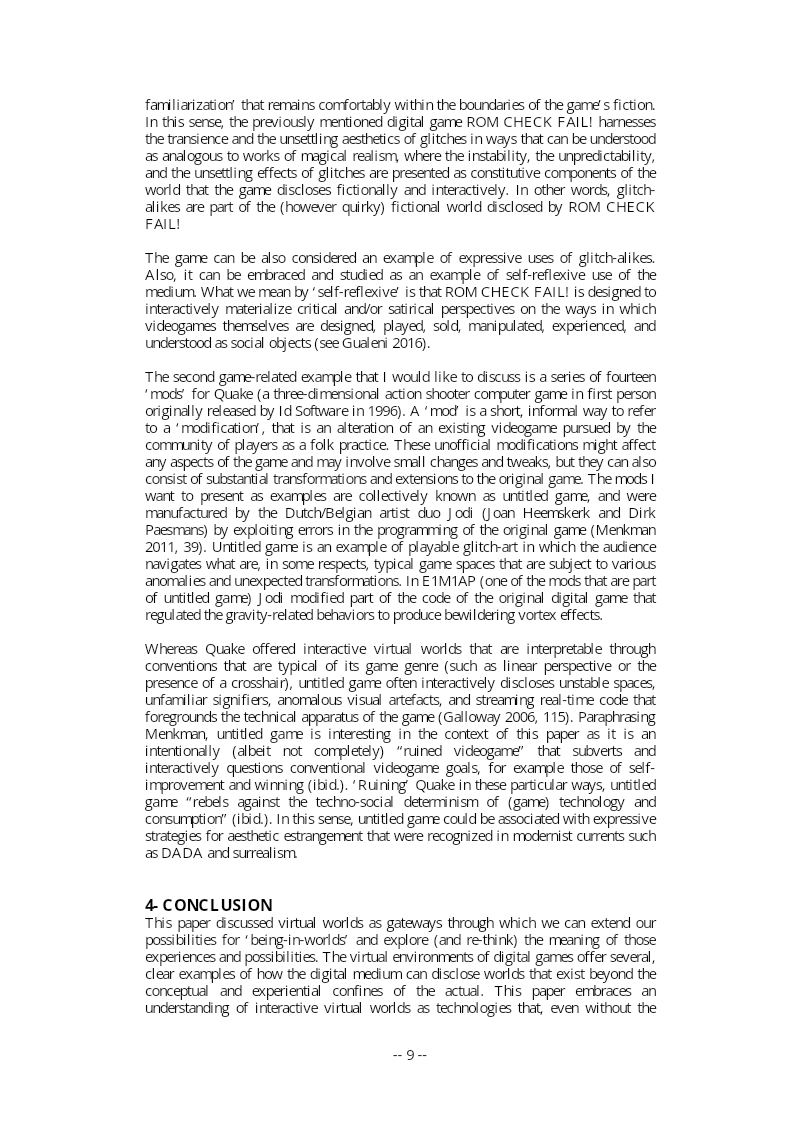
- The report's central thesis is that glitches and deliberately fabricated glitch-alikes can defamiliarize digital experience and prompt critical reflection that extends to how people perceive the actual world, a process the author calls "re-ontologizing."
- The analysis is grounded in modernist and DADA traditions, Shklovsky's concept of ostranenie, and literary currents from Borges to magical realism, positioning glitch-based works as heirs to modernist defamiliarization.
- The argument is primarily theoretical, and its critical potential depends on the active interpretive stance of the audience rather than on the glitch alone.
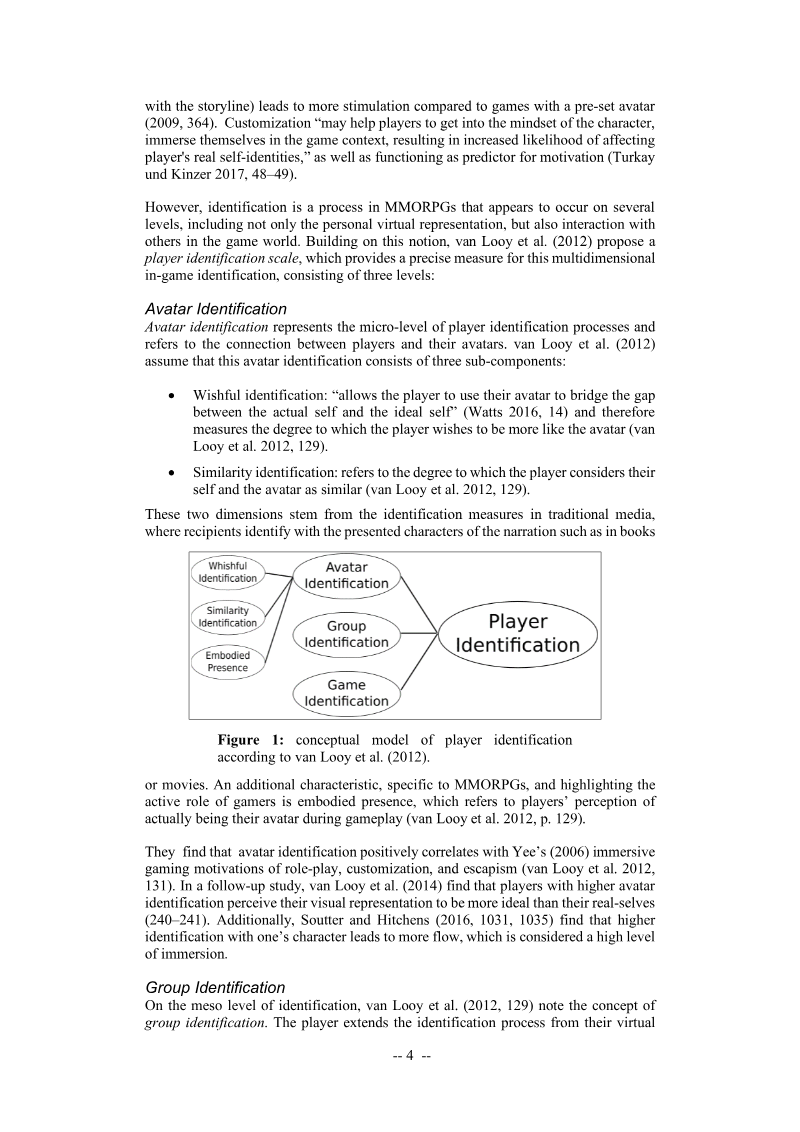
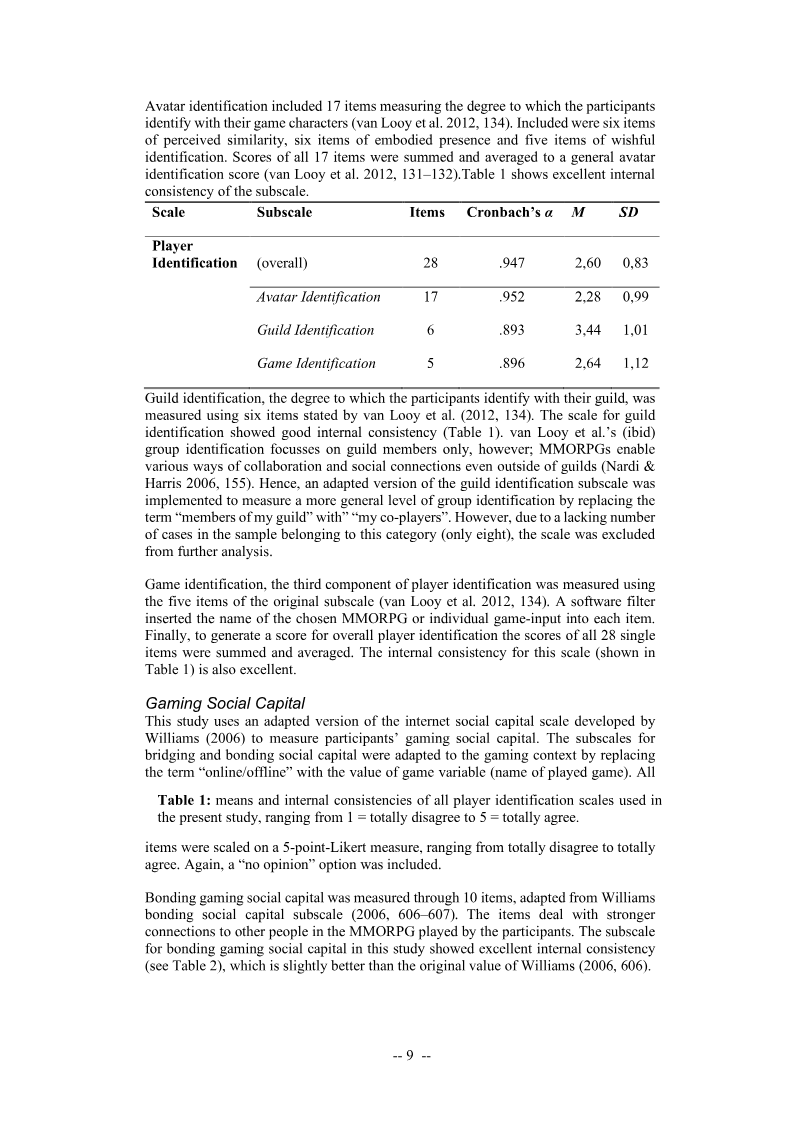
Me, Myself and Others: Connecting Player Identification to Gaming Social Capital
The study, "Me, Myself and Others: Connecting Player Identification to Gaming Social Capital," examines the relationship between various forms of player identification and the development of social capital within massively multiplayer online role-playing games (MMORPGs).
- Player identification correlates strongly and positively with overall gaming social capital among 339 adult German-speaking MMORPG players (Spearman's ρ = 0.59, p < .001).
- Avatar identification is linked to bridging social capital (numerous weaker ties) with ρ = 0.46, while guild identification is linked to bonding social capital (strong ties) with ρ = 0.56.
- The authors argue that time-based measures such as play frequency fail to capture the social dynamics that matter in MMORPGs, and that identification better explains social outcomes.
Do you work at DiGRA? Get a free report of how these documents are read and cited here.