1 free read left. Create a free account for unlimited reading + AI research.
Create free accountReport DiGRA
1 free read left. Create a free account for unlimited reading + AI research.
Create free accountReportDiGRA
Most entered gaming at comparable ages, often via family-shared consoles from Nintendo and SEGA. Most share largely the same core motivations.
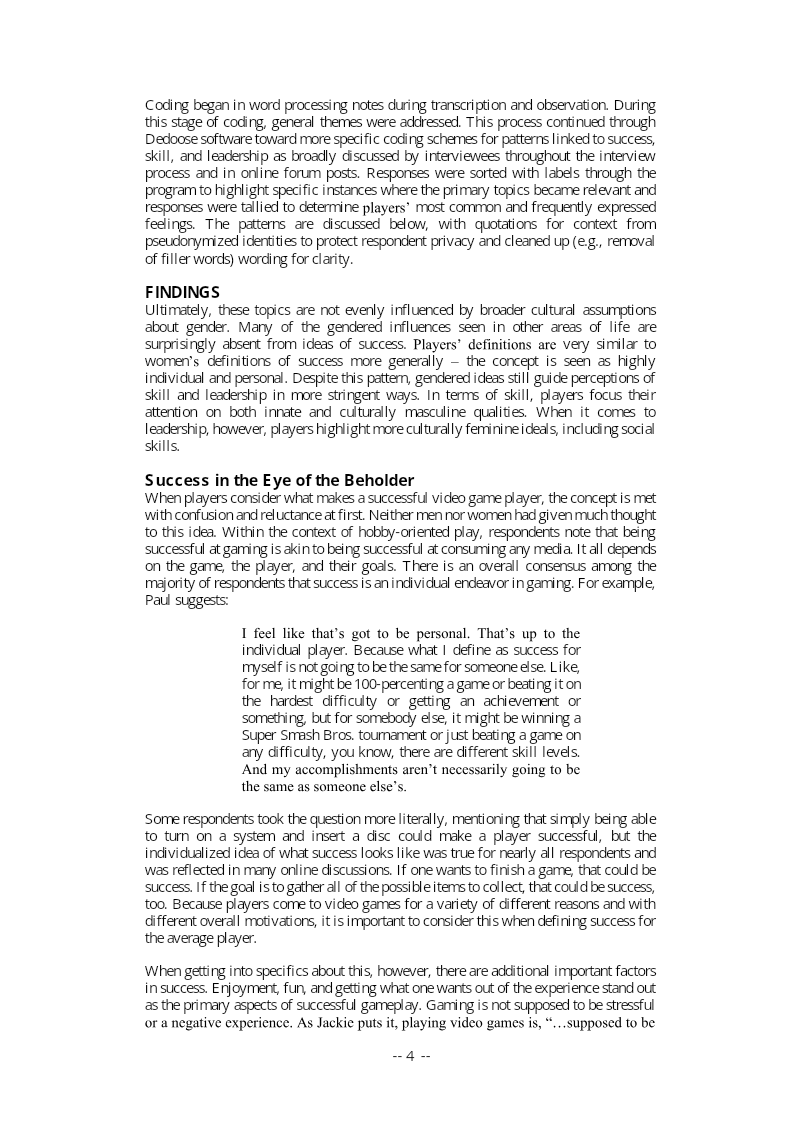
This study examines how adult video game players differ, and how they resemble one another, across gender and genre. Drawing on 54 interviews and analysis of online forum discussions, its central thesis is that players are far more alike than earlier research suggested. Most entered gaming at comparable ages, often through family-shared consoles such as those made by Nintendo and SEGA, and most share largely the same core motivations: relaxation, narrative, and overcoming challenges. The authors' qualitative approach, in which terms like "most" and "majority" denote approximate proportions of responses, yields rich insight but limits how far the findings can be generalized beyond this sample.
The most notable gender finding challenges conventional assumptions. While relaxation is the dominant reason players engage with games across the board, men more often describe gaming as a means of maintaining friendships, whereas women's conception of relaxation tends to be less social. Women also more frequently avoid multiplayer play, citing pressure, judgment, and hostility from other players. Forum users more often named male family members as their entry point into gaming, yet early experiences were broadly similar across genders. Genre and personal interests, such as an affinity for reading, proved better predictors of preference than gender did.
Story and immersion emerged as a major factor across the sample, with most players identifying narrative as central to whether they enjoyed or disliked a game. Challenge was similarly valued for self-improvement and the sense of earned achievement, though it became discouraging when difficulty was set too high or too low. Together, relaxation, story, and challenge stand out as the three most consistent motivators regardless of gender.
The study concludes that gender differences in gaming preferences are narrowing and that similarities among players are more striking than their differences, though social pressures in multiplayer environments remain a real barrier for many women. The authors call for future research into how players enter the hobby and industry, particularly why gender gaps persist in professional game development despite the shared interests that unite players.
Each row is a game or company this document names, each column a document, oldest first. A mark means that document names it. Select a row to see those documents.



DiGRA · 2023

DiGRA · 2023



DiGRA · 2023

DiGRA · 2023
DiGRA · 2023



DiGRA · 2023



DiGRA · 2023



DiGRA · 2023



DiGRA · 2023



DiGRA · 2023



DiGRA · 2023

DiGRA · 2023

GameMakers · 2021