
Breda University of Applied Sciences
Dutch university of applied sciences in Breda with a large games programme (Academy for AI, Games & Media). Its research portal publishes open papers and reports on game design, serious games and the games industry.
Documents
A Shipping Simulation Through Pathfinding: SEL Within the MSP Challenge Simulation Platform
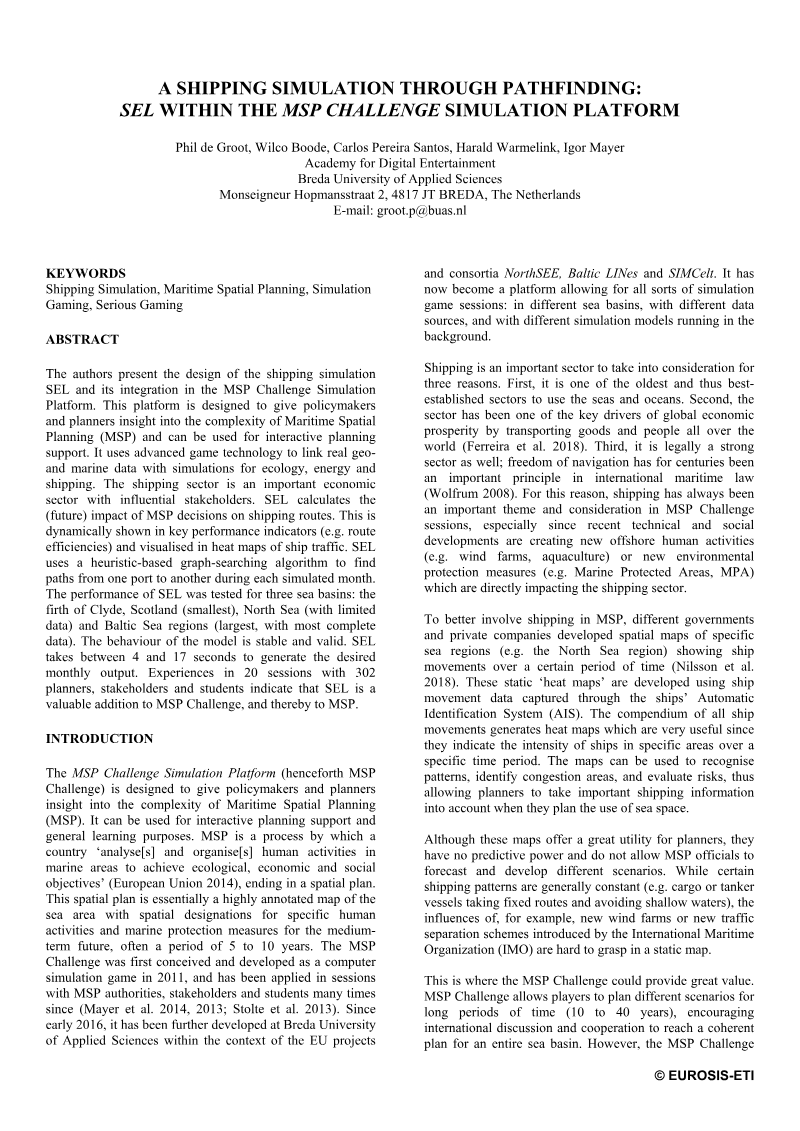
The paper introduces SEL (Shipping Emulation Layers), a heuristic shipping simulation embedded in the MSP Challenge platform, designed to show how maritime spatial plans shape vessel traffic.
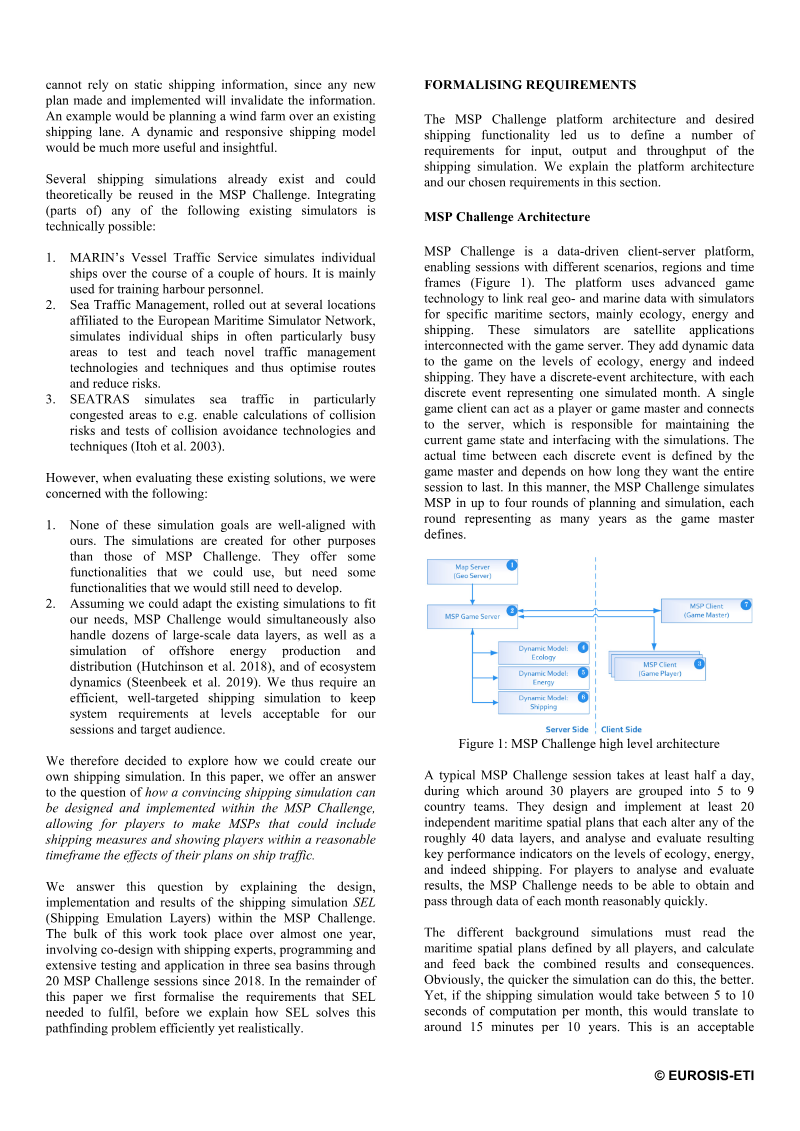
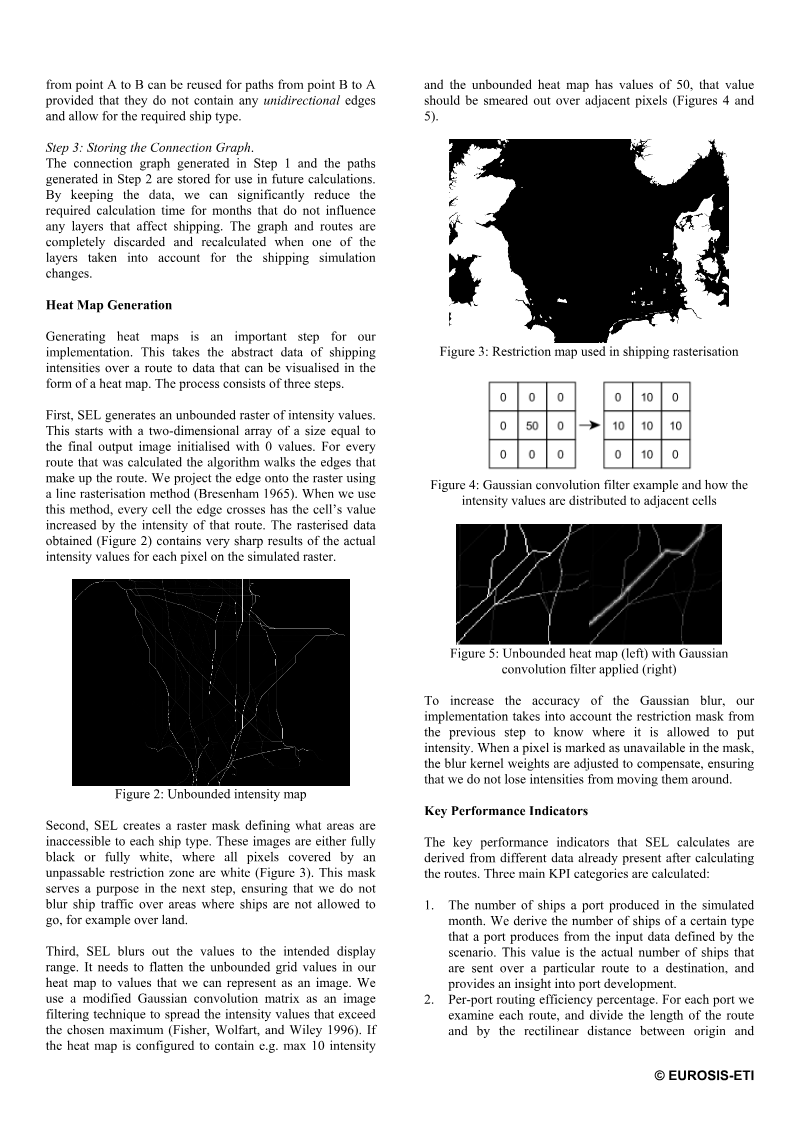
- SEL is a heuristic shipping simulation embedded in the MSP Challenge platform, built to show how maritime spatial plans shape vessel traffic, because existing simulators like MARIN's VTS, Sea Traffic Management, and SEATRAS are poorly aligned with maritime spatial planning goals and too computationally demanding for multi-layer planning sessions.
- At its core, SEL runs A pathfinding over a connection graph derived from game geometry, adding cost penalties for bathymetry and restricted zones, and rasterises routes into heat maps using a modified Gaussian blur.
- Validation against AIS and heat map data for the Firth of Clyde, North Sea, and Baltic Sea found that maritime professionals regarded the results as valuable.
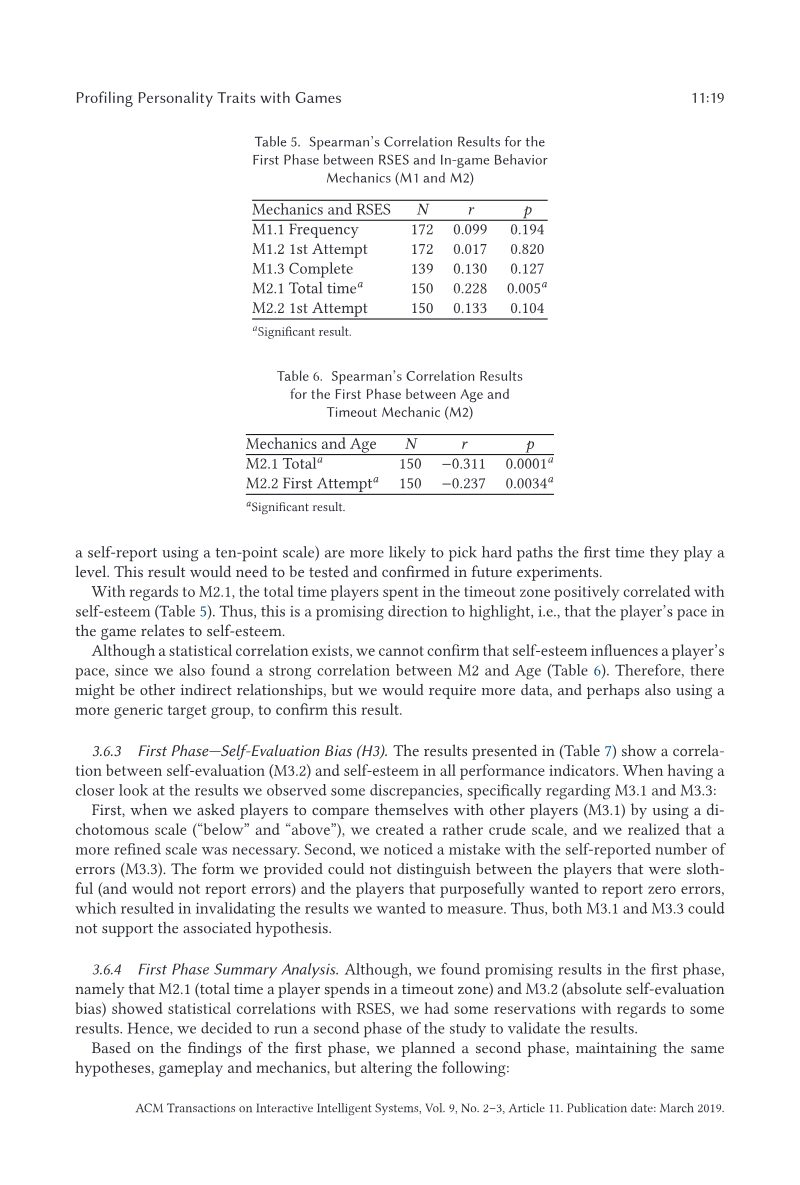
Profiling Personality Traits with Games
The paper "Profiling Personality Traits with Games" argues that in-game behavior can be used to infer personality traits, extending player modeling from adapting games to users toward what the authors call player profiling.
- Game behavior can serve as an implicit measure of personality traits, extending player modeling from adapting games to users toward 'player profiling', with claimed advantages over self-report questionnaires including sustained engagement, reduced reactivity, and the ability to combine implicit and explicit data.
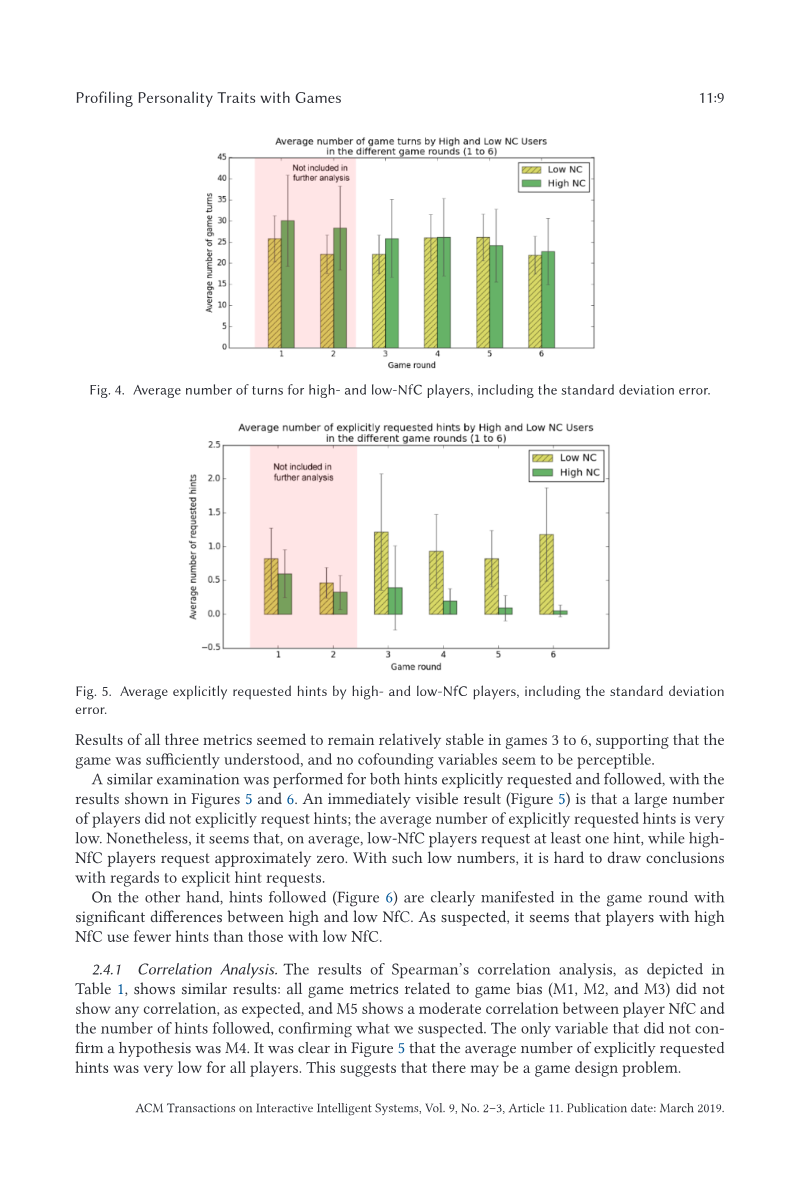
- In the Nanobots turn-based puzzle study, automatically requested hints showed a significant negative correlation with need for cognition (r = -0.223, p = 0.028), while performance metrics (win-lose ratio, round time, number of turns) showed no meaningful relation to the trait.
- Explicit hint requests were too infrequent in the Nanobots study to support firm conclusions, so passive hint-usage data was the key signal rather than deliberate player actions.
Educational Games as a Motivational Tool: Considerations on Their Potential and Limitations
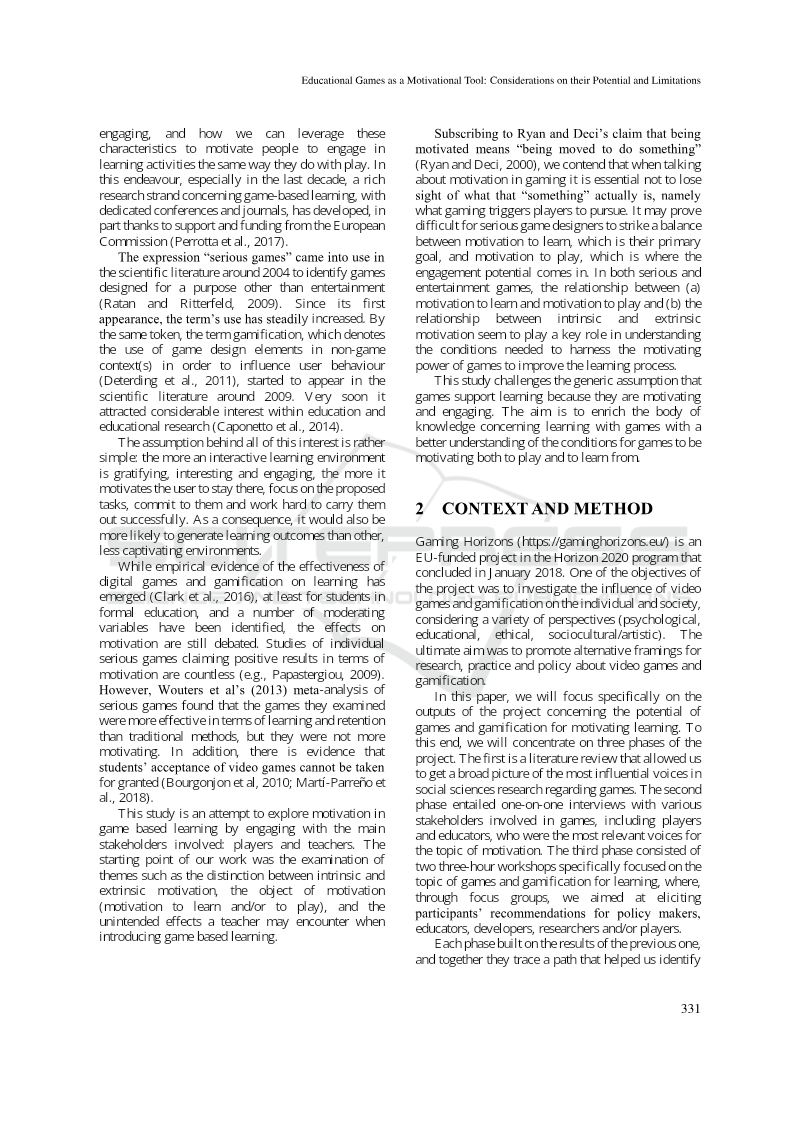
Educational games are widely promoted as a route to greater student motivation, yet this study questions whether the evidence supports that assumption.
- Serious games can improve learning and retention, according to meta-analytic evidence from Wouters et al. (2013), but they are not inherently more motivating than conventional instruction, challenging a core premise of game-based learning.
- The study's findings rest on a literature review, 73 stakeholder interviews, and workshops within the Gaming Horizons project, and the authors caution that their conclusions remain open to further empirical testing.
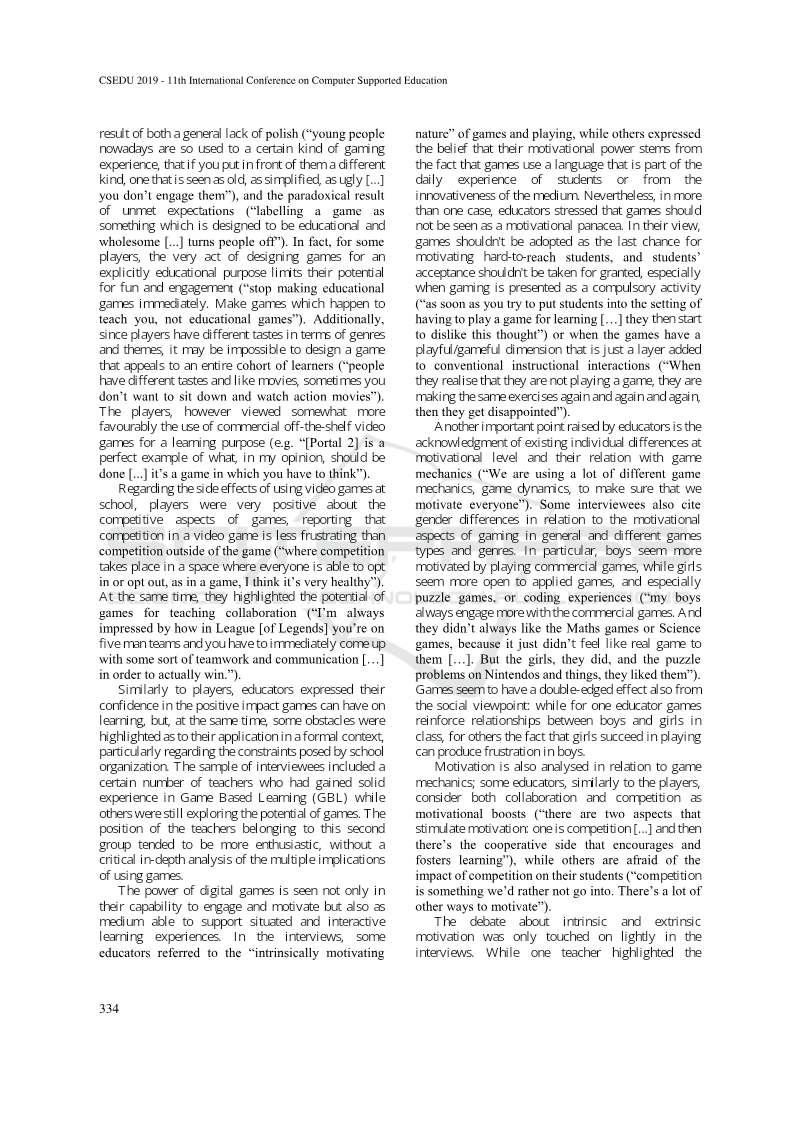
- Players often found serious games used in schools unengaging, citing lower production values and the tension between voluntary play and structured classroom settings.
Long-Run Gaming Start-Ups: Staying Fit in Networks
This study examines long-run Dutch gaming start-ups, companies that have survived roughly four to six years, with the aim of understanding what keeps such firms resilient in a sector marked by high cancellation rates.
- Dutch gaming start-ups that survive roughly four to six years are typically very small, project-based, and dependent on a handful of key partners, so network strength is central to their resilience.
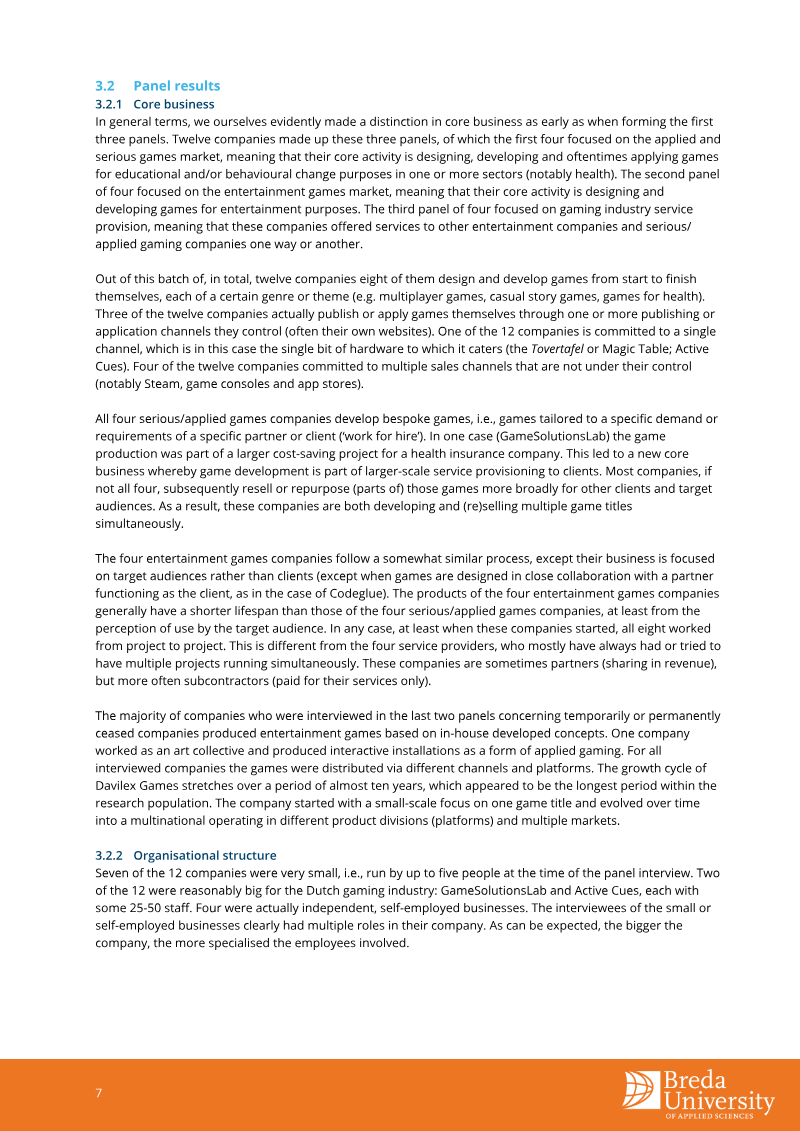
- Among the 12 long-run companies, five themes of organisational change emerged: product or service orientation, revenue model, key partners, staffing, and scale, with shifts in core business serving as the main mechanism of adaptation.
- Six drivers of change were identified, with personal entrepreneurial motivation the most prominent among them.
Serious Games as Planning Support Systems: Learning from Playing Maritime Spatial Planning Challenge 2050
Serious games are proposed here as planning support systems (PSS) for maritime spatial planning (MSP), a response to fragmented ocean governance and intensifying competition for marine space.
- Serious games are proposed as planning support systems (PSS) for maritime spatial planning, with MSP Challenge 2050 evaluated at three value levels: individual, group, and outcome.
- In the 2017 Newfoundland workshop (18 participants), about half of the 102 recorded interactions were socialization (players helping each other understand game features), while roughly a quarter each were externalization (requests for conceptual clarification) and combination (extrapolation to real-world planning).
- Players with under two years of MSP experience gained significant insight into how planning factors interact, and explicit knowledge transfer and reflection were the most common high-quality interactions, though high-quality interactions were far less frequent than total interactions.
Stakeholder Engagement in Maritime Spatial Planning: The Efficacy of a Serious Game Approach
This study evaluates the MSP Challenge, a constructionist tabletop serious game designed to help stakeholders engage with maritime spatial planning (MSP), a process the EU MSP Directive requires member states to implement by 2020.
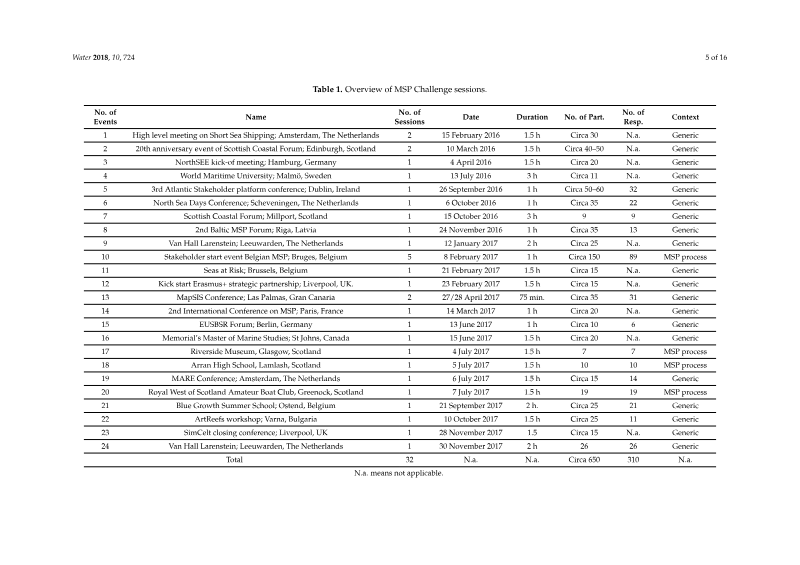
- The MSP Challenge serious game was evaluated across 19 sessions with 310 survey respondents in three contexts (generic events, Belgium, and Scotland), after being played in twenty countries across roughly 32 sessions involving about 650 people since its 2016 development.
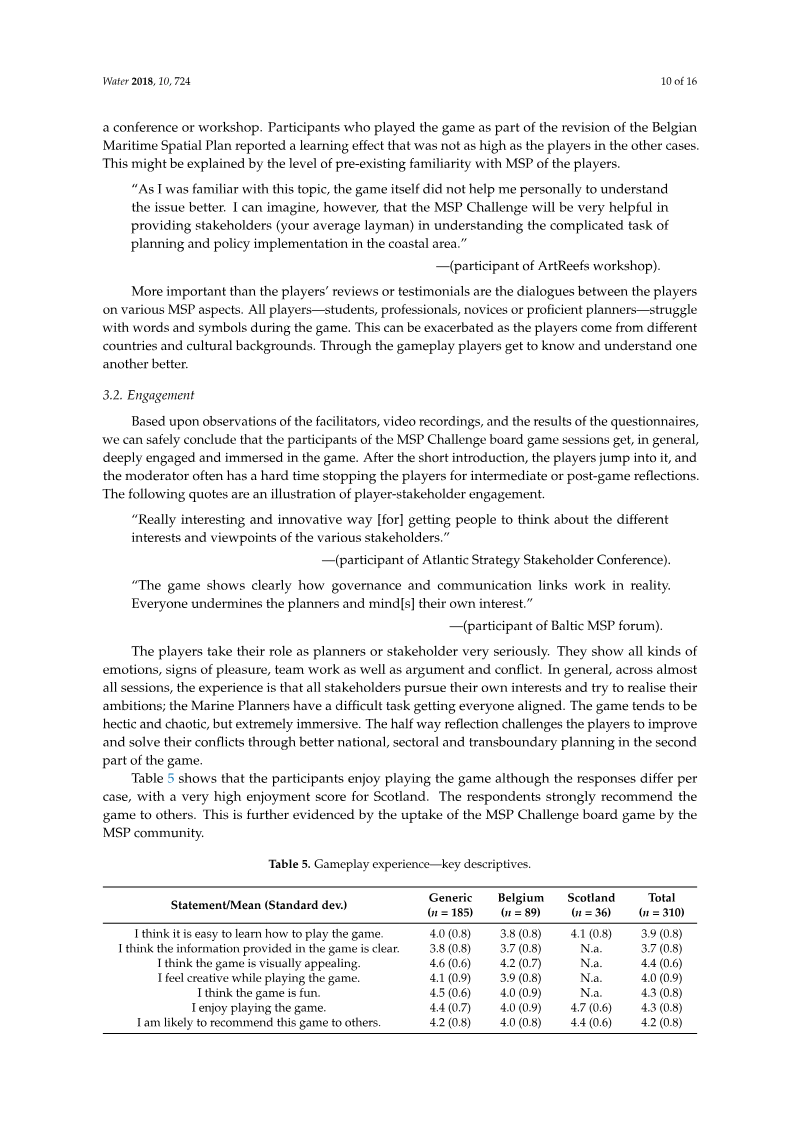
- Participants rated the game's reflection of real maritime spatial planning challenges highly (mean 4.1 out of 5) and reported improved understanding of MSP, with the strongest learning effect among new Scottish players (mean understanding 4.2 out of 5) versus 3.5 among experienced Belgian players.
- Prior MSP involvement appears to dampen perceived learning gains, as players with existing experience reported smaller improvements in understanding than newcomers.
Designing Location-Based Augmented Reality Games for Urban Tourism: A Conceptual Framework
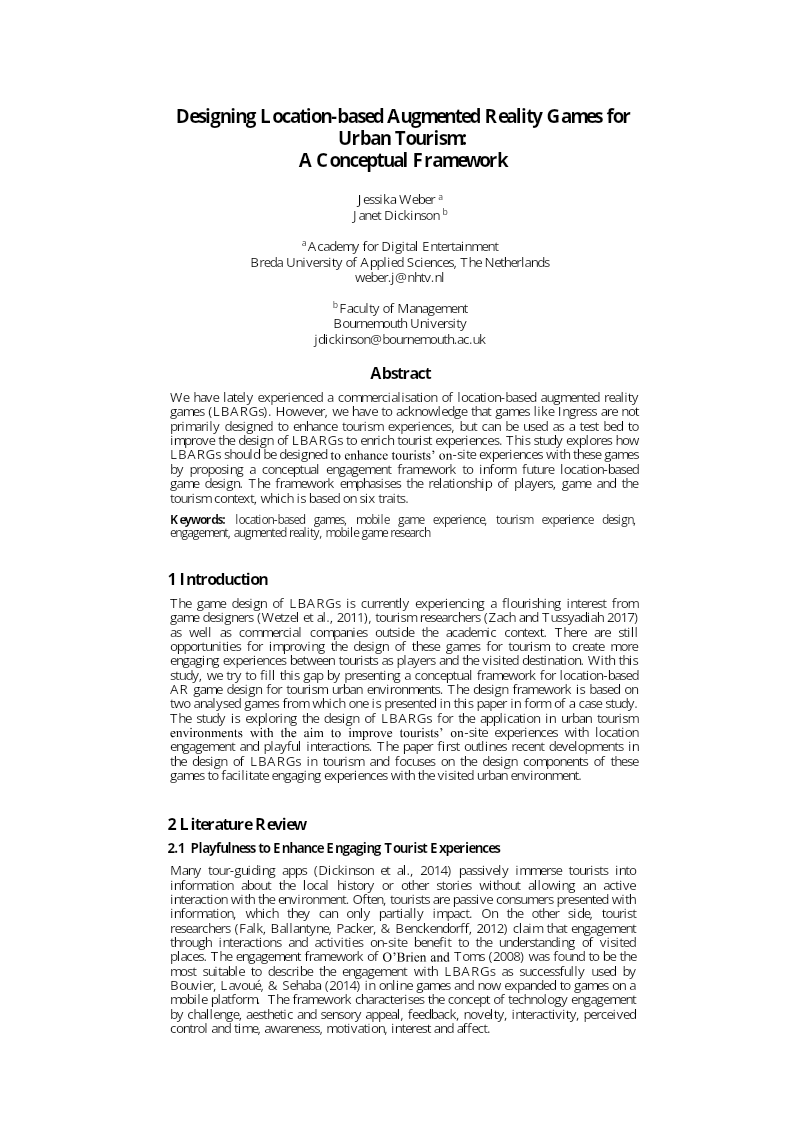
This study proposes a conceptual engagement framework for designing location-based augmented reality games (LBARGs) that enhance on-site tourist experiences in urban settings.
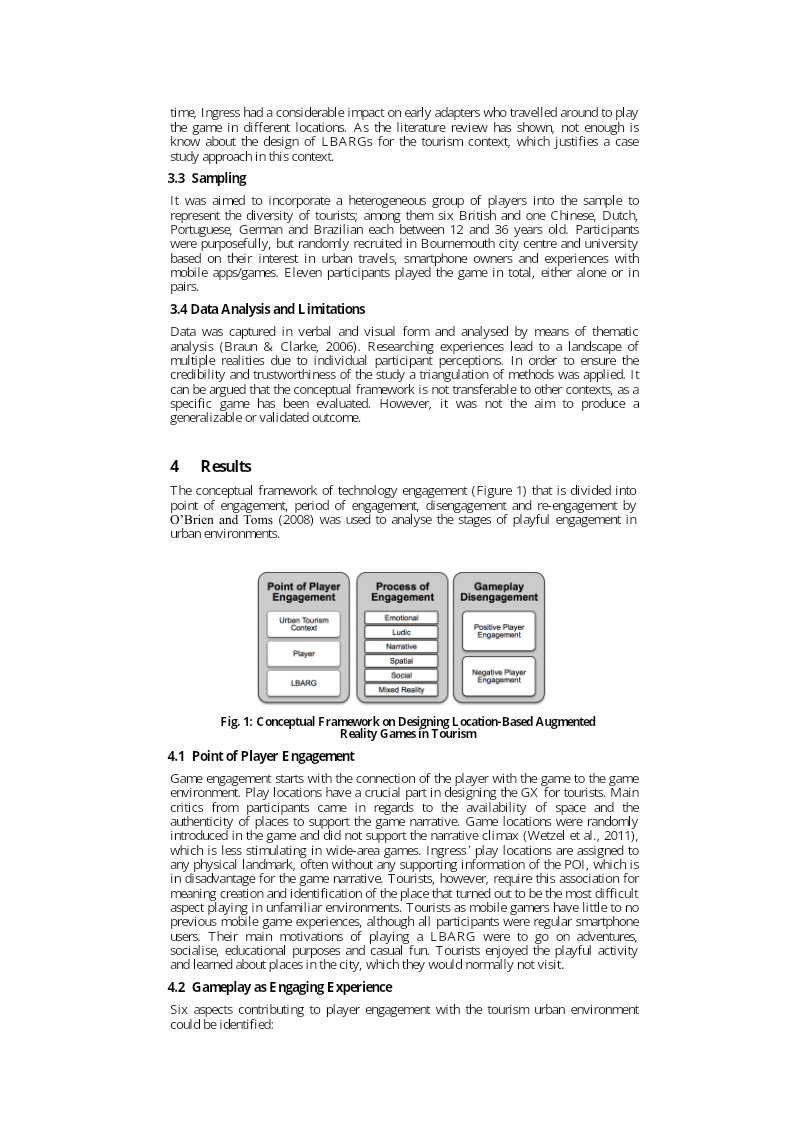
- The study proposes a six-trait engagement framework (emotional, ludic, narrative, spatial, social, and mixed reality) for location-based augmented reality games in urban tourism, built on O'Brien and Toms' (2008) engagement model.
- The framework was developed by testing Ingress, a commercial game not designed for tourism, in a qualitative exploratory study with 11 participants aged 12 to 36 of varied nationalities, playing on Android devices in Bournemouth city centre and surrounding parks in summer 2014.
- Players showed strong excitement during discovery and challenge completion, and spatial exploration heightened their awareness of unfamiliar locations.
Library Not Found: The Disconnect between Gaming Research and Development
"Library Not Found" examines why social science research on games has failed to meaningfully reach the game development community.
- Academic research on games has failed to reach developers: 46% of recommendations in the literature target researchers, while only 12% address developers, mirroring the distance reported by nearly every developer interviewed.
- The review drew on 9,157 retrieved papers, with 47 reviews and meta-analyses read in full, plus 73 stakeholder interviews with developers, educators, and players.
- Developers described academic research as tentative, inaccessible, outdated, and insufficiently attentive to market needs, citing dense jargon, difficulty locating papers, and a preference for industry venues such as the Game Developers Conference.
An Offshore Energy Simulation Through Flow Networks: CEL Within the MSP Challenge 2050 Simulation Game Platform
The paper presents the design of CEL, an offshore energy simulation integrated into the MSP Challenge 2050 simulation game platform, which is used to help maritime spatial planning authorities and energy stakeholders learn about and test offshore energy grids.
- CEL is an offshore energy simulation built into the MSP Challenge 2050 game platform, used by maritime spatial planning authorities and energy stakeholders to learn about and test offshore energy grids.
- The authors model energy grids as flow networks by extending standard maximum-flow with intermediary expected-energy nodes per team, split input/output nodes for capacity limits on transformers, sockets and sources, and bidirectional cable edges to support grids with loops, solved with Dinic's algorithm.
- When team expectations cannot be met, the simulation reports actual flows and residual energy as "wasted" energy to prompt players to revise their designs.
Models, Simulations and Games for Water Management: A Comparative Q-Method Study in The Netherlands and China
This study, published in the journal Water in 2018, examines how policy analysts in the Netherlands and China perceive Models, Simulations and Games (MSG) as instruments for Integrated Water Resources Management (IWRM).
- A 2018 Q-method study of 55 senior professionals (33 in the Netherlands, 22 in China) finds that perceptions of Models, Simulations and Games (MSG) for Integrated Water Resources Management diverge sharply across the two countries, shaping how relevant and widely adopted MSG-based innovations are.
- In the Netherlands, the largest group (11 respondents) views IWRM as the integration of engineering, spatial planning and governance and favors visualization and simulation for coordination while rejecting participatory learning, while 9 respondents emphasize serious games for fostering network cooperation and only 3 prioritize stakeholder learning and local knowledge.
- Among Chinese respondents, the dominant 'Doctrine of the Mean' frame (12 of 22, all water managers) favors strong central leadership and interagency coordination while rating conflict analysis and stakeholder participation as unimportant.
Creator's Discussion of the Growing Focus on, and Potential of, Storytelling in Video Game Design
This article examines the rise of narrative-driven, personally expressive video games as a counterweight to the medium's reputation for excessive violence and genre-bound spectacle.
- The video game industry's mainstream reputation for violent, otherworldly content (science-fiction, horror, fantasy) understates a growing arthouse movement of personal, autobiographical and life-inspired narrative games.
- Over the last decade, and especially the last five years, an increasing number of games have focused on vivid, believable characters, personal stories, and emotional experiences enhanced through interaction.
- The article examines key titles in this narrative-driven space and the debates they provoked within video game culture, including discussion of ludonarrative dissonance in BioShock.
MSP Challenge 2050: Ecopath with Ecosim Link Design Document
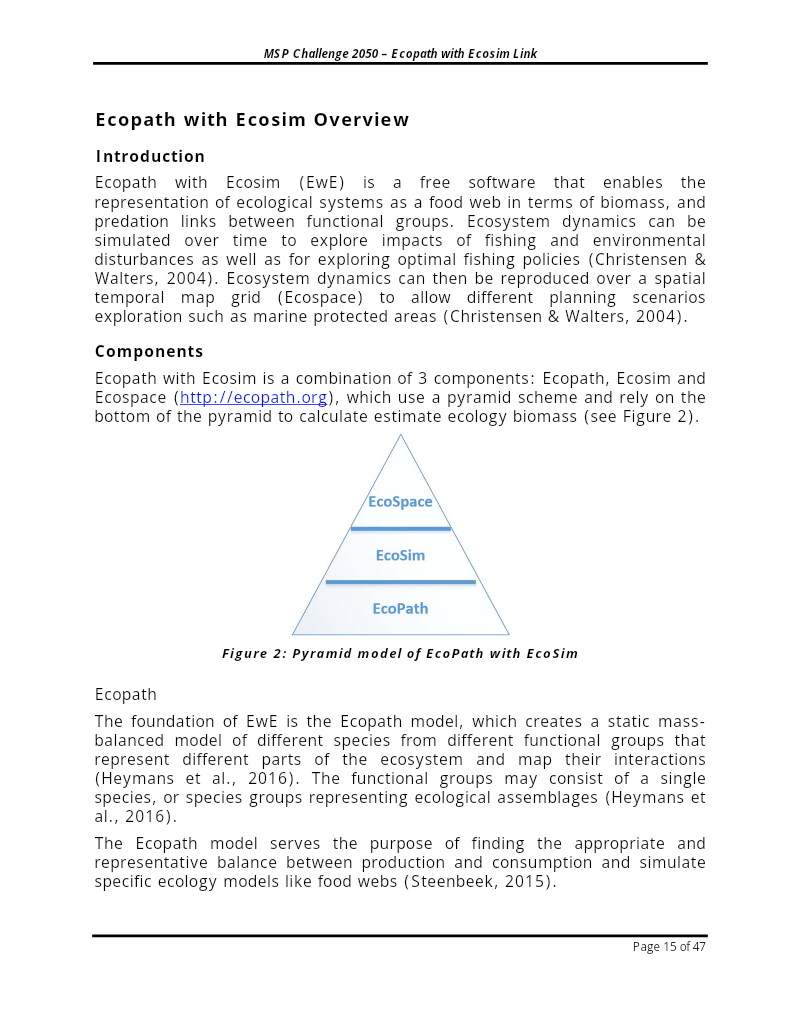
The MSP Challenge 2050 Ecopath with Ecosim (EwE) Link design document, prepared by NHTV Breda in late 2016 for Rijkswaterstaat and the Interreg NorthSEE project, proposes replacing the serious game's static, single-ecosystem ecology model with a dynamic, spatially explicit link to the EwE simulator.
- The current MSP Challenge 2050 ecology model is static and single-ecosystem: it ignores where species live and treats fishing as a fixed mortality term, so it cannot reflect how player decisions alter marine ecosystems.
- The design document, prepared by NHTV Breda in late 2016 for Rijkswaterstaat and the Interreg NorthSEE project, proposes linking the game to the Ecopath with Ecosim (EwE) simulator to make ecological consequences of player choices visible.
- An intermediary application, MSP EwE Link (MEL), would bridge the server-centric game architecture and EwE's raster-based food web model by converting vector-based human activity data into seven pressure layers and returning ecological estimates as vector layers.