1 free read left. Create a free account for unlimited reading + AI research.
Create free accountWhitepaper Breda University of Applied Sciences
1 free read left. Create a free account for unlimited reading + AI research.
Create free accountWhitepaperBreda University of Applied Sciences
Educational games are widely promoted as a route to greater student motivation, and this study questions whether the evidence supports that assumption.
Educational games are widely promoted as a route to greater student motivation, yet this study questions whether the evidence supports that assumption. Drawing on a literature review, 73 stakeholder interviews, and workshops conducted within the Gaming Horizons project, the work examines the relationship between games, motivation, and learning. Its central thesis is that serious games can improve learning and retention, as meta-analytic evidence from Wouters et al. (2013) indicates, but they are not inherently more motivating than conventional instruction, which challenges a core premise of game-based learning.
Stakeholder accounts reinforce this skepticism. Players frequently viewed serious games used in schools as unengaging, pointing to lower production values and to the tension between voluntary play and structured classroom settings. By contrast, commercial entertainment games repurposed for learning were received far more favourably. Across interviews and focus groups with players and educators, participants rejected the notion that games should be mandatory or regarded as a motivational cure-all. They emphasized that individual differences in taste, gender, and preferences for competition shape whether any given game will be effective.
The authors conclude that games can increase engagement when their mechanics are carefully aligned with learning objectives. They recommend teacher training in game literacy and a sharper conceptual distinction between motivation, engagement, and enjoyment, which the field often conflates. The findings should be read with caution, as the study's reliance on a limited set of interviews and a literature review leaves its conclusions open to further empirical testing.
Breda University of Applied Sciences · 2026
Breda University of Applied Sciences · 2026
Breda University of Applied Sciences · 2026



Breda University of Applied Sciences · 2026
Breda University of Applied Sciences · 2026
Breda University of Applied Sciences · 2026
Breda University of Applied Sciences · 2026

Breda University of Applied Sciences · 2026

Breda University of Applied Sciences · 2026
Breda University of Applied Sciences · 2026
Breda University of Applied Sciences · 2026
Breda University of Applied Sciences · 2026


European Conference on Games Based Learning (ECGBL) · 2026
European Conference on Games Based Learning (ECGBL) · 2026
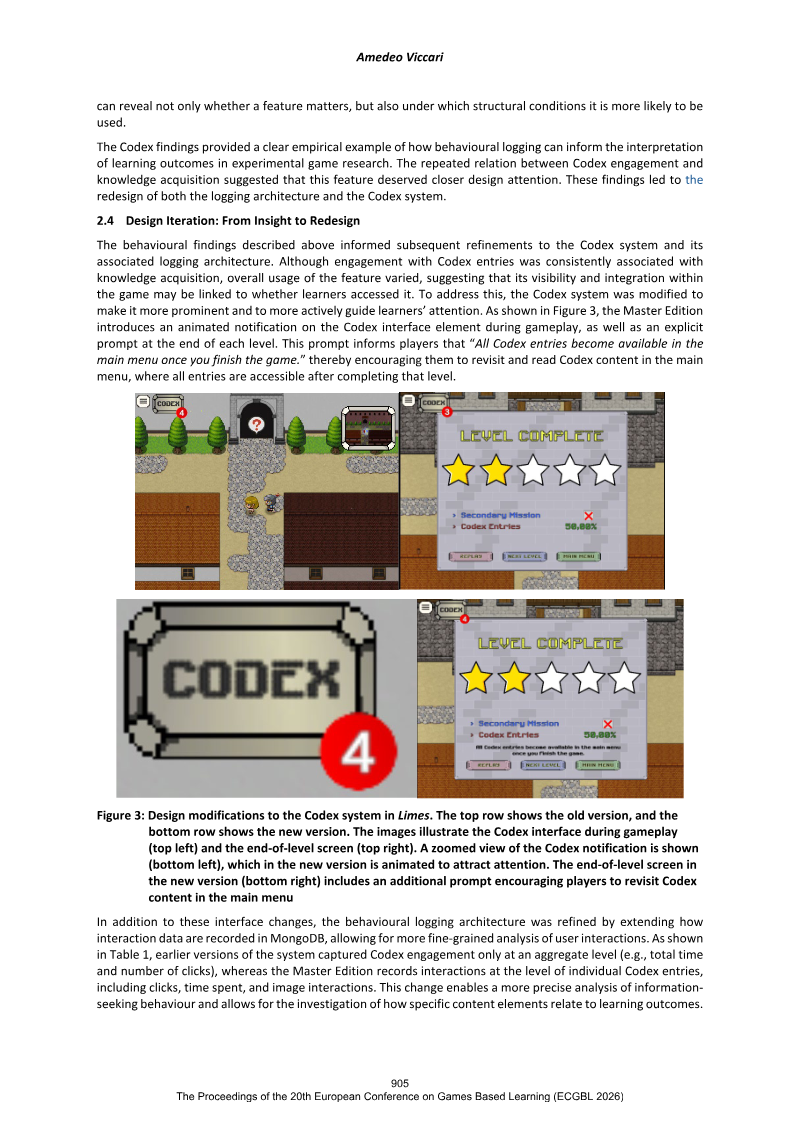
European Conference on Games Based Learning (ECGBL) · 2026