Atari SA
French video game publisher and owner of the Atari brand, listed on Euronext Paris.
Documents
No published documents yet
Reports about Atari SA
99 documents by other writers name Atari SA in the title or summary.

Into the Void: Where Crypto Meets the Metaverse
Crypto, and in particular decentralized networks and NFTs, is positioned as the essential infrastructure for an open Metaverse built on self-sovereign finance, true digital ownership, and a creator economy.
- Non-fungible tokens (NFTs) provide a decentralized, universal ownership layer that solves the 'original sin' of the internet by enabling peer-to-peer value transfer and verifiable scarcity for digital goods.
- Current digital goods are 'unsound' because they exist in siloed databases where users lack true ownership, face liquidity risks, and are subject to arbitrary supply inflation by central authorities.
- Axie Infinity serves as a primary case study for cryptoeconomics, having achieved an 11.6x growth in its user base during 2020 by utilizing governance tokens to transition toward player-owned and operated systems.
Steam Gets 'Experimental' with Discovery
Valve's latest Steam Labs experiment, a store navigation feature, is the centerpiece of this December 2020 edition of the GameDiscoverCo newsletter.
- Valve has introduced 63 new Steam store categories—consisting of 48 genres, 8 themes, and 7 player modes—to improve game discovery through granular, niche-specific landing pages.
- Titles launching directly into subscription services like Xbox Game Pass demonstrate substantially higher player counts compared to those released via traditional storefront models.
- The cessation of third-party tracking services like GamStat has created significant limitations in accurately measuring player acquisition metrics across PlayStation and Xbox platforms.
Blockchain Gaming's Beginnings: From Crypto-craze to Decentralized Fun
Blockchain gaming, in mid-2021, sits at the intersection of genuine business model innovation and speculative excess, and the analysis argues for a middle path between "all hype" and "the future of gaming."
- Blockchain gaming represents a third macro-shift in industry economics, transitioning from centralized digital services to decentralized models that prioritize player-owned economies and governance.
- The sector experienced a massive capital injection of over $1.2 billion in venture funding within a 24-hour period, resulting in the creation of at least six unicorn startups valued at $1 billion or more.
- The market exhibits a extreme 'winner-takes-most' dynamic, with the top-ranked game commanding a user base nearly 60 times larger than the 15th-ranked title.

Amazon's Celestial Arcade: Cloud Gaming Is Starting to Become a Scourge to the Industry
Amazon's launch of Luna, its cloud gaming service, is framed as a skeptical case against the idea that Big Tech is disrupting games with real value rather than extracting rent.
- Cloud gaming platforms like Amazon’s Luna risk prioritizing corporate financial stability and subscription-based revenue models over the creative innovation required to sustain the hit-driven gaming industry.
- Tech giants with massive market capitalizations, such as Amazon, possess the financial capacity to acquire major publishers like Electronic Arts but currently lack the original software hits necessary to compete with established gaming ecosystems.
- Industry consolidation is accelerating, evidenced by Microsoft’s $7.5 billion acquisition of ZeniMax Media and Sony’s aggressive pursuit of high-end intellectual property.

How to Build the Amazon of Game Companies
Game companies lack the durable defensive moats that define firms like Amazon, and this 2020 analysis by Michail Katkoff examines why and what studios could do about it.
- Most game companies lack the long-term defensibility seen in tech giants like Amazon or Facebook because they rely primarily on brand or scale rather than the network effects that drive 70% of value in the broader tech sector.
- Network effects—where each new user increases the value for others—are rare in gaming, with only platforms like Roblox, Epic Games, and Unity successfully leveraging this model to build durable, multi-generational businesses.
- While companies like Nintendo, Activision Blizzard, and EA are considered the most durable in the industry, they have struggled to maintain dominance during platform shifts, particularly the transition to mobile gaming.

Games, AI, and Systems
Straeubig's 2019 essay in Eludamos argues that current progress in game AI differs fundamentally from the "AI revolution" Paul Tozour called for in 2002.
- Recent AI progress rests largely on decades-old algorithms made practical by dramatic declines in computing cost, with the price of a teraflop falling from an inflation-adjusted US$156.8 trillion in 1961 to roughly US$30 in 2017, alongside the availability of large datasets.
- Straeubig argues that game AI and academic AI have developed largely in parallel, and that game-based perspectives offer a more grounded way to think about AI than prevailing speculative debates about an 'AI revolution.'
- The paper proposes a framework of seven roles AI can play in games: Mechanic, Alter/Ego, Observer, Protector, Player, Creator, and a speculative seventh role, the 'God,' an AI integrating all the others.

Games and AI: Paths, Challenges, Critique
This introduction to a special issue of Eludamos examines the two-way relationship between artificial intelligence and games, framing it as both the implementation of AI to make games more believable and immersive, and the use of games as benchmarks and training environments for AI.
- Games and AI influence each other in both directions: games serve as a testbed for AI research, while AI increasingly shapes game design, testing, and marketing.
- The authors frame the issue as a critical inquiry into the sociocultural, ideological, and economic dimensions of AI, rather than a purely technical account of its capabilities.
- A 2012 University of Toronto team won the ImageNet competition using convolutional neural networks trained on GPU hardware developed for gaming, showing how the games industry indirectly advanced AI.
Sweeney's Utopia: The Puritan Perspective of Epic Games CEO
This February 2020 newsletter from a games-industry analyst, written as he marks ten years since founding SuperData, offers a weekly roundup of commentary on business strategy, platform competition, and monetization across the global games market.
- Apple’s 2019 services revenue reached $46 billion with a 64% margin, which is double the margin of its hardware business.
- Tim Sweeney’s push for open ecosystems and reduced monetization is financially viable primarily due to the massive success of Fortnite, while most other industry players remain dependent on closed platforms and predatory revenue models.
- YouTube’s $160 million media rights deal for Activision Blizzard’s Overwatch and Call of Duty leagues indicates a stagnation in esports growth compared to previous Twitch agreements.
The Technical, Social, and Cultural Affordances of Intellivision
Mattel's Intellivision, produced from 1979 to 1984 as the chief rival to the Atari VCS, is examined here as a case for expanding platform studies beyond its traditional focus on material constraint.
- The authors argue that temporal pressures, inherited code, licensing agreements, and marketing strategies shaped Intellivision game design as much as or more than the hardware, and sometimes productively expanded creative possibilities rather than only limiting them.
- The study rests on thousands of archival documents (marketing research, game code, memos, test reports, legal records) and more than 125 interviews with engineers, programmers, executives, lawyers, marketers, and testers.
- Over 80 percent of sales in the second-generation cartridge period occurred during the Christmas season, making holiday timing a defining pressure on development.
Popular History: Historical Awareness of Digital Gaming in Finland
Popular accounts of Finnish digital gaming history took shape in the 1980s, well before any academic historiography of games in Finland existed.
- The analysis draws on roughly 800 items from Finnish computer and hobbyist magazines such as Potti, MikroBitti, and Printti to trace how popular narratives of Finnish digital gaming history first took shape in the 1980s, before any academic historiography existed.
- Popular histories tend to canonize an official narrative built around an origin and turning point tied to commercial or technical success, which can overshadow personal and unorthodox recollections of gaming.
- Discourse across the periods studied is classified into four waves, moving from early-1980s popular articles through mid-1980s chronicles and nostalgic player accounts to a 2000s national narrative shaped by institutions such as Neogames and the Finnish Museum of Games, which opened in 2017.

From Symbolism to Realism: Physical and Imaginary Video Game Spaces in Historical Aspects
Filip Tołkaczewski argues that video game space has evolved from symbolic, minimally defined environments into highly realistic, elaborately constructed worlds, and that this shift is turning games toward a new medium resembling interactive film.
- The study argues that video game spaces evolved from abstract, symbolic settings in early titles like Spacewar!, Space Invaders, and Asteroids toward increasingly realistic, continuous, and detailed worlds, a shift tied to technological advancement.
- The analysis frames early game spaces as simplified 'allegories of space' in the sense described by Espen Aarseth, relying heavily on player imagination to fill in what the graphics did not show.
- Key milestones in the trajectory include the flip-screen technique in Adventure and Gravitar, the side-scrolling and off-screen virtual space introduced by Defender (1980/1981), the 2D era of Super Mario Bros. (1985) and Contra (1988), the pseudo-3D of Wolfenstein and Doom, and the true 3D turn of Super Mario 64 on the Nintendo 64.
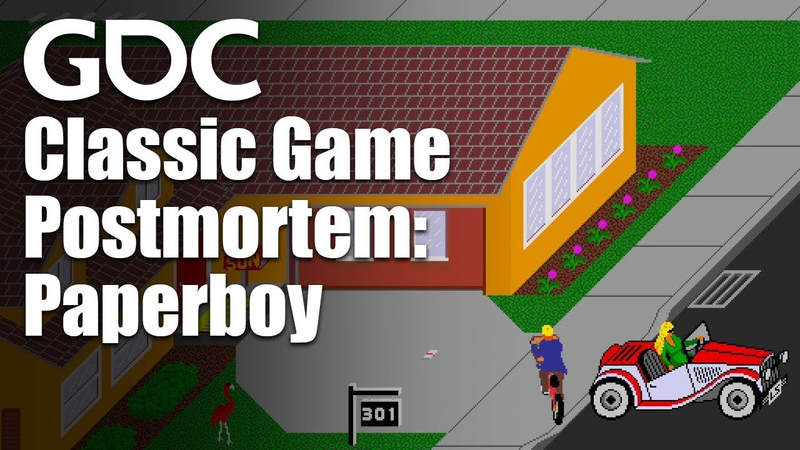
Classic Game Postmortem: Paperboy
The development of the 1985 arcade title Paperboy represents a pivotal shift in Atari’s design philosophy, moving away from traditional vector-based graphics toward a sophisticated, isometric raster-based experience.
- The NES home console port of Paperboy achieved significant commercial success with 2 million copies sold, far outpacing the 3,500 units sold for the original 1985 arcade version.
- Development of the arcade title utilized Atari’s System 2 hardware, featuring a 16-bit processor programmed in BLISS and a custom medium-resolution monitor to surpass the fidelity of 8-bit competitors.
- Gameplay was engineered around tight 30-to-90-second loops to maximize arcade player turnover, a strategy refined after initial focus group failures led to a shift toward a parallel horizontal layout.