1 free read left. Create a free account for unlimited reading + AI research.
Create free accountArticle Naavik
1 free read left. Create a free account for unlimited reading + AI research.
Create free accountArticleNaavik
NFTs enable peer-to-peer value transfer and verifiable scarcity for digital goods.
Crypto, and in particular decentralized networks and NFTs, is positioned as the essential infrastructure for an open Metaverse built on self-sovereign finance, true digital ownership, and a creator economy. The argument rests on the scale of gaming: 2.7 billion players worldwide and $174.9 billion in 2020 spending, up 19.6% year over year and roughly double film and music combined. Free-to-play accounts for 78% of digital game revenue but is reaching an efficiency plateau of diminishing returns, which crypto-enabled models could address. The Metaverse idea is traced from McLuhan's warnings about private control of information technology through Gibson's cyberspace to Stephenson's Snow Crash, and Fortnite's Travis Scott concert, with 12.3 million players, serves as an early example.
NFTs are presented as the missing universal ownership layer for a digital goods market estimated at about $50 billion and growing to $190 billion by 2025. Grey markets provide evidence of latent demand, such as RuneScape gold buying by an estimated 40-50% of players and Call of Duty exploit services, which developers could capture through legitimate tokenized secondary markets. Fortnite's $2.4 billion in 2018 cosmetic sales shows how much players will pay for virtual goods. Ethereum's network effects and decentralization commitment make it the likely foundation, though its ERC-721 market (about $540 million in market cap and 200,000 users) is constrained by high fees, unproven scaling, and persistent scams.
Early traction appears in crypto art (Beeple's $3.5 million weekend), sports collectibles (NBA Top Shot), virtual land (Decentraland estates above $50,000), and blockchain games. Axie Infinity grew users 11.6-fold in 2020, lets Filipino families out-earn conventional jobs, and funds a community treasury through marketplace and breeding fees. Dapper Labs has raised $50.9 million, with NBA, UFC, and Ubisoft partnerships. Large publishers remain reluctant to cede economic control, but community ownership can improve customer acquisition, ARPU, and cross-game partnerships.
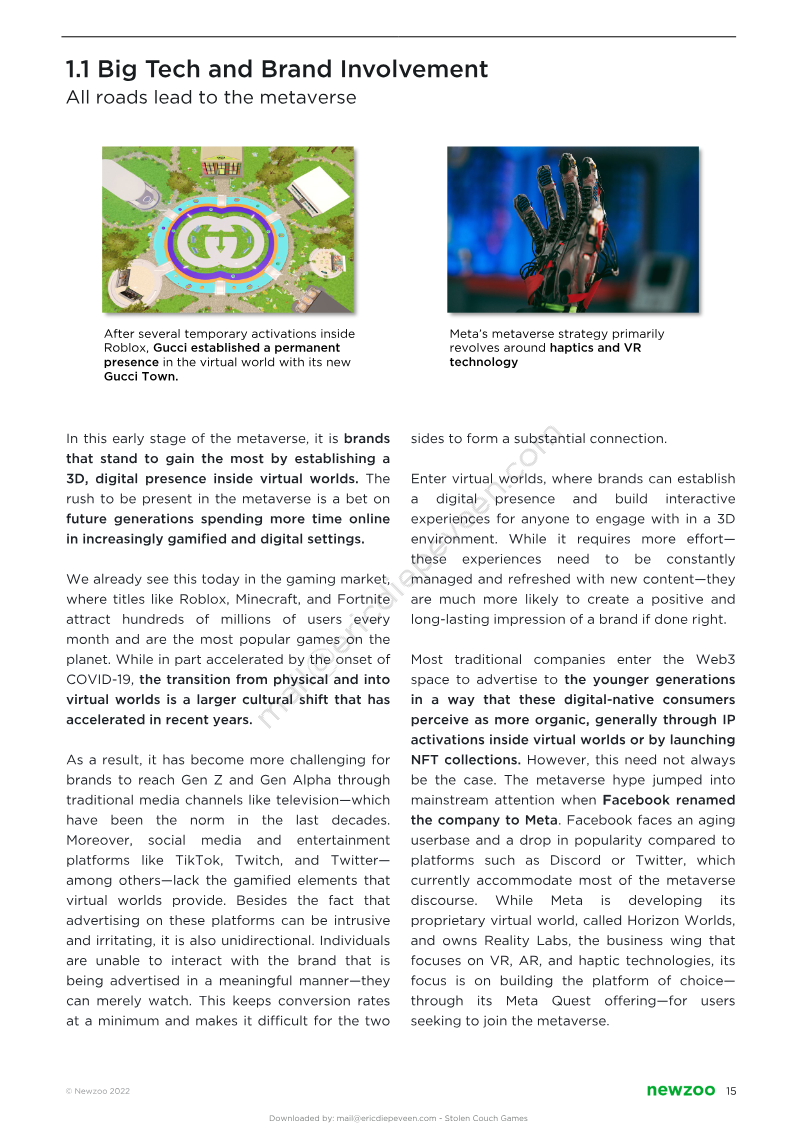
Investors are advised to prioritize network effects and token value accrual, while brands such as Atari, Square Enix, and Gucci are urged to explore virtual goods for their scalability, zero marginal cost, and secondary-sale revenue. The conclusion is that early movers who experiment creatively and manage the cost of being wrong will be rewarded, with decentralized web3 technologies ultimately channeling trillions of dollars through a Metaverse economy over the coming decades.
 FortniteGame · Epic Games · 2020 · 1,131 documents
 Call of DutyGame · Infinity Ward · 2003 · 978 documents
 UbisoftCompany · Game company · 748 documents
 Square EnixCompany · Japan · founded 2003 · 393 documents
 AtariCompany · United States · founded 1972 · 99 documents
 RuneScapeGame · Jagex · 2001 · 55 documents
 DecentralandCompany · Game company · 17 documents
Each row is a game or company this document names, each column a document, oldest first. A mark means that document names it. Select a row to see those documents.

Naavik · 2026
Blockchain Game Alliance · 2025