User Acquisition reports and market data
Documents

A Single Source of Truth for Measurement
The mobile marketing landscape underwent a fundamental shift following the introduction of iOS 14 and Apple’s App Tracking Transparency (ATT) framework.
- The shift to Apple’s App Tracking Transparency (ATT) framework and the loss of IDFA has created a fragmented measurement environment that requires reconciling anonymous SKAdNetwork data with traditional MMP reporting.
- Implementing a conversion studio allows advertisers to automate the encoding and decoding of conversion values, enabling the measurement of revenue, engagement, and funnel events without frequent code updates.
- Advertisers can extend post-install measurement windows up to 72 hours to capture more granular user behavior data within the constraints of privacy-centric design.

Panel: Creative Ways to Grow: Innovating in User Acquisition & Retention
Sustainable growth in the modern gaming industry necessitates a holistic strategy that bridges the gap between marketing, product development, and community management.
- Retention is the primary driver of revenue and long-term scale, as acquiring new users is ineffective if the first-time user experience (FTUE) fails to engage players or if the game suffers from technical instability.
- Maintaining creative integrity in user acquisition (UA) is critical; using misleading ads that do not reflect actual gameplay can damage long-term app store rankings due to high visit-to-download drop-off rates.
- Influencer marketing campaigns can drive significant short-term install spikes, but they require careful tracking and coordination to avoid negative impacts on store algorithms if the traffic does not convert into sustained downloads.
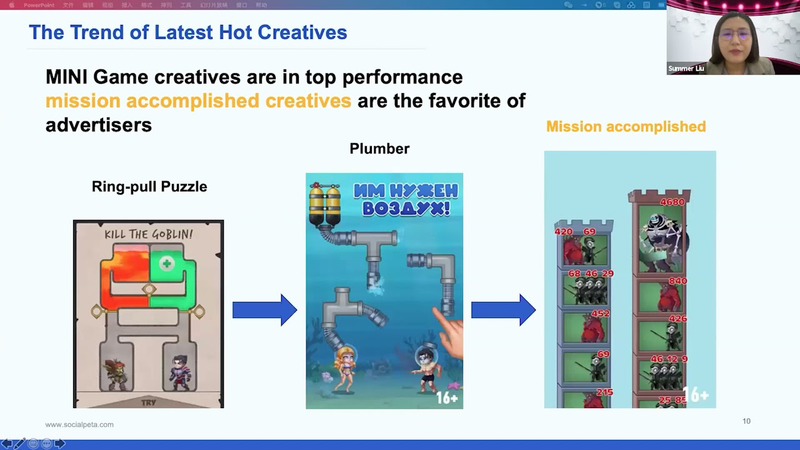
The Key Role of Ad Creatives in Advertising Game & Tips on Creative Optimisation
The mobile gaming industry has entered a phase of extreme saturation, necessitating a shift toward high-volume, data-driven advertising strategies.
- The mobile gaming industry has reached extreme saturation, with the average number of ad creatives per game increasing by 110% year-over-year to 543 as of the first half of 2021.
- Top-tier mobile titles now require over 1,000 unique ad assets throughout their lifecycles to maintain effective user acquisition and revenue growth.
- Developers should validate market demand by testing game concepts with low-budget trailers and creative assets before committing to full-scale production.

Speed Panel: A Whole New Ballgame: How a Top Gaming App Publisher Tackled iOS 14+ & SKAdNetwork
The mobile gaming industry has undergone a fundamental shift in user acquisition and data strategy following the implementation of Apple’s iOS 14+ privacy requirements and the adoption of SKAdNetwork.
- Publishers must shift from granular, long-term tracking to predictive modeling based on user activity within the first 24 hours to compensate for the loss of long-term monetization metrics under SKAdNetwork.
- Successful App Tracking Transparency (ATT) opt-in rates are achieved through concise, localized pre-prompts that are kept separate from other regulatory disclosures like GDPR.
- Strategic timing for ATT prompts is critical, with optimal results often achieved by triggering the request immediately before a user interacts with an advertisement.

Panel: UA & Retention: How to Pick the Ideal Tactic for Your Target Demographic
Effective user acquisition and retention in the mobile gaming sector require a strategic alignment between monetization models and specific payback windows.
- Developers must align monetization models with specific payback windows, prioritizing rapid returns for hyper-casual titles and long-term lifetime value for midcore games.
- Success in user acquisition relies on a formalized, iterative approach to creative testing to identify and scale concepts that resonate with target demographics.
- Machine learning and AI are essential for automating bidding and hitting return on ad spend targets, though they require human oversight to manage channel volatility and performance tracking.

Curated Panel: IDFA Effect' on UA Performance & New Changes for ASO
The mobile gaming industry is undergoing a fundamental transition from granular, device-level user acquisition to an aggregated, privacy-centric model following the implementation of Apple’s App Tracking Transparency framework.
- The implementation of Apple's App Tracking Transparency (ATT) and IDFA deprecation forced a shift toward probabilistic attribution and the use of Apple's SKAdNetwork (SKAN) to maintain user acquisition measurement.
- To address limited data visibility, advertisers are utilizing Conversion Studio tools to measure flexible activity ranges (e.g., levels 1-3) and sequences of events rather than relying on a single 24-hour window.
- Game developers are increasingly shifting UA budgets toward Android and exploring alternative acquisition methods, such as web-to-app flows using landing pages and smart banners to bypass iOS tracking limitations.
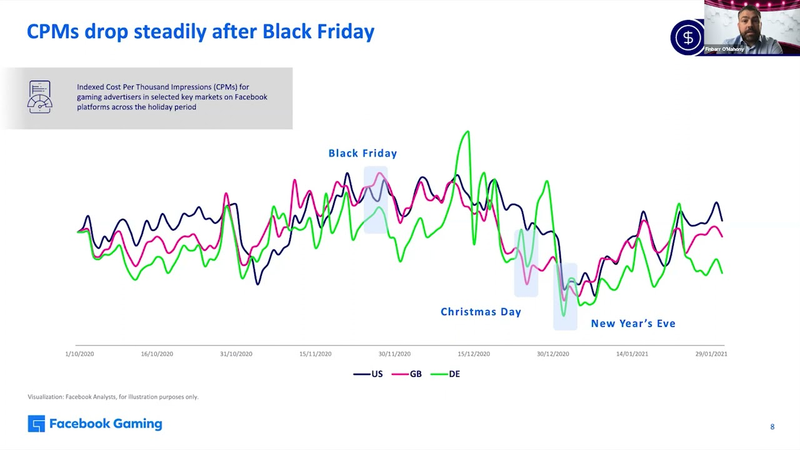
Preparing for the 2021 Holiday Season
The global gaming industry is poised for a robust 2021 holiday season, characterized by sustained engagement levels that have persisted even as pandemic-related restrictions eased.
- The global gaming market maintains a strong 8.74% compound annual growth rate, supported by a player base of nearly 3 billion people.
- Advertisers must abandon pre-pandemic audience assumptions, as record-high consumer confidence in 2021 has expanded the demographic and increased spending intent.
- To maintain campaign stability and avoid the pitfalls of manual adjustments, automated ad solutions should be configured to achieve a minimum of 50 conversions per week.
Bridge Between Marketability Testing & $100m UA Spend: Go-to-market Strategy Optimised for Growth
A full life-cycle go-to-market strategy integrates continuous marketability testing from the earliest stages of pre-production through global launch, replacing traditional siloed development with an iterative, data-driven framework.
- Integrating continuous marketability testing from pre-production through global launch replaces siloed development with an iterative framework that de-risks projects and builds a library of high-performing creative assets.
- This methodology accelerates time-to-market by three to six months by allowing studios to optimize cost-per-install metrics and creative strategies before the game is fully built.
- Independent data collection via web-based testing and simulated store pages mitigates the impact of platform privacy changes like IDFA, enabling more reliable cash flow projections.

Strategies to Get Ready for iOS 15
The release of iOS 15 introduced transformative App Store features designed to refine organic discovery and user acquisition strategies.
- iOS 15 introduced three core features to drive organic discovery and user acquisition: product page optimization for A/B testing, custom product pages for targeted messaging, and in-app event cards for engagement.
- Successful implementation requires cross-departmental synchronization between ASO experts, creative teams, developers, and user acquisition managers to align technical execution with growth objectives.
- Smaller studios should prioritize product page optimization to refine creative assets through organic testing, while larger organizations should focus on custom product pages to maximize the ROI of paid traffic.

Secrets to Successful Cross Promotion with Playtika
Cross-promotion has transitioned from a secondary marketing tactic to a fundamental pillar of mobile game growth, particularly as privacy-centric shifts in the digital landscape have constrained traditional user acquisition channels.
- Cross-promotion has evolved into a primary growth pillar for mobile games, necessitated by privacy-centric shifts that have restricted traditional user acquisition channels.
- Effective cross-promotion relies on AI-driven personalization and behavioral correlations across genres rather than superficial game similarities to minimize cannibalization.
- Playtika manages a portfolio of over 15 titles and 30 million monthly active users, demonstrating that success requires heavy investment in R&D and internal data infrastructure.

SciPlay's Joe Byrne on Social Casino
The social casino industry is currently navigating a significant strategic shift, driven by the need for granular market intelligence and the operational challenges posed by the deprecation of IDFA.
- Social casino developers are shifting toward a higher volume of spenders with smaller transaction sizes, necessitating a focus on increasing average transaction value and session frequency.
- The deprecation of IDFA has forced companies like SciPlay to rely on granular market intelligence, including detailed taxonomy and competitive performance analysis, to guide product roadmaps and M&A activity.
- Social casino games are increasingly adopting meta-progression systems—such as progression maps, builder mechanics, and narrative-driven live operations—to improve player retention and engagement.

IDFA Loss: Real Data & Real Talk
The deprecation of the Identifier for Advertisers (IDFA) on iOS has fundamentally restructured the mobile gaming industry, resulting in a 15% to 20% decline in revenue across diverse portfolios.
- The deprecation of IDFA has caused a 15% to 20% decline in revenue across mobile gaming portfolios due to the collapse of granular tracking and lookalike audiences.
- Market efficiency has decreased as the loss of deterministic tracking leads to higher costs per mille and lower install quality.
- Niche, whale-dependent genres like social casino and strategy games have experienced the most significant disruptions, whereas broad-market titles remain more resilient.