Player Behavior

169 documents·85 publishers

Documents

Page 1
Report22 pages

Newzoo Gen Z & Gen Alpha Report 2022

This analysis examines the gaming behaviors and preferences of Gen Alpha (ages 10-12) and Gen Z (ages 13-27), positioning these cohorts as the primary drivers of the industry's future. The central thesis asserts that for these younger generations, gaming has evolved beyond a mere pastime into a ubiquitous "lifestyle" platform that fulfills fundamental needs for socialization, self-expression, and immersion. This shift is characterized by high engagement across multiple dimensions, including playing, viewing content, and participating in virtual social communities.

Key findings indicate that 90% of Gen Alpha and Gen Z are "game enthusiasts," significantly higher than the 79% found in the total online population. These groups invest a substantial portion of their leisure time in gaming; it is the top entertainment source for Gen Alpha and a top-three source for Gen Z, rivaling social networks and streaming. Socialization is a critical driver, with 70% of Gen Z expressing interest in using game worlds for social gatherings beyond active gameplay, such as attending virtual parties or watching movies. This behavior suggests these generations will be the primary catalysts for metaverse adoption.

Economic engagement is also high, with 52% of Gen Alpha and Gen Z spending money on games, compared to 42% of the general population. Mobile is the leading platform for both play and spend, though Gen Alpha shows a unique affinity for consoles driven by franchises like Fortnite and Mario. The primary motivators for spending include unlocking exclusive playable content and personalizing the in-game experience through virtual goods like currencies and gear.

The data is derived from Newzoo’s 2022 Global Gamer Research, utilizing Computer Assisted Web Interviewing (CAWI) conducted between February and April 2022. The study features a representative sample of 75,930 respondents across 36 global markets, covering North America, Europe, MEA, Latin America, and Asia-Pacific.

  • 90% of Gen Alpha and Gen Z are game enthusiasts, significantly outpacing the 79% engagement rate found in the total online population.
  • Gaming is the primary entertainment source for Gen Alpha and a top-three source for Gen Z, competing directly with social networks and streaming services.
  • 70% of Gen Z are interested in using virtual game worlds for social activities beyond gameplay, such as attending parties or watching movies, positioning them as the primary drivers of metaverse adoption.
  • Economic engagement is higher among younger cohorts, with 52% of Gen Alpha and Gen Z spending money on games compared to 42% of the general population.
  • Mobile is the dominant platform for both play and spending, though Gen Alpha demonstrates a notable preference for consoles, specifically citing franchises like Fortnite and Mario.
+1
NewzooJan 2022
Page 1
Report26 pages

Multiplayer Report 2022

The 2022 Multiplayer Report examines the evolving preferences, behaviors, and technical expectations of online gamers across major global markets. The primary thesis suggests that while traditional genres like Battle Royale and First-Person Shooters remain dominant, the success of multiplayer titles increasingly depends on social connectivity and technical reliability. The findings indicate that 77% of the global gaming population engages in multiplayer play, with overall engagement across all genres increasing by an average of 3.3% compared to the previous year.

Key data points highlight that genre is the primary factor for game selection (49%), followed closely by social drivers such as the ability to chat in-game (31%) and having friends already active in the title (34%). Technical performance is equally critical, with 35% of players prioritizing quick matchmaking and 33% requiring skill-based pairing. Regarding monetization, the data shows a 5% year-over-year increase in players purchasing downloadable content. While core gamers are 58% more likely to spend over $20 on additional content, casual audiences remain active spenders in lower price brackets.

The scope of the research covers four major gaming markets—the United States, United Kingdom, Japan, and South Korea—representing a significant portion of global gaming revenue. The analysis segments the industry into various categories, including mobile, PC, and console platforms, while distinguishing between casual and core gamer demographics. Internal data from Unity reveals a 150% growth in PC multiplayer development and a 40% increase in mobile multiplayer projects since early 2021.

Methodology for these insights involved a survey of approximately 1,500 multiplayer gamers conducted in Q3 2021 and Q3 2022. The sample was split evenly between casual players, defined by a minimum of 30 minutes of weekly multiplayer play, and core players, who engage for at least four hours weekly in competitive genres. This survey data was supplemented by anonymized, aggregated internal metrics from Unity’s live gaming solutions.

  • Multiplayer gaming engagement grew by 3.3% year-over-year, with 77% of the global gaming population now participating in online play.
  • Unity internal data shows a 150% surge in PC multiplayer development and a 40% increase in mobile multiplayer projects since early 2021.
  • Genre remains the primary driver for game selection at 49%, followed by social connectivity factors including existing friend groups (34%) and in-game chat capabilities (31%).
  • Technical performance is a critical retention factor, with 35% of players prioritizing quick matchmaking and 33% requiring skill-based pairing.
  • Players purchasing downloadable content increased by 5% year-over-year, with core gamers being 58% more likely to spend over $20 on additional content than casual audiences.
+1
UnityJan 2022
Page 1
Report11 pages

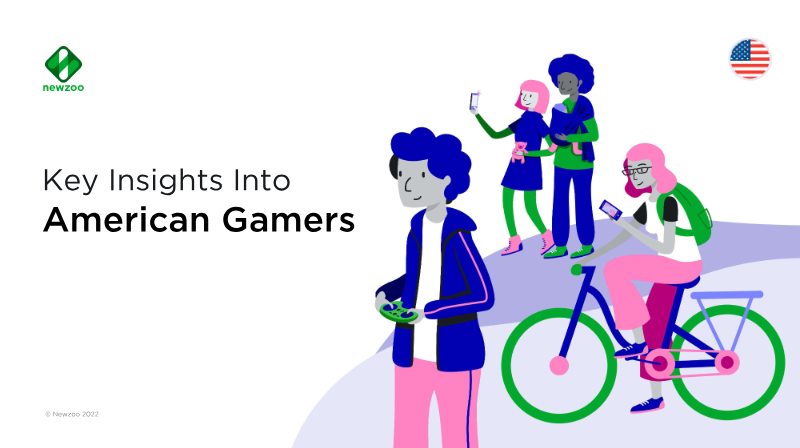
Key Insights Into American Gamers

The United States represents the second-largest gaming market globally, generating $47.3 billion in revenue from a population of 191 million gamers. Research conducted in 2022 indicates that 72% of the American online population are game enthusiasts, a broad category encompassing those who play, watch, or socially engage with video games. While 71% of the population plays games, there is a significant overlap with viewership, as 44% of the population watches gaming video content and 18% engages with esports.

The demographic profile of American gamers is nearly evenly split by gender, with 52% identifying as male and 47% as female. Engagement spans all age groups, though the 21-35 bracket is the most active at 35%. Player motivations are diverse, led by social interaction (37%), action (37%), and achievement (36%). While mobile is the most popular platform by reach, capturing 48% of players, console gaming commands the highest engagement time, averaging six hours per week.

Economic engagement is high, with 49% of the online population spending money on games. The primary drivers for spending include the desire to play with friends or family, taking advantage of sales, and unlocking exclusive content. Popular titles like Fortnite, Grand Theft Auto V, and Call of Duty dominate the market, with shooters and adventure games ranking as the top genres by monthly active users. This data is derived from a 2022 consumer insights survey of 3,054 online respondents in the U.S., part of a broader global study covering 36 markets.

  • The U.S. gaming market generated $47.3 billion in revenue from 191 million gamers, representing 72% of the online population.
  • Engagement is driven by a mix of play and viewership, with 71% of the population playing games, 44% watching gaming content, and 18% engaging with esports.
  • Mobile is the most popular platform by reach at 48%, while console gaming commands the highest engagement at an average of six hours per week.
  • The demographic profile is nearly evenly split, with 52% male and 47% female, and the 21-35 age bracket serving as the most active segment at 35%.
  • Nearly half of the online population (49%) spends money on games, primarily motivated by social interaction, sales, and exclusive content.
+1
NewzooJan 2022
Page 1
Report11 pages

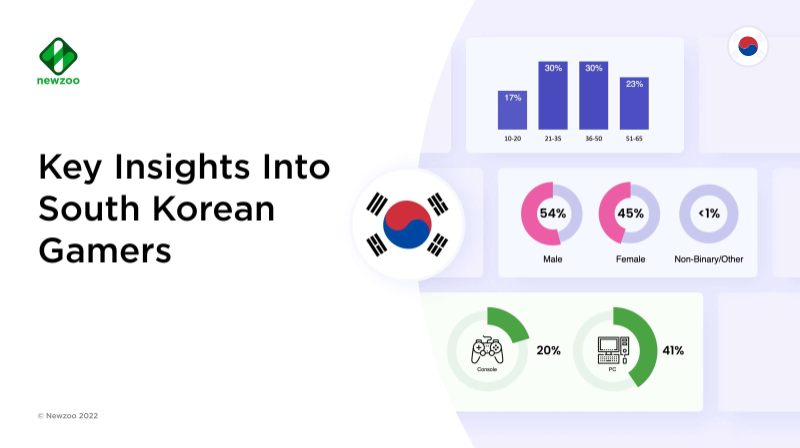
Key Insights Into South Korean Gamers

South Korea represents the fourth largest gaming market globally by revenue, valued at $8.3 billion, with a highly engaged population of 33 million gamers. Research conducted in 2022 indicates that 76% of the online population are game enthusiasts who engage with the medium through playing, viewing, or social interaction. While 72% of the population plays games, there is a significant overlap with viewership; 48% of South Koreans both play and watch gaming content, while 22% specifically engage with esports.

The demographic profile of South Korean gamers is diverse, with a nearly even split between males (54%) and females (45%) and broad representation across age groups, particularly those between 21 and 50. Socializing is the primary motivator for play, followed by action and achievement. Despite the high engagement levels, player personas vary; the most common types are Time Fillers, who play casually to pass the time, and Mainstream Gamers, who invest heavily in both playing and viewing.

Mobile is the dominant platform, utilized by 59% of the online population, though PC players record the highest average weekly engagement at five hours. In terms of software, League of Legends and Shooter genres lead in monthly active users. Monetization is also robust, with 38% of the population spending money on games. The primary drivers for spending include the desire to advance more quickly or easily in-game, followed by responding to sales or special offers.

The findings are based on a 2022 consumer insights survey of 2,094 respondents from the South Korean online population. The data highlights a mature market where gaming is a mainstream social activity integrated into daily life across all demographics, supported by a strong esports culture and a high propensity for in-game spending.

  • South Korea is the world's fourth-largest gaming market, generating $8.3 billion in annual revenue from a highly engaged base of 33 million gamers.
  • Gaming is a deeply integrated social activity, with 76% of the online population participating, 48% both playing and watching content, and 22% specifically following esports.
  • Mobile is the primary platform for 59% of the online population, though PC gamers demonstrate higher engagement with an average of five hours of play per week.
  • The player base is demographically balanced, with a 54% male and 45% female split and strong representation across the 21–50 age range.
  • Monetization is robust, with 38% of the population spending money on games, primarily driven by the desire for faster progression or to capitalize on special offers.
+1
NewzooJan 2022
Page 1
Report40 pages

India: Mobile Market Spotlight: A Booming Mobile Economy

This analysis examines the rapid expansion of India’s mobile economy, focusing on user behavior, app categories, and market growth between 2019 and mid-2021. Utilizing proprietary intelligence data, the findings characterize India as one of the world’s most mobile-first markets, ranking second globally in total app downloads. In 2020, Indian users downloaded 24 billion apps, a 28% year-over-year increase, and spent a total of 651 billion hours on Android devices. Driven by the COVID-19 pandemic, average daily time spent per user rose from 3.3 hours in 2019 to 4.8 hours by the third quarter of 2021.

Mobile gaming represents a significant pillar of this growth, with India becoming the largest market for game downloads in the first half of 2021, accounting for nearly one-fifth of global installs. While titles like Ludo King and Free Fire dominate active user and spend charts, homegrown publishers represent only 7.6% of the top 1,000 downloaded games, suggesting a major opportunity for local development. Additionally, monetization strategies are evolving, with a 15% increase in top-grossing games adopting hybrid models that combine in-app purchases with advertising.

The financial services sector has also seen a dramatic transformation. Hours spent in investment and trading apps grew by 65% in 2020, led by platforms like Upstox Pro and WazirX. The Unified Payments Interface (UPI) continues to drive the market, with transaction volumes doubling year-over-year by mid-2021. Emerging segments such as "Buy Now Pay Later" and merchant utility apps like Khata Book are gaining significant traction. Beyond finance and gaming, the report highlights surging engagement in digital-first shopping, video streaming services like MX Player and Netflix, and a growing demand for mental health resources through meditation apps.

  • India is a global mobile-first leader, ranking second in total app downloads with 24 billion installs in 2020, a 28% year-over-year increase.
  • India became the world's largest market for game downloads in the first half of 2021, accounting for nearly 20% of global installs.
  • Daily mobile usage per user surged from 3.3 hours in 2019 to 4.8 hours by Q3 2021, fueled by pandemic-driven engagement.
  • Homegrown publishers hold only 7.6% of the top 1,000 downloaded games, indicating a significant market opportunity for local developers.
  • Monetization in top-grossing games is shifting toward hybrid models, with a 15% increase in titles combining in-app purchases and advertising.
+2
data.aiJun 2021
Page 1
Report185 pages

Online Nation 2021 Report

Overview............................................................................................................................ 3 What we have found – in brief ........................................................................................................... 3 1. The online consumer ......................................................................................................

  • Adults spent significantly more time online in 2020 compared to 2019, with the 18-24 age group showing the largest increase, particularly during lockdown periods.
  • Despite a potential decrease, 6% of UK households (approximately 1.5 million) still lacked internet access in March 2021, though direct comparability with previous years is limited due to methodology changes.
  • Social video platforms are actively launching new features to maintain and build engagement, exemplified by Snapchat's 'Spotlight' which gained 100 million users by January 2021 and offers creators a share of $1 million daily.
  • TikTok removed 104.5 million videos in the first half of 2020 and 89.1 million in the second half, with 'minor safety' and 'adult nudity/sexual activities' consistently being among the top removal reasons.
  • The COVID-19 pandemic led to a significant increase in online education for children, with nearly 90% of parents in Britain homeschooling their children in May-June 2020 and January-February 2021.
+1
OfcomJun 2021
Page 1
Report145 pages

Cultural and Creative Sectors in Post-COVID-19 Europe: Crisis Effects and Policy Recommendations

Requested by the CULT Committee European Parliament Policy Department for Structural and Cohesion Policies Directorate-General for Internal Policies PE 652.242 – February 2021 EN Cultural and creative sectors (CCS) have been hit hard by the consequences of the COVID -19 pandemic. This study analyses the so far effects of the crisis on the CCS, as well as the policy responses that are formulated to support the sectors.

  • The Cultural and Creative Sectors (CCS) in the EU-27 were economically fragile before COVID-19, characterized by over 1.1 million enterprises (5% of non-financial businesses) generating EUR 145 billion (2.3% of the non-financial business economy) in 2017, with growth rates slightly above the overall non-financial business economy (1.5% vs 1.4% annually between 2012-2017).
  • The COVID-19 pandemic severely impacted the CCS through measures like halting non-essential business, banning public events, and restricting movement, leading to significant income loss for suppliers (e.g., sound/lighting, caterers) and local economies dependent on festivals and events.
  • Freelance performing artists, who often rely on multiple income streams and networking at events, were particularly hard hit by movement bans and social distancing, with many unable to access public support.
  • While some digital-native CCS sub-sectors (e.g., gaming) and those with large IP portfolios thrived, content creators often did not receive fair remuneration from digital platforms, highlighting a need for equitable compensation models.
  • The crisis accelerated the adoption of digital income sources and online distribution for CCS sub-sectors traditionally reliant on physical/live components (e.g., performing arts, live music), demonstrating potential for crisis resistance.
+1
European ParliamentFeb 2021
Page 1
Report21 pages

Newzoo's Generations Report: How Different Generations Engage with Games 2021

This analysis examines how different generations engage with video games, highlighting the medium’s evolution from a simple pastime into a multifaceted social and entertainment ecosystem. The research, based on a survey of 72,068 respondents across 33 global markets conducted in early 2021, reveals that while gaming is a universal form of entertainment, engagement patterns vary significantly by age. Younger cohorts, specifically Gen Z and Millennials, increasingly view gaming as a primary leisure activity that encompasses not just playing, but also watching content, socializing, and participating in virtual communities.

Key findings indicate that the share of leisure time dedicated to gaming increases with each younger generation. Gen Z and Millennials report spending more time on gaming than on social media or streaming movies and television. While relaxing and unwinding remain the top motivations for playing across all demographics, younger players are uniquely driven by competition, social interaction, and creative achievement. Consequently, these groups favor multiplayer modes and genres that offer sandbox or social elements, such as Fortnite and Roblox. In contrast, older generations, including Gen X and Baby Boomers, primarily utilize games for casual relaxation, often preferring single-player experiences on mobile devices.

The research also identifies a growing trend toward the metaverse, where virtual worlds serve as platforms for non-gaming activities like social gatherings and digital events. Younger consumers show high interest in avatar customization and content creation, signaling a shift toward digital identity and persistent virtual spaces. While older gamers are less likely to engage with gaming-related video content, those who do often prioritize practical information, such as reviews and tutorials, to inform their purchasing decisions. Ultimately, the data suggests that gaming has become a foundational pillar of modern entertainment, offering brands and developers diverse opportunities to reach audiences through increasingly immersive and social digital experiences.

  • Gaming has become the primary leisure activity for Gen Z and Millennials, who spend more time playing games than engaging with social media or streaming video content.
  • The 2021 survey of 72,068 respondents across 33 global markets confirms that the share of leisure time dedicated to gaming increases progressively with each younger generation.
  • Younger players are primarily motivated by competition, social interaction, and creative achievement, driving high engagement with multiplayer, sandbox, and social platforms like Fortnite and Roblox.
  • Older demographics, specifically Gen X and Baby Boomers, primarily utilize gaming for casual relaxation and show a distinct preference for single-player mobile experiences.
  • Younger consumers are driving the shift toward the metaverse by prioritizing avatar customization and content creation as core components of their digital identity.
+1
NewzooJan 2021
Page 1
Report73 pages

Q1 2021: Store Intelligence Data Digest

Global mobile app downloads reached 36.6 billion in the first quarter of 2021, representing an 8.7% year-over-year increase. This growth was primarily fueled by a 15.3% surge on Google Play, which reached 28.2 billion installs, effectively counteracting an 8.6% decline on the App Store. While emerging markets like India and the Philippines saw growth exceeding 30%, established markets such as the United States and Russia experienced slight contractions as the initial download spikes seen during the 2020 pandemic began to stabilize.

The quarter was defined by a significant shift in consumer behavior toward privacy-focused communication and financial management. Telegram and Signal saw massive adoption, with Telegram becoming the top messaging app worldwide and Signal’s installs jumping from 2 million to over 60 million. Simultaneously, interest in cryptocurrency and retail investing drove a 34% increase in Finance category downloads across the U.S. and Europe, propelled by platforms such as Robinhood, Coinbase, and Binance. TikTok maintained its position as the top global app, while Google and Facebook continued their rivalry as the leading publishers by volume.

In the gaming sector, hypercasual titles remained the dominant force, accounting for 80% of the top 20 games in the United States. Join Clash 3D emerged as the most downloaded game globally, bolstered by heavy adoption in Asia. Despite a late-quarter release, Crash Bandicoot: On the Run achieved a standout performance with 23 million installs in its first week. Although App Store game downloads fell 22.4% year-over-year due to a high 2020 baseline in China, the overall market remained competitive, with hypercasual publishers like Voodoo and Zynga maintaining high rankings through aggressive acquisition and rapid release cycles.

  • Global mobile app downloads rose 8.7% year-over-year to 36.6 billion in Q1 2021, driven by a 15.3% surge on Google Play that offset an 8.6% decline on the App Store.
  • Hypercasual games dominated the U.S. market, accounting for 80% of the top 20 titles, with Join Clash 3D ranking as the most downloaded game globally.
  • Finance category downloads in the U.S. and Europe grew by 34%, fueled by retail investing and cryptocurrency platforms like Robinhood, Coinbase, and Binance.
  • Privacy-focused communication apps saw massive adoption, with Telegram becoming the top global messaging app and Signal installs increasing from 2 million to over 60 million.
  • Emerging markets like India and the Philippines experienced growth exceeding 30%, while established markets like the U.S. and Russia saw slight contractions as pandemic-era download spikes stabilized.
+1
Sensor TowerJan 2021
Page 1
Report24 pages

Games Marketing Insights for 2021

This analysis examines the shifting landscape of the global gaming industry following the COVID-19 pandemic, focusing on player motivations, monetization, and community engagement. The primary thesis asserts that the pandemic catalyzed a permanent expansion of the gaming audience, introducing a "new gamer" cohort that differs significantly from existing players in demographics and behavior. While existing players increased their time spent gaming, they became less likely to spend money, whereas new players emerged as a high-value segment with a greater propensity for in-game purchases.

The findings are based on a July 2020 survey of 13,246 mobile gamers across nine markets, including the United States, United Kingdom, Germany, and South Korea. Data indicates that the mobile gaming audience grew by 28 million in the US and 8.6 million in the UK. In Western markets, these new players are significantly younger than existing ones and gravitate toward "core" genres like shooters and strategy rather than casual puzzles. Conversely, South Korea proved an anomaly, where new gamers are older and prefer casual titles. Across all regions, new gamers play more hours per week than veterans and are more open to social features, such as multiplayer modes and in-game chatting.

The industry saw a massive shift toward digital discovery and community. Live-streaming platforms experienced record growth, with Facebook Gaming surpassing one billion hours watched in Q3 2020. Furthermore, 70% of consumers reported increased mobile device usage, making mobile-first discovery essential. A critical finding for marketers is the rising importance of brand familiarity; less than a quarter of players in the US, UK, and Germany tried games they had never heard of, suggesting that title recognition and IP strength are now as vital for mobile games as they are for the console market.

To navigate these shifts, the analysis recommends a mixed monetization model that balances ad-supported content with in-app purchases to capture diverse spending habits. It concludes that developers must embrace "always-on" marketing and community management, as players are increasingly seeking engagement through social media groups and streaming partnerships outside of the game client itself.
  • The pandemic triggered a significant expansion of the gaming audience, adding 28 million mobile players in the US and 8.6 million in the UK by July 2020.
  • New gamers represent a high-value segment with a greater propensity for in-game purchases compared to veteran players, who increased their playtime but decreased their spending.
  • Brand familiarity is critical for acquisition, as fewer than 25% of players in the US, UK, and Germany are willing to try games they have not heard of previously.
  • New gamers in Western markets are younger and prefer core genres like shooters and strategy, while new gamers in South Korea are older and favor casual titles.
  • Live-streaming platforms saw record growth during the pandemic, with Facebook Gaming exceeding one billion hours watched in Q3 2020.
+1
KingJan 2021
Page 1
Report23 pages

Newzoo Trends to Watch 2021

This analysis outlines the primary trends shaping the global games, esports, and mobile markets for 2021. The central thesis posits that while the COVID-19 pandemic accelerated engagement and spending, these behaviors have become permanent habits that will sustain market growth even as lockdowns ease. By the end of 2021, the global games market is projected to reach $189.3 billion in revenue, supported by a player base of 2.8 billion people, with significant growth emerging from Southeast Asia and the Middle East.

The scope of the findings covers PC, console, and mobile segments across major global regions, including North America, Europe, China, and emerging markets. Key data points include the rise of cloud gaming, which is expected to surpass $1 billion in annual revenue for the first time, and the rapid expansion of 5G technology, with 5G-ready active smartphones forecasted to grow from 5% in 2020 to 16% (700 million units) by the end of 2021. In the esports sector, mobile titles like PUBG Mobile and Garena Free Fire are now challenging traditional PC giants in viewership, signaling a shift toward mobile-first competitive gaming.

Methodologically, the findings are derived from proprietary market models and consumer research. The analysis highlights several structural shifts: the evolution of games into "metaverse" social platforms for non-gaming events, the disruption of mobile marketing due to the removal of Apple’s Identifier for Advertisers (IDFA), and the increasing pressure on traditional app store revenue-share models. Furthermore, the industry is noted to be prioritizing diversity, inclusion, and reduced toxicity in response to social movements and player demand. Ultimately, the convergence of platforms and the expansion of gaming IP into broader entertainment media are identified as the defining characteristics of the industry's trajectory.

  • The global games market is projected to reach $189.3 billion in revenue by the end of 2021, supported by a permanent shift in consumer spending habits and a total player base of 2.8 billion people.
  • Cloud gaming is expected to surpass $1 billion in annual revenue for the first time in 2021, while 5G-ready active smartphones are forecasted to grow from 5% in 2020 to 16% (700 million units) by year-end.
  • Mobile titles such as PUBG Mobile and Garena Free Fire are increasingly challenging traditional PC giants in esports viewership, marking a significant shift toward mobile-first competitive gaming.
  • The removal of Apple’s Identifier for Advertisers (IDFA) is disrupting mobile marketing strategies and intensifying industry pressure on traditional app store revenue-share models.
  • Gaming platforms are evolving into 'metaverse' social hubs for non-gaming events, while industry leaders are increasingly prioritizing diversity, inclusion, and reduced toxicity in response to player demand.
+1
NewzooJan 2021
Page 1
Report1 pages

Survey on Games and Daily Life: Japan

The survey was launched to deepen understanding of how gaming activities intersect with everyday life in Japan and to inform strategies for mitigating “gaming disorder,” a condition recently classified by the World Health Organization. Its overarching aim is to promote healthier gaming habits across a broad spectrum of participants, ranging from casual players to professional gamers and students enrolled in specialized esports training programs.

Fieldwork took place in February 2021 and targeted three distinct groups: active professional gamers, individuals attending dedicated esports academies, and the general gaming public. Data were collected through an online questionnaire distributed via email by the research team and Cross‑Marketing, with respondents directed to a secure response site. To encourage participation, incentives varied from ¥500 to ¥2,000 Quo‑card vouchers, supplemented by point awards for panel members of the survey firm.

The investigation was coordinated by the Social Psychology Laboratory at Ochanomizu University, under the leadership of Professor Akira Sakamoto, with operational support from Cross‑Marketing and endorsement from the Japan eSports Union (JeSU). Although specific results are not disclosed in the excerpt, the study’s design reflects a comprehensive, mixed‑audience approach intended to generate actionable insights for policy makers, health professionals, and the esports industry regarding responsible gaming practices in Japan.

  • The study, conducted in February 2021, aimed to analyze the intersection of gaming and daily life to inform strategies for mitigating gaming disorder.
  • Research was led by Professor Akira Sakamoto of the Social Psychology Laboratory at Ochanomizu University with endorsement from the Japan eSports Union (JeSU).
  • The survey targeted three distinct demographics: active professional gamers, students in specialized esports academies, and the general gaming public.
  • Data collection was facilitated through an online questionnaire managed in partnership with the research firm Cross-Marketing.
  • Participation was incentivized through a combination of point awards and Quo-card vouchers ranging in value from ¥500 to ¥2,000.
+1
CESA – Computer Entertainment Supplier's AssociationJan 2021

Publishers

Related Topics