PC reports and market data
Documents
Start Your Own Game Studio With These 5 Tools!
The primary objective of this guide is to provide independent developers with a foundational software toolkit for establishing a functional game studio.
- Unity serves as the foundational game engine for the studio due to its robust cross-platform porting capabilities and extensive C# documentation.
- Photoshop is essential for visual asset creation because it allows for real-time graphic updates within Unity during active play sessions.
- Spine 2D provides an accessible alternative to complex 3D software for character rigging and skeletal animation, featuring direct synchronization with Unity’s animation state machines.

THQ Nordic Company Presentation: September 2017
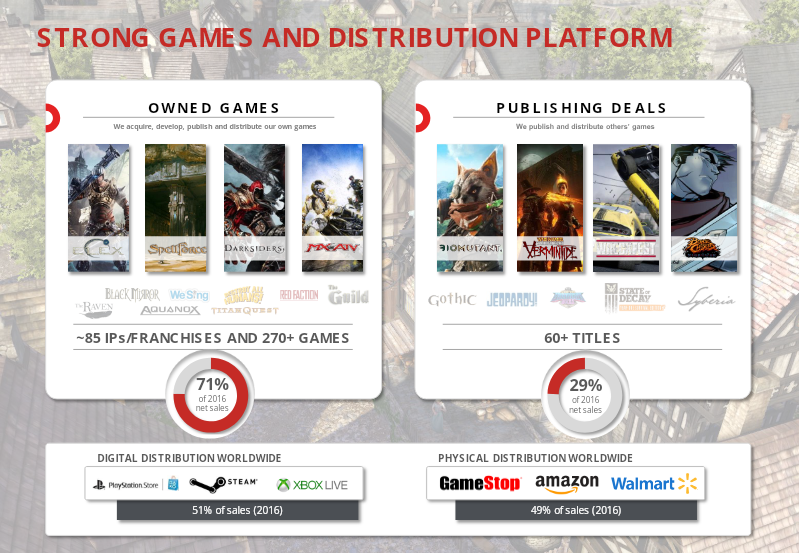
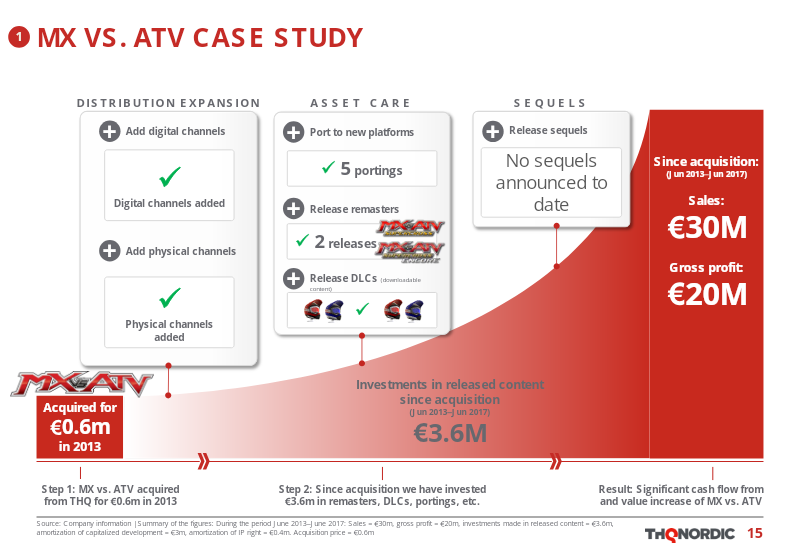
THQ Nordic operates as a global video game publisher and developer with a core business model centered on the acquisition of intellectual property (IP) and the subsequent enhancement of those assets.
- THQ Nordic’s business model centers on acquiring and revitalizing intellectual property, managing a portfolio of approximately 85 franchises and over 270 games as of September 2017.
- The company experienced rapid financial growth in the first half of 2017, with net sales and EBIT more than doubling compared to the same period in 2016.
- Digital distribution has become the primary revenue driver, accounting for 69% of net sales by the second quarter of 2017.
The Story of Transformice: An Indie Game with 70 Million Players
Transformice emerged from a brief three-week prototype to become a global phenomenon, ultimately attracting 70 million players through viral growth, extensive localization, and consistent seasonal engagement.
- Transformice grew from a three-week prototype to a global title with 70 million players, primarily through viral growth and extensive localization.
- A sudden Google AdSense ban forced a pivot to a free-to-play, cosmetic-focused monetization model, which generated over $1 million in microtransactions within six months.
- The studio remains a 'one-game studio' with 99% of its total revenue derived from Transformice, as subsequent releases have failed to replicate its initial success.
Animating Dauntless: Slaying AAA Animation on the Indie Scale
Achieving AAA-quality animation within an independent studio environment requires a strategic shift toward modularity and agile production workflows.
- Small teams can achieve AAA-quality animation by adopting a modular, genus-based classification system that allows skeletal rigs and geometry to be reused across different creature types.
- Utilizing automated Python-based rigging toolkits and dynamic simulation for secondary motion significantly reduces the need for manual keyframing.
- Integrating portable motion capture technology, such as OptiTrack, enables teams to reduce iteration cycles from days to hours, facilitating rapid gameplay prototyping.
Creating Mixed Reality Trailers and Livestreams
Mixed reality serves as a vital bridge for marketing virtual reality experiences, addressing the inherent difficulty of conveying immersive gameplay to audiences accustomed to traditional flat-screen media.
- Mixed reality bridges the gap between immersive VR gameplay and flat-screen audiences by placing the player inside the virtual environment, which resolves the visual disconnect and motion sickness common in raw first-person captures.
- High-quality production requires precise choreography and technical alignment, often utilizing depth-sensing cameras and calibration software to synchronize real-world physical movements with virtual perspectives.
- Creators must choose between external compositing for superior visual fidelity at the cost of high hardware and space requirements, or internal compositing for better streamer accessibility despite lower resolution and synchronization quality.
Getting Inquisitive About the AI of Dragon Age Inquisition
The development of Dragon Age: Inquisition necessitated a fundamental shift in artificial intelligence architecture to accommodate the transition to the Frostbite engine and the demands of an expansive, open-world environment.
- BioWare utilized a decision tree architecture with a visual node editor to manage complex combat logic, allowing party members to evaluate and select from over 90 unique abilities dynamically.
- To handle ability selection, the combat system uses a scoring-based evaluation where each potential action is assigned a value, allowing the AI to choose the most effective move regardless of the order in which abilities are processed.
- The AI system incorporates 'fear zones' and 'tether zones' to manage creature movement and combat boundaries, ensuring NPCs avoid environmental hazards like fire while preventing them from being kited indefinitely by players.

DOOM: Behind the Music
Innovation in game audio requires a fundamental departure from established creative templates, favoring instead a culture of experimentation and the acceptance of potential failure.
- To achieve unique creative results, composers must abandon standard templates and established workflows, as repeating the same process inevitably leads to the same output.
- Creating an environment where failure is acceptable is essential for innovation, as the fear of rejection often prevents experimentation and the pushing of creative boundaries.
- The DOOM soundtrack utilized complex signal chains involving vintage distortion pedals, bit crushers, and tape echoes to process simple sine waves into aggressive, unique textures.
Tooth and Tail: Building Community Within Open Game Development
Pocketwatch Games successfully navigated the resource constraints inherent in small-scale game production by pioneering a model of community-integrated development.
- Pocketwatch Games utilized community-integrated development to offload critical operational tasks like quality assurance, balance testing, and tournament organization to their player base.
- The studio transformed development into a collaborative ecosystem by treating dedicated users as an extension of the internal team, allowing for faster iteration cycles.
- Access to early development builds was restricted to active participants, ensuring that testers were genuinely invested in the project’s long-term success.
Indie Polish: Making the Most of the Last 10%
Polish serves as a critical differentiator for independent games, transforming functional prototypes into cohesive, commercially viable experiences.
- Prioritize visual consistency and essential quality-of-life features, such as UI scaling and control rebinding, to establish a professional first impression that differentiates indie titles from functional prototypes.
- Reallocate resources from non-essential high-fidelity elements, like hyper-realistic environments, toward core mechanics that define the primary player experience.
- Utilize cost-effective animation techniques like squash and stretch, alongside strategic lighting, to elevate aesthetic quality without the need for massive production budgets.

eSports Day: Building eSports: Twitch, Rocket League, and H1Z1: King of the Kill
Building a sustainable esports ecosystem requires a holistic strategy that transcends top-tier professional leagues to prioritize grassroots engagement and long-term infrastructure.
- Sustainable esports ecosystems require integrating competitive features like private matchmaking, skill-based leaderboards, and custom rule sets directly into the game’s core architecture.
- Developers should adopt a 'walk, not run' growth strategy that prioritizes grassroots community engagement and iterative development over immediate, large-scale event production.
- Success in titles like the Rocket League Championship Series is driven by balancing in-house management with strategic partnerships to foster fan loyalty and viewership.

Cuphead's Animation Process and Philosophy
The development of the 2D action game Cuphead is defined by a commitment to the aesthetic and production techniques of 1930s animation.
- Studio MDHR maintains the aesthetic of 1930s animation by utilizing traditional paper-based animation, hand-inked frames, and watercolor backgrounds rather than digital simulations.
- The design process for Cuphead bosses prioritizes simplicity and solid shapes, avoiding overly complex details that would be difficult to animate or rotate in 2D space.
- To ensure technical feasibility, animators create rough blue-pencil sketches before committing to final designs, as the high-stakes nature of paper animation makes late-stage changes labor-intensive.
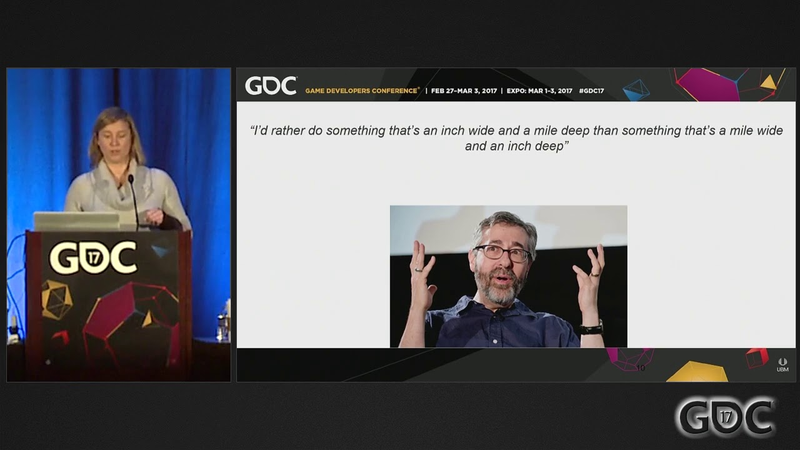
Rewarding Exploration in Deus Ex: Mankind Divided
The design philosophy behind the Prague city hub in Deus Ex: Mankind Divided centers on the creation of dense, interconnected environments that prioritize player agency and environmental storytelling.
- The Prague city hub design prioritizes player agency by replacing linear progression with dense, interconnected environments that reward curiosity with loot, narrative secrets, or alternate mission paths.
- Designers strictly enforced a policy of physical accessibility, ensuring that any location visible to the player can be reached without the use of artificial barriers or 'magic locks.'
- Narrative gating, such as district curfews, is implemented through diegetic justifications rather than arbitrary design choices to maintain immersion.