Monetization reports and market data
Documents

MAU'25 Live Special: The Bold New Era of Rewarded Gaming & UA in 2025
The rewarded gaming landscape is undergoing a significant transformation as platforms transition from traditional Android-centric models to more complex, multi-platform ecosystems.
- Rewarded gaming strategy for 2025 is shifting from Android-centric models to iOS expansion, requiring a move away from last-touch attribution toward rigorous incrementality testing.
- Measurement frameworks now rely on a triangulation strategy that combines last-touch data with causal incrementality testing and self-reported user insights to validate growth.
- Successful geographic expansion, particularly in competitive markets like South Korea, now mandates deep culturalization through local staffing and region-specific reward structures.

Apple vs Epic Aftermath: A New Era for Game DTC
The gaming industry is undergoing a fundamental shift toward direct-to-consumer (DTC) monetization, catalyzed by recent legal rulings in the United States and the European Union that dismantle restrictive app store billing policies.
- Following the April 30, 2024, ruling, Apple now permits developers in the U.S. to freely link to external payment channels and advertise those channels within their apps without paying a 27% commission or displaying anti-steering 'scare screens.'
- Studios are increasingly adopting a hybrid monetization model where 'evergreen' impulse purchases remain in-app, while exclusive or high-value offers are routed through web-based stores to bypass platform fees.
- To drive traffic to web stores, developers are utilizing two primary strategies: offering direct discounts or providing 'extra value' through exclusive bundles, loyalty points, or cashback incentives that are unavailable in-game.

The Xsolla Report: State of Play Q2 2025
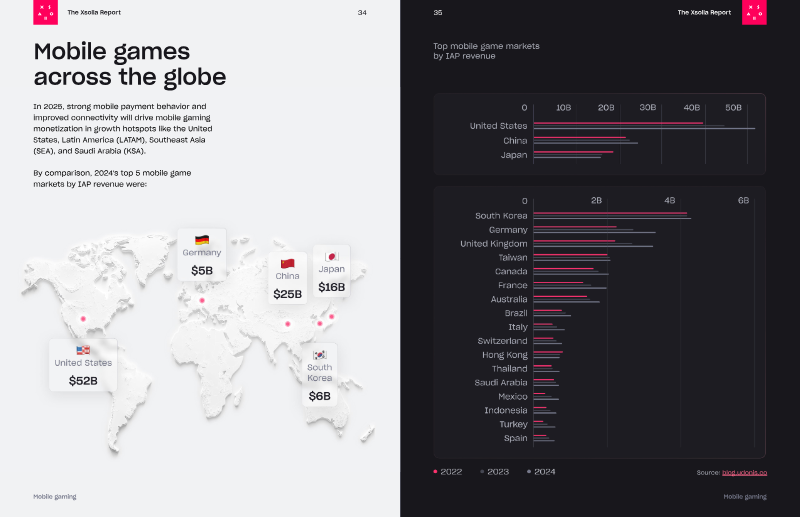
Mobile gaming has become the dominant engine of the global video-game market, now accounting for more than half of total industry revenue and projected to exceed $126 billion in 2025, with an overall forecast of $150 billion for the segment.
- Mobile gaming is the industry's primary revenue driver, projected to reach $126 billion in 2025 with a total segment forecast of $150 billion.
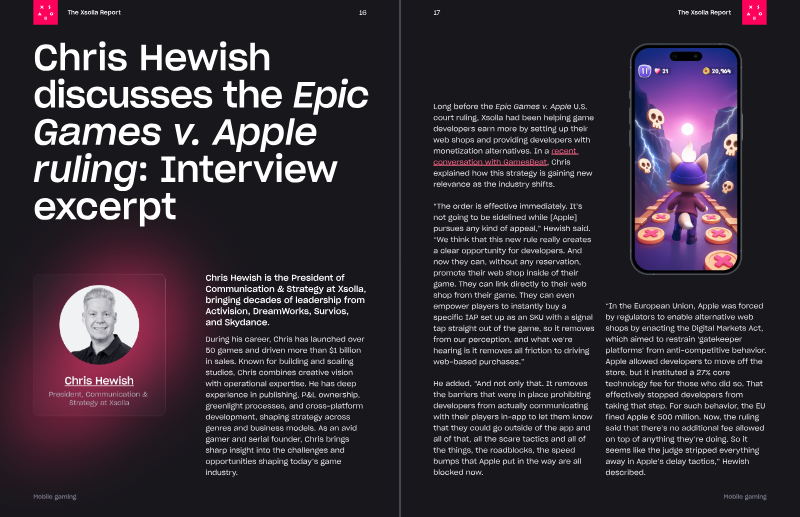
- Following the April 2025 Epic Games v. Apple court order, developers can now utilize direct-to-consumer web-shops to retain up to 95% of transaction value, with early adopters seeing millions in revenue recovery.
- Hybrid monetization models—combining in-app purchases, advertising, and subscriptions—are used by 72% of developers and account for approximately 75% of total mobile revenue.

Week in Mobile Games E55 - Apple faces further EU fines and Trump tariffs chaos continues
The mobile gaming industry is currently navigating a period of significant regulatory pressure and structural transformation.
- Mobile gaming monetization is shifting toward direct-to-consumer web shops and alternative payment systems to bypass traditional 30% platform fees and reclaim control over customer data.
- Despite a 7% decline in total U.S. mobile game downloads, average player spending has increased by 11% to $152 per install in 2024.
- Apple faces significant regulatory pressure from the European Commission, which has set strict deadlines for compliance with the Digital Markets Act regarding anti-steering practices under threat of substantial fines.

TWIG #333: Apple's Stand Up Comedy, Fortnite Mobile's Tea Leaves, and a Mystery Success
Generative AI is fundamentally reshaping game development, offering transformative potential for asset creation, trailer production, and the implementation of sophisticated conversational systems.
- Generative AI is currently being integrated into game development to enhance asset creation, trailer production, and the implementation of complex conversational systems.
- High-budget television advertising campaigns for mobile games continue to underperform in ROI compared to data-driven user acquisition strategies.
- Apple's development of a dedicated gaming hub is interpreted as a defensive legal strategy to protect its 30 percent commission structure rather than a user-centric innovation.

GOAT: Paul Bowen on Ad Network Wars & Future of UA
The mobile advertising landscape has transitioned from a fragmented, high-growth environment into a mature, consolidated market dominated by major entities such as Meta, Google, and AppLovin.
- The mobile advertising landscape has undergone significant consolidation, leaving AppLovin as a dominant force in the ad network space alongside the walled gardens of Google, Facebook, and TikTok.
- The incentivized offer market, popularized by Mistplay, has a low barrier to entry that has led to a surge of new, non-defensible business models relying on gift card rewards.
- Allegations of fraud regarding AppLovin's auto-downloading of apps are largely misunderstood, as iOS technical constraints make such actions impossible and the ecosystem remains a matter of buyer awareness and contract transparency.

🔥 The Art of Scaling Applovin UA & Admon: A Deep dive
AppLovin’s Axon 2 algorithm represents a fundamental shift in user acquisition, moving away from manual optimization toward a sophisticated, data-driven black box model.
- AppLovin’s Axon 2 algorithm functions as a black box that requires stable data inputs; changing ROAS goals every 2–3 days prevents the system from calibrating, as it forces the algorithm to constantly re-target different user segments.
- For IAP-based games, D28 ROAS campaigns are recommended over shorter windows because they yield higher-quality, higher-retention users, even if initial D0 metrics appear significantly lower.
- Campaigns require a minimum of 10–14 days to calibrate on a specific ROAS goal before any adjustments should be made to the target.

Curated Panel: Global Strategies For Indie Success – Publishing, Monetisation, & Market Expansion...
The global independent gaming landscape is undergoing a fundamental shift toward long-term sustainability, moving away from the traditional focus on singular, high-impact launches.
- Indie studios are shifting from high-impact, singular launches to long-term sustainability models focused on evergreen catalog management and live operations.
- Revenue-share financial models are increasingly replacing traditional venture capital to help developers retain greater equity and creative control over their intellectual property.
- The Middle East and North Africa, specifically the UAE, have become critical growth frontiers due to a young, tech-savvy population and high average revenue per user.

Session: Pushing To The Edge: Unlocking Gameplay Potential With The Cloud - Jason Attwood.
The gaming industry increasingly relies on cloud infrastructure to manage the complex requirements of modern titles, ranging from real-time multiplayer games to asynchronous experiences like turn-based strategy and leaderboard-driven titles.
- Cloudflare utilizes a global network of 335 points of presence across 125 countries, employing an anycast system to route traffic to the nearest data center for low-latency performance.
- Serverless 'Workers' allow developers to execute custom logic at the network edge, billing only for active computation time rather than total request duration to optimize costs.
- The platform provides integrated security layers designed to mitigate volumetric DDoS attacks and credential stuffing, acting as a proxy between users and core infrastructure.

Session: Playhop: Current State & Opportunities For Developers - Nikita Bokarev, Playhop.
Web-based gaming has emerged as a critical strategic pivot for mobile developers facing rising user acquisition costs and stagnant lifetime values.
- Web gaming serves as a high-margin alternative to mobile, where revenue contributes directly to profit rather than being absorbed by rising user acquisition costs.
- Playhop currently hosts over 20,000 games and reaches 10 million monthly active users who spend an average of more than 50 minutes per session.
- Successful midcore titles on the platform now derive up to 85% of their total revenue from in-game purchases rather than traditional ad-based monetization.

Session: State Of Gaming - Josh Skinner, Sensor Tower
The mobile gaming industry experienced a notable shift in 2024, characterized by a return to revenue growth despite a contraction in global download volume.
- Mobile gaming revenue grew by 3.8% in 2024 despite a global decline in download volume, driven largely by a 17% drop in casual game installs.
- Live service models are the primary revenue engine for the industry, currently accounting for 84% of all mobile in-app purchase spending.
- Hybrid casual games are a major growth segment, recording a 37% revenue increase as publishers increasingly pivot toward this monetization model.

Take-Two’s Financials Are In — Is the House of Grand Theft Auto Wobbling?
Take-Two Interactive’s recent financial performance reveals a company in transition, balancing a massive legacy console business with a struggling mobile strategy.
- Take-Two Interactive has recorded a cumulative $6.21 billion impairment charge against its Zynga acquisition, consisting of a $3.7 billion write-down this year following a $2.5 billion charge last year.
- While mobile games now account for 52% of Take-Two’s $5.6 billion total net revenue, the company projects flat growth for the mobile segment in the upcoming fiscal year.
- Take-Two’s 33% increase in market capitalization since the Zynga acquisition is driven primarily by investor anticipation for Grand Theft Auto VI rather than operational success from the Zynga integration.