Mergers & Acquisitions reports and market data
Documents
Subnautica 2 Publisher Implosion | Design Club
The game industry frequently operates without standardized business frameworks, leaving creative studios vulnerable to the structural instability inherent in publisher-developer relationships.
- Krafton, which acquired Unknown Worlds in October 2021, removed three key project leads—Ted Gill, Charlie Cleveland, and Max McGuire—from Subnautica 2 on July 2, 2025.
- Charlie Cleveland has filed a lawsuit against Krafton, disputing the company's claim that the game was not ready for Early Access and alleging the leadership change was a strategy to avoid paying out contractual earnouts.
- The dispute centers on conflicting assessments of development progress, with Krafton alleging the team failed to meet milestones, including the removal of a custom game mode and a reduction in narrative content from two chapters to one.

The Great Mobile Reversal: Why Buyers Pay Billions for What VCs Abandoned
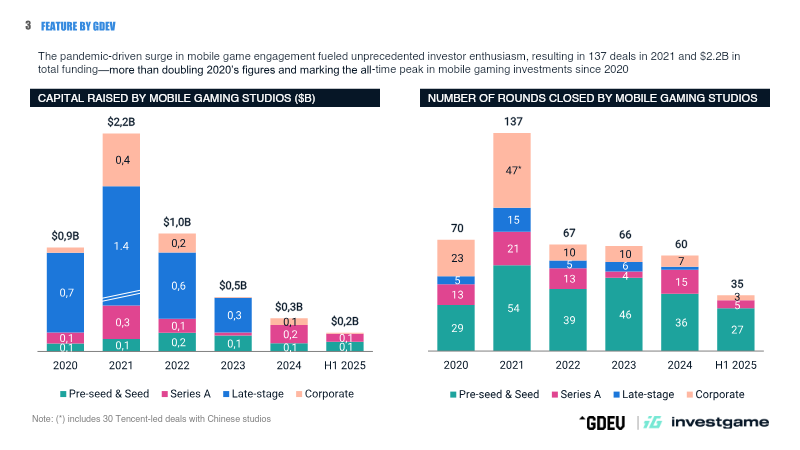
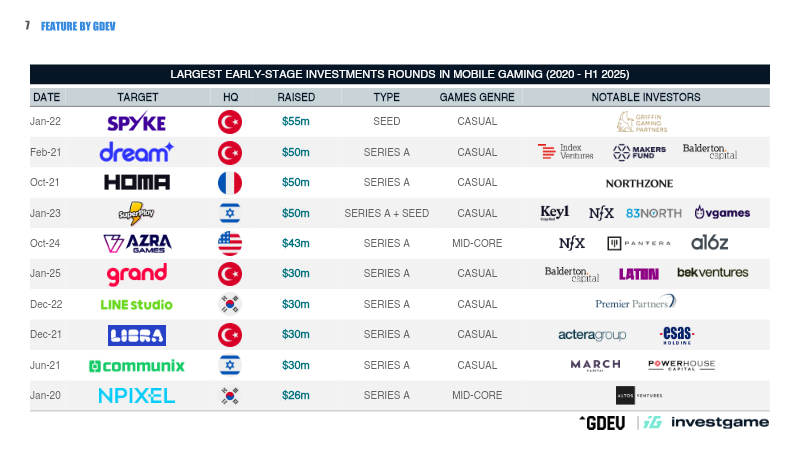
The analysis examines the evolution of mobile gaming investment and M&A activity from 2020 through the first half of 2025.
- Mobile gaming accounted for 61% of total gaming deal value (excluding ATVI) between 2020 and H1 2025, with strategic buyers and private equity firms driving nearly all deal volume in the first half of 2025.
- Strategic consolidation has replaced VC-led growth, highlighted by $7 billion in mobile M&A activity across six major deals, including Af’s $12.7 billion acquisition of 2yga and Scopely’s $4.9 billion purchase of GamesGroup.
- Venture capital interest has shifted heavily toward casual gaming, which now captures 65% of all deals due to its broader audience reach and faster iteration cycles.
$200M raised. 90% year-on-year growth. 500 million gamers in-market.
Nazara Technologies has established itself as a diversified global gaming powerhouse, currently pursuing a strategic objective to reach a $10 billion valuation.
- Nazara Technologies, India's first listed gaming company, has achieved 90% year-on-year growth and successfully raised $200 million in capital.
- The company follows a decentralized M&A strategy that prioritizes acquiring profitable studios with established IP, such as Fusebox Games and Curve Games, rather than forcing immediate operational synergies.
- Nazara emphasizes a 'cash-flow-first' DNA, focusing on profitability and sustainable growth rather than the high-burn models common in many gaming startups.
Why Did Microsoft Cut 9,000 Jobs This Year?
Microsoft’s recent workforce reductions, totaling approximately 15,000 positions across 2024, signal a period of significant instability within its gaming division.
- Microsoft cut approximately 15,000 positions across its gaming division in 2024, representing roughly 4% of the company's total workforce.
- The layoffs are attributed to a systemic management failure and a strategic pivot away from hardware toward a reliance on Game Pass and third-party partnerships.
- The acquisition of Activision Blizzard is identified as a primary catalyst for the current crisis, as the company struggles to generate sufficient returns by forcing high-value intellectual properties into a subscription-based model.
Stop Killing Games, Nuance, and Jobs! | Gaming News | Games For Breakfast
The video game industry is currently navigating a period of profound instability characterized by widespread corporate layoffs and a strategic pivot toward artificial intelligence.
- Microsoft has laid off 9,100 staff members as part of a broader industry-wide post-pandemic correction that has led to the cancellation of multiple high-profile projects.
- Consumer spending among the 18- to 29-year-old demographic has declined by 25%, driven by macroeconomic factors such as student debt and reduced disposable income.
- The 'Stop Killing Games' initiative has successfully triggered a formal review process within the European Union to address consumer concerns regarding the permanent loss of access to purchased digital software.
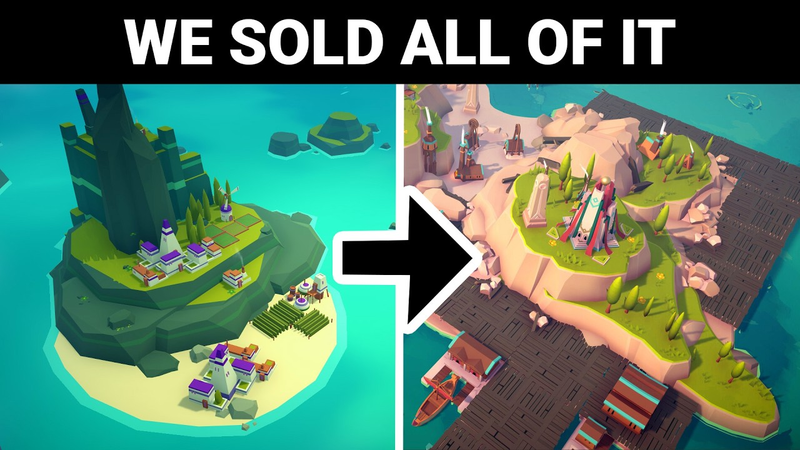
They Paid Us To Upgrade Our Indie Game
The sale of intellectual property (IP) by independent developers can serve as a viable strategy for both exiting a project and ensuring its continued development.
- Selling an indie game IP can be a viable exit strategy when the original developers no longer wish to maintain the project, as demonstrated by the sale of 'Islanders' to the porting studio Coatsync.
- The sale price for the 'Islanders' IP was approximately 1 to 2 times the total revenue the game had generated in the year following its initial release.
- Selling an IP can provide significant relief from the long-term stress of maintenance, porting, and community management, which the author notes can be exhausting and prone to contractual failures.
Week in Mobile Games E59 - A dark day for Xbox
Microsoft is currently navigating a period of profound instability characterized by massive workforce reductions affecting approximately 9,100 to 10,100 employees across key studios, including King, Rare, Turn 10, and Blizzard.
- Microsoft has initiated a significant restructuring of its gaming division, resulting in the closure of The Initiative, the cancellation of 'Ever Wild' and 'Warcraft Rumble', and substantial layoffs at studios including Rare, Raven Software, and Turn 10, which saw a 50% staff reduction.
- Microsoft's strategy to integrate Activision Blizzard IP into Game Pass has faced criticism for potentially devaluing premium franchises like Call of Duty without driving a commensurate surge in subscription growth.
- Microsoft's internal mobile gaming strategy remains fragmented, as the company struggles to translate its core console IP to mobile platforms, with King remaining focused on casual titles rather than midcore or high-end adaptations.
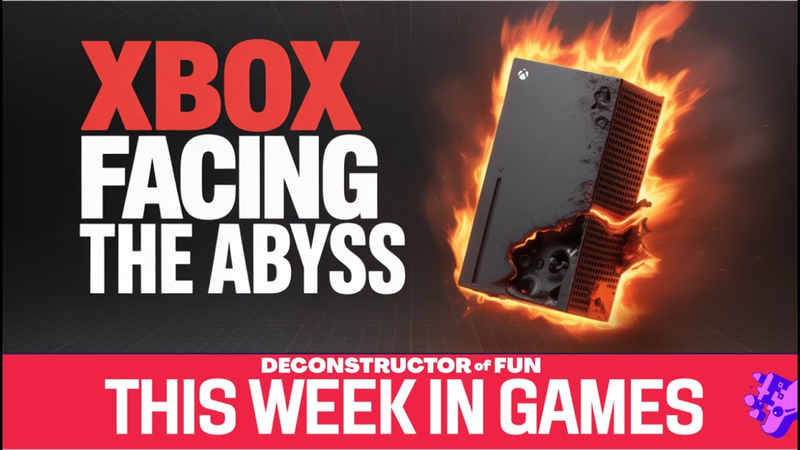
TWIG #338 Apple’s Cat-and-Mouse Game, Xbox's Doom Loop, and Splitgate 2’s $100M Misfire
The gaming industry is currently navigating a period of profound instability characterized by widespread workforce reductions and the failure of high-budget projects to capture market share.
- High-budget game launches are increasingly failing to gain traction, exemplified by the $130 million Splitgate 2, which failed to match the concurrent player counts of its predecessor due to a market dominated by entrenched titles like Fortnite and Counter-Strike 2.
- Microsoft’s strategic shift toward Game Pass and third-party hardware is creating a 'doom loop' that devalues its intellectual property and alienates its core consumer base.
- Long-term revenue stability is still possible through rigorous lifecycle management, as evidenced by Rainbow Six Siege generating $300–$400 million annually a decade after its initial release.
Week in Mobile Games E57 - The solitaire gold rush and Finland's new immigration rules bite
The mobile solitaire genre has undergone a period of rapid expansion, with global player spending climbing to $470.2 million in 2023, nearly double the figures recorded in 2019.
- The SAG-AFTRA strike in the games industry has ended with a deal that includes a 15.17% pay increase, guaranteed minimums for digital replica use, and protections regarding AI-generated voice and performance work.
- Mobile solitaire games generated $470.2 million in gross player spending in 2024, a figure that has roughly doubled since 2019 despite a slight decline from the 2023 peak of $564.7 million.
- Disney Solitaire has significantly outperformed Candy Crush Solitaire in revenue, generating $25 million compared to $8 million despite both titles sharing a similar download volume of approximately 7.7 million.
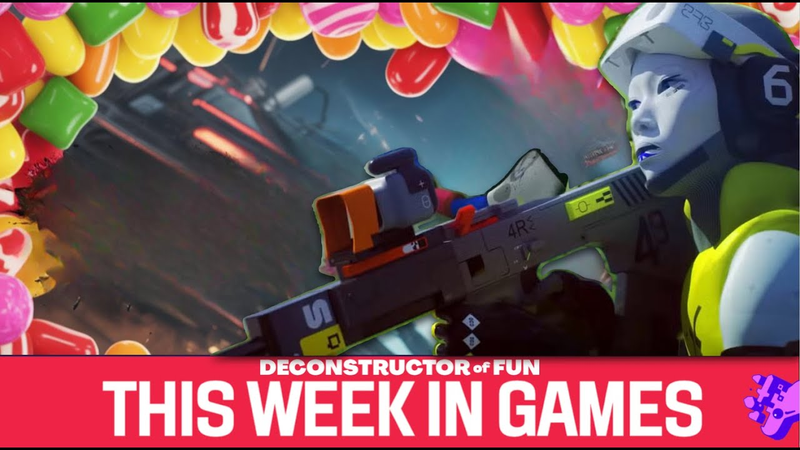
TWIG #336 Candy Crush Veterans Return as Marathon Runs Out of Steam
The global gaming industry is currently navigating a period of significant structural correction characterized by stagnant revenue growth, the collapse of over-leveraged studios, and a shift in consumer attention toward non-gaming entertainment.
- The mobile gaming sector has plateaued with a 4% year-over-year revenue increase, shifting the competitive focus from innovation to sophisticated monetization strategies.
- The traditional AAA development model is under severe pressure, as high-budget, single-title projects frequently fail to achieve market fit, leading to widespread studio closures and restructuring.
- Industry success is increasingly driven by a publishing-led model that mitigates risk through multiple product bets rather than the high-risk, single-title focus of the previous decade.

TWiG #335: Embrace CEO Exits, Pokémon meets Genshin, and Nintendo’s Mysterious On Switch
The current state of the gaming industry is defined by a tension between aggressive expansion and structural stagnation.
- Major conglomerates like Embracer Group are undergoing a prolonged recovery phase following the failure of aggressive, acquisition-heavy growth strategies to deliver sustainable results.
- Mobile publishers are attempting to combat market stagnation by blending mechanics, such as FunPlus combining creature collection with open-world exploration, while others like Habby refine midcore monetization.
- The gaming industry continues to rely on legacy intellectual property, specifically the Marvel franchise, as a primary risk mitigation strategy despite clear signs of consumer fatigue.
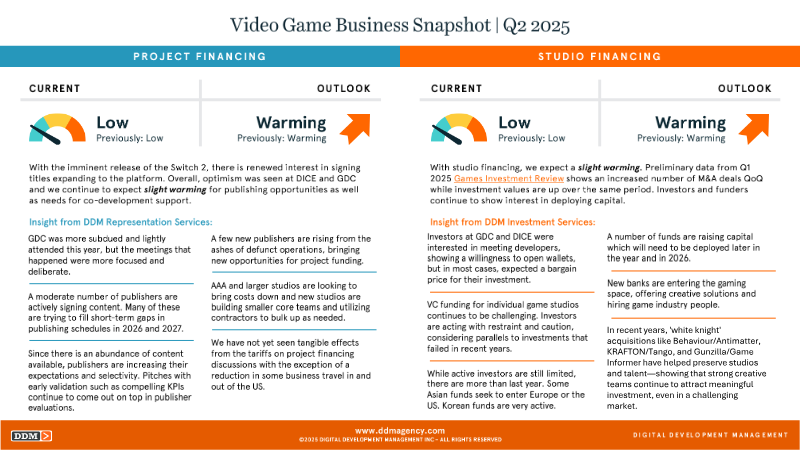
Video Game Business Snapshot: Q2 2025
The gaming industry is experiencing a period of cautious optimism as it enters the second quarter of 2025, characterized by a slight warming in both project and studio financing.
- Q2 2025 is defined by a surge in 'white knight' acquisitions, where major conglomerates are purchasing studios facing closure or downsizing to preserve creative talent and intellectual property.
- Notable rescue acquisitions this quarter include KRAFTON’s purchase of Tango Gameworks, Behaviour Interactive’s absorption of Antimatter, and Gunzilla Games’ involvement with Game Informer.
- The industry is shifting away from speculative growth toward strategic preservation, as large publishers prioritize securing proven development teams to stabilize long-term production pipelines.