Market Analysis
Documents

Global LiveOps Trends 2025
The global mobile gaming landscape in 2025 is characterized by a notable deceleration in overall market growth, with revenue increases stalling at 0.7% and download growth slowing to 4.1%. In response to this stagnation, developers are intensifying LiveOps strategies to sustain engagement and monetization. The average number of monthly events per game has risen to 89, shifting away from traditional holiday-centric scheduling toward persistent, competitive mechanics such as Win Streaks, Leaderboards, and various collection-based systems. This strategic pivot reflects a broader industry effort to maximize the lifetime value of existing player bases, particularly within the Midcore and Hybridcasual segments.
Genre performance is undergoing a significant realignment, as Puzzle and Strategy titles experience growth while RPG and Shooter categories face substantial declines. Midcore titles remain the primary drivers of revenue, relying on cooperative events and targeted monetization of high-spending players to maintain stability. Simultaneously, the Hybridcasual sector has emerged as a high-growth area, recording a 75% year-over-year revenue increase despite stagnant download figures. This success is largely attributed to the integration of Casual-style mechanics, such as Digging and Expedition events, which effectively boost session length and ad-based monetization.
The industry is currently defined by a move toward greater mechanical complexity and event density. By adopting diverse features like Stamp-based systems and Core Duplicates, developers are successfully diversifying their monetization strategies across different player archetypes. While Midcore games continue to prioritize whale-focused cooperative events, Hybridcasual titles are increasingly leveraging competitive, short-term engagement loops to drive performance. Ultimately, the 2025 market environment demonstrates that sustained success is no longer dependent on rapid user acquisition, but rather on the sophisticated, data-driven application of LiveOps to deepen engagement within established gaming ecosystems.
- The global mobile gaming market has stagnated, with revenue growth slowing to 0.7% and download growth to 4.1%, forcing a shift toward maximizing the lifetime value of existing players.
- Hybridcasual games have emerged as a high-growth sector, recording a 75% year-over-year revenue increase despite flat download numbers.
- LiveOps strategy has shifted toward high-frequency engagement, with the average number of monthly events per game rising to 89.
- Developers are moving away from holiday-centric calendars in favor of persistent, competitive mechanics like Win Streaks, Leaderboards, and collection-based systems.
- Genre performance is realigning, with Puzzle and Strategy titles showing growth while RPG and Shooter categories face substantial declines.
The Gaming and Interactive Media Opportunity in India
India’s gaming and interactive media sector is undergoing a rapid transformation, evolving from a $2.4 billion market into a projected $7.8 billion industry by fiscal year 2030. This growth is underpinned by a young, digitally native population, widespread smartphone penetration, and a robust digital payment infrastructure. While the industry is pivoting away from online money games due to regulatory shifts, the broader ecosystem is finding resilience through a transition toward core and mid-core digital gaming, esports, and emerging interactive media platforms.
The market is increasingly defined by a mobile-first approach that prioritizes culturally relevant, vernacular content to capture audiences in Tier 2 and Tier 3 cities. Domestic studios are scaling their capabilities to serve both local and global markets, leveraging generative AI and gamification to enhance user engagement. Monetization strategies are maturing alongside this expansion, moving toward in-app purchases, subscriptions, and nanotransactions facilitated by seamless payment systems like UPI AutoPay. These financial models are proving essential for the sustainability of diverse segments, including social discovery, audio streaming, and micro-dramas.
Niche sectors such as devotional tech and AI-driven companionship are also emerging as significant growth engines. By integrating localized storytelling and personalized digital services, these platforms address specific cultural needs and the rising demand for community-driven experiences. Although the industry faces ongoing challenges related to regulatory scrutiny, content authenticity, and the necessity of optimizing customer acquisition costs, the overall trajectory remains positive. The convergence of technological innovation and a deepening consumer appetite for interactive, short-form content positions India as a critical player in the global digital media landscape through the end of the decade.
- India’s gaming and interactive media market is projected to grow from $2.4 billion to $7.8 billion by fiscal year 2030.
- The industry is shifting its focus away from online money games toward core and mid-core digital gaming, esports, and interactive media platforms due to regulatory changes.
- Market expansion is driven by a mobile-first strategy that targets Tier 2 and Tier 3 cities through culturally relevant, vernacular content.
- Monetization is evolving toward sustainable models including in-app purchases, subscriptions, and nanotransactions, supported by digital infrastructure like UPI AutoPay.
- Domestic studios are increasingly utilizing generative AI and gamification to scale production and enhance user engagement for both local and global audiences.

Mobile App Trends: Türkiye 2025
The mobile app economy in Türkiye is experiencing a high-growth phase, characterized by a young, tech-savvy population and robust digital infrastructure. With 80.7 million active mobile connections and internet penetration reaching 87%, the market is maturing into a global competitor. The sector is supported by government incentives and a thriving startup ecosystem, with total revenue projected to reach $1.65 billion by 2029. This analysis, covering the period from January 2023 through July 2025, utilizes data from a mix of 5,000 top-performing apps and the broader dataset tracked by Adjust to benchmark performance across gaming, finance, and e-commerce verticals.
The gaming sector remains a primary driver of growth, with Türkiye’s studios achieving significant international success. In the first half of 2025, gaming installs in Türkiye grew 4% year-over-year, while sessions increased by 12%, significantly outpacing global and regional benchmarks. Average session lengths reached 32.8 minutes, reflecting high user engagement. While day-1 retention in Türkiye stands at 19%, the market shows shorter user lifecycles compared to global averages, suggesting a need for refined engagement strategies.
Finance and e-commerce apps are also evolving rapidly. Finance app installs surged 30% in the first half of 2025 compared to the same period in 2024, despite a slight decline in session lengths, which may indicate improved efficiency in user transaction flows. E-commerce apps demonstrated resilience, with a 4% increase in sessions during the first half of 2025, outperforming both global and MENAT regional trends. Retention rates in both sectors remain competitive, with Türkiye consistently exceeding regional and global medians.
A notable trend is the rapid expansion of AI-powered applications, which saw a 142.5% year-over-year increase in downloads in 2024. This growth is fueled by a shift of talent from hypercasual gaming to AI-first development and the creation of proprietary Turkish-language large language models. As the market matures, the integration of AI-driven personalization and streamlined, friction-free user experiences remains critical for developers aiming to capture and retain high-value audiences in this increasingly competitive landscape.
- The Turkish mobile app market is projected to reach $1.65 billion in revenue by 2029, supported by 80.7 million active mobile connections and 87% internet penetration.
- AI-powered applications experienced a 142.5% year-over-year increase in downloads in 2024, driven by a talent shift from hypercasual gaming to AI-first development.
- Finance app installs surged by 30% in the first half of 2025 compared to the same period in 2024, despite a slight decline in session lengths indicating more efficient transaction flows.
- Gaming sessions in Türkiye increased by 12% in the first half of 2025 with average session lengths of 32.8 minutes, significantly outpacing global and regional benchmarks.
- While gaming session engagement is high, day-1 retention stands at 19% with shorter user lifecycles than global averages, highlighting a need for improved engagement strategies.

Vorhaus Digital Strategy Study: All Findings
The 2025 digital landscape is defined by a fundamental transition in entertainment consumption, as smartphones and connected TVs have officially supplanted traditional television as the primary mediums for American audiences. This shift is accompanied by a broader decline in legacy pay TV services, with nearly a quarter of consumers signaling an intent to cancel subscriptions within the next year. While the streaming market remains highly competitive, with the average consumer maintaining 3.5 paid subscriptions, cost-sensitivity has emerged as the primary driver for churn. Simultaneously, digital engagement is deepening across gaming and social platforms, with 80% of the population now participating in gaming activities, reflecting a 4% increase since 2024.
Gaming has evolved into a central pillar of digital life, characterized by rising in-game spending and a growing preference for mobile platforms across all age groups, including those over 55. Discovery mechanisms are also shifting, as traditional advertising loses efficacy in favor of video-based gameplay content, which has become a critical influence for younger demographics. While interest in emerging technologies like the Metaverse, virtual reality, and augmented reality remains concentrated among the 18–34 cohort, adoption is tempered by broader consumer apprehension regarding data privacy and security. Furthermore, while the creator economy is expanding in terms of participation, monetization remains a significant hurdle, with many creators facing declining average earnings despite the rise of user-generated content platforms.
The demographic profile of this digital ecosystem is largely composed of educated, established homeowners, though self-identification varies sharply by age. Younger users increasingly embrace niche digital identities, whereas older cohorts lean toward mainstream engagement. Looking ahead, the integration of virtual goods and blockchain-based tracking presents a potential avenue for increased revenue, as a significant portion of gamers express a willingness to spend more if ownership and transferability of digital assets are secured. Despite this, cryptocurrency adoption remains limited, suggesting that while consumers are increasingly comfortable with digital transactions, they remain cautious regarding speculative financial technologies.
- Gaming participation has reached 80% of the U.S. population, marking a 4% increase since 2024 and establishing gaming as a primary pillar of digital engagement.
- Traditional pay TV is in decline, with nearly 25% of consumers planning to cancel their subscriptions within the next year as smartphones and connected TVs become the dominant media platforms.
- Cost-sensitivity is the primary driver of churn in the streaming market, where the average consumer currently maintains 3.5 paid subscriptions.
- Mobile gaming is the preferred platform across all age groups, including users over 55, while video-based gameplay content has replaced traditional advertising as the most effective discovery mechanism for younger demographics.
- While interest in the Metaverse, VR, and AR is concentrated in the 18–34 age demographic, widespread adoption is currently hindered by consumer concerns regarding data privacy and security.

Insights into the Japanese Gaming Market: 2025
The Japanese gaming market stands as a uniquely high-value ecosystem, generating 9.1% of global industry revenue despite accounting for only 2.2% of the worldwide player base. This disparity underscores a high average revenue per user driven by a mature demographic that prioritizes quality, depth, and domestic intellectual property. While Nintendo and established local publishers maintain a firm grip on the console sector, the landscape is undergoing a structural shift as PC gaming emerges as a critical growth engine, representing a substantial $2.5 to $3.0 billion opportunity for international entrants.
Success within this region necessitates a nuanced understanding of local consumer behavior, which diverges significantly from Western trends. Japanese players demonstrate a profound preference for narrative-driven, single-player role-playing games and fantasy-themed experiences, often eschewing the open-world, sports, and multiplayer-centric titles that dominate other major markets. This cultural specificity acts as a barrier to entry for many global publishers, who must tailor their content to align with these distinct aesthetic and gameplay expectations to achieve meaningful penetration.
Beyond cultural alignment, international companies must navigate complex macroeconomic conditions, most notably the volatility of the Japanese Yen. While the market remains a lucrative target, the combination of currency headwinds and the entrenched dominance of domestic franchises requires a strategic, long-term approach. By focusing on high-fidelity, story-rich experiences that resonate with the local appetite for solo play, external publishers can effectively capture a share of this high-margin market, provided they remain adaptable to the evolving preferences of the Japanese gaming audience.
- The Japanese gaming market generates 9.1% of global industry revenue despite representing only 2.2% of the worldwide player base, indicating an exceptionally high average revenue per user.
- PC gaming is a critical growth engine in Japan, representing a $2.5 to $3.0 billion opportunity for international publishers.
- Success in Japan requires prioritizing narrative-driven, single-player role-playing games and fantasy themes, which contrast with the multiplayer and sports-centric preferences of Western markets.
- Domestic publishers and Nintendo maintain a firm grip on the console sector, creating a high barrier to entry for international companies.
- International entrants must navigate macroeconomic challenges, specifically the volatility of the Japanese Yen, when planning market entry.

Games Industry Region Report: China 2025
China maintains its position as the world’s most lucrative and influential gaming market, generating $48.7 billion in total revenue during 2024. While the domestic landscape has faced challenges such as stringent regulatory licensing, rising production costs, and intense competition, the industry has successfully transitioned from a mobile-centric model toward the development of high-end, triple-A intellectual property. This evolution is underscored by the global success of titles like Black Myth: Wukong and the fact that Chinese companies or their subsidiaries now account for 14 of the top 30 highest-grossing games worldwide.
The financial performance of the sector remains robust, with mobile App Store revenue reaching $15.6 billion and PC gaming experiencing significant growth bolstered by platforms like Steam. Although domestic App Store downloads have receded from their 2020 peak, Chinese publishers have effectively offset this by expanding their international footprint, generating over $18.5 billion in worldwide gross revenue. Furthermore, the ecosystem is diversifying through the rise of accessible platforms such as WeChat Mini Games, which provide unique avenues for engagement alongside traditional gaming segments.
Looking toward the future, the Chinese games industry is poised to lead in the integration of artificial intelligence and the export of original, globally recognized content. As regulatory barriers show signs of easing, the market is increasingly fostering international collaboration, positioning itself as a strategic gateway for Western studios. By balancing domestic market saturation with aggressive global expansion, the region is cementing its role as a primary architect of the modern gaming landscape, moving beyond its historical reliance on mobile titles to become a comprehensive powerhouse of interactive entertainment.
- The Chinese gaming market generated $48.7 billion in total revenue in 2024, maintaining its status as the world's most lucrative region.
- Chinese publishers generated $18.5 billion in international gross revenue, successfully offsetting a decline in domestic App Store downloads from their 2020 peak.
- Chinese companies or their subsidiaries now account for 14 of the top 30 highest-grossing games worldwide, signaling a shift toward high-end, triple-A intellectual property.
- Mobile App Store revenue reached $15.6 billion in 2024, while PC gaming experienced significant growth supported by platforms like Steam.
- The domestic market is diversifying through the rise of WeChat Mini Games, which offer new engagement avenues alongside traditional gaming segments.
Monetization Landscape for Video Games in MENA
The gaming market across the MENA-3 region—comprising Saudi Arabia, the United Arab Emirates, and Egypt—is undergoing a period of rapid expansion, with total revenue projected to reach $2.7 billion by 2028. This growth is fueled by a confluence of high internet penetration, significant government investment, and a young, tech-savvy demographic. While the region presents a lucrative opportunity, it remains highly fragmented, necessitating nuanced monetization strategies that account for stark economic differences, such as the preference for premium and subscription models in wealthy Gulf states versus the dominance of free-to-play structures in Egypt.
A critical barrier to entry in this market is the low penetration of traditional credit cards, which has historically hindered revenue conversion. To address this, developers are increasingly shifting toward Direct-to-Consumer platforms. This strategic pivot allows companies to bypass high app store commissions while integrating essential local digital wallets and alternative payment methods. By adopting these flexible, localized payment infrastructures, developers can effectively reach the region’s significant unbanked and underbanked populations, ensuring broader accessibility and higher conversion rates.
Recent performance data underscores the efficacy of this localized approach, as evidenced by a 12.6% increase in regional sales and a 45% surge in games distributed through D2C ecosystems over the past two years. Long-term success in the MENA region depends on a developer’s ability to navigate these complex payment landscapes while simultaneously prioritizing cultural adaptation. By combining region-specific pricing strategies with multi-platform engagement, stakeholders can better capitalize on the region’s burgeoning digital economy and secure a sustainable foothold in this high-growth market.
- The MENA-3 gaming market (Saudi Arabia, UAE, and Egypt) is projected to reach $2.7 billion in total revenue by 2028.
- Direct-to-Consumer (D2C) distribution has surged by 45% over the past two years, helping developers bypass app store commissions and integrate local payment methods.
- Localized payment strategies, including the integration of digital wallets, have contributed to a 12.6% increase in regional sales.
- Monetization models must be bifurcated by economic region, favoring premium and subscription services in wealthy Gulf states while prioritizing free-to-play structures in Egypt.
- Low traditional credit card penetration remains a primary barrier to entry, necessitating the adoption of alternative payment infrastructures to capture unbanked and underbanked demographics.

PC & Console Year in Review: 2025
The 2025 PC and Console Year in Review provides a comprehensive analysis of the global gaming landscape, focusing on market performance, consumer behavior, and development trends. The primary thesis highlights that while pre-launch marketing and wishlist campaigns remain foundational for success, post-release player reception and the integration of social, co-op elements are the primary drivers of long-term revenue and sustainability. The analysis covers the period from January 1, 2025, through late 2025, utilizing proprietary data estimates to track sales, player engagement, and platform distribution across global markets.
Key findings indicate that the premium game market remains dominant, accounting for 78% of Steam’s $16.8 billion revenue. Indie developers continue to capture significant market share, contributing over 25% of Steam’s total revenue, with "Triple-I" titles demonstrating exceptional return on investment. Geographically, China has solidified its position as a critical market, serving as the top region for Steam and a major driver for both Western and Eastern-developed titles. Furthermore, the data reveals a shift in marketing efficacy; while wishlist counts are rising, conversion rates are declining, forcing studios to experiment with in-game incentives and community-driven engagement strategies.
Genre trends show that action, adventure, and RPG titles continue to lead in player interest, though "cute" and atmospheric games experienced significant year-over-year growth in revenue. Co-op mechanics have emerged as a vital pillar for commercial success, with 11 of the top 20 highest-grossing titles featuring cooperative elements. From a technical perspective, Unreal Engine maintains its status as the market leader for AA and AAA development, while many studios continue to leverage proprietary engines for large-scale projects. The report concludes that while pre-launch hype is a useful tool for visibility, the post-release sales trajectory is ultimately dictated by player sentiment and the ability of a title to foster sustained social interaction.
- Premium games dominate the market, accounting for 78% of Steam’s $16.8 billion total revenue in 2025.
- Cooperative gameplay is a primary driver of commercial success, with 11 of the top 20 highest-grossing titles featuring co-op mechanics.
- Indie developers contribute over 25% of Steam’s total revenue, with 'Triple-I' titles delivering exceptional return on investment.
- China has become the top global region for Steam, serving as a critical market for both Western and Eastern-developed titles.
- Marketing efficacy is shifting as wishlist counts rise while conversion rates decline, necessitating a move toward in-game incentives and community-driven engagement.

From Data to Personas: The 2025 Guide to US Gaming Audiences
The modern gaming landscape in the United States has evolved into a diverse, cross-generational ecosystem that fundamentally challenges outdated stereotypes of the solitary, young male player. Current data indicates that today’s gaming population is characterized by middle-to-high-income individuals who prioritize quality, convenience, and social connectivity. Far from being sedentary, these consumers frequently integrate digital play with active, outdoor lifestyles, sports participation, and family-oriented activities. This shift reflects a broader demographic reality where gaming serves as a primary form of entertainment across all age groups and socioeconomic backgrounds.
Consumer behavior within this segment extends well beyond the digital realm, as gamers demonstrate significant purchasing power and a strong affinity for premium brands, casual dining, and higher education. Analysis reveals a consistent tendency for these audiences to over-index on online shopping and delivery services, favoring mainstream, value-oriented brands across the retail and fitness sectors. These habits suggest that gaming is not an isolated hobby but a central component of a lifestyle defined by convenience and digital-physical integration.
Segmentation reveals distinct behavioral patterns that allow for more nuanced marketing strategies. For instance, sports-oriented gamers gravitate toward fast-food and convenience-driven brands, whereas those who favor board, puzzle, and trivia games tend to be older, more education-focused, and financially prudent. By moving past monolithic industry tropes, advertisers can leverage these granular insights to execute more precise, data-driven campaigns. Ultimately, the gaming audience represents a highly active, diverse, and economically influential consumer base that requires sophisticated engagement strategies tailored to specific lifestyle personas rather than generalized assumptions.
- The US gaming population is characterized by middle-to-high-income individuals who integrate digital play into active, outdoor, and family-oriented lifestyles rather than operating as a sedentary, isolated demographic.
- Gamers demonstrate significant purchasing power with a strong affinity for premium brands, higher education, and convenience-based services like online shopping and delivery.
- Gaming has evolved into a cross-generational, mainstream form of entertainment that transcends traditional age and socioeconomic stereotypes.
- Consumer behavior within the gaming segment is highly segmented, with sports-oriented gamers favoring fast-food and convenience brands, while puzzle and trivia gamers skew older and more financially prudent.
- Effective marketing in 2025 requires moving away from monolithic industry tropes in favor of granular, data-driven strategies tailored to specific lifestyle personas.

Games Industry Employment Survey: Europe 2025
The European games industry is currently navigating a period of profound instability, characterized by widespread layoffs and a significant exodus of talent. Over the past year, 26% of professionals have faced involuntary unemployment, with junior-level staff suffering a disproportionate 39% exit rate. This volatility is driven by a transition from rapid market expansion to a focus on operational optimization, further complicated by the rapid integration of artificial intelligence. While 63% to 69% of the workforce now utilizes AI for core tasks, this shift has fostered deep-seated skepticism among creative and quality assurance roles regarding long-term job security and the potential devaluation of human expertise.
Financial dissatisfaction has become a defining feature of the current landscape, exacerbated by salary freezes, reduced bonuses, and a persistent gender pay gap. With over a third of companies eliminating financial bonuses entirely, salary has emerged as the primary motivator for 87% of employees. This economic pressure, combined with a lack of structured support—such as the absence of dedicated diversity and inclusion specialists in 67% of firms—has contributed to a sharp decline in employee engagement. Burnout, affecting up to 63% of the workforce, and ineffective management are now the leading drivers for professionals considering career changes or leaving the industry altogether.
Despite these challenges, the workforce remains committed to hybrid work models, though a growing disconnect exists between employee preferences for flexibility and actual workplace mandates. Relocation trends have shifted toward a pragmatic focus on cost-of-living stability rather than traditional geographic mobility. As the industry matures, the data underscores a critical need for improved management practices and better alignment between organizational goals and employee well-being to mitigate the ongoing loss of talent and restore professional morale across the European sector.
- The European games industry is experiencing significant volatility, with 26% of professionals facing involuntary unemployment and a 39% exit rate among junior-level staff.
- Financial dissatisfaction is widespread, as 87% of employees now prioritize salary above all else following salary freezes and the elimination of bonuses at over one-third of firms.
- Burnout affects up to 63% of the workforce, serving as a primary driver for professionals considering leaving the industry alongside ineffective management practices.
- While 63% to 69% of employees now utilize AI for core tasks, the integration has triggered deep skepticism regarding job security and the devaluation of human expertise.
- Organizational support structures are lacking, evidenced by the absence of dedicated diversity and inclusion specialists in 67% of European gaming companies.
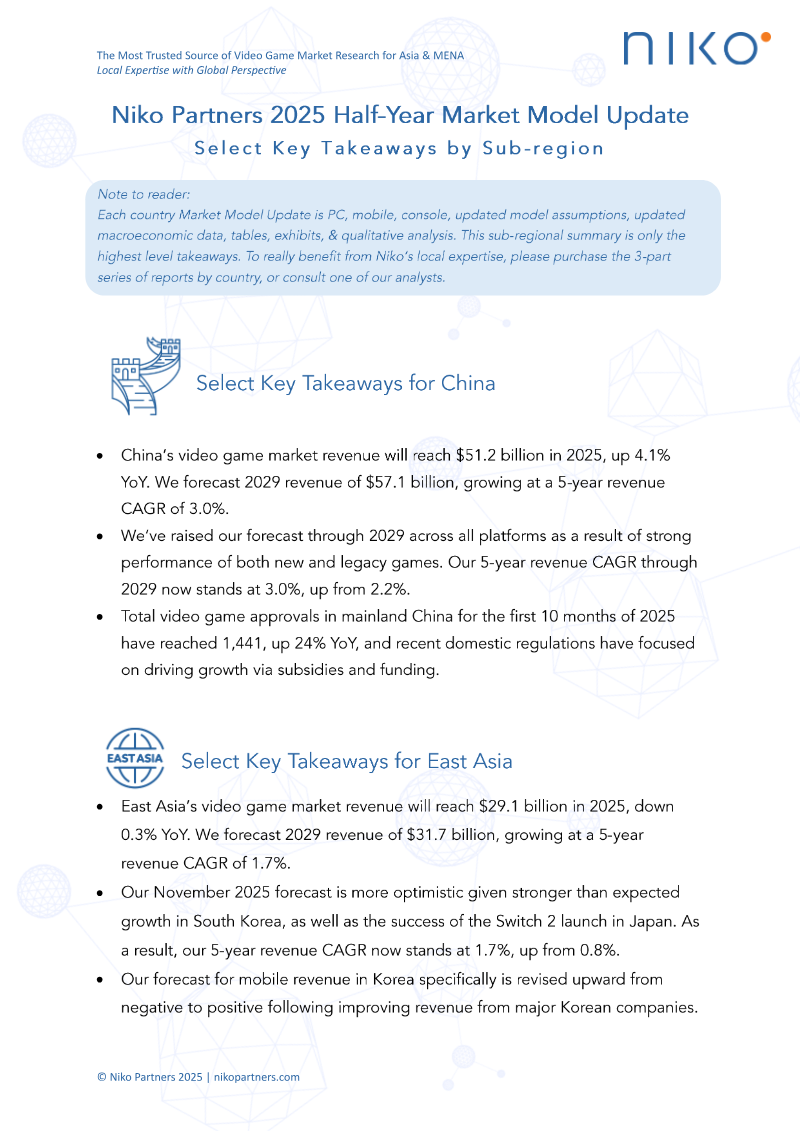
2025 Half-Year Market Model Update: Asia & MENA
The 2025 Half-Year Market Model Update provides a comprehensive assessment of the video game industry across Asia and the Middle East and North Africa (MENA) region. By synthesizing macroeconomic data, platform-specific performance metrics, and regulatory developments, the analysis offers updated revenue forecasts through 2029 for key markets, including China, East Asia, India, Southeast Asia, and the MENA-3 region. The primary objective is to adjust long-term growth expectations based on recent industry performance, government policy shifts, and evolving consumer behavior.
Regional performance varies significantly, with India emerging as a high-growth market, projected to reach $1.1 billion in 2025 with a robust 12.9% five-year compound annual growth rate (CAGR). China remains the dominant market, with 2025 revenue expected to hit $51.2 billion, supported by a 24% year-over-year increase in game approvals. Conversely, East Asia and Southeast Asia show more moderate growth trajectories, with five-year CAGRs of 1.7% and 3.5%, respectively. The MENA-3 region is forecasted to reach $2.2 billion in 2025, though long-term projections have been tempered by economic headwinds in Egypt and slower mobile growth in Saudi Arabia and the UAE.
Methodologically, these insights are derived from proprietary market models that integrate platform-specific data for PC, mobile, and console segments. The analysis highlights the critical role of government intervention, such as the PROG act in India and regulatory subsidies in China, in shaping market expansion. By updating previous forecasts to reflect current fiscal realities and hardware cycles, such as the Switch 2 launch in Japan, the findings offer a refined outlook for stakeholders navigating the complex regulatory and economic landscapes of these diverse geographic segments.
- China remains the dominant regional market with projected 2025 revenue of $51.2 billion, bolstered by a 24% year-over-year increase in game approvals.
- India is positioned as a high-growth market expected to reach $1.1 billion in 2025 with a 12.9% five-year compound annual growth rate (CAGR).
- The MENA-3 region is forecasted to reach $2.2 billion in 2025, though long-term growth is tempered by economic headwinds in Egypt and slowing mobile performance in Saudi Arabia and the UAE.
- East Asia and Southeast Asia exhibit moderate growth trajectories, with five-year CAGRs of 1.7% and 3.5%, respectively.
- Market expansion across these regions is increasingly driven by government policy, including the PROG act in India and regulatory subsidies in China.

Video Gaming Report 2025: How Platforms Are Colliding and Why This Will Spark the Next Era of Growth
The global video game industry is currently emerging from a three-year period of stagnation, transitioning toward a future defined by platform convergence and hardware-agnostic ecosystems. The traditional era of console-centric competition is being replaced by a multiplatform landscape where success is increasingly dictated by community engagement, user-generated content, and discoverability. This structural shift is underpinned by the integration of generative AI, the expansion of cloud gaming, and the diversification of distribution channels, which collectively aim to move the industry beyond the limitations of legacy hardware.
Cloud gaming is projected to reach $18.3 billion in revenue by 2030, serving as a primary catalyst for this growth. However, this transition introduces significant challenges, most notably the risk of market saturation caused by an influx of low-quality, AI-generated content. To maintain profitability and relevance, developers are pivoting toward direct-to-consumer monetization strategies, including tiered pricing models, windowing, and the integration of in-game advertising. These tactics are designed to capture value from a increasingly price-conscious global player base while navigating a shifting regulatory environment.
The dominance of incumbent app stores is simultaneously being challenged by the rise of developer-owned webstores and alternative distribution platforms. While these new channels offer the potential for improved margins and deeper player relationships, their long-term viability depends on the industry’s ability to address consumer concerns regarding security and platform convenience. Ultimately, the next era of growth will be defined by the ability of stakeholders to balance technological innovation with the necessity of fostering sustainable creator economies, ensuring that discoverability remains the central pillar of the modern gaming experience.
- Cloud gaming is projected to reach $18.3 billion in revenue by 2030, acting as a primary driver for industry growth as the market moves toward hardware-agnostic ecosystems.
- The industry is shifting from console-centric competition to a multiplatform model where success depends on user-generated content, community engagement, and discoverability.
- Developers are adopting direct-to-consumer monetization strategies—including tiered pricing, windowing, and in-game advertising—to address a price-conscious global player base.
- The rise of developer-owned webstores and alternative distribution platforms is challenging the dominance of incumbent app stores to improve margins and deepen player relationships.
- Market saturation caused by an influx of low-quality, AI-generated content poses a significant risk to profitability and requires a focus on sustainable creator economies.