1 free read left. Create a free account for unlimited reading + AI research.
Create free accountReport Ukie
Ukie
1 free read left. Create a free account for unlimited reading + AI research.
Create free accountReportUkie
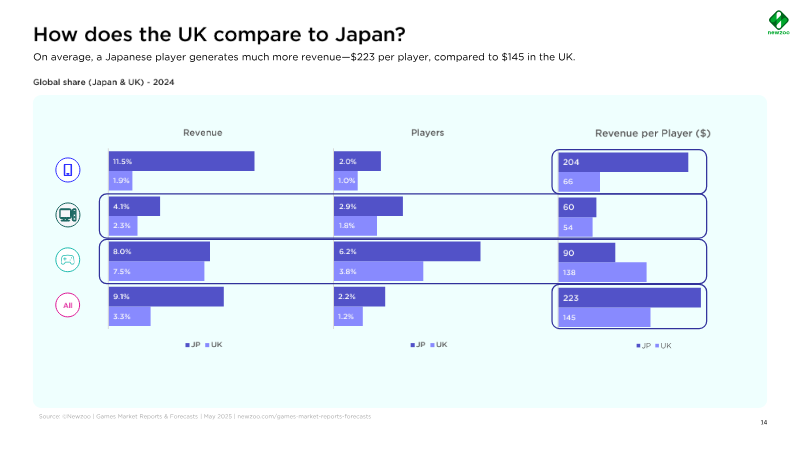
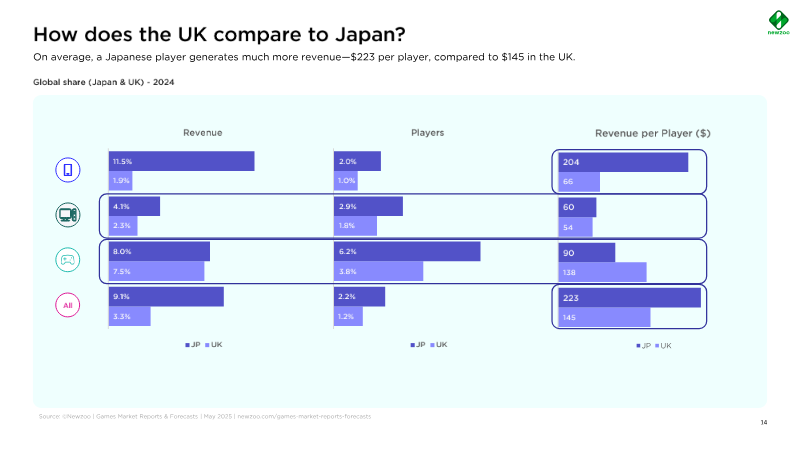
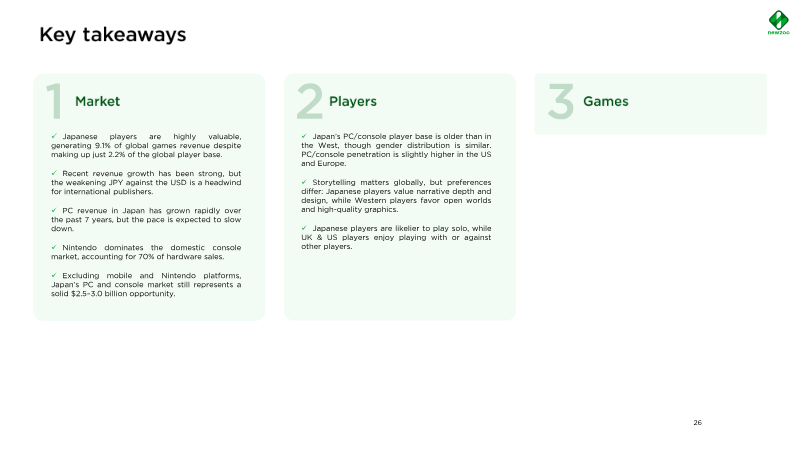
Japan’s average per-player spend is $223, compared with $145 in the UK. The PC and console segment represents a $2.5–3.0 billion opportunity.
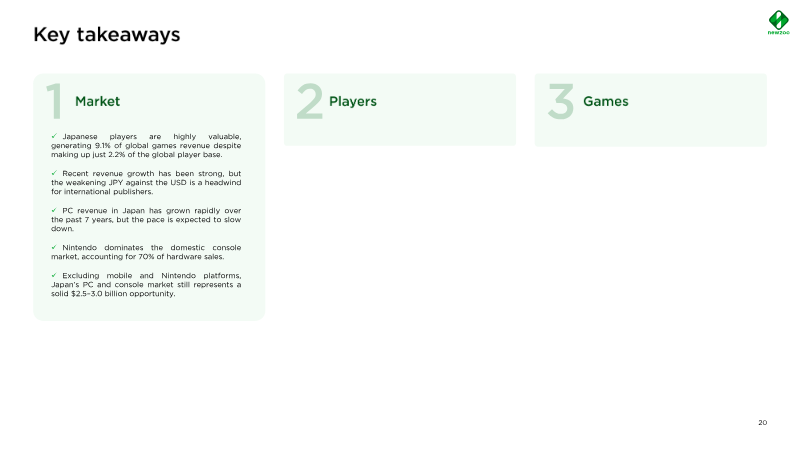
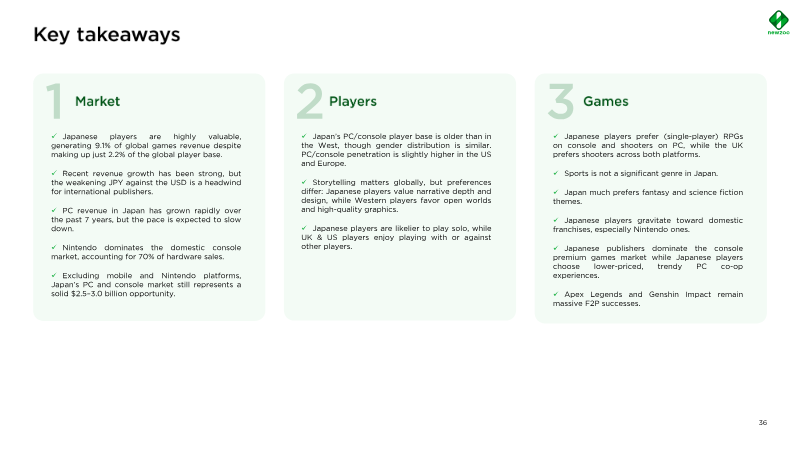
The report examines Japan’s interactive entertainment market for 2025, aiming to guide UK game developers and publishers in entering or expanding within a culturally distinct yet lucrative region. Japan accounts for only 2.2% of the global player base but generates 9.1% of worldwide game revenue, underscoring high per-player spend—$223 in Japan versus $145 in the UK. The PC and console segment, excluding mobile and Nintendo platforms, represents a $2.5–3.0 billion opportunity.
Key market dynamics include an older player demographic than the US and Europe, a strong preference for single-player role-playing games with deep narratives, and a dominance of domestic publishers—70% of console hardware sales are controlled by Japanese firms. Nintendo’s presence is particularly pronounced, while sports titles remain marginal. Revenue growth has been robust, with PC revenue rising 16.2% YoY in 2024 versus a global 4.4% increase, though the pace is expected to decelerate as the Japanese yen weakens against the dollar.
Methodologically, insights derive from Newzoo’s flagship global gamer study and proprietary market intelligence tools, sampling 73 000 gamers across PC and console platforms. The analysis covers player overlap, retention, and engagement metrics (DAU/MAU), and includes forecasted growth through 2027. The report concludes that strategic localization—emphasizing narrative depth, fantasy and science-fiction themes, and solo play experiences—will be critical for success in Japan’s competitive landscape.



Ukie · 2026
Ukie · 2026


Ukie · 2026


Ukie · 2026


Ukie · 2026
Ukie · 2026
Ukie · 2026
Ukie · 2026
Ukie · 2026



Ukie · 2025

Ukie · 2025
Ukie · 2025
CESA – Computer Entertainment Supplier's Association · 2021