Investment
Documents
Gaming VC Trends: Q2 2025
The report examines global venture capital activity in the gaming sector through Q2 2025, highlighting a pronounced contraction in deal volume and value compared with the prior year. Total venture capital raised fell to $904.6 million across 113 closed rounds, a 27.2% QoQ decline and 47.6% YoY drop; the run‑rate projects a 31.1% annual pullback, marking the steepest deceleration since 2023. Deal concentration remains high, with late‑stage and venture‑growth rounds accounting for nearly 40% of transactions despite a historic low in early‑stage activity, which now represents just 61.1% of deals.
Median deal size rose 19% to $5 million, while pre‑money valuations climbed 41.7%, reaching $29.9 million YTD. Content development continues to dominate, capturing half of all deals and two‑thirds of exit value; it raised $261.5 million in Q2 versus $512.6 million for gametech/SaaS startups, yet exits remain sparse with only $347.7 million in VC‑ and PE‑backed deals YTD, the lowest run‑rate observed. Geographic focus shifted toward emerging markets—India, Singapore, Argentina, Brazil—where content studios secured multi‑million rounds.
Methodologically, data derive from PitchBook’s proprietary database, covering global transactions as of June 30 2025. The analysis aggregates quarterly and trailing‑12‑month figures, disaggregating by stage, segment, and geography to illustrate shifting investor sentiment amid rising development costs, saturated content supply, and regulatory pressures on platform fees.
- Global gaming venture capital plummeted in Q2 2025, with total funding falling to $904.6 million, representing a 27.2% quarterly decline and a 47.6% drop year-over-year.
- Median deal sizes increased by 19% to $5 million, while pre-money valuations surged 41.7% to $29.9 million year-to-date, signaling a shift toward higher-cost, later-stage investments.
- Early-stage deal activity has hit a historic low, now accounting for only 61.1% of transactions, while late-stage and venture-growth rounds have consolidated to represent nearly 40% of the market.
- Gametech and SaaS startups outperformed content development in capital raised, securing $512.6 million compared to $261.5 million for content studios in Q2.
- Exit activity remains at a record low, with only $347.7 million in VC- and PE-backed deals recorded year-to-date.

The Take-Two Diaspora: Why Alumni Win Big in Mobile, Not AAA
The analysis examines the investment trajectory of companies founded by former senior executives from Take‑Two Interactive and its subsidiaries. From 2020 to the present, alumni have launched 23 startups that collectively attracted $1.2 billion in capital across 43 deals, with the most substantial transaction being Dream Games’ $2.5 billion sale in July 2025. The portfolio spans mobile casual titles, instant‑play games, sports apps, and publishing ventures, but shows a pronounced skew toward mobile platforms rather than AAA titles.
Key financial metrics reveal that alumni‑led firms secured an average early‑stage check of $12 million, with mobile projects commanding the largest median ($22.6 million) and multiplatform deals following closely. In 2021–2022, the cohort’s subsequent‑round funding rate was nearly four times the industry average, and 60 % of companies raised a second round within a year versus 20 % for comparable VC‑backed gaming startups. The most active investors include Dream Ventures, Balderton Capital, and LORIC, each contributing between $40 million and $575 million across multiple alumni deals.
Geographically the activity is concentrated in North America, with notable studios such as Dream Games (San Francisco), Build a Rocket Boy (London), and Spyke Games (Los Angeles). The time frame covers 2020–2025, covering both pre‑pandemic and post‑pandemic market dynamics. Methodologically, the study aggregates venture, corporate, and strategic investment data from public filings, press releases, and proprietary databases, focusing on firms whose founders held senior roles at Take‑Two or its subsidiaries. The findings underscore a robust pipeline of mobile‑centric startups emerging from the Take‑Two alumni network, delivering high valuation exits and rapid follow‑on funding relative to broader gaming benchmarks.
- Former Take-Two senior executives founded 23 startups between 2020 and 2025, securing $1.2 billion in capital across 43 deals.
- Dream Games, a prominent alumni-led studio, achieved a $2.5 billion exit in July 2025, highlighting the high valuation potential of these ventures.
- Alumni-led firms significantly outperform industry benchmarks, with a 60% rate of raising a second funding round within one year compared to the 20% industry average.
- Investment is heavily skewed toward mobile platforms, which command the highest median early-stage funding at $22.6 million per deal.
- Between 2021 and 2022, the alumni cohort secured subsequent-round funding at nearly four times the rate of comparable VC-backed gaming startups.

Beyond the Game: How Gamification is Becoming Mainstream
The analysis examines how gamification—applying game‑like mechanics such as streaks, leaderboards, and reward loops—to non‑gaming consumer apps has shifted the mobile app economy over a five‑year period (2020‑2025). Data from 208 transactions totaling $20.7 billion reveal that EdTech, Fitness & Wellness, and Entertainment & Social are the primary verticals, with deal value shares of roughly 40 %, 37 %, and 23 % respectively. EdTech dominates both deal volume (43 %) and exit activity, accounting for 45 % of exits and 34 % of exit value, indicating a mature market attractive to strategic buyers. Fitness & Wellness shows concentrated exits in two mega‑deals (Headspace $3 billion, Fitbit $2.1 billion) but a broader spread of capital across many platforms, suggesting growth potential beyond the top brands. Entertainment & Social receives steady, diversified investment; its exits lean toward IPOs (e.g., Reddit, NetEase Cloud Music) rather than M&A, reflecting limited strategic buyer appetite.
Capital flows peaked during the 2020‑21 COVID boom but recovered quickly for gamified apps, with 2024 stabilizing and 2025 YTD already surpassing full‑year 2024 figures. Seed and Series A rounds remain active, while late‑stage activity accelerated in 2025 following earlier Series A momentum. Early‑stage capital is evenly split between Fitness & Wellness and Entertainment & Social, highlighting a white‑space opportunity, whereas EdTech shows limited early‑stage activity due to market consolidation.
The report underscores that non‑gaming apps have overtaken mobile games in net revenue (Q2 '25: $21.2 billion vs. $19.8 billion) and are driving 24 % YoY mobile spend growth, while games stagnated. This structural shift signals that institutional capital increasingly targets gamified consumer apps across these three verticals, with strategic buyers actively consolidating the EdTech segment and exploring IPO pathways in Entertainment & Social.
- Gamified non-gaming apps have surpassed mobile games in net revenue, generating $21.2 billion in Q2 2025 compared to $19.8 billion for games.
- Gamified apps are driving a 24% year-over-year growth in mobile consumer spending, while traditional mobile gaming revenue has stagnated.
- EdTech, Fitness & Wellness, and Entertainment & Social account for $20.7 billion in transaction value, with EdTech dominating deal volume (43%) and exit activity (45%).
- Capital flow for gamified apps has recovered from the post-2021 decline, with 2025 year-to-date investment already exceeding the total figures for 2024.
- Fitness & Wellness shows high growth potential with capital spread across many platforms, despite being anchored by mega-deals like the $3 billion Headspace and $2.1 billion Fitbit acquisitions.

Middle East & Africa Gaming Review 2025
The Middle East and Africa gaming landscape is poised for rapid expansion, with market value projected to rise from US $7.4 billion in 2024 to over US $19.4 billion by 2033, reflecting an 11 % CAGR driven largely by mobile-first adoption and a vibrant startup ecosystem. Key hubs—Saudi Arabia, UAE, Turkey, Israel, and emerging African markets—are attracting substantial investment, hosting record‑setting esports events such as Saudi Arabia’s $70 million World Cup, and positioning the region as a growing share of the global gaming economy. Mobile dominance, government‑backed visions, and esports infrastructure are reshaping competitive dynamics across the region.
Funding flows reveal a highly concentrated investment landscape dominated by global players and regional leaders. Israel leads with nearly US $1 billion raised across 146 startups, followed by Turkey’s $961 million and Nigeria’s $371 million. The UAE lags behind but is rapidly scaling, with Dubai Vision 2033 earmarking $1 billion for talent and tech to achieve a $200 billion GDP contribution by 2033. Turkey’s “unicorn factory” status is underscored by Peak Games’ $1.8 billion acquisition and Dream Games’ record $2.6 billion raise, while Saudi Arabia’s Vision 2030 funding fuels a burgeoning local ecosystem that could produce future unicorns.
Digital payment adoption and Web3 innovation are accelerating growth, particularly in the UAE where blockchain publishing and VR/Metaverse platforms such as Fenix Games and True Gamers are attracting capital. In Africa, mobile-first adoption has driven revenue to $1.8 billion in 2024, with Egypt, South Africa and Nigeria dominating startup activity. The continent’s youthful demographics and entrepreneurial momentum position it as a dynamic frontier, with African studios like Sea Monster gaining traction through capital, mentorship and infrastructure support.
Legacy hardware sales remain a key revenue driver, with story‑rich single‑player titles and console sales generating multi‑billion dollar revenues. However, the rise of subscription models, microtransactions and expansion packs is reshaping monetisation strategies across all segments. Overall, the Middle East and Africa are emerging as a mobile‑first, VC‑backed powerhouse with significant potential for global influence in gaming and esports.
- The Middle East and Africa gaming market is projected to grow from $7.4 billion in 2024 to over $19.4 billion by 2033, representing an 11% CAGR driven by mobile-first adoption.
- Investment is highly concentrated, with Israel leading at nearly $1 billion raised across 146 startups, followed by Turkey at $961 million and Nigeria at $371 million.
- Turkey has established itself as a 'unicorn factory' through major deals, including Peak Games’ $1.8 billion acquisition and Dream Games’ $2.6 billion capital raise.
- The UAE is aggressively scaling its gaming sector via the Dubai Vision 2033 initiative, which earmarks $1 billion for talent and technology to boost GDP contribution.
- Africa’s gaming revenue reached $1.8 billion in 2024, with Egypt, South Africa, and Nigeria serving as the primary hubs for startup activity and entrepreneurial momentum.
Where the UGC Dollars Flow: Mapping $9B Investments in Creator Economy
The analysis maps a $9 billion investment wave in user‑generated content (UGC) gaming from 2020 to 2025, covering roughly 80 companies and titles. Early‑stage rounds (pre‑seed to Series A) account for $0.5 billion, while late‑stage and corporate deals bring the total to $8.9 billion, including major platform names such as Roblox, Epic Games (Fortnite), Linden Lab, and Sandbox. Corporate venture capital and strategic investors contribute $3.5 billion, with notable commitments from Sony/Kirkbi ($2 billion in 2022) and Disney ($1.5 billion in 2024). Modding ecosystems—overwolf, mod.io, CurseForge—receive $0.4 billion in VC or M&A activity.
The report tracks engagement metrics, noting Roblox’s 73.5 billion logged hours in 2024 and a peak concurrent user base of 21 million, while Fortnite Creative stabilizes around 1.3 million concurrent users. Creator payouts have risen sharply, with Roblox and Fortnite together disbursing approximately $1.5 billion to developers in 2024, and quarterly earnings showing a 38 % increase from Q2 23 to Q3 23.
Funding follows a classic hype cycle: an initial surge during Roblox’s IPO and metaverse buzz (2020‑21), a pullback in 2022, and renewed strategic investment from incumbents in 2023‑24. Early‑stage rounds remain steady, averaging 12–15 deals per year, targeting “next Roblox/Fortnite” platforms and infrastructure. The largest early‑stage investments include $50 million raised by YAHAHA in 2020 and multiple $15–40 million Series A rounds for platforms such as ZAllbaba, Manticore, and Lighforge.
Overall, the data illustrate a mature UGC ecosystem that has evolved from hobbyist modding to professionalized creator economies, with sustained capital inflows and growing monetization pathways for both platforms and individual creators.
- The UGC gaming sector attracted $9 billion in total investment between 2020 and 2025, with $8.9 billion concentrated in late-stage and corporate deals.
- Strategic investment from industry incumbents is a primary driver, highlighted by Sony/Kirkbi’s $2 billion commitment in 2022 and Disney’s $1.5 billion investment in 2024.
- Creator monetization is scaling rapidly, with Roblox and Fortnite collectively disbursing approximately $1.5 billion to developers in 2024 and reporting a 38% quarterly earnings increase between Q2 and Q3 2023.
- Roblox remains the dominant platform with 73.5 billion logged hours in 2024 and 21 million peak concurrent users, while Fortnite Creative maintains a stable base of 1.3 million concurrent users.
- Early-stage funding remains consistent at 12–15 deals per year, focusing on infrastructure and platforms attempting to replicate the success of established leaders like Roblox and Fortnite.
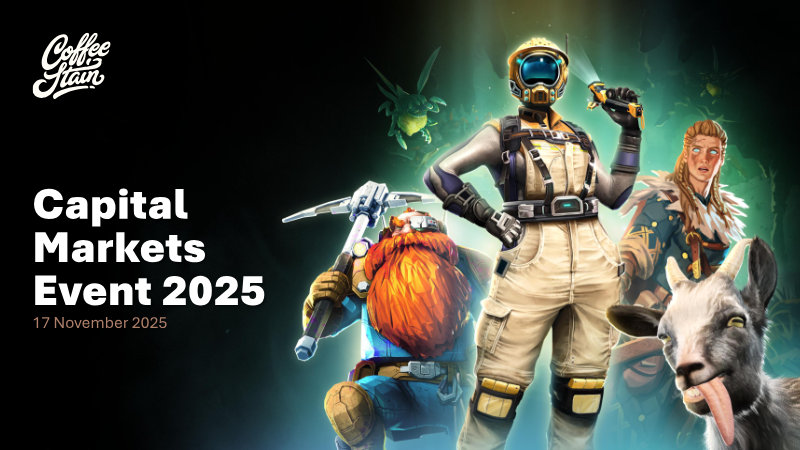
Capital Markets Event 2025: Coffee Stain Group
Capital Markets Event 2025 showcases the Coffee Stain Group’s strategy of building a portfolio around small, autonomous teams that prioritize gameplay quality and community engagement. Ninety percent of net sales derive from a handful of flagship titles—most notably Goat Simulator, Deep Rock Galactic and Satisfactory—which consistently achieve high review scores (above 96 %) and generate lifetime sales up to SEK 2 bn. The company’s partnership model, publishing and investing in niche‑focused games, sustains long‑term value through continuous content updates and a symbiotic developer‑player relationship.
The global gaming market is projected to grow at 3 % CAGR across all platforms, driven by rising consumer spend and the expansion of Steam, mobile, Game Pass and PlayStation Plus. Despite saturation and increased competition for player attention, Coffee Stain maintains a strong presence; its titles enjoy high review counts (over 500 k for Goat Simulator) and retain players through regular updates, platform expansions and community‑driven development. Innovation, creative gameplay and long‑term support are core to the firm’s approach.
Strategic collaborations reinforce this model. The partnership with Tuxedo Labs leverages the proprietary Teardown physics engine, producing a highly engaged community (10 000+ mods, 20 major updates) and peak concurrent users of 60 k for Deep Rock Galactic seasons. The studio’s headcount grew from six to 47 FTEs over five years, illustrating the scalability of open development and a “make happy decisions” culture that drives both critical acclaim (e.g., 9.5/10 reviews) and commercial success.
Coffee Stain’s Roblox title, Welcome to Bloxburg, exemplifies a successful free‑to‑play transition. With 791 k daily active users and SEK 1.35 bn in lifetime net sales, the monetization mix of currency purchases, optional unlocks and a premium subscription maintains a non‑pay‑to‑win stance while rebuilding player trust. The company’s lean cost base and strong cash generation are amplified by launch‑driven sales spikes from new content releases and strategic stakes such as its 30 % share in Iron Gate’s Valheim publishing.
Financially, the group reports a net‑sales CAGR of 34 % to SEK 1.2 bn and a cash EBIT margin of 44 %. Cash reserves reach SEK 472 m in 2025, with no external debt, providing flexibility for capital allocation and potential M&A. The lean, autonomous team model underpins low overheads, high cash conversion (≈120 %) and a focus on developing existing IPs while selectively pursuing new opportunities across platforms and partnerships.
- Coffee Stain Group maintains strong financial health with a 34% net-sales CAGR to SEK 1.2 bn, a 44% cash EBIT margin, and 120% cash conversion.
- The company holds SEK 472 m in cash reserves with zero external debt, providing significant flexibility for future M&A and capital allocation.
- Ninety percent of net sales are generated by a core portfolio of flagship titles—Goat Simulator, Deep Rock Galactic, and Satisfactory—which consistently maintain review scores above 96%.
- The Roblox title Welcome to Bloxburg has achieved 791,000 daily active users and SEK 1.35 bn in lifetime net sales following its transition to a free-to-play model.
- Strategic partnerships and investments, such as a 30% stake in Valheim publisher Iron Gate and the collaboration with Tuxedo Labs, serve as key drivers for long-term value and IP expansion.
The Rise and Reset of Sweden's $19B Gaming Capital Machine
The analysis demonstrates that Sweden’s gaming sector has evolved into a $19 billion capital ecosystem, with 1,100 companies and 202 firms engaging in tracked transactions since 2014. Sweden contributes roughly 20 % of Steam’s projected 2025 gross revenue, and its developers produced five of the platform’s global top‑10 bestsellers in 2024–25. Capital flows have shifted from early‑stage seed rounds to late‑stage growth and acquisition deals, reflecting a maturation of the pipeline. Private investment rebounded in 2024 after a pullback; late‑stage rounds now dominate, with Aonic’s $157 million growth round and Arrowhead’s $80 million investment illustrating investor preference for studios with proven commercial traction. Early‑stage deal counts have normalized from 2021’s peak, indicating a steady but active pipeline.
M&A activity peaked in 2021–22, with ESL’s $1.05 billion sale to Savvy marking the cycle’s apex; subsequent deals have become more selective. Three transactions—King ($5.9 billion), Mojang ($2.5 billion), and ESL ($1.05 billion)—account for 93 % of total M&A value, underscoring the premium paid by global acquirers for Sweden’s IP and engineering talent. Public market activity has shifted from equity‑fueled growth to defensive debt financing; Embracer’s $4.4 billion raised through fixed income and PIPE in 2020–22 exemplifies this trend. Capital concentration is high, with the top ten private rounds comprising over $495 million of an $811 million total.
The data, sourced from InvestGame and market‑cap records through December 2025, cover Sweden’s entire gaming industry—mobile, PC & console, VR/AR, esports, and platforms—from 2014 to the present. Methodology includes tracking VC rounds, public offerings, PIPEs, and M&A transactions across all segments. The findings illustrate a resilient ecosystem that has transitioned from early‑stage bootstrapping to mature, high‑value capital flows driven by proven studios and strategic consolidation.
- Sweden’s gaming sector has matured into a $19 billion ecosystem comprising 1,100 companies, with Swedish developers producing five of Steam’s global top-10 bestsellers in 2024–25.
- Swedish studios contribute approximately 20% of Steam’s projected 2025 gross revenue, cementing the country's status as a dominant global gaming hub.
- M&A activity is highly concentrated, with three major deals—King ($5.9 billion), Mojang ($2.5 billion), and ESL ($1.05 billion)—accounting for 93% of the total transaction value.
- Investment trends have shifted toward late-stage growth, evidenced by significant 2024 capital injections such as Aonic’s $157 million round and Arrowhead’s $80 million investment.
- Capital concentration remains high, as the top ten private funding rounds account for $495 million of the $811 million total tracked investment.
Oświadczenie dotyczące zrównoważonego rozwoju: Polska 2025
The statement establishes MTG’s commitment to a comprehensive sustainability agenda for 2025, integrating environmental stewardship, social responsibility and robust governance across its entire value chain. The company’s board maintains a 29 % female composition, and ESG oversight is embedded in the audit/ESG committee with executive pay linked to performance. Science‑Based Targets drive a 46.2 % reduction in Scope 1–2 GHG emissions by 2031 and a 20‑point rise in the S&P Global CSA score by 2027, while a 5 % executive pay linkage to ESG outcomes reinforces accountability.
Operationally, MTG targets Scope 1–3 emissions through energy‑efficiency upgrades, renewable procurement and low‑carbon digital services. Climate risks are quantified via IEA/IPCC scenarios, revealing significant temperature rises in India, Israel and Spain but no severe droughts or flooding; indirect Scope 3 emissions dominate the materiality assessment. The company’s 2031 decarbonisation roadmap aligns with EU Fit for 55, and a 40 % GHG cut in scopes 1–2 and 25 % in scope 3 by 2030 is monitored annually against a 2024 baseline.
Human‑capital strategies emphasize flexible work, DE&I, health and safety, and AI‑driven productivity. Annual engagement surveys, performance reviews (93 % participation) and a 22.7 % gender‑pay gap are tracked, with no discrimination incidents reported. Governance frameworks address anti‑corruption, whistleblowing and cyber‑security, while data privacy is upheld through GDPR‑compliant DPIAs, “privacy by design” and age‑gating mechanisms for digital titles.
Geographically, the focus spans Poland with operations in India, Israel and Spain; temporally, the scope covers 2025 with forward‑looking targets to 2031. The statement aligns with CSRD/ESRS requirements, mapping disclosures and ensuring compliance across environmental, social and governance dimensions.
- MTG has committed to a 46.2% reduction in Scope 1–2 greenhouse gas emissions by 2031, with a 2030 target of a 40% cut in Scopes 1–2 and 25% in Scope 3 against a 2024 baseline.
- Executive accountability is reinforced by linking 5% of executive pay to ESG performance outcomes, overseen by a board committee with 29% female representation.
- The company aims to increase its S&P Global CSA score by 20 points by 2027 while aligning its decarbonization roadmap with the EU Fit for 55 framework.
- Materiality assessments indicate that indirect Scope 3 emissions are the primary environmental impact, with climate risk modeling identifying potential temperature rises in India, Israel, and Spain.
- Human capital management includes tracking a 22.7% gender pay gap and maintaining a 93% participation rate in annual performance reviews, with no reported discrimination incidents.
The Essential UA Financing Guide: 2026
The guide outlines a non‑dilutive financing model designed to fund mobile studios’ user acquisition (UA) campaigns by leveraging cohort performance data. It argues that the global UA spend reached $78 billion in 2025, rising 13% year‑on‑year, and that studios typically allocate 50–70 % of revenue to paid UA while financing through equity. The proposed solution offers capital without equity dilution, with repayment tied directly to user revenue and a lock‑step mechanism that scales cash flow alongside UA spend. The repayment schedule follows the cohort’s return on ad spend (ROAS) curve, beginning when ROAS reaches 100 %.
Eligibility criteria focus on predictability rather than speed of payback. Studios must demonstrate at least six months of clean ROAS curves, a history of trending toward transaction data, and an average monthly payback around $100 k attributable to predictable cohorts. The financing partner evaluates whether recent cohorts mirror historically profitable ones, using a benchmark tool that compares a studio’s cohort against over 5,000 mobile app cohorts. Key metrics include cohort margin of safety, tail risk, payer retention, volatility, and scalability.
The methodology involves sharing cohort data from platforms such as Appsflyer, Adjust, GCP, or Snowflake. Underwriters then size a facility, allowing studios to draw up to 80 % of their monthly UA spend per cohort. Repayment proceeds once the ROAS curve reaches breakeven, with downside shared if cohorts underperform. The guide targets mobile studios worldwide operating in 2026, offering a structured pathway to unlock growth capital while preserving equity.
- Global mobile user acquisition (UA) spend reached $78 billion in 2025, representing a 13% year-on-year increase.
- Studios can access non-dilutive financing to cover up to 80% of monthly UA spend per cohort, avoiding equity dilution while scaling growth.
- Repayment is tied directly to cohort performance, with the schedule beginning only once the return on ad spend (ROAS) reaches the 100% breakeven point.
- Eligibility requires a minimum of six months of clean ROAS data and an average monthly payback of $100,000 from predictable cohorts.
- Underwriters evaluate studio eligibility by benchmarking cohort data against a database of over 5,000 mobile app cohorts, focusing on metrics like margin of safety, volatility, and payer retention.
Global Gaming Report Q1 2026
LOS ANGELES | SAN FRANCISCO | NEW YORK | LONDON | PARIS | MUNICH | BERLIN | DUBAI PROVEN TRACK RECORD IN GAMING M&A AND GROWTH FINANCING ADVISORY PROVEN TRACK RECORD IN GAMING M&A AND GROWTH FINANCING ADVISORY MICHAEL METZGER JULIAN RIEDLBAUER Linkedin - Free social media icons MOHIT PAREEK Linkedin - Free social media icons MICHAEL METZGER JULIAN RIEDLBAUER ...
- Q1 2026 saw 106 private placement deals totaling $785 million, a significant decrease from Q1 2025's $5.0 billion across 149 deals, indicating a cooling investment landscape.
- Project financing is now the primary funding path for studios due to headwinds in studio equity, with dedicated User Acquisition (UA) funds emerging as a new lifeline for mid-stage mobile studios.
- Key strategics to watch include PIF/Scopely, KRAFTON, NCSoft, Tencent, MTG, Take-Two, Netflix, everplay, and Keywords Studios, while Private Equity is expected to drive take-private transactions of publicly listed gaming firms.
- AI, User-Generated Content (UGC), and tech platforms remain top investment areas, with a projected surge in Augmented Reality (AR) activity, exemplified by RayNeo's eSIM-enabled AR glasses and 24% AR glasses market share in Q3 2025.
- Notable M&A activity includes NCSOFT acquiring a 70% stake in JustPlay for $202 million, Nazara Technologies acquiring a 50% controlling stake in Bluetile Games for $100.3 million, and Mattel taking full ownership of Mattel163 for $159 million.

Video Game Market Update: Q1 2026
This report is provided for general information and discussion purposes only and is intended solely for subscribers. It does not constitute a financial promotion, investment advice, or a recommendation to engage in any investment activity. The content reflects the views of the authors at the time of publication and may be subject to change without notice.
- The console market reached a record $21.7 billion in Q1 2026, primarily driven by the Nintendo Switch 2's first holiday season, while Sony and Microsoft experienced year-over-year revenue declines.
- Mobile gaming's in-app purchase (IAP) revenue has plateaued, with Q1 2026 gross IAP revenue at $20.6 billion, while install volumes hit multi-year lows, indicating a shift towards monetization efficiency.
- Mergers and Acquisitions (M&A) activity in Q1 2026 saw a high quarterly deal value of $7.7 billion across 52 deals, with mobile studios accounting for the majority of headline acquisitions.
- Public capital offerings remained subdued in Q1 2026, totaling $1.0 billion across 11 deals, concentrated in mid-sized fixed income deals (e.g., Hasbro, Stillfront) and strategic investments.
- Private investment in Q1 2026 totaled $0.8 billion across 101 deals, with early-stage activity falling to its lowest level in recent years at just 43 deals.
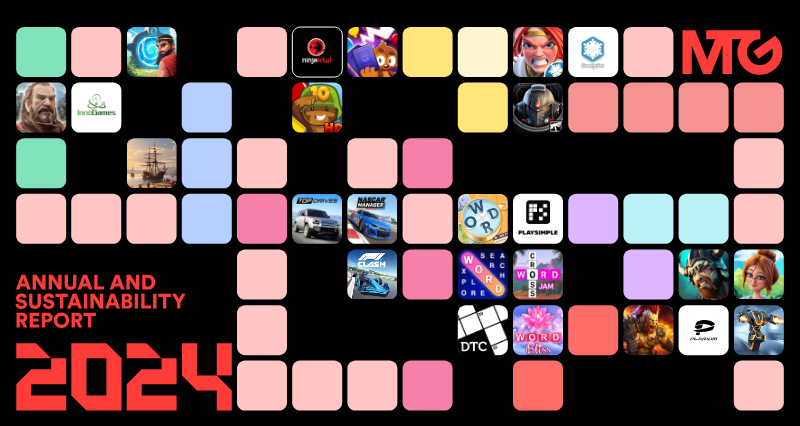
Annual and Sustainability Report 2024
Modern Times Group (MTG) concluded the 2024 fiscal year as a focused European mobile gaming entity, reporting net sales of SEK 6,015 million, representing a 3% currency-adjusted growth. Despite achieving an adjusted EBITDA of SEK 1,666 million, the group recorded a net loss of SEK 210 million. The company maintains a strong liquidity position with SEK 3,543 million in cash and equivalents and no utilized external debt, supported by a disciplined capital allocation strategy that includes active share buybacks and a commitment to long-term, evergreen game franchises.
The company’s strategic trajectory is defined by its "Gaming Village" model, which emphasizes organic growth and accretive M&A to bolster its portfolio of studios, including InnoGames, Hutch, and Ninja Kiwi. A transformative development in this period was the acquisition of Plarium Global Ltd, finalized in early 2025, which significantly scales the group’s mid-core gaming capabilities and adds the flagship title RAID: Shadow Legends to its offerings. This expansion is supported by the "Flow Platform," a centralized infrastructure designed to share business intelligence and user acquisition tools across the group’s subsidiaries.
Sustainability and governance remain central to the company’s operational framework. In 2024, MTG transitioned its reporting to align with the Corporate Sustainability Reporting Directive (CSRD) and European Sustainability Reporting Standards (ESRS). While this methodological shift resulted in a reported 118.2% increase in location-based greenhouse gas emissions due to expanded accounting scopes, the company has committed to a 50% reduction in value chain emissions by 2032. Furthermore, the group maintains a robust governance structure, reporting no incidents of corruption or bribery, and continues to prioritize consumer safety through transparent odds disclosure and data protection measures. The board remains focused on long-term shareholder value, integrating ESG metrics into executive incentive schemes while maintaining a stable, low-leverage financial foundation.
- MTG finalized the acquisition of Plarium Global Ltd in early 2025, significantly scaling its mid-core gaming capabilities and adding the flagship title RAID: Shadow Legends to its portfolio.
- The company reported 2024 net sales of SEK 6,015 million, reflecting 3% currency-adjusted growth, alongside an adjusted EBITDA of SEK 1,666 million and a net loss of SEK 210 million.
- MTG maintains a strong financial position with SEK 3,543 million in cash and equivalents and zero utilized external debt, supporting a strategy of active share buybacks and evergreen franchise investment.
- The group utilizes a 'Gaming Village' model supported by the 'Flow Platform,' a centralized infrastructure designed to share business intelligence and user acquisition tools across studios like InnoGames, Hutch, and Ninja Kiwi.
- Following a transition to CSRD and ESRS reporting standards, MTG reported a 118.2% increase in location-based greenhouse gas emissions and has committed to a 50% reduction in value chain emissions by 2032.