1 free read left. Create a free account for unlimited reading + AI research.
Create free accountReport Lucidity Insights
1 free read left. Create a free account for unlimited reading + AI research.
Create free accountReportLucidity Insights
The market value is projected to rise from $7.4 billion in 2024 to over $19.4 billion by 2033.
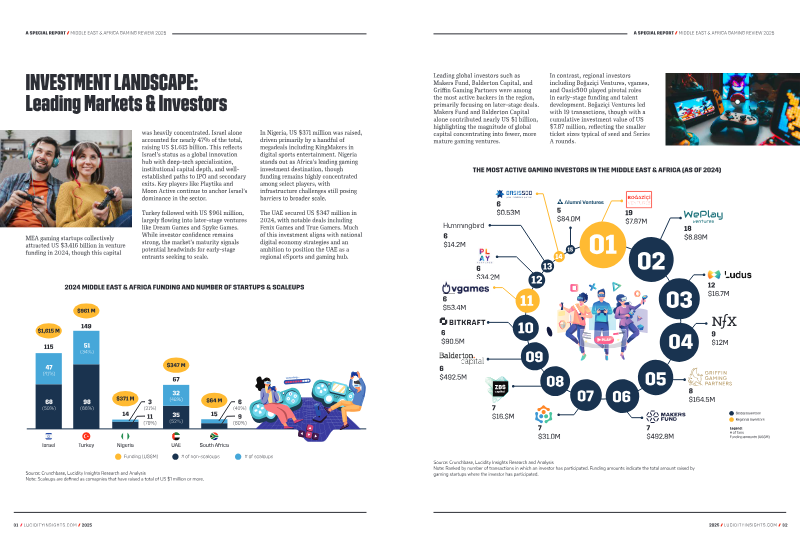
The Middle East and Africa gaming landscape is poised for rapid expansion, with market value projected to rise from US $7.4 billion in 2024 to over US $19.4 billion by 2033, reflecting an 11% CAGR driven largely by mobile-first adoption and a vibrant startup ecosystem. Key hubs—Saudi Arabia, UAE, Turkey, Israel, and emerging African markets—are attracting substantial investment, hosting record-setting esports events such as Saudi Arabia’s $70 million World Cup, and positioning the region as a growing share of the global gaming economy. Mobile dominance, government-backed visions, and esports infrastructure are reshaping competitive dynamics across the region.
Funding flows reveal a highly concentrated investment landscape dominated by global players and regional leaders. Israel leads with nearly US $1 billion raised across 146 startups, followed by Turkey’s $961 million and Nigeria’s $371 million. The UAE lags behind but is rapidly scaling, with Dubai Vision 2033 earmarking $1 billion for talent and tech to achieve a $200 billion GDP contribution by 2033. Turkey’s “unicorn factory” status is underscored by Peak Games’ $1.8 billion acquisition and Dream Games’ record $2.6 billion raise, while Saudi Arabia’s Vision 2030 funding fuels a burgeoning local ecosystem that could produce future unicorns.
Digital payment adoption and Web3 innovation are accelerating growth, particularly in the UAE where blockchain publishing and VR/Metaverse platforms such as Fenix Games and True Gamers are attracting capital. In Africa, mobile-first adoption has driven revenue to $1.8 billion in 2024, with Egypt, South Africa and Nigeria dominating startup activity. The continent’s youthful demographics and entrepreneurial momentum position it as a dynamic frontier, with African studios like Sea Monster gaining traction through capital, mentorship and infrastructure support.
Legacy hardware sales remain a key revenue driver, with story-rich single-player titles and console sales generating multi-billion dollar revenues. However, the rise of subscription models, microtransactions and expansion packs is reshaping monetisation strategies across all segments. Overall, the Middle East and Africa are emerging as a mobile-first, VC-backed powerhouse with significant potential for global influence in gaming and esports.

Deconstructor of Fun · 2025
PocketGamer.biz · 2023

Newzoo · 2018
Deconstructor of Fun · 2026

Two & a Half Gamers · 2026

Two & a Half Gamers · 2026

Stillfront · 2026
Niko Partners · 2026
InvestGame · 2026

The Game Business · 2026

Epyllion · 2026

Stillfront · 2026