Updated Jun 1, 2026 by PitchBook
Report
Published by PitchBook
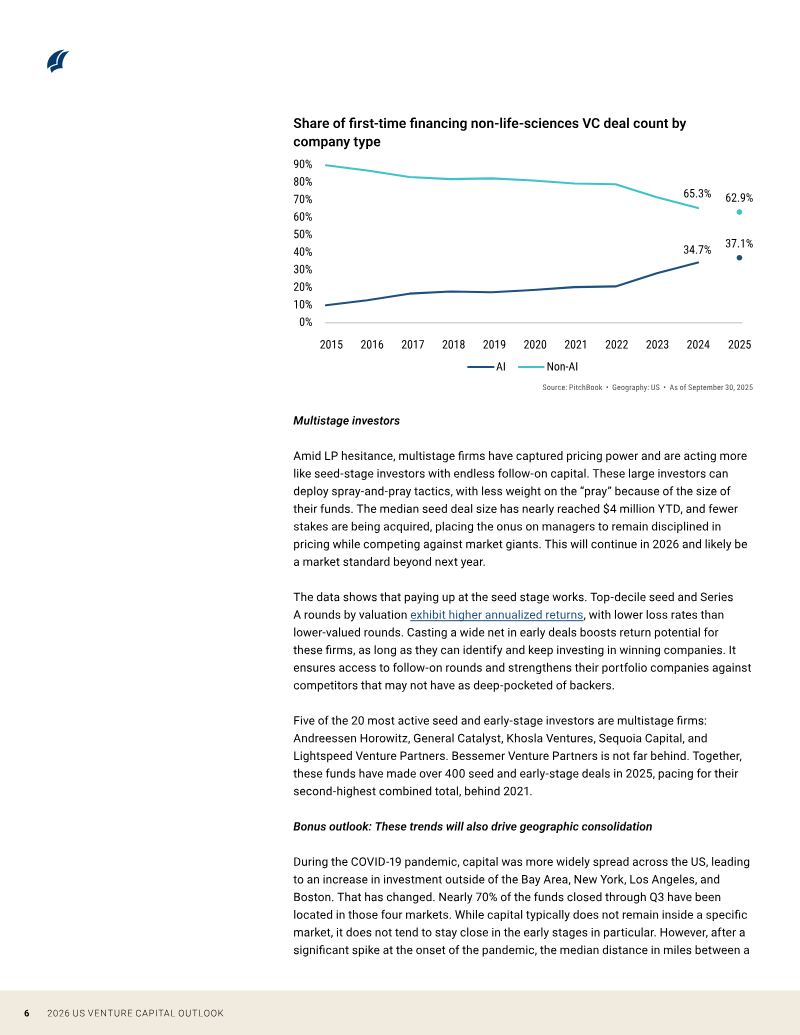
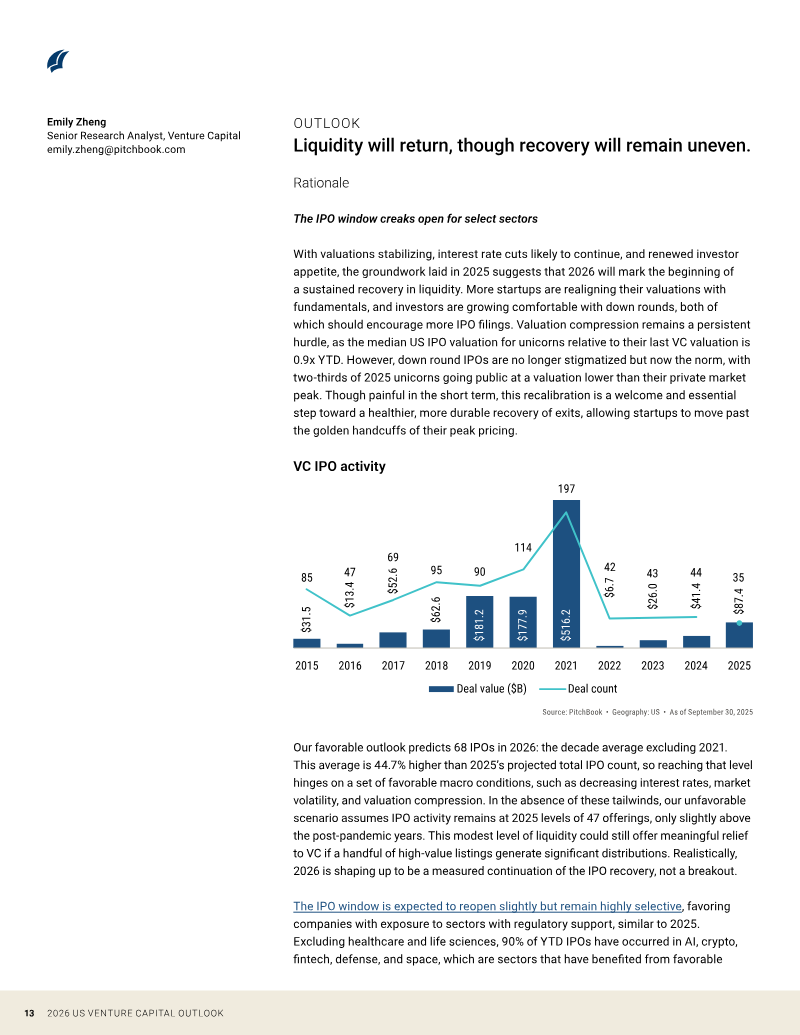
VC activity across the gaming ecosystem Q2 REPORT PREVIEW <u>2025</u> The full report is available through the PitchBook Platform. hrough Gaming landscape 3 Institutional Research Group Gaming VC ecosystem market map 4 Analysis VC activity 5 Eric Bellomo Senior Research Analyst, Gaming VC deal summary 24 E-commerce and Gaming [email protected] Report designed by Josie Doan, J...
EMERGING TECH RESEARCH Gaming VC Trends VC activity across the gaming ecosystem Q2 REPORT PREVIEW 2025 The full report is available through the PitchBook Platform. hrough
Contents Gaming landscape 3 Institutional Research Group Gaming VC ecosystem market map 4 Analysis VC activity 5 Eric Bellomo Senior Research Analyst, Gaming VC deal summary 24 E-commerce and Gaming [email protected] Data Harrison Waldock Data Analyst [email protected] Publishing Report designed by Josie Doan, Jenna O’Malley, and Megan Woodard Published on September 16, 2025
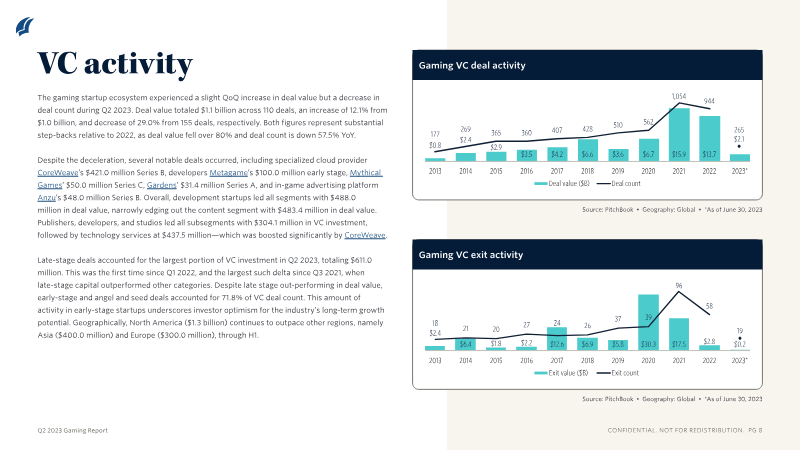
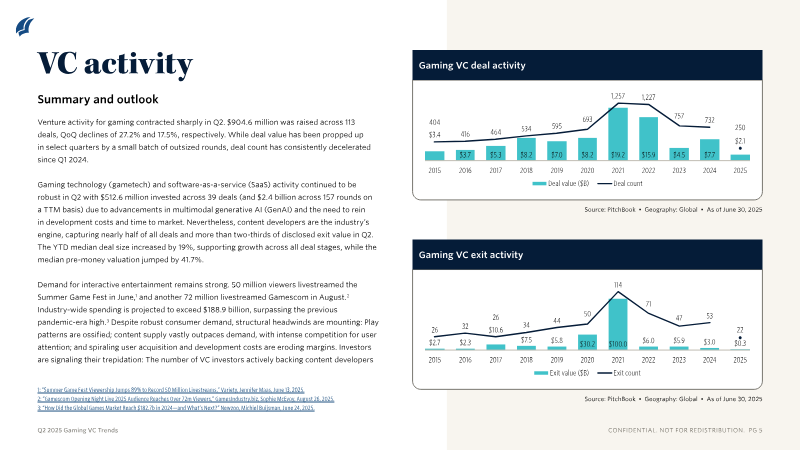
VC activity Gaming VC deal activity Summary and outlook 1,257 1,227 Venture activity for gaming contracted sharply in Q2. $904.6 million was raised across 113 404 416 464 534 595 693 757 732 250 deals, QoQ declines of 27.2% and 17.5%, respectively. While deal value has been propped up 3.4 2.1 in select quarters by a small batch of outsized rounds, deal count has consistently decelerated 3.7 5.3 8.2 7.0 8.2 19.2 15.9 4.5 $7.7 since Q1 2024. 2015 2016 2017 2018 2019 2020 2021 2022 2023 2024 2025 Gaming technology (gametech) and software-as-a-service (SaaS) activity continued to be Deal value (B) Deal count robust in Q2 with 512.6 million invested across 39 deals (and $2.4 billion across 157 rounds on a TTM basis) due to advancements in multimodal generative AI (GenAI) and the need to rein Source: PitchBook • Geography: Global • As of June 30, 2025 in development costs and time to market. Nevertheless, content developers are the industry’s engine, capturing nearly half of all deals and more than two-thirds of disclosed exit value in Q2. The YTD median deal size increased by 19%, supporting growth across all deal stages, while the Gaming VC exit activity median pre-money valuation jumped by 41.7%.
ontent developers are the industry’s engine, capturing nearly half of all deals and more than two-thirds of disclosed exit value in Q2. The YTD median deal size increased by 19%, supporting growth across all deal stages, while the Gaming VC exit activity median pre-money valuation jumped by 41.7%. Demand for interactive entertainment remains strong. 50 million viewers livestreamed the 114 Summer Game Fest in June,¹ and another 72 million livestreamed Gamescom in August.² 71 Industry-wide spending is projected to exceed $188.9 billion, surpassing the previous 26 44 50 47 53 pandemic-era high.³ Despite robust consumer demand, structural headwinds are mounting: Play 26 32 $10.6 34 22 patterns are ossified; content supply vastly outpaces demand, with intense competition for user 2.7 2.3 7.5 5.8 30.2 100.0 6.0 5.9 3.0 0.3 attention; and spiraling user acquisition and development costs are eroding margins. Investors are signaling their trepidation: The number of VC investors actively backing content developers 2015 2016 2017 2018 2019 2020 2021 2022 2023 2024 2025 Exit value ($B) Exit count 1: “Summer Game Fest Viewership Jumps 89% to Record 50 Million Livestreams,” Variety, Jennifer Maas, June 13, 2025. 2: “Gamescom Opening Night Live 2025 Audience Reaches Over 72m Viewers,” GamesIndustry.biz, Sophie McEvoy, August 26, 2025.
19 2020 2021 2022 2023 2024 2025 Exit value ($B) Exit count 1: “Summer Game Fest Viewership Jumps 89% to Record 50 Million Livestreams,” Variety, Jennifer Maas, June 13, 2025. 2: “Gamescom Opening Night Live 2025 Audience Reaches Over 72m Viewers,” GamesIndustry.biz, Sophie McEvoy, August 26, 2025. Source: PitchBook • Geography: Global • As of June 30, 2025 3: “How Did the Global Games Market Reach $182.7b in 2024—and What’s Next?” Newzoo, Michiel Buijsman, June 24, 2025.
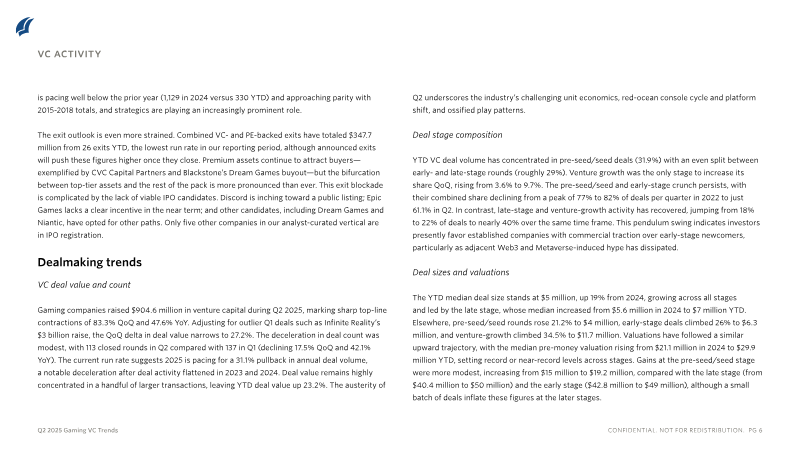
VC ACTIVITY is pacing well below the prior year (1,129 in 2024 versus 330 YTD) and approaching parity with Q2 underscores the industry’s challenging unit economics, red-ocean console cycle and platform 2015-2018 totals, and strategics are playing an increasingly prominent role. shift, and ossified play patterns. The exit outlook is even more strained. Combined VC- and PE-backed exits have totaled $347.7 million from 26 exits YTD, the lowest run rate in our reporting period, although announced exits will push these figures higher once they close. Premium assets continue to attract buyers— exemplified by CVC Capital Partners and Blackstone’s Dream Games buyout—but the bifurcation between top-tier assets and the rest of the pack is more pronounced than ever. This exit blockade is complicated by the lack of viable IPO candidates. Discord is inching toward a public listing; Epic Games lacks a clear incentive in the near term; and other candidates, including Dream Games and Niantic, have opted for other paths. Only five other companies in our analyst-curated vertical are in IPO registration. Dealmaking trends VC deal value and count
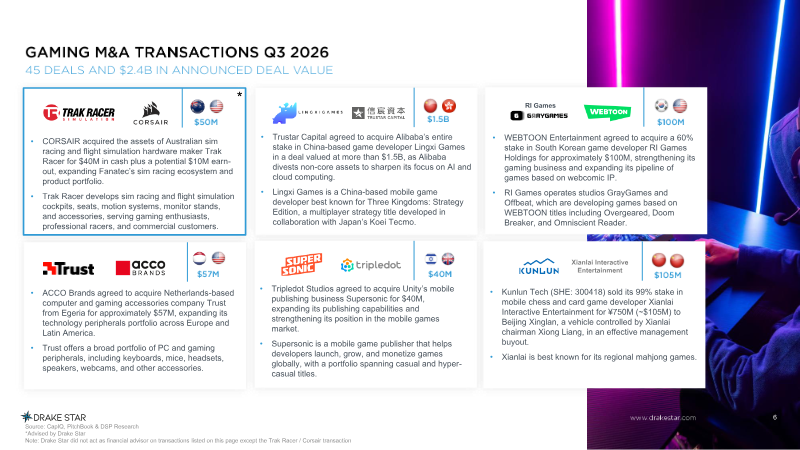
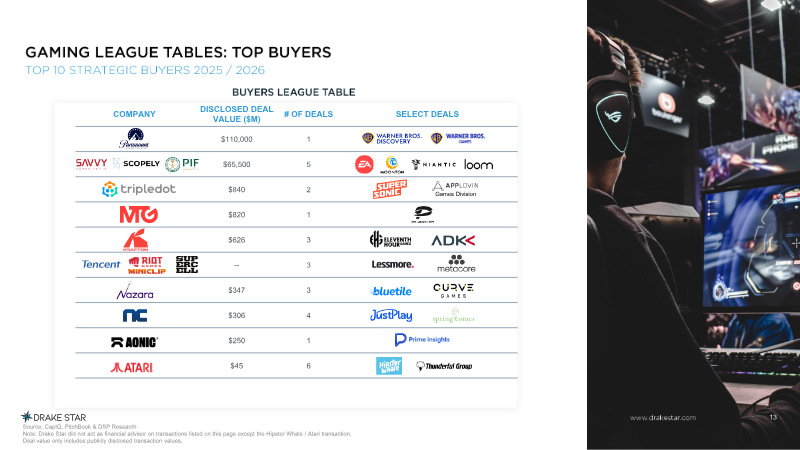
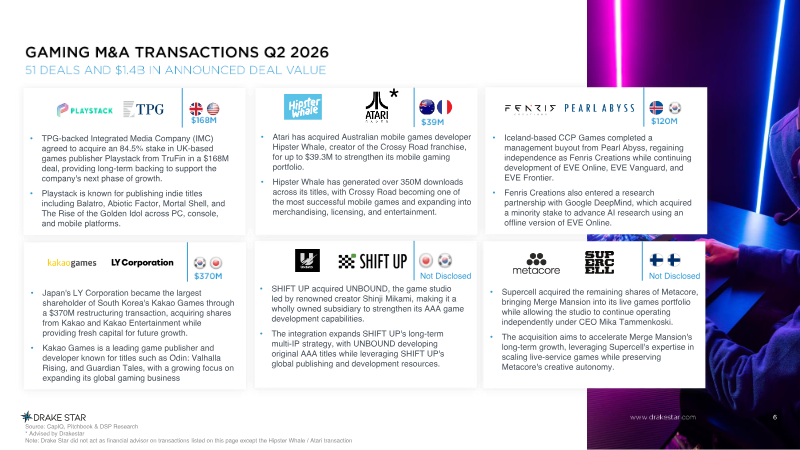
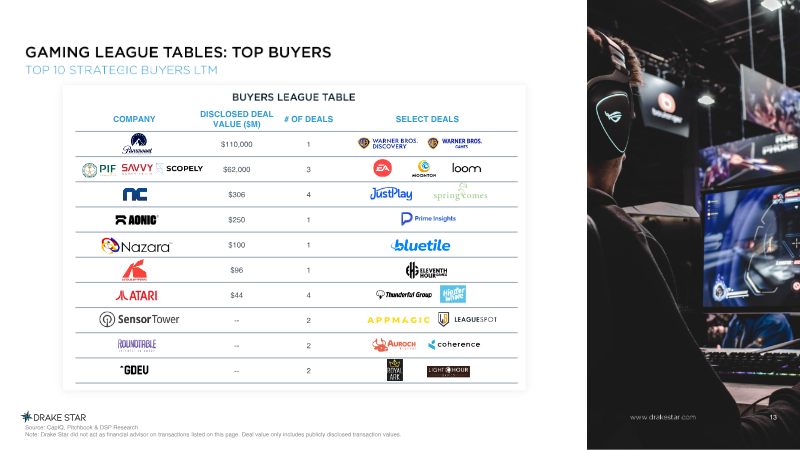
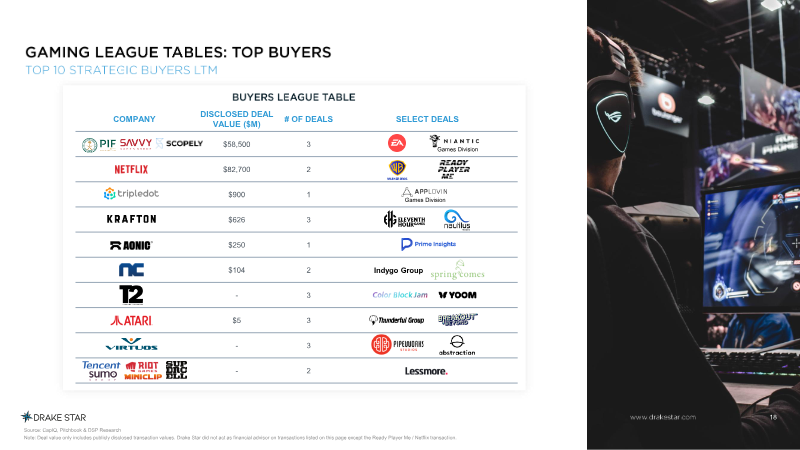
The global gaming industry experienced a notable resurgence in early 2025, characterized by a rebound in merger and acquisition activity and sustained interest in private financing. During the first quarter, 48 announced acquisitions reached a total value of $4.4 billion, anchored by the significant $3.5 billion acquisition of Niantic’s games division by Scopely. Simultaneously, the private placement market remained active, recording 149 deals worth $3.5 billion. These investments were primarily concentrated in mobile-focused developers and companies integrating artificial intelligence into their entertainment platforms, with major strategic entities like Savvy Games Group and Tencent continuing to drive market momentum. Despite this activity, the financial landscape remains bifurcated. While the broader sector shows signs of recovery, with the Drake Star Gaming Index posting a 16.37% gain, performance remains highly volatile across the top 35 public gaming companies. Valuation disparities are particularly pronounced; industry leaders such as NVIDIA and AppLovin command premium revenue multiples, while many other firms face a more challenging environment. Furthermore, while early-stage funding remains accessible, later-stage financing continues to present significant hurdles for companies seeking capital. Looking forward, the industry is positioned for a gradual increase in consolidation as public markets stabilize. Strategic focus is shifting toward the integration of AI and advanced technological platforms, which are expected to serve as primary catalysts for future growth. As market conditions improve, the sector is likely to see a renewed pipeline of initial public offerings, signaling a transition toward a more mature and diversified investment climate for global gaming stakeholders.
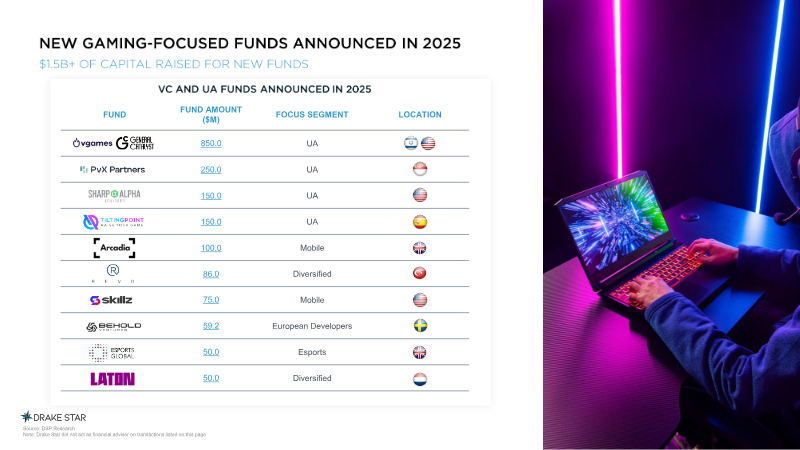
The analysis tracks global venture‑capital activity in the video‑game sector from the first quarter of 2019 through the second quarter of 2024, focusing on deals funded by VCs, strategic investors and publishers. It quantifies total capital deployed and deal counts, revealing a rapid expansion from $2 billion across 117 transactions in 2019 to a peak of $5.3 billion in 2021 (186 deals), followed by a sharp contraction in 2022 to $1.8 billion (126 deals) and a further dip to $874 million in 2023 (148 deals). Early‑stage financing remained relatively stable throughout, while the decline was driven primarily by fewer Series A‑plus rounds, creating a scarcity of growth‑stage capital. The report notes a modest rebound in 2024, with new funds entering the market and higher expected returns despite lingering marketing and user‑acquisition challenges. Geographically, investors increasingly target emerging regions such as South America, Eastern Europe, Southeast Asia and China, seeking cost‑efficient teams and pre‑seed opportunities. Mobile games continue to dominate the funding landscape, yet interest in mid‑tier “AA” titles is growing, reflecting a shift toward projects that promise shorter payback periods and stronger ROI. The pandemic‑driven hyper‑casual boom accelerated user‑acquisition technology, while post‑pandemic privacy changes (e.g., Apple’s IDFA restrictions) and macro‑economic headwinds have dampened overall spend and slowed M&A and IPO activity. Methodologically, the 2019 figures are derived from the Games Fund team’s synthesis of publicly available sources, while data for 2020‑2024 come from the investgame.net analytical platform. The combined dataset provides a comprehensive view of deal volume, value and regional distribution, supporting the conclusion that the gaming VC market exhibits pronounced cyclical dynamics, with early‑stage resilience and emerging‑region optimism offset by a constrained growth‑stage pipeline and broader economic uncertainty.
• 2024 market size: $188bn (+2.1% YoY) Total gamers in 2024 by region (millions): • Public markets: leading public gaming ETFs up 22- • 36% YTD (vs S&P 500 = 21%) Middle East & Africa Venture funding in Q3‘ 24: $517m across 92 deals 559 (funding +1% QoQ, number of deals -14% QoQ) (16%) • Epic sidesteps Apple in the EU, sues Google Europe (454 3,422m • Discord launches Activities ...
The snapshot evaluates financing conditions for game projects and development studios as of mid‑2024, highlighting a persistently constrained capital environment while noting modest signs of warming in project funding. Publishers remain risk‑averse after pandemic‑driven over‑expansion, with many having reduced staff, divested assets, and facing cash‑flow pressures compounded by high interest rates and the absence of large platform backers. Consequently, they prioritize core franchises, proven IP and work‑for‑hire arrangements, demanding projects that are further along in development, feature polished vertical slices, and fall within a budget sweet spot of roughly $500 k to $3 million, though an emerging demand for sub‑$500 k titles is evident. The upcoming Gamescom event is expected to catalyze deal flow for releases slated for 2025 and beyond. Studio financing remains low with no change in outlook, reflecting cautious growth after a volatile Q1 2024 period in which total investment value and volume rose, M&A value increased while deal count fell, and median developer investment grew quarter‑over‑quarter. New capital raises saw a decline in total value but an increase in deal count, underscoring a shift toward smaller, more frequent funding rounds. Investors continue to focus on early‑stage (pre‑seed, Series A) and later‑stage (Series C) opportunities, while Series B financing proves scarce as capital gravitates toward either nascent start‑ups or already successful entities. Geographically, funders exhibit a preference for European‑based studios over North American counterparts, and platform trends show mobile projects facing heightened difficulty, whereas PC and console titles dominate, especially those built around games‑as‑a‑service, multiplayer, and user‑generated content models. Overall, the financing landscape is characterized by conservative publisher behavior, modest but steady studio investment, and a strategic emphasis on later‑stage, lower‑risk projects as the industry settles post‑pandemic.