Global reports and market data
Documents
Remembering How You Died: Memory, Death and Temporality in Videogames
This paper examines how death and endings function in videogames, arguing that the repeated dying and resurrection of a player's avatar reflects a distinct and serious conception of mortality rather than a trivialisation of life.
- The paper argues that the repeated dying and resurrection of avatars in videogames reflects a serious conception of mortality rather than a trivialisation of life, challenging criticism from Gonzalo Frasca that reversible death cheapens life's sacred value.
- The author contends that Western narrative theory, shaped by Aristotelian plot structure and linear notions of telos, struggles to account for the 'dying and undying' logic of games.
- Drawing on Deleuze's concepts of immanence and virtuality, the paper proposes that in-game death is both immanent and imminent, with each playthrough actualising possible events rather than severing from a fixed past.
Kingdom Hearts, Territoriality and Flow
The analysis examines the Kingdom Hearts franchise, a collaboration between Square-Enix, which develops the core games and characters, and Disney, which licenses many of the worlds the series draws on.
- The report argues the Kingdom Hearts franchise, a Square-Enix and Disney collaboration, thematizes globalization, transnationalism, and cultural flow through its world-hopping structure and questions of intervention versus non-interference.
- The series uses the Heartless threat, the sealing of worlds, and Disney character interventions to dramatize cultural imperialism and global capitalism, which can be read as critiques of homogenization and forced modernization, though the author cautions such readings are overly simplistic.
- Mobility between worlds via dark corridors, Gummi Ships, and commodity-based trade routes forms the series' cosmological and political system, which the report says closely mirrors capitalist connectivity and Japan's own modernization.
Through the Looking Glass: Weavings between the Magic Circle and Immersive Processes in Video Games
The paper contends that the "magic circle," the widely used concept from Huizinga and Salen and Zimmerman for describing the boundary between play and everyday life, should be understood as a graded cognitive mediation structure rather than a rigid barrier.
- The 'magic circle' boundary between play and everyday life should be understood as a graded cognitive mediation structure rather than a rigid barrier, with the boundary solidifying as immersion deepens.
- The authors use Juul's two axes (rules and fiction versus players' social practices) to argue that rules and fiction compete asymmetrically for player attention during play.
- Immersion is modeled as a staged process tied to Parasuraman's three attentional functions (selection, vigilance, and control), alternating between operational immersion, where rules drive selective attention, and narrative immersion, where fiction sustains it.


Interactive XMF: File Format Specification
Interactive XMF (iXMF) serves as an open, interoperable standard for adaptive audio in gaming and interactive media.
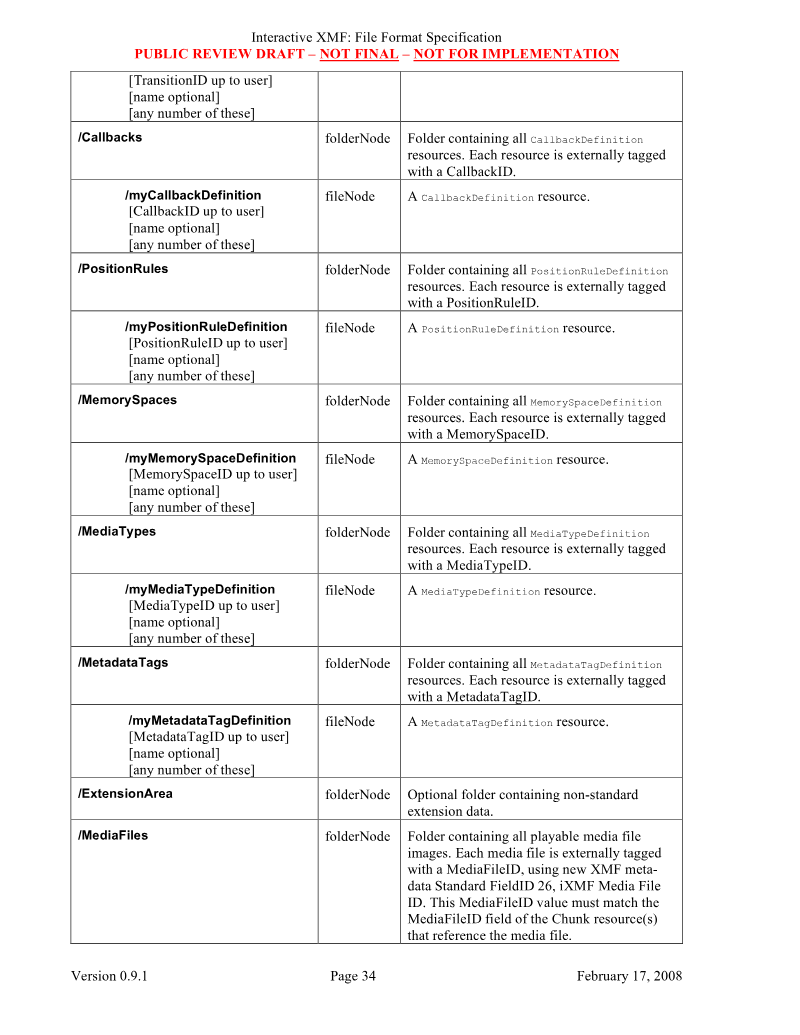
- Interactive XMF (iXMF) is an open, interoperable file format that bundles MIDI, digital audio, and scripting into a unified structure for dynamic, event-driven game audio.
- The iXMF Engine utilizes a stack-based expression processor to manipulate 32-bit signed integer variables across global, cue-specific, and instance-specific scopes.
- Developers can implement complex, non-linear audio through a built-in scripting language that supports conditional logic, DSP parameter adjustments, and memory management.


Ubisoft Annual Report 2007
The 2007 Ubisoft Annual Report details a period of robust financial expansion and strategic consolidation for the fiscal year ending March 31, 2007.
- Ubisoft achieved a 24.4% increase in annual sales to €680 million for the fiscal year ending March 31, 2007, shifting from debt to a net cash position of €55 million.
- The company successfully expanded its global workforce by 15% to nearly 4,000 employees to support aggressive in-house production and the development of proprietary brands.
- Strategic growth was driven by the acquisition of the Driver and Anno franchises and a commitment to launching three new brands every two years.

Mobile Audio Technology: Report and Recommendations
The mobile audio industry faces significant operational challenges due to extreme market fragmentation, characterized by the existence of over 50 file formats and 400 distinct device implementations.
- The mobile audio industry is hindered by extreme fragmentation, involving over 50 file formats and 400 distinct device implementations that inflate development and quality assurance costs.
- To achieve cross-platform interoperability, the industry must transition to non-proprietary standards, specifically adopting SP-MIDI, General MIDI, and the XMF format.
- Standardizing APIs such as JSR-234 and OpenSL ES is essential to provide developers with consistent access to advanced features like Digital Signal Processing and 3D audio.
Real Player Manifesto
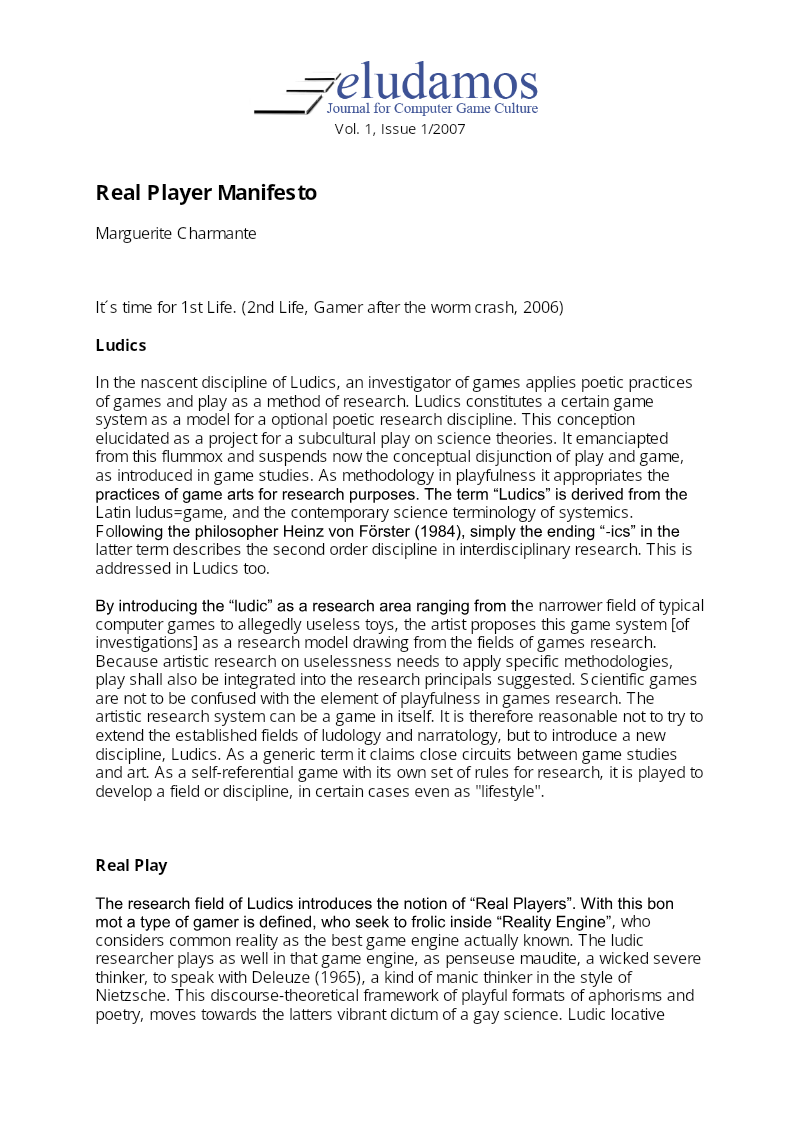
This document, titled "Real Player Manifesto" and published in the journal Veludamos in 2007, proposes a new research discipline called Ludics, which treats play and games as a methodology for artistic and scholarly inquiry.
- The 2007 manifesto "Real Player Manifesto" in the journal Veludamos proposes Ludics, a new interdisciplinary research discipline treating play and games as a methodology for artistic and scholarly inquiry.
- Its central thesis is that games should extend beyond the screen into everyday life, defining a "Real Player" as someone who treats common reality as a game engine and engages with it playfully and critically.
- Ludics is positioned as a second-order practice distinct from ludology and narratology, blending game studies with avant-garde traditions such as Pataphysics, the Oulipo group, and the Situationists.
Waiting for Something to Happen: Narratives, Interactivity and Agency and the Video Game Cut-Scene
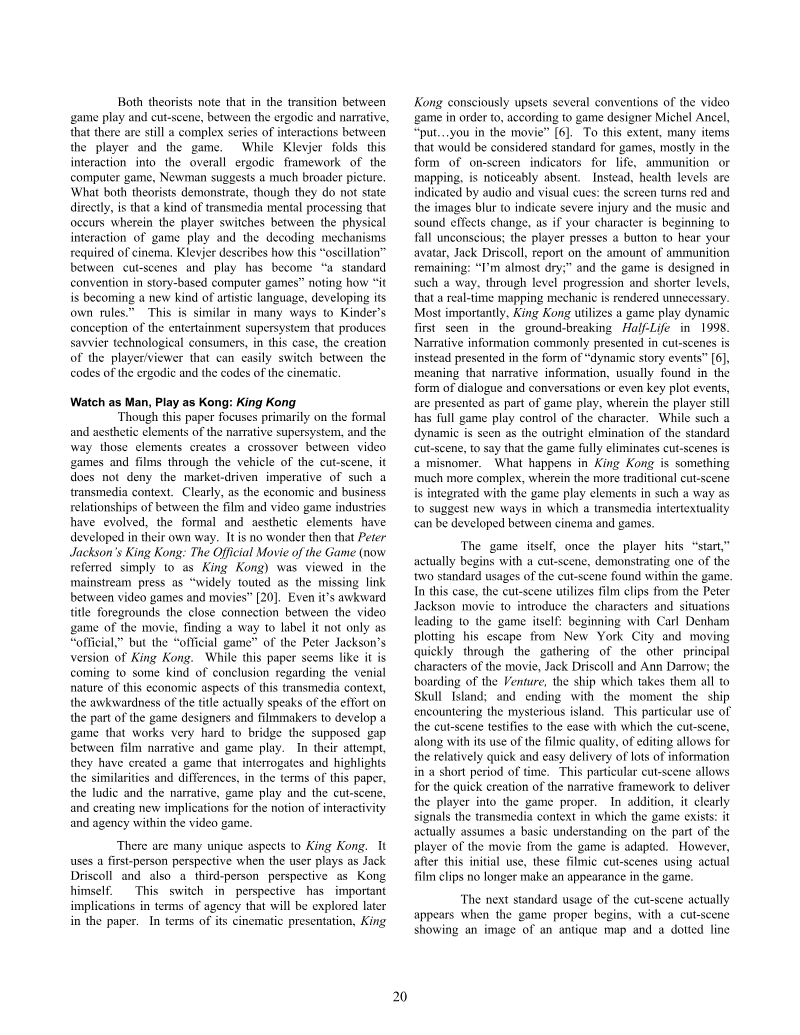
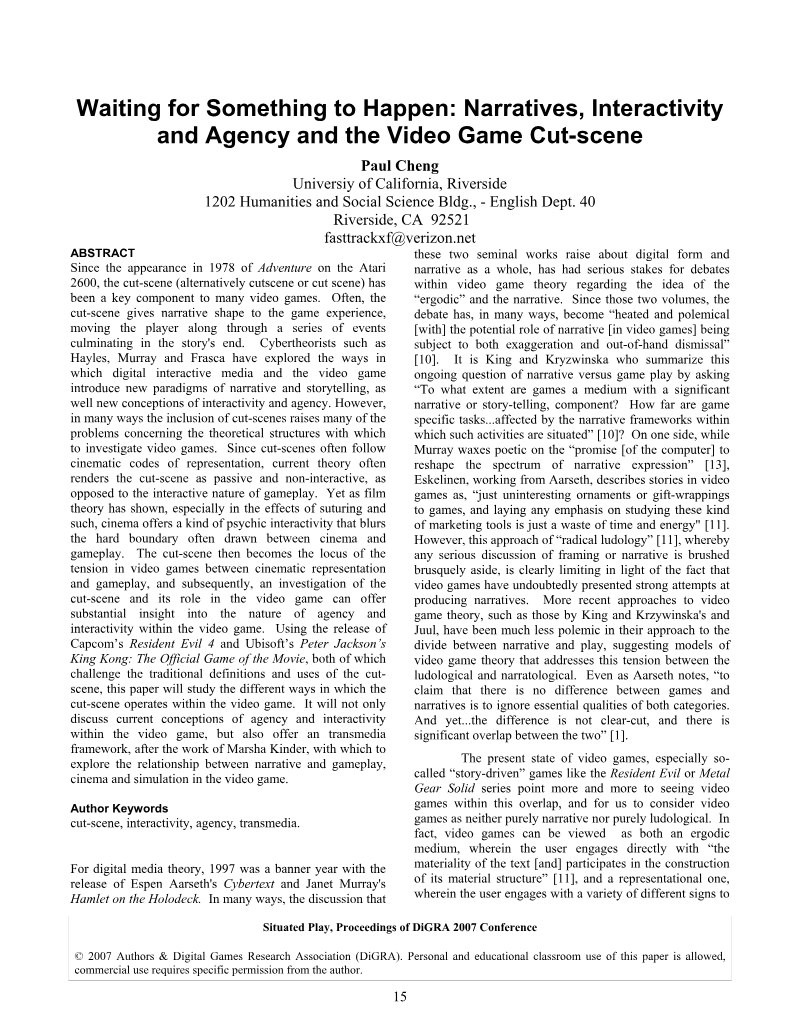
Cheng's paper treats the video game cut-scene as a contested site where narrative and gameplay converge, challenging the "radical ludology" position that cut-scenes are merely passive interruptions of play.
- The paper argues that interactivity and agency must be distinguished: a cut-scene can involve minimal player input yet still generate a strong sense of agency.
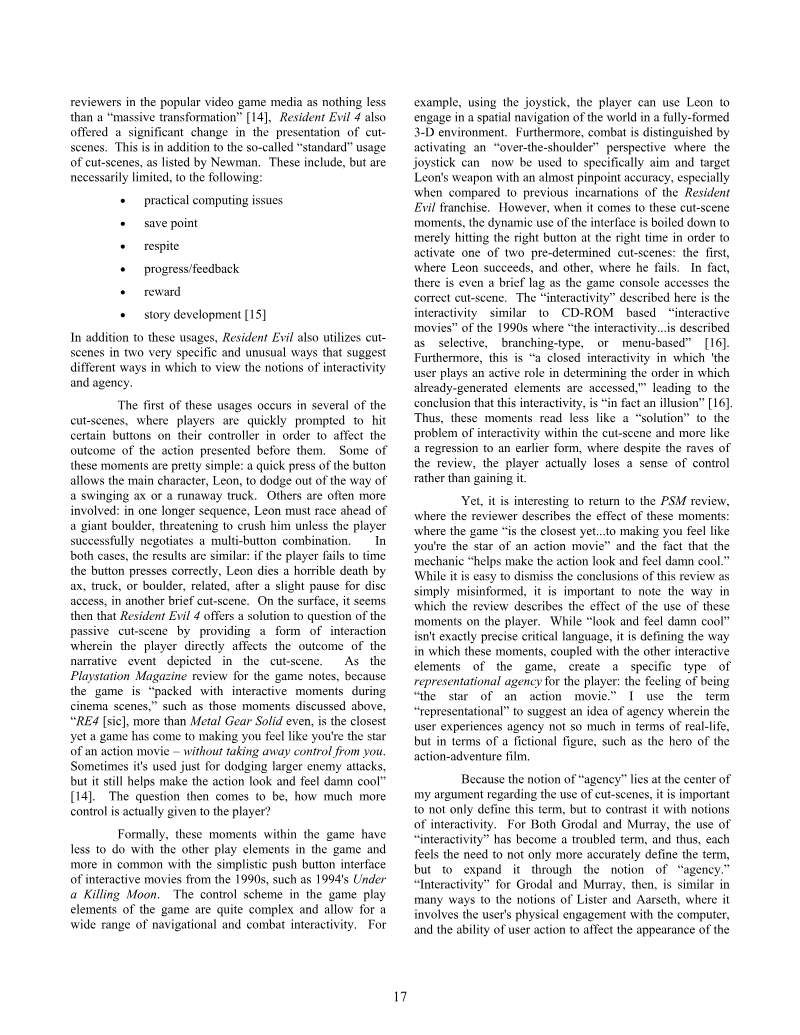
- Using Resident Evil 4, the author shows how quick-time event sequences create "representational agency," the feeling of being the protagonist of an action film, even when the underlying interactivity is tightly constrained.
- The paper challenges the "radical ludology" view that cut-scenes are merely passive interruptions of play, framing them instead as a contested site where narrative and gameplay converge.
Your Second Selves: Resources, Agency, and Constraints in Avatar Designs and Identity Play in a Tween Virtual World
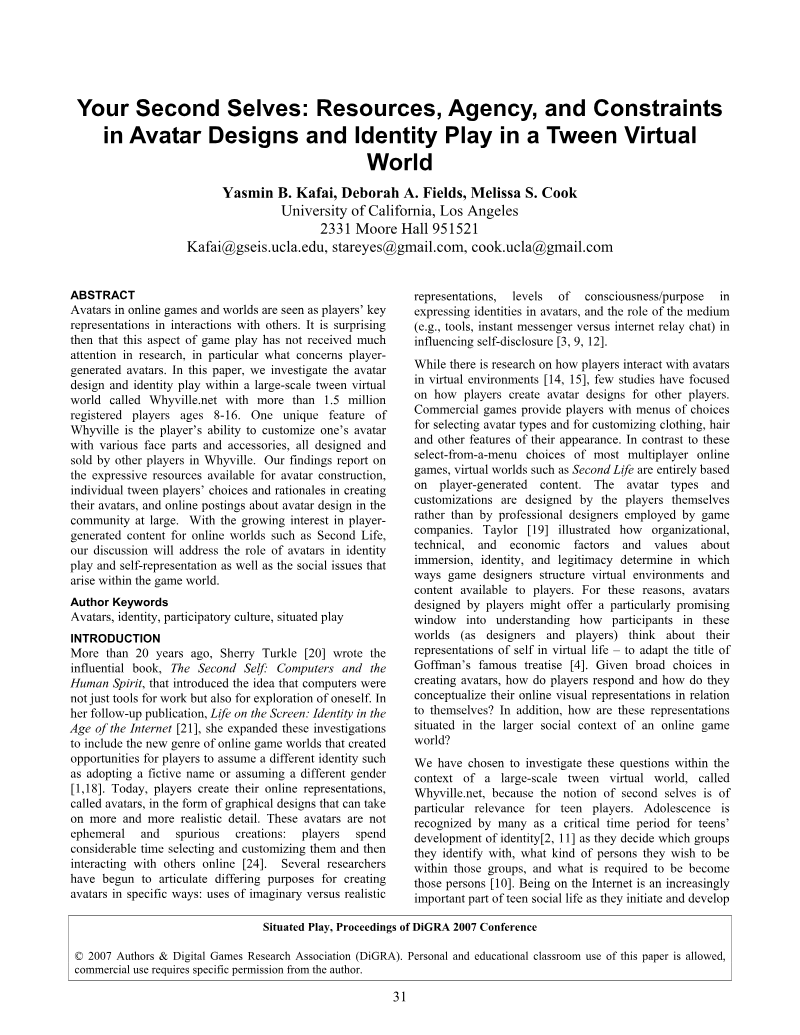
In "Your Second Selves," the authors examine how tweens in Whyville, a virtual world with over 1.5 million registered players aged 8 to 16, design and use their avatars.
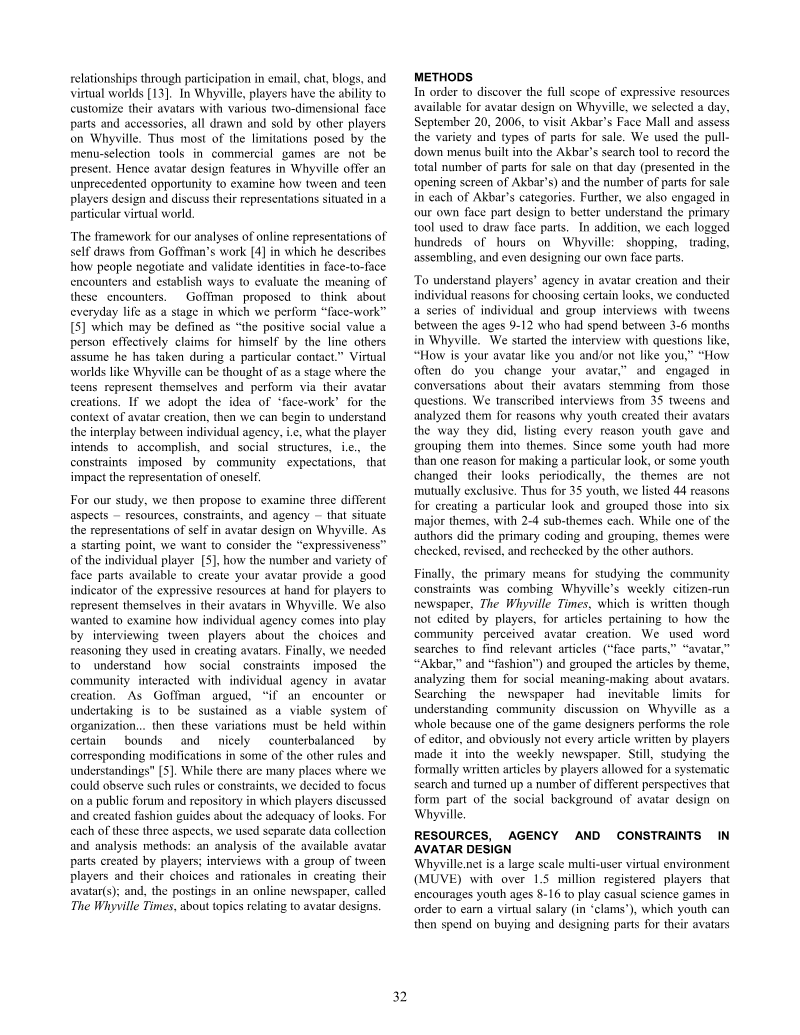
- Whyville, a virtual world with over 1.5 million registered players aged 8 to 16, is distinctive because players create and sell avatar parts themselves rather than company designers, and they earn virtual currency through science games to buy them.
- The study frames Whyville as an "identity playground" supporting multiple, fluid "second selves," drawing on Goffman's concept of face-work and combining analysis of over 30,000 parts for sale at Akbar's Face Mall, interviews with 35 tweens, and seven years of community newspaper coverage.
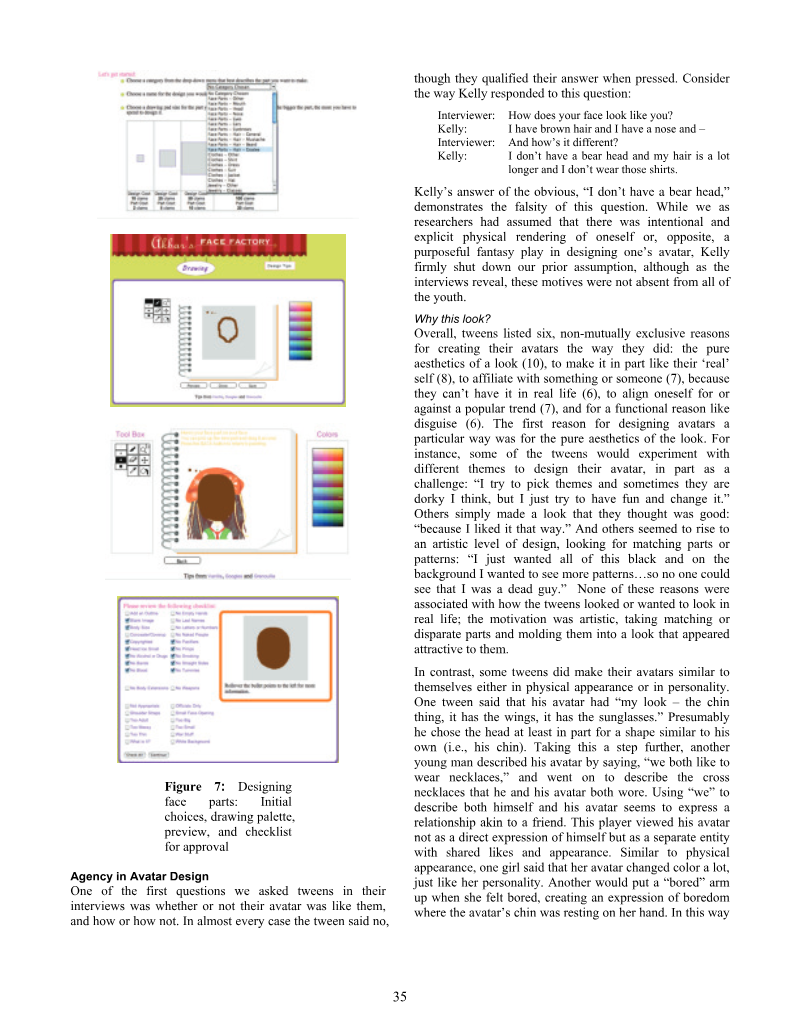
- Avatar design blends aesthetics, self-representation, affiliation, fantasy, and functional disguise, and tweens often deny their avatars resemble them even though probing reveals personal traits embedded in their choices.
Cross-Format Analysis of the Gaming Experience in Multi-Player Role-Playing Games
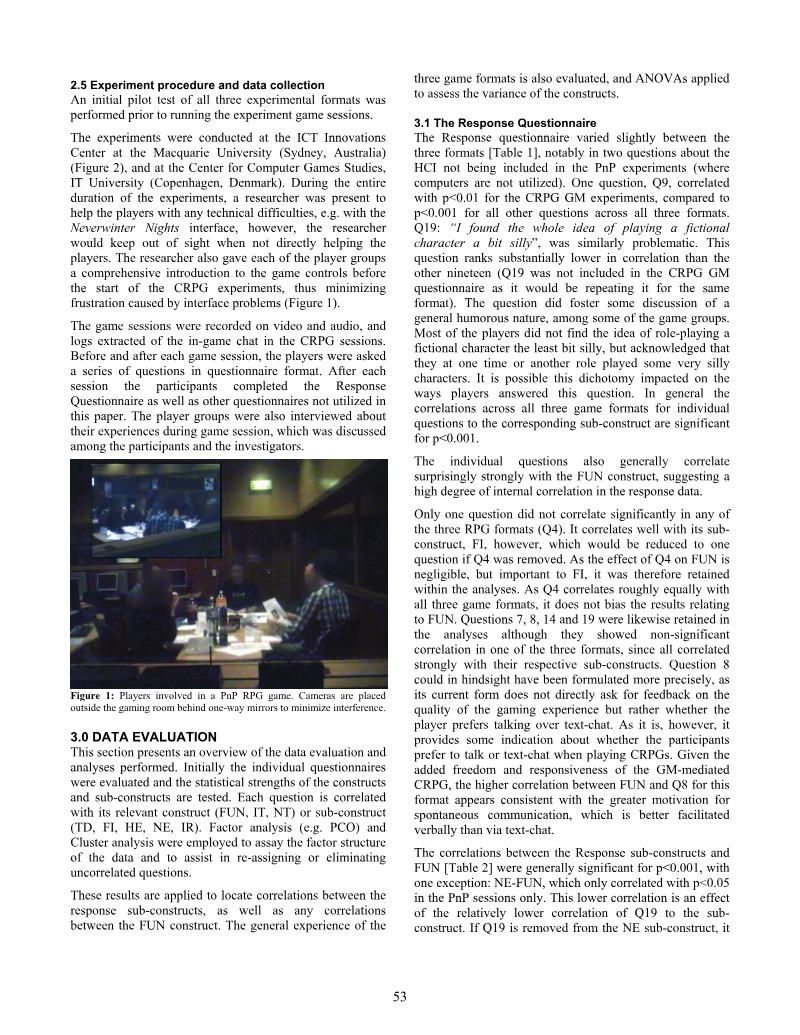
Across pen-and-paper (PnP), computer role-playing game (CRPG), and CRPG with a human Game Master formats, a cross-format study of multiplayer role-playing games finds that tabletop play delivers the most consistently enjoyable experience.
- Pen-and-paper role-playing delivered the highest mean FUN rating (3.98 on a five-point scale), versus 3.44 for CRPG with a human Game Master and 3.22 for standard CRPG, across a cross-format study of 51 players in 10 groups from Australia and Denmark.
- Pen-and-paper ratings were also more uniform, with a notably narrower response distribution than either CRPG format, indicating more consistent player enjoyment.
- Tabletop play outperformed CRPGs across most sub-constructs and across age, gender, and experience groups; the "I had fun" item averaged 4.75 for pen-and-paper versus 4.00 for CRPG.
Interaction Manifestations at the Roots of Experiencing Multiplayer Computer Games
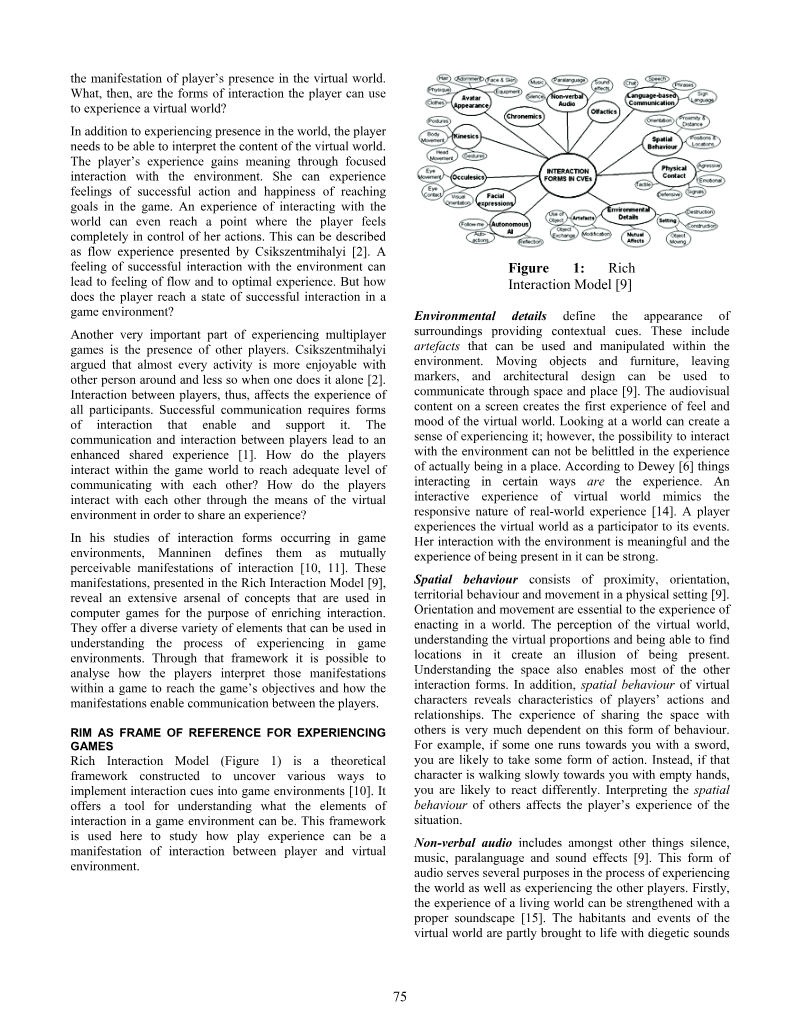
This paper proposes the Rich Interaction Model (RIM), a theoretical framework that treats interaction manifestations such as environmental details, spatial behaviour, chronemics, kinesics, audio, and avatar appearance as the perceivable cues through which players interpret multiplayer game worlds.
- The paper proposes the Rich Interaction Model (RIM), which treats environmental details, spatial behaviour, chronemics, kinesics, audio, and avatar appearance as the perceivable cues players use to interpret multiplayer game worlds, and argues that successful interaction with the environment and other players drives flow and shared enjoyment.
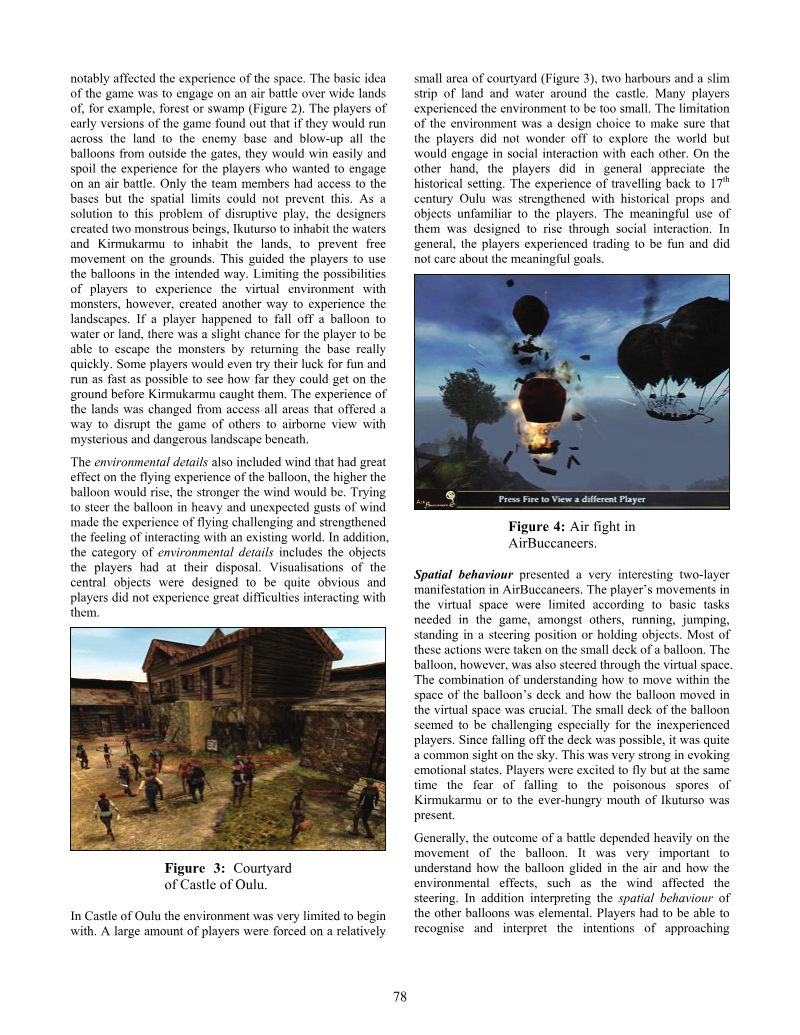
- Findings from two experimental multiplayer games, AirBuccaneers and Castle of Oulu, based on player testimonials, showed that environmental design, spatial positioning, slow chronemics, and sound effects strongly shaped player emotion and team coordination.
- Facial expressions and occulesics were largely absent or unimplemented, so players had to infer others' emotional states, while language-based communication (text chat or spoken headset conversation) served as the primary channel for sharing information and feeling.
Play with Me: Exploring the Autobiographical through Digital Games
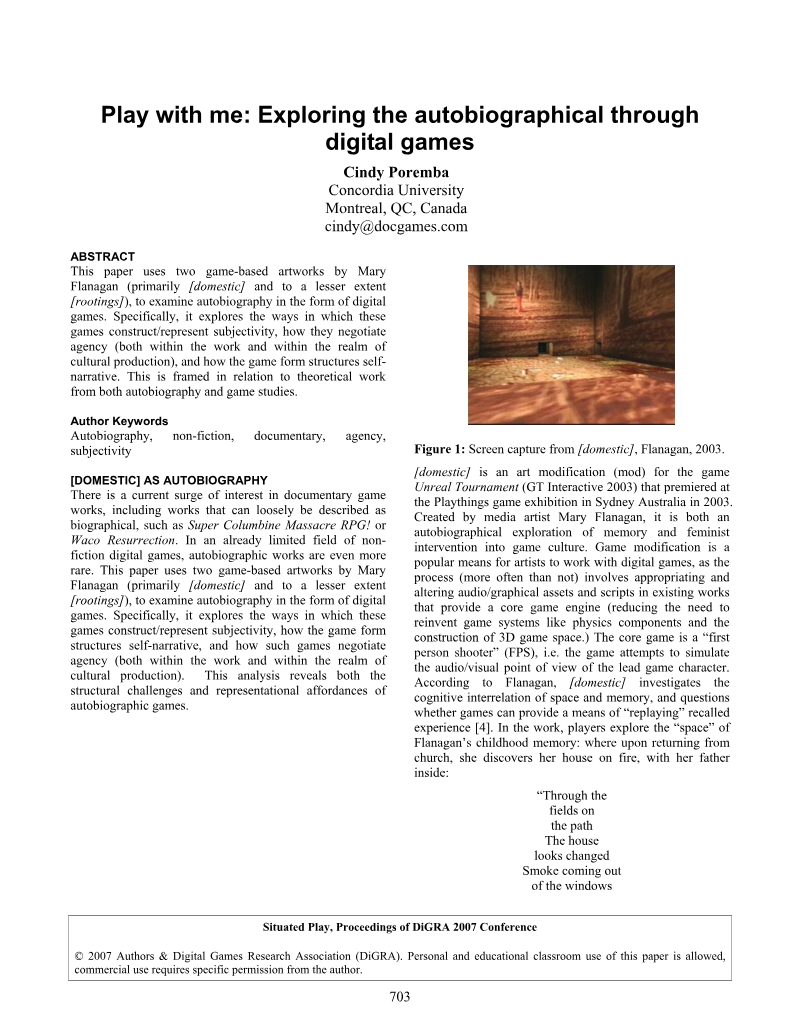
This paper examines autobiography in digital games through two artworks by media artist Mary Flanagan, primarily the game modification [domestic] (2003), with a shorter look at [rootings].
- The paper analyzes autobiography in digital games through two artworks by media artist Mary Flanagan, primarily the game modification [domestic] (2003), with a shorter look at [rootings].
- [domestic] removes a visible avatar and replaces combat imagery with personal photographs and poetic text about a childhood house fire, leaving the player's identity in contention and producing a shifting subjectivity.
- The paper argues that [domestic] reframes the first-person shooter's rules, which originally address a masculine subject of mastery, so that the player's shooting becomes defensive resistance against trauma and a reclaiming of agency within a feminist autobiographical project.